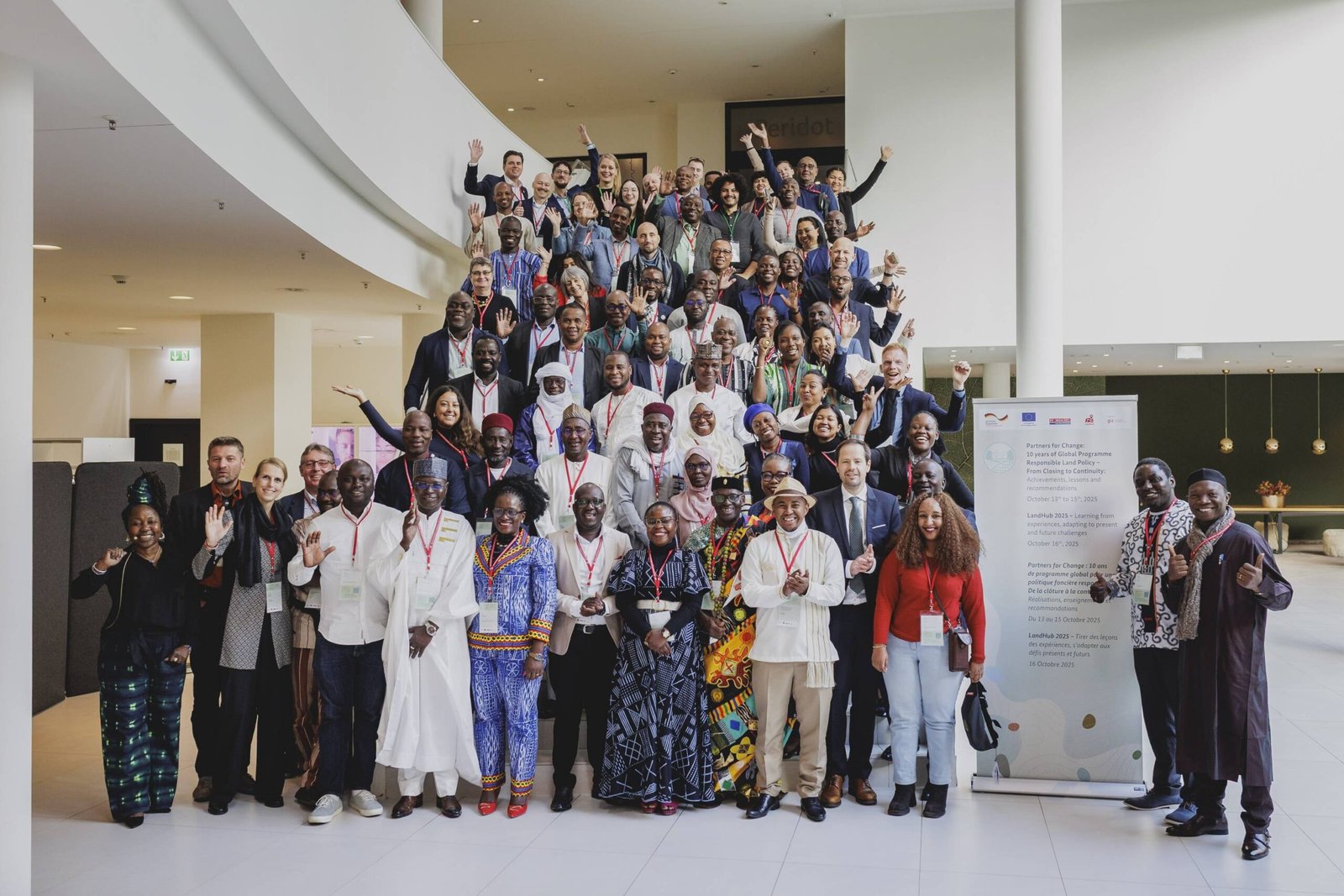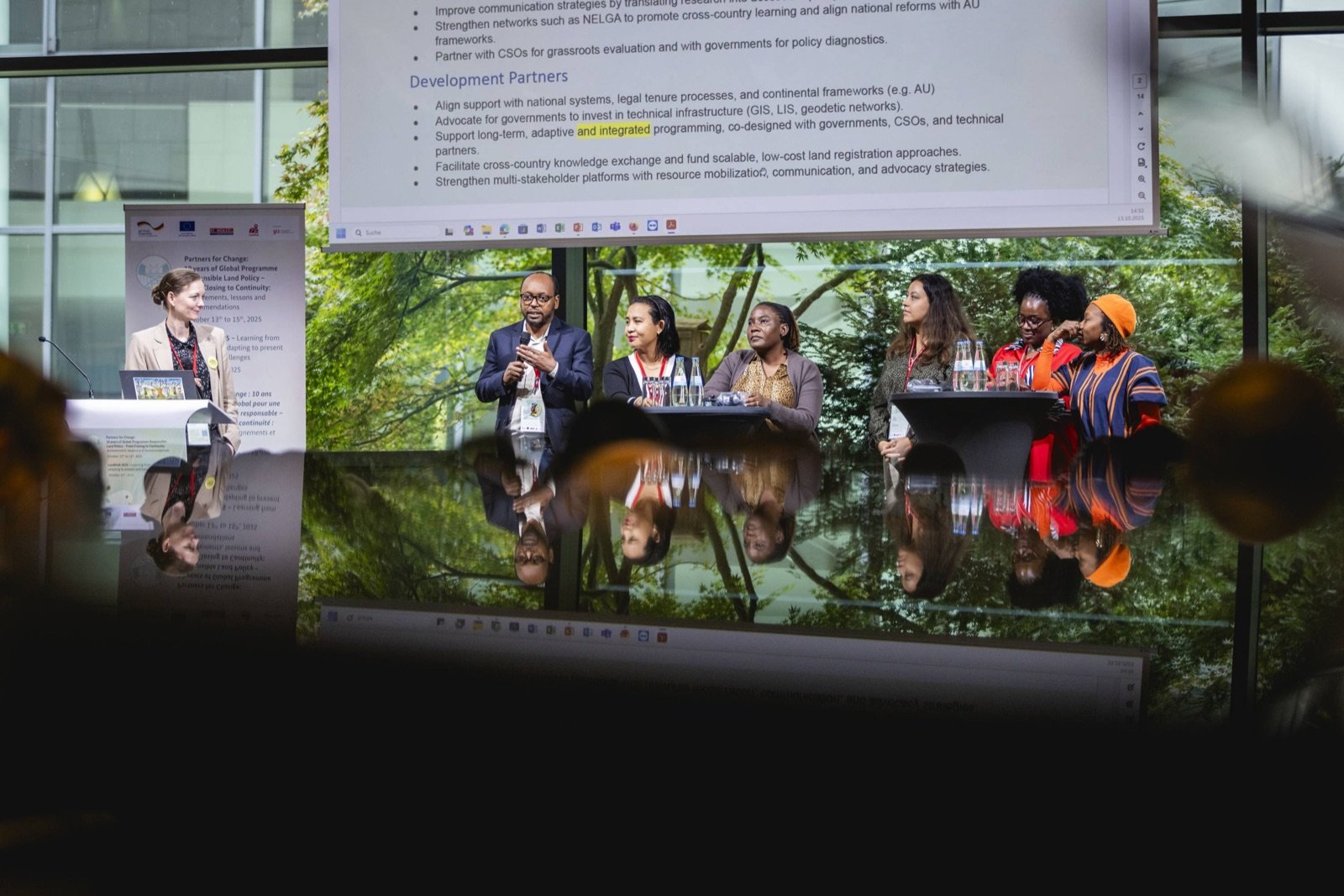

Evaluations in the land sector: Donor trends and emerging lessons

By Enrico Neumann, Joseph Holden, Nicole Naysmith

Originally published .

This blog is based on a learning session convened by the Land Facility programme’s Quarterly Learning series, which shared trends and emerging lessons from new research by the Decision Support Unit on land programme evaluations over the past decade. The session brought together experts from the Cadmus research team, Enrico Neumann and Joseph Holden, as well as Dr Lauren Persha, Principal Research Scientist from NORC at the University of Chicago (formerly the National Opinion Research Center) and Christina Ketter from GIZ. Together, they explored key themes and trends emerging from the research, as well as gaps and lessons that can be applied to future evaluations. 


Quick read

  • The analysis reviewed over 230 studies and closely examined 50 evaluated land programmes funded by major international development agencies.
  • Most programmes and evaluations focus on land titling, using rigorous quantitative methods like randomised controlled trials (RCT)s, while land governance reform receives less attention.
  • The research suggests a notable gap in the systematic consideration and analysis of the complexities of political economy and institutional structures and incentives.
  • Our discussion also brought out the importance of collaboration between evaluation teams and implementers and the need for more flexible, adaptive evaluation strategies that allow for timely adaptations while programmes are being implemented.


Background and evaluation insights

The Decision Support Unit commissioned this research to draw out relevant lessons for the Land Facility and the land evaluation community more broadly, with a particular focus on what is relevant for international development programming contributing to land governance reform.

A shortlist of 50 land programmes operating in the past decade were found with evaluations available. Evaluations were classified into three categories (impact, performance, and process), with some programmes having multiple types; about one-third had both impact and performance evaluations. 

  • For the 50 programmes analysed, two-thirds (62%) had a performance evaluation, while a quarter had an impact evaluation. Less than one-in-eight programmes had a process evaluation.
  • Impact evaluations have been rigorous and insightful, mainly focusing on higher-level outcomes and impact at household level (including on tenure security, investment, income, and gender equity). However, evaluation approaches often do not systematically consider the political economy context in which land programmes are necessarily embedded.   
  • All programmes in the sample included rights registration and formalisation activities (e.g., demarcation, titling, mapping).  
  • Most programmes also addressed land administration policy; a smaller share focused on demand-side measures (still 80%), and about two-thirds included complementary measures.
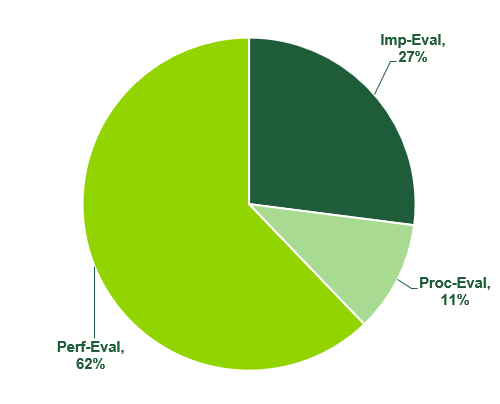
Share of evaluations by type: 62% performance, 27% impact and 11% process evaluations.
Figure 1: Share of all evaluations of each type
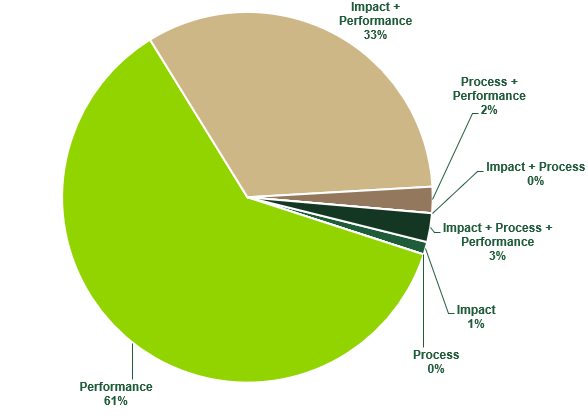
Programme evaluation mix: 61% performance only, 33% impact and performance, 3% all three types, 2% process and performance, 1% impact only; 0% process only or impact and process.

Figure 2: Share of programmes with different mixes of evaluation

Addressing a significant gap

The work found an impressive body of literature, with USAID and MCC in particular commissioning a range of substantive and long-term impact evaluations that have made significant contributions to the evidence on the link between land titling, tenure security, and social and economic outcomes at the community and household levels. This evidence has provided a significant contribution to justifying and demonstrating the value of land interventions across the past decade and going forward.

With respect to land governance reform, the research found that most programmes had a larger focus on land titling, with policy and regulatory reform components and interventions to improve land administration being more secondary. Evaluations appropriately mirror this structure and broadly focus on the effects of land titling, applying mostly quantitative approaches and often using a very rigorous research design that allows evaluators to deduce causality through robust studies, such as RCTs.

While this approach is appropriate to evaluate land titling-focused programmes, it doesn’t lend itself as well to understanding how and why changes to land governance reform come about, for example by considering political economy factors and systems changes. Whilst included in some evaluations of programmes with components focused on land governance reform, we find that policy and regulatory changes and institutional adaptations are rarely systematically reviewed or evaluated. 

This is a significant gap. The evaluation community can contribute to shaping the field of land evaluations by pioneering approaches to analysing and evaluating land governance reform processes through structured systems thinking and Thinking and Working Politically (TWP), to better recognise and incorporate political and contextual dynamics into evaluation design and implementation. 

Insights from a decade with USAID

Dr Lauren Persha shared related insights from her work with USAID over the past decade, including reinforcing the strong focus on impact evaluations in the land sector and on associated methods such as RCTs and quasi-experimental designs. 

These evaluations are notable for their depth and rigour, primarily assessing household- and community-level impacts, including household tenure security, land disputes, and local governance, often within the context of land governance reforms. Many programmes also targeted sectors such as economic growth and climate, with about half including a natural climate solutions component. The body of evidence shows positive effects on tenure security and dispute reduction, though outcome trends for land-based investments, agricultural productivity, environmental outcomes, and women’s empowerment remain more mixed and context-dependent.

Lauren highlighted key gaps, including limited evidence on land markets, land-based income, household well-being, cost-effectiveness analyses, and evaluations of higher-level governance structures and their links to local reforms. 

Two important lessons identified are the need for closer collaboration between evaluation teams and programme implementers to support adaptive programming, and the utility of follow-up studies to address emergent or unanswered questions. Additionally, mixed-method approaches and qualitative insights were crucial for understanding why and how impacts occur. 

Lauren suggested that future programmes can benefit from flexible evaluation strategies that include rapid learning cycles and feedback loops throughout implementation. Large-scale evaluations can also be combined with targeted in-depth studies to address emerging questions, which can often be accomplished at lower cost and offer faster delivery for learning needs. 

Insights from GIZ

Christina Ketter, an advisor on the Global Programme Responsible Land Policy at GIZ, discussed her organisation’s focus on process-oriented evaluations. These are designed for adaptive steering, allowing real-time adjustments and ongoing learning during implementation. She shared an example from Uganda showing that RCTs demonstrated strong short-term impacts; however, short evaluation windows make it difficult to identify transformational changes. She also noted that internal reviews can lack objectivity, highlighting the importance of external perspectives to reduce bias. 

Lessons learned from GIZ’s work show that short project cycles and evaluation periods limit the ability to capture systemic and long-term impact. Qualitative assessments often provide richer operational insights than formal, compliance-driven evaluations. Christina emphasised the importance of progress reviews as standard tools for adaptive steering, especially in long-running programmes, while combining these with mechanisms that generate aggregated impact evidence for donor reporting and public communication. 

She shared key lessons, including the need to invest in evaluations that examine how national policies influence local implementation and outcomes. These use both qualitative and quantitative methods to gather operational learning and measurable impacts, and to formalise mechanisms that turn thematic deep dives into actionable guidance for all participating countries. 

This experience suggests that, in primarily focusing on administrative aspects and elements that are not easily quantifiable, there are challenges related to timeframes, funding, and other factors. In the future, smaller impact evaluations could potentially be implemented for a set of higher-level interventions, requiring effective coordination with implementation teams. 

Next steps

The team from the Land Facility Decision Support Unit is exploring what this research means for future programmes, identifying gaps and next steps, and will share a learning brief in early 2026. Based on the evidence gathered and lessons learned throughout this research, there is considerable scope for land programmes and the evaluation community to shape the field of land evaluations through new approaches and help make interventions more relevant, effective, and sustainable. 

Related project: The Land Facility.

Republished from the original Land Portal article under Creative Commons Attribution 4.0 International.

Download the Land Facility practice brief Insights from Land Evaluations.

Read the full May 2026 research report, including the Tanzania, Mongolia, and Uganda case studies.
Ground Rules Ep 4: What is “good-enough” political economy analysis? Targeted approaches for early decisions

By Wilfred Mwamba.

Related project: The Land Facility.

Ground Rules E04

Editorial note: This interview is the third blog of the ‘Ground Rules’ series—an initiative of the Land Facility Decision Support Unit (DSU) that explores how ‘thinking and working politically’ can support more adaptive and effective programming in land governance and beyond.

In this edition, Wilfred Mwamba expands on a presentation he delivered to the Land Facility Political Economy Advisory Group (PEAG) on ‘good-enough’ political economy analysis and on how to employ targeted approaches for early programme decision-making. Mwamba is a political economy practitioner affiliated with The Policy Practice and a member of the PEAG.


Quick read — Five takeaways

  • Good-enough political economy analysis (PEA) is not lighter analysis. It is more targeted — focused on decisions you actually need to make, not context you already know.
  • Map the political landscape at programme level. The profile you produce — which dynamics are favourable, which are hostile — tells you what kinds of interventions can be effective.
  • Scoping PEA should produce two things: a framing summary that sharpens design questions, and a mechanism to track the dynamics that the analysis surfaced.
  • Design what you will monitor before you start — observable triggers linked to tactical responses. Adaptation should be planned, not improvised.
  • If scoping PEA doesn’t shape where you work, what you attempt, and what you leave out, it wasn’t political economy. It was background reading.


The problem with most scoping PEA

Most scoping exercises produce the wrong thing.

Teams commission lengthy diagnostics that repeat foundational analyses already available — elite bargains, institutional fragmentation, patronage dynamics, customary–statutory tensions. These factors matter. But they rarely shift within a programme cycle. Describing them again wastes time and budget that could be spent on actual engagement.

Meanwhile, the decisions that shape programme success get made with thin evidence:

  • Where should we work — and where should we not?
  • What does the political landscape actually look like across the dynamics that matter?
  • What signals will tell us when conditions are shifting?

Good-enough PEA answers these questions. It is not lighter. It is sharper — and it saves resources by stopping teams from designing programmes the political landscape will hinder.

What scoping PEA should produce

At inception, a programme typically has a broad frame — geography, thematic focus, candidate workstreams. What it lacks is political clarity on the operating environment and what to watch as implementation unfolds.

Scoping PEA should deliver two things:

  1. A framing summary. 

    A short reference (3–5 pages) that distils what is already known and translates it into design questions. Not another diagnostic — a decision tool.

    It should answer: What are the foundational political dynamics? Who benefits from the status quo? What institutional frictions will the programme encounter? Where do mandates overlap and coordination break down? How will authorities respond — as partners, gatekeepers, or blockers? What are we assuming about political will — and how will we know if we’re wrong?

    The framing summary makes existing PEA usable. It stops teams from commissioning research that already exists.

  2. A mechanism to track what the analysis surfaced

    This is what keeps political intelligence alive through implementation. The dynamics you map at scoping are the same dynamics you track through delivery.

    For each dynamic: What is the current baseline? Is the trend improving, stable, or declining? Who are the key actors? What observable events would signal that conditions are shifting — and what will the team do if that happens?

    Whatever way you structure this — a dashboard, a quarterly review, regular sensing with partners — the discipline is the same: know what you’re watching and why.

Mapping the political landscape

The core of scoping PEA is not testing interventions one by one. It is mapping the political landscape in which the programme will operate.

This means assessing — at programme level — the dynamics that will shape what’s possible. In land governance, these typically include elite alignment, institutional readiness, community ownership, gender responsiveness, customary politics, coordination gaps, timing, champion potential, resistance to reform, and trust between stakeholders. Your context will surface its own priorities and economic dynamics.

The result is a political profile: some dimensions are favourable, others are hostile, most are somewhere in between.

For example, one programme mapped its landscape and found several contested or unfavourable dimensions — weak elite commitment, fragmented institutional mandates, timing pressures, and low trust between government and communities. That profile ruled out system-wide reform. But it also revealed pockets of strength: genuine community ownership in specific areas, and a credible champion in a partner ministry. The team designed accordingly — targeted pilots where conditions were workable, not a national rollout the landscape couldn’t support.

This is how the landscape shapes design. You don’t test interventions against a checklist. You read the landscape and design into it.

Designing what to track — and what to do when it shifts

The most neglected part of scoping is designing the signals you will monitor.

Don’t track vague concepts. Track observable events:
• Not “declining political will” but “key champion redeployed within six months of launch.”
• Not “institutional resistance” but “ministry fails to issue coordination memo after three requests.”
• Not “community disengagement” but “complaints of exclusion surface in first pilot site.”

For each trigger, define the tactical response in advance. If the champion is redeployed, who is the fallback? If coordination stalls, what alternative pathway exists? If community complaints emerge, which safeguard is activated?

One programme built this discipline at inception. When a reform champion was suddenly transferred, the team flagged it immediately. Because they had already identified a secondary ally in a partner ministry, they adjusted engagement within weeks rather than losing six months of momentum.

This is what good-enough PEA enables: not prediction, but preparation.

Localisation is how, not what

PEA is not a report. It is a means of enabling thinking and working politically.

Too often, political economy analysis is treated as a deliverable — something commissioned, produced, and handed over. That framing misses the point. A report that sits in a shared drive has not changed anything. The test is not whether the analysis was produced, or who produced it, or who owns the document. The test is whether programme staff can use it to facilitate reform, and whether reformers are better equipped to navigate the politics they encounter.

Externals can lead the technical work. Consultants can bring method and rigour. What matters is whether the analysis lives inside the programme — shaping decisions, informing tactics, surfacing when conditions shift. If it does, that’s localisation. If the PEA exists to satisfy a tender requirement or a logframe milestone, it isn’t. The framing summary and tracking mechanism described earlier are not deliverables to hand over. They are tools that keep political intelligence alive inside the programme.

When political sensing is embedded in how a programme team works, staff learn to read signals, track shifts, and adapt. They hold the relationships that make intelligence possible. They stay when the programme ends.

This is not about who holds the contract. It is about whether the analysis enables reform — or just documents it.

The discipline that protects every design workshop

Before any design session, the team should answer:
• What do we already know — and where is it written?
• What is our political profile — which dynamics are favourable, which are hostile?
• Given that profile, what kinds of interventions make sense here — and what should we avoid?
• What triggers will we track, and what will we do if they fire?

If you cannot answer these, you are not ready to design. You have context, but not political intelligence.

Good-enough PEA closes that gap — not with more research, but with sharper questions, programme-level landscape mapping, and a system for learning as conditions change. It saves budget by stopping research that won’t change decisions, and it protects political capital by ensuring teams don’t commit to reforms the landscape won’t support.

Everything else is paperwork.

References
Whaites, A. (2025). Understanding a quick political economy analysis (PEA) approach (FCDO Practical Guidance Note). Foreign, Commonwealth & Development Office. https://www.gov.uk/government/publications/understanding-a-quick-political-economy-analysis-pea-approach 

About Wilfred K. Mwamba 

Wilfred K. Mwamba is a Principal at The Policy Practice and a political economy practitioner with over 25 years of experience leading governance reform across Sub-Saharan Africa — including Nigeria, the Democratic Republic of the Congo, and Zambia. He has designed and led adaptive, politically informed programmes for USAID and DFID/FCDO, most recently as Chief of Party for USAID’s Local Impact programme in Zambia. He is a member of the Land Facility Political Economy Advisory Group and a leading voice in the Thinking and Working Politically community of practice.

***
This material has been funded by UK International Development from the UK government; however, the authors’ opinions in the ‘Ground Rules’ blog series do not necessarily represent the UK government’s official policies, nor the Land Facility programme’s view on political economy. Rather, these blogs are part of the Decision Support Unit’s mandate to facilitate global learning and knowledge exchange that can inform best practices across the land and development world.
 

By Wilfred Mwamba. Originally published February 13, 2026 by the Land Portal Foundation as part of the Land Facility Decision Support Unit’s Ground Rules series. Republished from the original article under Creative Commons Attribution 4.0.

Ground Rules Ep 3: An introduction to Thinking and Working Politically (TWP) with Graham Teskey

Interview with Graham Teskey by Lilian Lee.

Related project: The Land Facility.

Ground Rules E03

Editorial note: This interview is the third blog of the ‘Ground Rules’ series—an initiative of the Land Facility Decision Support Unit (DSU) that explores how ‘thinking and working politically’ can support more adaptive and effective programming in land governance and beyond.

Political economy analysis (PEA) helps programmes identify the power dynamics and incentives that shape land governance, shedding light on why certain challenges persist—and what it takes to achieve lasting, effective reforms.

Quick read: 

  • At their core, Thinking and Working Politically (TWP) approaches are based on the understanding that development always involves change. Development work is ‘political.’
  • ‘Thinking politically’ generally means understanding the political economies of the countries where development programmes are based; ‘working politically’ generally means being ready to adapt and change our investments in response to those political economies.
  • The development community has rapidly adopted the rhetoric and language of TWP, but there are continued challenges (or is it reluctance?) to translate those ideas into practice. Governments that invest in international development require a high degree of ‘certainty’ that TWP approaches will have positive returns—’certainty’ that is hard to come by.
  • Development practitioners may be hesitant to adopt TWP approaches because of the common over-emphasis on ‘thinking’ and under-emphasis on ‘working’ politically to identify and design practical solutions.


An interview with Graham Teskey by Lilian Lee

Land Portal: Can you briefly summarize the concept of ‘Thinking and Working Politically?’

Graham Teskey: At the heart of TWP lies a simple idea—one that has been known forever, but which the development community resisted for decades for the fear of upsetting anyone. The idea is that ‘development’ involves change, that all change generates winners and losers and that the losers will probably not like the change and may seek to do something about it. In short, all development work has political implications. It is political.

LP: How did the concept and term TWP emerge, historically?

It was the World Bank that first began to engage with the implications of TWP when it published the Berg Report on Accelerated development in Sub-Saharan Africa in 1981. However, the Bank is required by its Articles of Agreement not to interfere with the political affairs of any member. Over the next decade aid donors flirted with the idea of ‘governance.’ After all, it is much safer to talk about governance than politics. It sounds technical and was thus widely considered acceptable.

I had the privilege of being in the Overseas Development Administration (ODA) in the UK when it created the Governance and Institutions Department in 1996. After the change of the UK government in May 1997, ODA was replaced by the Department for International Development (DFID). Under Clare Short’s transformational leadership, the ‘governance agenda’ thrived. Sue Unsworth led the ‘Drivers of Change’ work in the early 2000s, and the work – and the phrase – gained international traction. The UK’s 2006 White Paper on development was entitled Making Governance Work for the Poor.

No one is quite sure where the term TWP originated. I think it was coined by a DFID governance adviser in or around 2009. In 2013, in New Delhi, India, a bunch of governance advisers established a loose Community of Practice (CoP). Its aim was to demystify TWP ideas and make them practical and operational. The CoP still exists today.

LP: You are one of the original group of people who developed the concept of TWP as a development approach and started the associated Community of Practice (COP). Looking back, what has surprised you most about the TWP journey?

One thing has surprised me, and one thing hasn’t.

I was surprised by the rapid take-up of the rhetoric and language of TWP. (I even wrote a paper in 2018 asking whether it had become a ‘second orthodoxy’). The idea seemed to resonate. When explained in simple terms, TWP approaches seem intuitive and obvious. The notion of a ‘second orthodoxy’ was—paradoxically—given a boost when many heretofore independent development agencies were absorbed into their foreign affairs counterparts. Diplomats, whose bread and butter is politics, said, “of course development is political! What took you so long to discover this?”

What has not surprised me is the continued challenges and reluctance to translate the ideas of TWP into practice. Senior officials, and especially ministers in foreign affairs agencies, continue to demand high degrees of certainty in proposed investments. This, I think, has been fuelled by two things. In his excellent 2010 paper for the Centre for Global Development, The Clash of the Counter-bureaucracy and Development, Andrew Natsios (ex-head of USAID) caught the zeitgeist of development in the 2010s; everything had to be specified, reported, recorded, and measured (he called this the “results frenzy”).

The second thing has been the steady – some would say precipitate – decline in public support for aid, which was never high anyway. Why spend money thousands of miles away when we have so many problems at home?

These two things have resulted in TWP being left somewhat stranded: we know that we need to understand the political economy of partner countries (the T bit of TWP), and therefore we need to be ready to adapt and change our investments as we go along (the W bit of TWP). It is however difficult to let go of prescriptive blueprint plans and admit that, as Stefan Dercon, now Professor at Oxford University and formerly Chief Economist in DFID, said a couple of years ago, “we are gambling on development.” Senior civil servants don’t like gambling, and ministers want surety and certainty. TWP does not give them that. Rather the opposite in fact. Investments in rich countries always involve risk – even more so in emerging economies.  

In short, all development work has political implications. It is political. — Graham Teskey


It seems that TWP should be an instinctive part of working anywhere, but especially when implementing projects in countries other than your own. So, why do you think TWP has not been more enthusiastically embraced by development professionals?  

TWP has been embraced by many development professionals but not by all. Again, I think the simplest explanation is the right one (Occam’s razor here!), that is: continued professional jealousies and silos. Other sector specialists may think, “TWP is not our thing. Please leave us alone to get on with our thing, which you don’t understand.” I am exaggerating to make the point, I admit. However, sector colleagues do have a valid criticism of political economy and TWP. This is that it emphasises why something may not succeed rather than why and how it can succeed. The application of these approaches often fails to identify potential avenues of success. I agree we could do better here.

What are some common misconceptions you have encountered when introducing TWP to specific sectors? What are the things people new to the approach get confused about?

I am not sure ‘misconceptions’ is the right word. I think most practitioners ‘get’ TWP. What is more difficult is to design an investment that operationalises the idea—the ‘W’ bit. But we are making progress. In the part of the world where I work, we are increasingly seeing flexible and adaptive logframes built into development programmes. Here, the ‘end-of-program outcomes’ are specified but broadly articulated. The precise nature and content of the investments needed to reach the ‘end-of-program outcomes’ are either only loosely defined or left blank altogether, to be identified once implementation starts. These are brave decisions.  

TWP is articulated as an approach for development professionals. What are  practical ‘baby steps’ for land practitioners to start taking more of a TWP approach?

As much as anything, TWP is a way of thinking about development. The first thing to do is to think of the interests and incentives that motivate all the key actors, be they individuals or organisations. “What is in it for them?” “Why do I think they will go along with what I am proposing?” They may agree with my proposal, but are they sufficiently powerful to make it happen? Who will oppose this and how powerful are they?

You may say this is an overtly cynical approach. If so, I agree and am delighted. As Julien Baggini, one of the UK’s leading popular philosophers, said in an article in The Guardian on 11 July 2023:

“But at its best, cynicism is a greater force for progress than optimism. The optimist underestimates how difficult it is to achieve real change, believing that anything is possible and it’s possible now. Only by confronting head-on the reality that all progress is going to be obstructed by vested interests and corrupted by human venality can we create realistic programmes that actually have a chance of success. Progress is more of a challenge for the cynic but also more important and urgent, since for the optimist, things aren’t that bad and are bound to get better anyway”

Bravo.

What message about TWP do you want to share with Land Portal visitors, of whom more than 70% are from the global south?

Think politically. Every day. Never take at face value what you are told. Understand incentives and interests.

Please give us your top two-three resources for people interested in Thinking and Working Politically to learn more.

  1. The FCDO has just published a three page guide to PEA.
  2. The Asia Foundation published a longer version here a few months ago: PEA in Practice: A Practical Guide to Political Economy Analysis – The Asia Foundation
  3. Abt’s approach to PEA and adaptive management is here.

About Graham Teskey 

Graham Teskey is a member of the Land Facility’s Political Economy Advisory Group (PEAG). He leads Abt Global’s Global Governance practice out of Canberra, Australia. Graham has 40 years of experience in governance and international development. He has worked with (and for) for DFID, the World Bank, and Australia’s Department of Foreign Affairs and Trade. See his full bio here.

*** 
This material has been funded by UK International Development from the UK government; however, the authors’ opinions in the ‘Ground Rules’ blog series do not necessarily represent the UK government’s official policies, nor the Land Facility programme’s view on political economy. Rather, these blogs are part of the Decision Support Unit’s mandate to facilitate global learning and knowledge exchange that can inform best practices across the land and development world.

Interview with Graham Teskey by Lilian Lee. Originally published February 9, 2026 by the Land Portal Foundation as part of the Land Facility Decision Support Unit’s Ground Rules series. Republished from the original article under Creative Commons Attribution 4.0.

CLPA 2025 – Strengthening Land Governance for Displaced Communities: Lessons from LAND-at-scale in Uganda, Mozambique, and Chad

By Aoife Ossendorp, Simon Peter Mwesigye, Borges Chivambo, Mahamat Abdoulaye Malloum

Introduction

Across Africa, conflict, climate change, and political instability continue to drive forced displacement at unprecedented levels. As people are uprooted, whether as refugees or internally displaced persons (IDPs), questions of land access, tenure security, and coexistence with host communities become central to peace, resilience, and long-term development. Yet land governance systems are often ill-equipped to manage these pressures, particularly in fragile contexts where customary and formal systems overlap. There are clear opportunities to not only respond to displacement through strengthened land governance, but also reduce future displacement by addressing the cycle between land insecurity, conflict, and environmental stress.

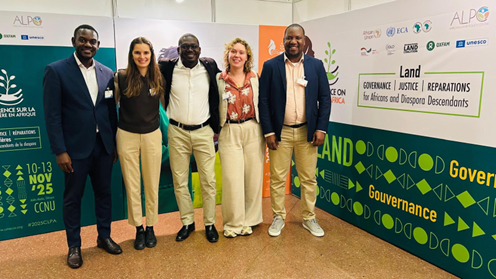
This challenge was at the heart of a recent side session hosted at the Conference on Land Policy in Africa (CLPA 2025) on “Strengthening Land Governance for Displaced Communities”, which brought together experiences from the LAND-at-scale programme in Uganda, Mozambique, and Chad. The session created space for practitioners, policymakers, and civil society actors to reflect on what works and what still needs to change when land governance meets displacement.

Conference on Land Policy in Africa 2025


Displacement and Land: A Shared Challenge, Diverse Contexts

Despite the diversity of country contexts, a common thread emerged: displacement places immense strain on land systems, often exposing gaps in policy, regulation, and practice. These gaps disproportionately affect women, youth, and other vulnerable groups whose land rights are frequently informal, unrecognised, or contested.

The LAND-at-scale programme works at this intersection, supporting fit-for-purpose land administration, participatory land use planning, policy development, and addressing tenure security in fragile and displacement-affected settings. Through country case studies, the session highlighted how tailored, context-specific approaches can contribute to conflict prevention and social cohesion.


Chad: Pastoralism, Conflict, and Inclusive Land Delimitation

In Chad, Mahamat Abdoulaye Malloum (Kadaster International) shared insights from work in pastoral areas where land use is highly dynamic and deeply embedded in social relations. The coexistence of farmers, pastoralists, and refugees,particularly those fleeing conflict in neighbouring Sudan, is increasingly under pressure. Where in the past pastoralists respected local laws, now new groups of agro-pastoralists has increased tension between communities. Furthermore, this is heightened by the existing pressure on natural resources in the face of climate change. 

Land governance provides an entry-point to addressing these tensions. Fit-for-purpose land administration has been used as an entry point to address displacement by integrating social data, recognising pastoral corridors, and mapping sacred and shared-use areas often excluded from formal systems. This approach goes beyond technical mapping, focussing on dialogue and participation across these different stakeholders. Malloum stressed that land delimitation must be sensitive to power dynamics and evolving social norms, especially as new actors enter pastoral systems and traditional conventions weaken. Strengthening dispute resolution mechanisms is therefore critical as communities and land use patterns continue to change.


Mozambique: Conflict, Climate, and the Absence of Regulation

Borges Chivambo (Centro Terra Viva – CTV) highlighted Mozambique’s dual displacement drivers: armed conflict in the north and climate-related disasters such as floods and cyclones. While both IDPs and host communities have rights, Mozambique lacks clear regulations governing resettlement and compensation for displacement caused by conflict or natural disasters. Regulations currently focuss on compensations for (private) investments alone. In practice, this regulatory vacuum leaves government authorities improvising, often without consulting host communities on the exact terms and rights of IDPs and hosts.


Secondly, in the face of disaster, individuals and communities without tenure security have spoken of apprehension to leaving their homes in the fear of someone occupying or claiming the land in their absence. This has resulted in situations where people have kept themselves in unsafe areas, despite encouragement to leave. In cases where people have fleed and been provided shelter in hosts communities, many displaced people then fear returning to their land due to the probable risk of others having claimed it,  with little ability to prove prior rights. Thus, situations arise where after 10 years, IDPs are still part of hosts communities and never return, which contrasts to initial expectations of host communities. Adding to that, it is worth mentioning that according to the land law in use, one of the ways to acquire the Land Use Rise is through occupation in good faith for a period of 10 years by individual nationals.

LAND-at-scale’s contribution in Mozambique has focused on prevention and advocacy – strengthening land use planning, raising legal awareness, and pushing for regulatory reforms that clarify responsibilities, compensation, and tenure security. As Chivambo emphasised, without clear legal frameworks, even well-intentioned humanitarian responses can sow the seeds of future conflict.

Uganda: Hosting Refugees and Managing Growing Pressure on Land

Uganda’s progressive refugee policy was a focal point of Simon Peter Mwesigye’s (GLTN/UN-Habitat) presentation. Refugees are integrated into host communities and allocated land to support self-reliance – a model widely praised internationally. However, with over 1.5 million refugees, pressure on customary land, forests, and water resources is intensifying. Plot sizes have shrunk, competition over resources is increasing, and host communities often feel that refugees receive disproportionate support, heightening  tensions.  

LAND-at-scale is addressing these challenges by securing host community land rights, supporting participatory land use planning that includes both refugees and hosts, and strengthening joint refugee and host community conflict resolution committees. Importantly, the Uganda case also highlighted the link between land governance and climate resilience. Secure land rights encourage sustainable land use practices and long-term investments in land- such as tree planting, wise use of wetlands  and soil conservation practices- which can help prevent land degradation and future climate-induced displacements. Thus, by protecting the resources for future generation, possible future displacement can be mitigated.


A Chief’s Perspective: Our Joint Responsibility of Care

The session was enriched by His Highness – Stephen Drani Izakare, who has received and hosted refugees in his own Madi Chiefdom in West-Nile, Uganda. Recognising the challenges mentioned in the three presentations, he stressed the importance of our responsibility of care towards each other. It should not be seen as optional to take ones neighbour into your home in their time of need, especially since many are fleeing from hunger and/or violence. We should have empathy, and to be a host is an honour. He therefore stressed the importance that land governance should have a clear integration of traditional authorities to adress tensions between groups and strengthen dispute resolution mechnanisms, while keeping humanity central.


Cross-Cutting Reflections: Balancing Rights and Social Dynamics

A critical reflection running through the session was that providing assistance without formalisation can unintentionally create conflict. When displaced people stay for extended periods without clear tenure arrangements, informal hospitality can evolve into contested claims. At the same time, granting rights to one group without addressing the needs of others risks deepening tensions.

Participants emphasised the need to balance legal rights with social realities, recognising that land governance is not only about rules and titles but also about relationships, trust, and long-term co-existence. Strengthening dispute resolution, aligning humanitarian, land, and environmental policies, and ensuring development benefits all groups – not just displaced populations – are essential steps forward.


Land Governance as Transformative Role in Displacement Contexts

The experiences shared from Chad, Mozambique, and Uganda show that strenghened land governance can play a transformative role in displacement contexts – supporting peacebuilding, resilience, and social justice. But this requires political will, coherent legal frameworks, and sustained collaboration between governments, communities, and international partners.

As displacement continues to shape Africa’s development landscape, initiatives like LAND-at-scale offer valuable lessons on how land governance can be part of the solution – rather than another source of conflict.

CLPA 2025 - Cérémonie d'ouverture

A special thanks to the speakers Simon Peter Mwesigye (GLTN/UN-Habitat), His Highness, Stephen Drani Izakare, Borges Chivambo (CTV), and Mahamat Abdoulaye Malloum (Kadaster International) and moderator Aoife Ossendorp (RVO).  

The LAND-at-scale programme is a land governance support programme financed by the Ministry of Foreign Affairs of the Netherlands and managed by The Netherlands Enterprise and Development Agency (RVO). Want to hear more about the session or about the work of the LAND-at-scale programme? Get in contact via landatscale@rvo.nl or follow us on LinkedIn.

Program: LAND-at-scale.

Related projects: LAND-at-scale Chad: Land reform and tenure security, LAND-at-scale Chad: Towards inclusive land governance, LAND-at-scale Uganda: Community-based land registration and land use planning, LAND-at-scale Knowledge management: LANDac contribution, LAND-at-scale Knowledge management: International Land Coalition contribution, LAND-at-scale Knowledge management: KIT support to country partners, LAND-at-scale Knowledge management: Land Portal strategy support, LAND-at-scale Mozambique: Community land rights and climate resilience, LAND-at-scale Mozambique: Community land rights certification in municipal areas.

Original image CLPA LAS.

Originally published on the Land Portal. Creative Commons Attribution 4.0 International.

Strengthening the Capacity of African Land Governance Systems Through Sustainable Financing

Originally published .

Conference on Land Policy in Africa — 12 November, Addis Ababa
Session Summary

Introduction and Context

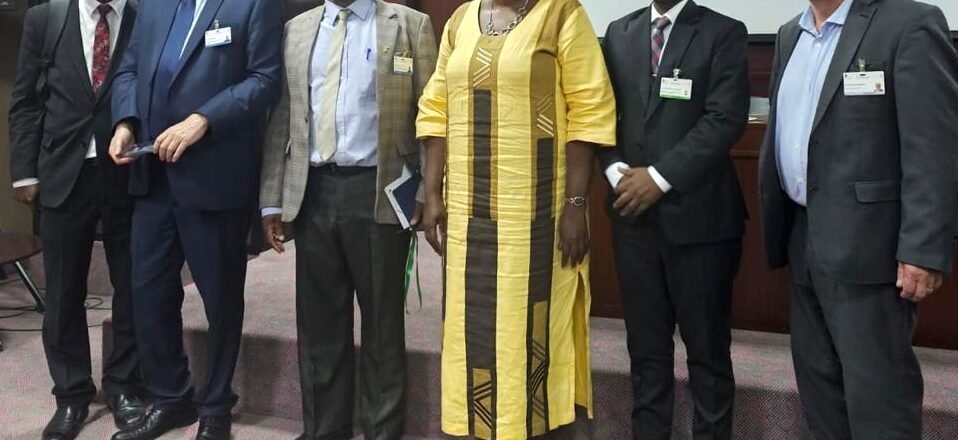
The side event “Strengthening the Capacity of African Land Governance Systems Through Sustainable Financing” brought together government leaders, development partners, and technical specialists to examine how African countries can finance long-term land governance reforms. The session was chaired by Robin Bloch (Team Leader, FCDO Land Facility Decision Support Unit (DSU)) and moderated by Esther Obaikol (Land Governance Advisor, DSU). The discussion centered on practical financing models, political economy strategies, and lessons emerging from Rwanda, Malawi, Ethiopia, and international practice.

Robin Bloch welcomed participants and set out the purpose of the session as exploring “how African governments can strengthen their land governance systems through sustainable financing approaches.” He emphasized the relevance of the topic given shifting aid landscapes, noting that the sector must increasingly rely on domestic solutions. He thanked partners and introduced the speakers, highlighting the DSU’s role in supporting analytical and operational work on land sector financing.

Richard Baldwin opened by connecting the session to the conference’s earlier plenary discussions, noting that the Right Honorable Minister Mzwanele Nyhontso had spoken about “the need for sustainable transformations and the importance of additional sources of financing.” He added: “We know how difficult it is to reform land governance. Existing systems are not well established, and development funding sources are reducing.”

During his keynote presentation, Baldwin argued that sustainable financing must be built into land programmes from the beginning, rather than introduced as an afterthought:

“Often we only think about sustainable financing once land administration systems have matured. Can we bring that conversation more upstream into the planning of the land governance reform programme?”

He outlined the three main areas of land administrations that require financing:

  1. Administrative infrastructure and system development
  2. Registration processes
  3. Operations and service delivery

He explained that costs vary enormously for establishing infrastructure, system development and deployment, and capacity development, depending on scope, functionality, and organisational/institutional factors. For first-time registration of land parcels, costs depend on the model used (e.g. systematic, individual, and voluntary registration that includes a contributory model). Baldwin also commented that comparing expenses across countries requires a standardised step-based costing approach to be sure we are accurately comparing all steps in the registration process—from initial programme design to final registration in a national land administration system.

When looking at operational and service delivery, he emphasised the need to undertake robust financial analysis of the existing land administration system, which may include non-government organisations or businesses. 

On revenue mobilization, he emphasised:

“If we have better coverage and better quality of land administration data, then land-related revenue collection rates can be increased. There is a wide net of potential land-related revenues including own-source, tax and non-tax revenues.”

Baldwin put forward a conceptual model that combines supply and demand-side factors with sustainable financing in a Theory of Change that explicitly includes financial analysis and developing incentives and benefits for citizens when using land administration services. He  also presented three case studies, illustrating different approaches to more sustainable financial solutions:

Rwanda: Cost recovery through land-transaction revenues

Rwanda’s initial land registration programme cost approximately USD 70 million; at present, the country has nearly recovered the whole cost of that investment in land-transaction revenues. Baldwin showed that “by 2025, the cumulative income from land transactions is around USD 66 million,” adding that the country has largely achieved an annual operational break-even due to large increases in transactions and strong digitisation of land records.

Malawi: A promising financial model

A detailed financial model, generated from existing government budget baselines, demonstrated that Malawi’s land reforms could generate substantial revenues. Baldwin highlighted that ground rent alone was projected at “USD 38 million over nine years,” compared to a cost of roughly USD 28 million.

Ethiopia: Access to microfinance loans through land certification

Ethiopia’s land certification programme supports access to finance for rural producers and small business operators:

“Over four billion birr has been generated as of November this year through microfinance loans backed by land certificates.”

Baldwin closed his presentation by noting an emerging shift globally:

“There is a lot more interest recently in thinking about sustainable financing at the country level and building it into land governance reform programmes on both the demand and supply sides – it can take many different forms.”

Esther Obaikol reflected on the evolution of financing debates in African land governance and the promising case studies presented in Baldwin’s keynote, saying:

“So many years ago, we started talking about improving financing for land administration. These were real discussions in different member states, and these [promising early results in Rwanda, Malawi and Ethiopia] are real things that have happened.”

She underscored that hearing directly from governments and development partners was essential to understanding practical pathways forward.


Panel Reflections

Following the keynote presentation and reflections, the session invited panelists to weigh in with their own experience working with land administrations and development programmes across Africa. They communicated advances in land administration technical capacity, funding sustainability, and gender-balanced ownership, setting an optimistic tone for the work ahead.

1. Rwanda — Sylvain Muyombano

Sylvain Muyombano, Head of Land Administration and Registrar of Land Titles in Rwanda, traced the country’s land reform back to 1998, explaining the pressures of population growth, scarcity, displacement, and informality. He said:

“Before 1994 all the land belonged to the government. After the war the government changed the policy and decided that the land should be a common heritage to all Rwandans, and that the state would manage the land in the interest of everyone. The citizen could own and enjoy rights on land.”

“Land is part of the common heritage of all Rwandans, the ancestors, present and future generations”, he said. The government is mandated to oversee that the landowners are using their land efficiently for the general interest, which is different from government ownership.

Key achievements since that position shift have included a complete legal and policy reform, creation of a national land institution, and the landmark Land Tenure Regularisation (LTR) programme.

“We registered 10.4 million parcels in a short period of time,” said Muyombano “Today we have 11.9 million parcels registered.”

He drew attention to gains in gender-balanced land ownership: 

“Nineteen percent [of land parcels] are owned in the names of women, twelve percent by men, and forty-nine percent jointly by couples.”

On technical capacity to enact large-scale land registration, he said: 

“[When we began,] We didn’t have any surveyor who could measure land. By now we have more than 306 private surveyors and more than 200 private notaries.”

Rwanda has integrated its land administration system with 17 other national systems for data sharing purposes, including banking, agriculture, and finance. It has also registered over 153,000 mortgages valued at USD 16.7 billion.

On sustainability, he reported:

“We are sure that by the end of this month we shall be recovering all the investments made [in improving the national land administration system].”

He explained that Rwanda is continuously striving to keep services affordable and accessible, which has reduced informal land ownership and use and tripled annual transactions.

 “The law now allows us [land administrators] to generate our own revenue to sustain our systems,” he said.

He stressed the ongoing need for a comprehensive strategy to demonstrate the total national benefits of land governance, which would help secure more domestic investment.


2. Malawi — Devie Chilonga

Devie Chilonga, Former Permanent Secretary of the Ministry of Lands in Malawi described the country’s long land reform process, starting in 1994.

 “It took a long time —over 22 years—to develop the consensus on the review of land-related legislation. But we just had to be patient.”

Since that consensus, major reforms have included the 2002 National Land Policy, the 2016 legislation, 2022 amendments, and alignment with decentralization. The country also made important advancements in recognising and developing capacity for customary land holders:

“Every Traditional Authority now has a land clerk trained for one year on land administration,” said Chilonga.

Additionally, Malawi developed a national Land Information Management System (LIMS) with support from multiple partners:

“The system is robust. It issues inheritances, subdivision approvals, and certificates for customary estates. It is rolling out nationwide.”

The breakthrough on sustainable financing came from negotiations with the Ministry of Finance:

“Treasury said no. They said all revenue must go into Account Number One. But after demonstrating the risks if the system collapsed, they were convinced. We agreed that twenty-five percent of the resources collected from LIMS would be retained for sustaining the system.”

He stressed performance and credibility:

“We were given a target by the Treasury. We delivered. That opened the whole conversation.”

On gender, he noted:

“Most of the land parcels have been registered in favor of joint tenants or tenants in common. Even in patriarchal societies, women are able to register land in their favor.”


3. Ethiopia — Rahel Hailu (GIZ)

Rahel Hailu, Deputy Project manager at Support to Responsible Agricultural Investment (S2RAI) II Project, GIZ Ethiopia & Djibouti, described the Government of Ethiopia’s collaboration with GIZ to continue the rural land administration programme after external funding ended.

 “With a budget of EUR 600,000, we managed to issue more than one million certificates.”

She highlighted the country’s investment in mobile back-office centers (e.g. vans that provide land services to rural communities) that reduce informal transactions and build trust:

 “The service is provided closer to the citizens, so they can transact formally and build trust in the system.”

Other national accomplishments include:

  • Establishing an economic empowerment unit linking land rights to access to finance;

  • Formalising land rental services;

  • Building youth skills through technical colleges teaching surveying technologies.

On financing models, she emphasised:

“Sustainable financing [for land administrations] does not come from a single model. It should be a linkage of different mechanisms.”

She highlighted four pathways to achieve more sustainable financing:

  1. Enhancing land-based revenue systems
  2. Improving service quality to build willingness to pay (e.g. the cost of land registration)
  3. Results-based financing (e.g., Ethiopia’s land governance pay for results system (PforR)
  4. Linking communal land titling with climate and ecosystem financing


4. International Perspective — Christelle van den Berg (Kadaster International)

Christelle van den Berg, Regional Manager for Kadaster International, stressed that first-time registration is not sufficient for sustainability.

“What is really killing for land administration is data that is not up-to-date. If the data is not reliable, the system will not be used.”

She explained that sustainable systems require investment in registration, system development, and the institutions responsible for maintaining data.

“Do not allow all the benefits of land administration to flow back to the national treasury. A portion must return to the organizations responsible for managing the data.”

She highlighted the example of the Netherlands, where the land agency retains revenues to provide ongoing services:

“Our annual turnover is three hundred million euros, while land-related taxes amount to twelve billion euros. It is worth investing in these institutions.”


Audience Insights

Joan Kagwanja, Coordinator, African Land Policy Centre (ALPC)

Joan emphasized that evidence is essential for securing political support:

“We have to sustain if the government sees value. Document the value, package it in a way that can be communicated, especially to ministries of finance and planning.”

Jonathan Ochom, Land Governance Specialist, Transparency International:

Jonathan raised two political economy questions:

“Money politics determines where the money goes. What exactly did you do to convince your government to prioritise this issue?”

He also asked how land reforms in Rwanda avoided reproducing “injustices, fragility and exclusion” in a post-genocide context.

Ward Anseeuw, Senior Land Tenure Officer, Food and Agriculture Organization of the United Nations (FAO)

Ward emphasized revenue retention:
 “Most of our countries send all revenues to the Treasury. You need a clear policy that restricts a certain percentage to go directly to your agencies.”

Esther Mwaura-Muiru, Stand for Her Land Global Advocacy Director, Landesa

Esther stressed financing constraints:

“Ministries of Lands have been crippled because of limited financing.”
She asked whether the session’s insights could become “a continental recommendation,” and encouraged Rwanda to expand analysis of how women’s land rights translate into socioeconomic gains.

Christian Mesmer, Project Lead, GIZ

Christian reflected on the broader economic significance of land governance:

“Land is the foundation for economic development. Would it not be good to onboard Ministries of Finance directly into these programmes?”


What works – in the panelists’ words

Richard Baldwin

Baldwin advised engaging Ministries of Finance using their tools and formats:

“Speak their language and use Ministry of Finance spreadsheets, not development project files.”
He warned that full revenue retention can trigger central government pushback and suggested phased models.

Sylvain Muyombano (Rwanda)

He explained that Rwanda established credibility through results:

“We started by showing government that our system cannot work properly if they do not invest in it.”

Annual transactions rose from around 100,000 to over 700,000. 

On post-conflict justice, he noted:

“We had land-sharing programmes, and model villages for vulnerable groups. If a landowner was not around, their land was registered and protected until they came back.”

Devie Chilonga (Malawi)

Chilonga described how Malawi’s land authority built trust with the Ministry of Finance:

 “We worked as a team. We delivered on targets. That opened up the conversation.”


Conclusion

This session demonstrated that sustainable financing for land governance is not only possible but already underway across African countries. Rwanda’s revenue-generating land information system, Malawi’s negotiated revenue-retention model, Ethiopia’s low-cost high-impact service delivery innovations—as well as international examples—underscore the feasibility of building self-financing, resilient land administration systems.

A shared set of lessons emerged:

  • Sustainable financing must be built upstream into programme design—before the actual programme work has begun. Sustainability is not an afterthought.

  • Reliable, up-to-date land data increases both service uptake and revenue.

  • Ministries of Finance respond to evidence packaged in their own formats.

  • Revenue retention or reinvestment is essential for operational resilience.

  • Inclusive tenure practices, especially for women, strengthen legitimacy and demand.

  • New opportunities such as climate finance and results-based financing expand the resource base.

At its core, the session showed that investing in land governance is a strategic national priority that yields high returns in economic development, social inclusion, climate resilience, and public trust. African governments are increasingly demonstrating that sustainable financing is a cornerstone of strong, long-lasting land governance systems.

Related project: The Land Facility.

Republished from the original Land Portal article under Creative Commons Attribution 4.0 International.

Photograph from the original Land Portal article. No individual photographer was named.

Ground Rules Ep 2: Engaging and influencing Ministries of Finance: Lessons from a learning session

By Enrique Mendizabal.

Related project: The Land Facility.

Ground Rules E02

Editorial note: This is the second blog in the ‘Ground Rules’ series, an ongoing initiative that explores how ‘thinking and working politically’ can support more adaptive and effective programming in land governance and beyond. The series is curated​ by the L​​​​and Facility Decision Support Unit (DSU) in collaboration with the Land Portal Foundation.

Enrique Mendizabal, founder of On Think Tanks and member of the Land Facility’s Political Economy Advisory Group (PEAG), moderated a discussion on this topic during a DSU-hosted internal learning session.  


Quick read: To engage Ministries of Finance, this blog proposes four concrete steps for development programmes and policy advocates:  

  • Map the ministry. Understand its internal dynamics, whether it leans transactional or policy-oriented, and who really makes decisions.
  • Frame evidence politically. Translate sectoral priorities into fiscal and political terms that resonate with finance officials.
  • Support weaker ministries. Equip them with arguments, allies, and data to strengthen their negotiations.
  • Invest in champions. Identify and support individuals inside finance ministries who can carry reforms forward.


In September 2025 I had the chance to moderate a fascinating discussion as part of the Land Facility’s quarterly learning series. The theme was one that has preoccupied me for some time: how to engage with and influence ministries of finance.

For those of us working on policy reform—whether in land governance, health, education, or other sectors—ministries of finance are crucial allies. They decide how resources are allocated, set the fiscal tone for the entire government and often shape national policy priorities. Yet, as several participants reminded us, Ministries of Finance remain under-engaged by many of the actors trying to promote reform.

The discussion was led by Philipp Krause, Visiting Fellow at the University of Potsdam and Director on the board of the African Economic Research Consortium, and Oswaldo Molina, Associate Professor of Economics at Universidad del Pacifico in Peru and founding director of the think tank, Red de Estudios para el Desarrollo (REDES) [Network for Development Studies].


Ministries before finance

One of the session’s key takeaways came from Philipp, who has worked extensively with Ministries of Finance around the world. He reminded us that Ministries of Finance are, first and foremost, ministries—subject to the same civil service laws, organisational logics, and political imperatives and pressures as any other.

They are staffed by civil servants with careers, incentives, and bureaucratic cultures, and they spend much of their time negotiating with other ministries. Their identity as ‘ministries’ shapes how they operate just as much as—if not more than—their function of overseeing public finances.

At their core, they are also ministries of balancing: they manage the tension between spending and taxation. Their responsibility is to keep the fiscal system stable, which means they often play the role of the “no” ministry—pushing back against the constant financial demands from other sector ministries. Their job is not about obstruction but about ensuring sustainability.

Philipp presented this and several other principles that can help make sense of finance ministries across contexts: 

  1. They are ministries first. Their behaviour is shaped by bureaucratic norms, hierarchies, and civil service structures.
  2. They are the counterweight. Their job is to balance spending and taxation, not to champion one sector over another.
  3. They have two core functions. Budget management (where most sector ministries interact with them) and macro-fiscal policy (which usually dominates internally and politically).
  4. Their roles vary between transactional and policy orientations, depending on the country. Some Ministries of Finance are tasked with managing detailed financial transactions and controls, others focus on broader policy frameworks.
  5. Policy is not the same as evidence. Finance ministries may be policy-focused, but that does not necessarily mean they are evidence-focused.

 These principles already challenge some common assumptions. Too often, advocates for development causes treat finance ministries as if they were neutral arbiters of evidence or technical merit. In practice, however, they are institutions embedded in politics, bureaucracy, and short-term pressures.


Policy ministries vs. evidence ministries

This distinction merits special attention.

  A policy-oriented ministry—such as finance—is primarily concerned with steering the machinery of government, ensuring fiscal sustainability, and delivering on economic and political priorities. Its work is about making political trade-offs, aligning taxation and expenditure, and arbitrating between competing demands.

An evidence-oriented ministry, by contrast, would be one that relies heavily on research, data, and evaluation to determine what programmes deserve support. Health and education ministries, at least in principle, operate closer to this model. For example, evidence of cost-effectiveness or health impact can directly shape funding decisions and legitimise reforms.

Noting this distinction, Krause reminded us that policy work is different from evidence work. Policy in a  of finance often means deciding whether transport should receive more resources than housing, or whether debt sustainability requires cutting programmes despite their social benefits. Those choices cannot be made purely based on technical evidence; they are inherently political.

A good example is found in infrastructure. Evidence of the poor economic returns of a specific project may convince a housing minister to pause a particular project. But if that evidence was first presented to the finance ministry, officials may reply: “This is a matter for the land and housing ministry; infrastructure is the government’s priority, and we will continue allocating resources to that budget.” Evidence itself rarely shifts finance ministry priorities, unless it is translated into fiscal or political terms.

This reality does not make Ministries of Finance “anti-evidence.” Rather, it means evidence needs to be framed differently. Messages that will resonate are not necessarily those that reference the internal rate of return of a land titling programme, but those that can demonstrate how return rates align with fiscal sustainability, political commitments or short-term revenue needs. 


The allocators and policy shapers

Oswaldo, who served in government before founding a think tank in Peru, expanded the context around Philipp’s principles, painting a vivid picture of finance ministry operations.

Because of the pressing social and economic needs of developing countries, the balancing role that Ministries of Finance play is especially strong. Oswaldo described finance ministries in these contexts as both allocators and policy shapers. The Ministry of Finance often decides which projects even make it onto the table, and, through the budget, it determines which policies will expand, stall, or die. No social programme, infrastructure project, or reform can survive without its endorsement.

He compared finance ministries to jugglers, constantly balancing demands to:

  • on one hand, contain spending pressures and maintain fiscal discipline while;
  • on the other, shape proposals from sector ministries into cost-effective options that can survive political and fiscal scrutiny.

In Peru, for example, no matter what the health or development ministry might propose, Oswaldo observed that nothing moved forward without the ‘green light’ from the Ministry of Economy and Finance. This centrality, which Philipp suggested is very particular to Peru, makes finance ministries essential partners for every sector, as well as arbiters of which priorities matter.


Who influences finance ministries?

Although Ministries of Finance have a lot of power to decide which initiatives receive funding, they are also highly influenced by forces beyond their walls. As Philipp reminded the discussion group, Ministries of Finance are never purely technocratic “evidence ministries”; they must reflect the political priorities of the current national government.

Therefore, the cabinet and head of government are perhaps the most direct sources of influence on finance ministries. When the president or prime minister declares that a sector—say, transport or infrastructure—is a political priority, the finance ministry must ensure that priority is reflected in the budget. This is part of finance ministries’ delicate political balancing act: aligning fiscal discipline with the promises on which the government was elected.

The legislature is another critical player. In countries like the United States, Congress holds overwhelming authority over spending decisions, leaving the Treasury relatively weak. Even in systems where finance ministries are formally very strong—Philipp mentioned Chile as an example—they must still secure legislative approval for the annual budget. This process forces negotiation and compromise and creates space for parliamentarians and their constituencies to shape allocations.

There are also less formal but persistent pressures on finance ministries:

  • Media and public opinion can elevate or sink spending priorities.
  • Local governments and other ministries lobby hard for resources and use public narratives to push their cases.
  • Development partners and donors can create fiscal incentives, especially when loans or large grants are on the table.

Finally, as one participant pointed out, finance ministries are deeply aligned with the political calendar. They rarely take on reforms that will make the sitting president unpopular, especially if the pay-off lies beyond the current electoral cycle. This short-termism is not a design flaw but a reflection of their role; they must keep the government’s programme on track, both fiscally and politically. 


People, not machines

Both Oswaldo and Philipp insisted on something that we in the evidence-to-policy world sometimes forget: ministries are made up of people.

Officials are not neutral bureaucrats who calmly weigh the recommendations of long research reports. They are individuals under immense pressure with limited time, short tenures and political constraints. Many Ministries of Finance act as firefighters, responding to daily crises and looking for quick wins.

For outsiders, this means three things:

  • Empathy matters. Understand the pressures officials face and the incentives that drive them.
  • Pragmatism matters. Offer ready-to-use comparative examples rather than long-term research projects.
  • Champions matter. Reforms need internal advocates who can navigate the ministry’s internal politics and lend credibility to outside proposals.

As Oswaldo put it, identifying and nurturing an individual ‘champion’ inside the Ministry of Finance is often the difference between success and failure. Doing so requires consistent interpersonal engagement and trust building over years, activities which are made more difficult by short-term project cycles.


Context, politics and champions

Several participants offered powerful illustrations of how context and politics shape finance ministries’ decisions.

  • In Peru in the 1990s, a major land titling programme was championed by the President himself. The Ministry of Finance supported it, not because the evidence was overwhelming, but because it delivered visible political wins and helped balance other reforms. Land titling became a quick, popular success that bolstered the government’s legitimacy.
  • In the US, the Treasury plays a relatively weak role in budget setting. Instead, the Office of Management and Budget and Congress dominate. This shows why it is essential to understand the institutional landscape before deciding whom to influence.
  • In Africa, land advocates often struggle to “speak the language” of finance. Ministries demand economic justifications and return on investment, which land specialists are often ill-equipped to provide.

These cases underline that Ministries of Finance and their roles in government are not uniform. Their power varies by country, their orientation by context, and their priorities by politics. But what unites them is their central role in deciding what gets funded and sustained. 


Elevated status of finance ministries

Another participant noted that finance ministries sometimes operate with a sense of superiority over other ministries. Staff are treated as if they belong to a different government altogether, with higher status and influence—and at times higher salaries. 

When compared to other public bodies, Ministries of Finance and central banks are often referred to as “islands of excellence.”

This, combined with their short-term political alignment with the president’s agenda, makes it particularly hard for weaker ministries—such as those responsible for land —to push long-term reforms. If land governance is politically unpopular or offers little short-term gain, it is unlikely to secure support from finance officials.


Looking ahead

This session reinforced something I have long argued: influencing policy is not about producing more evidence, but about understanding systems of power, incentives, and decision-making.

Ministries of Finance occupy a unique position in these systems. They cannot be bypassed, and engaging them requires a mix of:

  • technical insight into fiscal and political trade-offs;
  • political savvy to align reforms with broader government priorities; and
  • relational trust built through champions and sustained engagement.

For the Land Facility, this discussion supported four concrete steps for engaging Ministries of Finance:

  • Map the ministry. Understand its internal dynamics, whether it leans transactional or policy-oriented, and who really makes decisions.
  • Frame evidence politically. Translate sectoral priorities into fiscal and political terms that resonate with finance officials.
  • Support weaker ministries. Equip them with arguments, allies, and data to strengthen their negotiations.
  • Invest in champions. Identify and support individuals inside finance ministries who can carry reforms forward.

If we want reforms in land governance—or any sector—to be sustainable, engaging Ministries of Finance is not optional; it is indispensable.


Additional resources:

Coalition of Finance Ministers for Climate Action. (2025). A Global Survey of Ministries of Finance: Economic analysis for green and resilient transitions (HP4 Report). Link

Oriol, A. M., Velandia, A. S. (2025). The Role of Evidence in Latin American Finance Ministries in Budgets and Crisis Response. ODI. Link

Hashemi, T. (2025). Yes, The Treasury Blocks Stuff… Bad Stuff – Bim Afolami. Policy Unstuck. Link

Krause, P. (2024). The Role of Fiscal Think Tanks in Fiscal Policy: Global Patterns and Lessons for South Africa. Southern Centre for Inequality Studies (SCIS), University of the Witwatersrand, Johannesburg. Link

Rosengren, A., Shah, N., & Commodore, R. (2021). The Role of Evidence in Policymaking in Ghana: A Political Economy Analysis. African Center for Economic Transformation (ACET). Link

UNICEF. (2017). UNICEF’s Engagements in Influencing Domestic Public Finance for Children (PF4C): A Global Programme Framework. Link

*** 

This material has been funded by UK International Development from the UK government; however, the authors’ opinions in the ‘Ground Rules’ blog series do not necessarily represent the UK government’s official policies, nor the Land Facility programme’s view on political economy. Rather, these blogs are part of the Decision Support Unit’s mandate to facilitate global learning and knowledge exchange that can inform best practices across the land and development world.

By Enrique Mendizabal. Originally published November 3, 2025 by the Land Portal Foundation as part of the Land Facility Decision Support Unit’s Ground Rules series. Republished from the original article under Creative Commons Attribution 4.0.

Ground Rules Ep 1: Navigating political economies for effective climate action

Related project: The Land Facility.

Ground Rules E01

Editorial note: Welcome to the Ground Rules blog series — an initiative of the Land Facility Decision Support Unit (DSU) that explores how ‘thinking and working politically’ can support more adaptive and effective programming in land governance and beyond.

Political economy analysis (PEA) helps programmes identify the power dynamics and incentives that shape land governance, shedding light on why certain challenges persist—and what it takes to achieve lasting, effective reforms.

To launch the series, we are re-sharing a blog from the Land Facility’s session at the 2025 World Bank Land Conference: “Navigating Political Economies to Strengthen Land Governance for Climate Action.” This theme remains timely amid the lead-up to COP30 and growing recognition — reflected in efforts such as the COP26 Forest Tenure Pledge — that many climate commitments cannot succeed without transparent and secure tenure. Robust national land governance and administration systems are essential foundations for both secure tenure and effective climate action.

The series is curated by the Land Facility DSU in collaboration with the Land Portal Foundation.

Quick read:

  • Climate change is a ‘risk multiplier’; it puts new pressures on people and governments, intensifying land governance challenges across sectors (e.g. infrastructure, energy, mining).
  • Technical models should ‘look below the surface’ to align with the changing social and economic processes impacting land governance across contexts.
  • Political economy analysis (PEA) is a practical approach for land programmes to understand why some problems persist and which actions are most likely to succeed.
  • Understanding power dynamics can help programmes to more effectively incentivise climate action, sustainable land use, and inclusive land tenure.

As climate change intensifies the fragility of governance systems and access to resources, a new imperative is emerging in the land sector: look beyond technical solutions and confront the underlying political economy. That was the focus of “Navigating Political Economies to Strengthen Land Governance for Climate Action,” a well-received session organised by the Land Facility, a global programme funded by the UK’s Foreign, Commonwealth and Development Office (FCDO). Held on May 6 at the World Bank Land Conference 2025, the session brought together practitioners, reformers, and thinkers who are reshaping how land governance is approached in an era of urgent climate action.

Moderated by Tony Burns, Executive Director of the company Land Equity International, the panel explored how Political Economy Analysis (PEA) is not simply an academic exercise but a practical tool for navigating the invisible forces—interests, incentives, ideologies, and power asymmetries—that shape the success or failure of land reform.

“Land tenure policy is the foundation of a society’s ability to meet the competing needs of population growth, food security, biodiversity, and climate action,” Burns said. “But there is no one-size-fits-all model. Each country faces its own political circumstances and historical burdens.”

Download session PPT 

Mapping the hidden terrain of reform

Claudia D’Andrea, political economy analyst for the Land Facility, opened the session with a grounding in the concepts and tools of political economy. Representing the Land Facility, D’Andrea argued that PEA helps development actors look “below the surface” of technical land challenges to reveal why some reforms stagnate while others succeed.

“Climate change is a risk multiplier. It exacerbates fragility, deepens social fissures, and adds urgency to already complex land governance problems,” D’Andrea explained. “Yet most reform failures are not due to bad policies—they’re due to power, resistance, and conflicting incentives.”

She described PEA as a set of methods to analyse stakeholders, institutional barriers, informal rules of the game, and power asymmetries—particularly along gender and customary lines. “We must ask: who benefits from the current system? Who loses from change? And where are the ‘loose bricks’ in the wall of resistance that can become entry points for reform?”

Importantly, D’Andrea emphasised that PEA is not about publishing reports. “It’s about actionable insight. It’s about identifying politically feasible pathways for inclusive tenure reform that supports climate goals,” she said.

“[PEA] is about actionable insight. It’s about identifying politically feasible pathways for inclusive tenure reform that supports climate goals.” – Claudia D’Andrea

Legal empowerment and bottom-up change in Sierra Leone

Erin Kitchell, Managing Director of Land, Environment, and Climate at the nonprofit, Namati, followed with a compelling case study from Sierra Leone. Namati’s “legal empowerment” approach equips local communities with legal knowledge to assert their land rights and creates pathways to translate local struggles to solve lived problems into broader structural reforms.

Kitchell speaking at the Land Conference 2025 side event on “Navigating political economies for effective climate action.” Source: World Bank


Kitchell traced a decade-long journey from the passage of Sierra Leone’s National Land Policy in 2015 to the landmark Customary Land Rights Act (2022), one of the most progressive land laws in Africa.

“The law recognises full collective and customary land rights, gives communities the power to reject or accept investments through free, prior and informed consent (FPIC), and mandates protection of ecologically sensitive zones,” she said. “But it didn’t happen by accident—it was a strategic campaign.”

Kitchell explained how community paralegals not only documented rights violations but built public leadership among community members, fuelling a national campaign. During the 2018 elections, Namati mobilised every presidential candidate to sign the Our Land, Our Future pledge. The resulting political pressure set the stage for the law’s to be adopted.  

“We anticipated opposition from both the private sector and traditional leaders,” Kitchell noted. “So we built coalitions of unusual allies—from progressive Paramount Chiefs to businesses who saw benefit in clarifying tenure rights.”

Today, Namati is working to ensure implementation: “It’s not enough to pass a law. It must be activated in practice. That’s the power of the legal empowerment cycle—moving from knowing and using the law to shaping it, and then back again.”

Changing norms, not just policies

Christopher Tanner, Principal Consultant at Mokoro Limited, shifted the focus to customary law and gender, arguing that land governance is inherently a matter of political economy.

“When you work in land, you are automatically working in political economy. It’s about power over a key resource, and customary systems are very much part of that,” he said.

Tanner cautioned against the trend of discarding customary institutions in favour of formal systems. “To erase customary law is to erase legitimacy and proximity. Reform must work with—not against—existing norms,” he said.

Drawing on Mokoro’s work in Tanzania, Mongolia, Mozambique, and Timor Leste, Tanner described how community-led dialogues can shift entrenched gender norms and promote inclusive tenure.

“When you work in land, you are automatically working in political economy. It’s about power over a key resource, and customary systems are very much part of that” – Christopher Tanner

“It’s not about ticking boxes—how many women attended a meeting. It’s about recognizing women as agents of change, as decision-makers with voice and power,” Tanner emphasised.

Tanner speaking at the Land Conference 2025 side event on “Navigating political economies for effective climate action.” Source: World Bank


He praised participatory landscape planning in Mongolia and peer-to-peer engagement in Tanzanian villages, where trained champions catalyse behaviour change by engaging their neighbours. In Mozambique, where implementation of a progressive land law has been obstructed by political elites, communities created a “People’s Cadastre” to assert their rights from below.  

“Customary practices are not immutable. They can evolve—but that evolution must be driven by communities themselves,” Tanner concluded.

Embedding PEA in national reform in the Mekong Region

John Meadows, Land Governance Adviser for the Land Facility, closed the panel with lessons from the Mekong Region Land Governance Program (MRLG), covering Laos, Cambodia, Vietnam, and Myanmar.

Meadows described how PEA was used not just as a research tool, but as a strategy to build reform coalitions. A key finding in Laos, for example, was that over 3,000 villages were living within state forest zones without any legal tenure security.

“Phase one of the MRLG generated rich academic analysis. But the risk was that reports would gather dust,” said Meadows. “So, in phase two, we turned the PEA findings into action.”

Through stakeholder workshops, power mapping, and targeted engagement, Meadows’ team identified key blockers and champions. They worked closely with Laos’ Ministry of Lands and Forestry, presented findings to the 164-member National Assembly, and built donor consensus.

“We found that practical, country-specific PEA—shared through safe, non-public channels—can bridge the gap between civil society and state, and ultimately change laws,” Meadows said. The result: new legal provisions recognizing community tenure in forests, and a shift in national discourse around land and climate.

PEA as process, not just product

The session concluded with rich reflections and audience questions, ranging from transitional justice in the Philippines to carbon markets in Latin America.

Claudia D’Andrea emphasised that PEA is not one thing—it can be national, sectoral, or problem-based. It is not a dataset, but a “map of incentives, alliances, and entry points for change.”

Christopher Tanner added that PEA must disrupt silos. “In Mozambique, the land administration tried to monopolize reform. We had to open the tent—to bring in tourism, defense, finance, and women’s ministries.”

Erin Kitchell stressed that political savviness must be distributed—not just at the top. “We involve communities in political analysis. We ask them: who has influence? Who listens? And what messages resonate?”

John Meadows offered a final word of caution and hope: “PEA is inherently sensitive. But when done with care, and applied iteratively, it can turn fragile openings into durable change.”

“PEA is inherently sensitive. But when done with care, and applied iteratively, it can turn fragile openings into durable change.” – John Meadows

Conclusion: Power, politics, and the path to just climate action

This session was a clarion call for politically intelligent land reform. Climate goals—whether tied to REDD+, carbon markets, or forest restoration—will falter without secure land tenure. And tenure security, in turn, will remain out of reach unless we confront the deeper drivers of exclusion, informality, and resistance.

D’Andrea speaking at the Land Conference 2025 side event on “Navigating political economies for effective climate action.” Source: World Bank

“In the end, political economy isn’t just about understanding how power works; it’s about figuring out how to make power work differently.” – Claudia D’Andrea

Political Economy Analysis is not a luxury—it is a necessity. It helps us ask better questions, avoid blind spots, and design reforms that stick. It shows us that power can be shifted not only through policy, but through paralegals, champions, and coalitions.

The Land Facility and its partners have shown what is possible. Now the challenge is to replicate, scale, and institutionalise this political intelligence in every land project that claims to serve the climate, equity, and justice.

“In the end, political economy isn’t just about understanding how power works,” said D’Andrea. “It’s about figuring out how to make power work differently.”

***

This blog post was produced with the assistance of AI. The content has been reviewed by panellists as well as members of the Land Portal team who attended the session. In some cases, summaries are based on event recordings, and transcripts are created and carefully reviewed to ensure each speaker’s interventions are accurately represented.

This material has been funded by UK International Development from the UK government; however, the authors’ opinions in the ‘Ground Rules’ blog series do not necessarily represent the UK government’s official policies, nor the Land Facility programme’s view on political economy. Rather, these blogs are part of the Decision Support Unit’s mandate to facilitate global learning and knowledge exchange that can inform best practices across the land and development world.


Originally published October 31, 2025 by the Land Portal Foundation and the Land Facility Decision Support Unit. Republished from the original article under Creative Commons Attribution 4.0. The original photographs have been omitted.

Berlin Land Week 2025: From Closing to Continuity – Learning Together for a Future with Secure Land Rights

Celebrating a Decade of the Global Programme Responsible Land Policy in Berlin 

In October 2025, Berlin became a global meeting point for land governance. More than 130 experts and partners from various countries gathered to celebrate the closing of the Global Programme Responsible Land Policy (GPRLP) implemented by the Deutsche Gesellschaft für Internationale Zusammenarbeit (GIZ) GmbH and commissioned by the German Federal Ministry for Economic Cooperation and Development (BMZ) and the European Union (EU). 

For millions of people, land is far more than a piece of ground. It is a source of life, identity, and belonging. It is where livelihoods begin and communities take root. That understanding was evident throughout the event, reflecting a shared commitment to social cohesion, economic growth and reduced poverty through secure land rights.  

A Decade That Changed Futures 

Ten years of the GPRLP have left a lasting mark across continents. Since 2015, the programme has strengthened land rights in partner countries including Peru, Paraguay, Cameroon, Niger, Côte d’Ivoire, Burkina Faso, Benin, Uganda, Ethiopia, Madagascar, and Laos. Now, at the end of the programme, achievements are striking: more than three million people, over 650,000 households, now hold secure land certificates. Sixty-four percent of documented rights involve women or joint ownership, advancing gender equality and economic empowerment. More than 11,000 land conflicts have been peacefully resolved through participatory dialogue, and over 300 investors now apply responsible land management standards. 

But the numbers only tell part of the story. Behind each figure lies a family whose future has become more secure, a farmer who can invest with confidence, or a woman who now has legal recognition of her right to the land she cultivates. 

Group Photo of the conference participants

Throughout the conference, one central truth resonated: secure land rights are about more than technicalities or legal frameworks. As Marcy Vigoda, Director of the International Land Coalition, put it, “Land rights are not just a technical or policy issue. They are about dignity, survival, equity, and hope.”  

Learning That Never Stops 

The closing conference in Berlin was not just a moment to look back, it was a space for learning, reflection, and forward thinking. Over three days, participants explored how to carry lessons from the past decade into the future. The message was clear: responsible land governance is a global team effort. Real progress comes when partners share what works, adapt to changing realities, and continue to learn from each other. 

Workshops, exhibitions, and dialogue sessions created a vibrant atmosphere of exchange. Impact marketplaces buzzed with stories and innovations from the field. A photo exhibition brought local experiences vividly to life. Technical sessions drew connections between land rights, gender, and sustainable food systems, while high-level panels with speakers from different levels and institutions and organisations helped align future priorities. As insights and ideas crossed borders, continuity took on a deeper meaning: it became a living, evolving process.  

Mr. Paul Garaycochea speaking during the high level panel

Mr. Paul Garaycochea – BMZ, Director – Sustainable supply chains; agricultural and food systems

Youth and Agriculture: Shaping the Future 

One key topic was raised: the role of Africa’s youth in transforming the continent’s food systems. With more than 60% of Africans under the age of 25, and the average farmer now over 55, the generational gap is striking. “Africa’s future food systems depend on empowering its youth,” said John World Ackah Bonoua from the Youth Initiative for Land in Africa (YILAA). Secure land tenure and fair access are crucial for unlocking investment, innovation, and climate-smart entrepreneurship. If Africa is to feed its growing population and build sustainable rural economies, young people must be placed at the heart of land policies. 

 “Youngpeople have ideas, but they lack trust and means to act. Africa’s future will be built with its youth – or it will not be built at all.” 

John World Ackah Bonoua at Berlin Land Week

Mr. John World BONOUA, YILAA, Youth Initiative for Land in Africa 

A Co-Created Commitment: The Closing Declaration 

The conference culminated in the “Closing Declaration” — a collective Call for Action to the global land governance community. Far from being a formal conclusion, the declaration marks a new beginning: it seeks to strengthen collaboration by sharing scalable good practices and concrete, actor-specific recommendations. 

Drawing on more than ten years of experience from GPRLP and the Strengthening Advisory Capacities for Land Governance in Africa (SLGA), the declaration aims to inform key continental and global platforms that shape land policy and governance. 

What makes the document unique is how it came to life. It was co-created through a participatory process involving diverse stakeholders — from government representatives and civil society to private sector actors, academia and implementing partners in the land sector. Drafted through a series of virtual consultations and workshops, the declaration was further refined and officially endorsed during the closing conference.  

The declaration’s message is clear: building secure land rights requires shared responsibility, evidence-based decision-making, and a culture of learning that transcends projects and borders. It stands as both a roadmap and a promise — to keep learning together for a future where land truly means life. 


Members of the Berlin Land Week closing declaration writing committee

Writing committe of the declaration: Mr. Woldu Tadesse Reda representing Ministry of Agriculture in Ethiopia, Ms. Iantefana Rajenarison representing Ministry of Decentralization and Land Planning in Madagascar, Ms. Carol Namuzimule representing UCOBAC/ Stand for her land in Uganda, Ms. Valérie Cromer representing Meridia in Cote d’Ivoire, Prof. Rose Mediebou representing NELGA/ University of Yaoundé in Cameroon,Dr. Faridah Dosso representing NELGA/ University of Parakou in Benin

Looking Ahead 

The motto “From Closing to Continuity” perfectly captures the spirit of the conference: making knowledge last, letting evidence travel, and scaling what works. The decade-long journey of the GPRLP is not ending—it is entering a new phase of land governance! 

Form more information visit: Global Programme Responsible Land Policy | Land Portal

Explore the Global Programme Responsible Land Policy project page.

Originally published on 31 October 2025 by the Global Programme Responsible Land Policy on Land Portal. Republished under Creative Commons Attribution 4.0. Photographs: GIZ, via Land Portal.

Securing Land, Securing Climate: Gaps and Opportunities in Nationally Determined Contributions

By Eli Calhoun and Rachel McMonagle of Landesa.

Related project: The Land Facility.

Original article photo (not reproduced here): Aerial view of Chompou Khmao village in Prek Kampong Smach Marine Fishery Management Area (MFMA) in Prey Nob district of Preah Sihanouk Province, Cambodia.

By Eli Calhoun, Climate Change Program Intern and Rachel McMonagle, Climate Change Program Director, Landesa

As countries revise their Nationally Determined Contributions (NDCs) ahead of COP30, including land tenure in the NDCs remains a missed opportunity. Land is the physical and legal basis for much of global climate action – from forests and other natural areas that sequester carbon to renewable energy projects providing green energy alternatives. And where there is land, often there are communities engaged in sustainably managing it. By strengthening gender-equitable and inclusive land tenure, governments can seize a crucial opportunity to advance climate goals and protect the livelihoods and culture of their constituents. While NDCs increasingly promote land-based solutions like reforestation and clean energy, most do not include secure land tenure for the people who live on and steward that land. These groups, largely comprised of Indigenous Peoples, rural smallholders, and local communities, are both powerful change agents in the fight for climate action and among the most susceptible to the worsening effects of climate change.

A review of 170 active NDCs reveals a trend: while all countries rely on land to meet their climate goals, few recognize or safeguard the tenure rights of rural people and communities, thereby excluding powerful climate actors and missing investment opportunities. 

Climate Action Without Tenure Safeguards

All 170 NDCs include land-based climate goals, but only 10% include safeguards regarding land tenure. Integrating secure, gender-equitable and inclusive land tenure into NDCs and their implementation provides a cost-effective strategy that boosts climate mitigation and adaptation, mitigates risks like conflict and displacement, and advances social, economic, and environmental benefits.

For instance, the Bahamas plans to scale up solar energy but includes no mention of land rights or community consent. While the country has not yet seen land conflicts tied to these projects, examples elsewhere are instructive. In India, a 300 MW solar project was shut down in 2025 after it was revealed to be built on tribal land without consent or compensation. In Indonesia, the Rempang Eco-City development led to forced evictions of Indigenous communities—again, without NDC safeguards.

These cases underscore a critical point: renewable energy is not tenure-neutral. Even well-meaning projects can cause harm when individual and community land rights aren’t respected.

Framing Matters: Land Tenure as Risk or Solution

Land tenure, when it appears in NDCs, is framed in two distinct ways. Some countries treat secure land rights as a solution—a foundation for increased investments and resilient and equitable climate action. In Vanuatu, for example, the government commits to preserve cultural and traditional knowledge, including climate adaptation practices related to land tenure. This links tenure to resilience, not just risk.

Others frame tenure only as a vulnerability. Malawi’s NDC identifies “insecure and unforeseeable property rights” as a driver of land degradation but offers no plan to address it. While such framing is not inaccurate—tenure insecurity does increase vulnerability—it misses the opportunity to make tenure part of the solution.

To unlock the full potential of land-based climate action, countries must move beyond reactive framing and embrace tenure-secure pathways to increase investment in the very communities driving efficient, effective climate action.

The Metrics Gap

Where NDCs recognize land rights, including indicators to track progress strengthens the likelihood for tenure-based interventions to be implemented and environmental, economic, and social benefits to follow. Without indicators, strong commitments risk being deprioritized amid competing interventions.

Measurable targets—like the percentage of land under community tenure or the share of women with documented land rights—are essential for accountability and equity.

Gender and Inclusion: Often Named, Rarely Measured

Only 11.8% of NDCs mention gender-equitable land rights — a missed opportunity, given that evidence shows that women with secure land rights are more likely to invest in sustainable practices and lead local adaptation.

Nepal’s NDC models powerful language by committing to expanding community forestry and ensuring 50% female representation in user group leadership—embedding gender equity directly into tenure systems that govern land and forest management.

What Governments Can Do

To encourage greater uptake of land tenure in NDCs, Landesa, with partnership and support from the United Kingdom’s Foreign, Commonwealth & Development Office’s Land Facility Programme, has developed a resource to support governments and their counterparts. This resource outlines a suggested process, helpful resources, and template language to consider for revising and implementing NDCs, thereby providing a pathway for leveraging the power of land tenure to advance human security and climate change solutions such as sustainable land-based investments, nature-based solutions, and renewable energy. It includes sample targets, suggested indicators to track progress, and model language on legal reform, safeguards, and participation.

The Opportunity Ahead

As the next round of NDC revisions approaches, governments and their counterparts can leverage their existing land laws, mapping efforts, and gender strategies to create a powerful foundation for achieving their climate goals. Including land tenure commitments in NDCs welcomes local knowledge, investment, and action to governments’ climate programs. With governments and communities working together, these NDC goals can become a reality.

By Eli Calhoun and Rachel McMonagle of Landesa. Originally published October 27, 2025 on the Land Portal. Republished from the original article under Creative Commons Attribution 4.0.

Context photograph by Dmitry Makeev, Wikimedia Commons, CC BY-SA 4.0.

Data and Collaboration: Catalysts for Women’s Land Rights

Photo by Chandra Shekhar Karki/CIFOR (CC BY-NC-ND 2.0)

This session explored global efforts in SDG 5.a.2 data and data collection process, initiated by FAO, to assess women’s land rights frameworks which links legal, policy and statistical data. Discussions highlighted how this process fostered broad stakeholder ownership and aided alignment with international instruments. Land Portal underscored the importance of data availability for policy gain, while ILC championed citizen-generated data. Participants learned how comprehensive data including 5.a.2 fuelled evidence-based reforms, as demonstrated in Guinea, where national capacities and embedded multi-actor platforms were crucial. Challenges faced by Land@Scale RVO projects (e.g., Burundi, Chad) regarding government data access and the underutilization of project data were also discussed. The session concluded by showcasing how data collected and disseminated by the FAO, Land Portal, KIT Institute & RVO, supports equitable land governance and scales knowledge to inform national and global debates.


Key Takeaways

  • Reliable, disaggregated data serves as the bedrock and critical catalyst for understanding disparities, monitoring progress, raising awareness, influencing policy, establishing baselines, and identifying gaps in women’s land rights.
  • Its full potential is unlocked when integrated into inclusive, multi-stakeholder processes that foster dialogue, build shared understanding, and translate legal provisions into tangible, equitable outcomes. 
  • This complex journey is steadily leading to significant global advancements, marked by a growing demand for data, particularly SDG 5.a.2 data, and technical support in its collection and use from diverse stakeholders, including governments and other data users. FAO’s global reporting further emphasizes this trend, identifying the SDG 5.a.2 process as a critical, recurring multi-stakeholder exercise that fosters shared understanding and dialogue.
  • Data availability, even if imperfect or incomplete, is crucial for driving progress and revealing critical insight, as transparency itself fosters improvement and leads to unexpected uses.
  • This aligns with Burundi’s underscore of the continuous need for up-to-date, disaggregated data to fuel constructive debates and action, despite challenges like missing baselines. Chad’s experience further exemplifies this, showing how existing population data directly influenced political engagement, and FAO and Oxfam data spurred the “Land at Scale” project, demonstrating the tangible impact of making data accessible.


Presentation

Monitoring and reporting women’s land rights in the law through SDG indicator 5.a.2

Muriel Veldman, Senior Gender and Land Specialist at the FAO (Rome)

“Data is not merely a quantitative output but a fundamental tool for dialogue, empowerment, and tangible progress in securing land tenure rights for women and other groups in a position of vulnerability. Even when navigating initial imperfections and ongoing challenges, generating a shared understanding of the data creates the conditions for change.”

Global SDG 5.a.2 reporting on women’s land rights has grown significantly, from 15 countries in 2019 to 91 by July 2025, demonstrating substantial global advancement. While two-thirds of countries fall short on legal protections, results are national-context specific and all, even those with strong laws, face implementation challenges, highlighting SDG 5.a.2 as a crucial entry point for reforms to ensure tangible results.

Despite data gaps, clear regional patterns are discernible, emphasizing the need to understand effective reform types for specific contexts. Key structural barriers persist in marital property, inheritance, fund allocation, customary law, and participation in land governance.

The SDG 5.a.2 monitoring and reporting process itself is critical: a recurring, multi-stakeholder approach to data collection and analysis undertaken every four years or during legal or policy reforms, it involves diverse Technical Working Groups (NSOs, ministries, civil society, traditional leaders, private sector) leveraging existing platforms. It fosters shared understanding of legal strengths/weaknesses against international and regional standards and instruments, fuels national/regional women’s land rights dialogues, and ensures advocacy is grounded in legal data, as well as governance and citizen insights (e.g., Mozambique and Guinea). Requests for policy contributions from especially sub-Saharan African countries and CEDAW shadow reporting indicate high demand. Knowledge dissemination occurs through various reports (e.g., 2025 SOFA and State of Land Tenure and Governance Report).

Future priorities include improving data coverage, tracking progress in legal reforms, deepening understanding of country/regional drivers, strengthening implementation through enhanced capacity and collaborative efforts, and refining methodologies. This involves shifting to nuanced interpretations, with a refined reporting tool expanding collective tenure and excluding statistics in lieu of affirmative action.


Presentation 2 

Open by Default, Useful by Design: Embracing Imperfect Land Data for Transparency and Impact

Charl-Thom H. Bayer, Team Lead, Land Portal Foundation

At the Land Portal Foundation, we believe that publishing imperfect land data is better than waiting for perfect data. Our work is grounded in an ecosystem approach that complements existing efforts and prioritizes openness, usefulness, and impact. Through three key initiatives, namely the Land Projects Database, SDG Land Tracker, and the State of Land Information (SOLI), we aim to make land data more discoverable, interoperable, and usable.

The SOLIndex dashboard visualizes data openness across five categories of land governance, while SOLI Country Reports provide in-depth national analyses. The SOLIndex is not just about ranking or scoring countries, but about using data as a diagnostic tool to spark conversations, drive policy, and encourage better practices in data openness and land governance. The Open Up Guide for Land Governance supports governments in publishing better-quality land data, despite limitations. We consistently encounter reluctance to publish incomplete or unvalidated data. Yet, we emphasize that transparency, even with gaps, can drive improvement and lead to unexpected uses, such as EUDR compliance or digital land data readiness assessments.

Additionally, many South-South development cooperation efforts are underrepresented in global datasets such as the Land Projects Database. This forces us to recognize that using and publishing data exposes gaps, which is a good thing. When countries hesitate to publish data because it’s incomplete or unvalidated, we emphasize that publication itself can drive improvement. Describing data transparently allows users to evaluate its relevance, identify flaws, and contribute to a virtuous cycle of data quality enhancement.

We are working with partners like Transparency International to analyze links between openness and anti-corruption indices and explore how technical capacity in stronger sectors can be leveraged for land data governance improvements. Ultimately, open data is not an end in itself, but a starting point for reform, accountability, and innovation. 


Presentation 3

Citizen-generated data on land tenure and governance

Alain Christian Essimi Biloa, Land Governance Specialist at the International Land Coalition (Rome)

“With the data generated, our members and platforms develop outputs such as analytical or thematic Reports, SDG Shadow Reports and country profiles that are used to inform national, regional and global governance processes and guide policy reforms and implementation, providing evidence-based insights. n Cameroon, for example, ILC members held a 2024 national consultation on women’s land rights. They subsequently developed a Shadow Report that pinpointed gaps in the legal framework for SDG 5.a.2 and offered concrete recommendations to enhance women’s access to justice.”

Through its data portfolio, the International Land Coalition (ILC) works with a diversity of sources and methods to generate and use data that makes people and their communities visible, providing valuable inputs into decision-making and accountability processes. With its members, ILC has also championed citizen-generated data, including citizen-led assessments of SDG 5.a.2. Working in partnership with governments and other stakeholders, ILC members can directly contribute with their own knowledge, experiences and data to more responsive policies, especially those addressing the land rights of women.


Presentation 4

SDG 5.a.2 in Agrarian Land Reforms: The Guinean Case

Touré Aboubacar Demba, National Expert in Rural Land Affairs at the Ministry of Agriculture and Livestock in Guinea

“Just as international instruments such as the Voluntary Guidelines, African Union Framework and Guidelines on Land Policy, Sustainable Development Goals (SDG 5.a.2) advocate for inclusive and participatory consultations in developing legitimate land policies, it’s equally essential to train and inform local stakeholders beforehand. This empowers them to articulate their concerns more effectively, for it’s impossible to claim a right one doesn’t know exists.”

Guinea’s Agricultural Land Policy (PFA), currently undergoing validation, strongly highlighted the crucial role of SDG 5.a.2 in land reforms during its development. This process included extensive preparatory work (training 150 individuals, leveraging 37 field experiences) and broad, iterative consultations. Notably, 16 of these consultations focused on ensuring secure land access for women and girls. Two phases involved 21 multi-stakeholder and thematic workshops with over 500 participants, benchmarking against African reforms and international standards.

The PFA consolidates existing legal measures (spousal consent, equal inheritance) and introduces new provisions for women’s land rights. Key measures include reducing land security costs, mandatory spousal consent for transfers, strategic inclusion of women in land commissions, allocating 30% of developed perimeters to vulnerable groups (including women), accelerating judicial procedures, and ensuring their representation in conciliation commissions.

While the PFA provides a strong foundation, full details on women’s land rights will be consolidated in a revised Land and Domain Code. This national ownership of international instruments like SDG 5.a.2 enabled contextually relevant proposals, aiming for Guinea to lead in respecting women’s and girls’ land rights. Reliable data collection and stakeholder consultation were essential for this informed policy-making.


Presentation 5

Experiences from the RVO project ‘Land reform based on rapid evolutions and present crisis’ in partnership with Oxfam, FAO and Kadaster International 

Mahamat Abdoulaye Malloum, Land Governance Expert at Kadaster International in Chad

In Chad, the link between data and women’s rights emerged in the 1990s with democracy’s advent. Post-1993 and 1996 censuses revealed women comprised over 50% of the population. Recognizing “one person, one vote,” politicians swiftly incorporated women’s issues to secure votes, leading to increasing female representation across all governance levels.

The movement for women’s rights accelerated in the 2000s, driven by a First Lady who championed their cause. Relying on INSEED projections confirming women’s majority status, her leadership spurred their political prominence and the rise of influential NGOs advocating for women. Data from organizations like FAO, Oxfam, and UNICEF fuelled battles with clear impacts, including advancements in education and combating forced marriage and gender-based violence.

Critically, FAO and Oxfam data highlighted that rural women, though over 53% of the active agricultural population, faced very limited land access. This insight prompted Oxfam’s “Land at Scale” project, focusing on women’s land rights. Influential women championed the project, leading to the acquisition of over 10,000 hectares from traditional chiefs for women. These actions challenged the notion that local land tenure systems impede women’s empowerment, with leaders like Sultan Moussa Bezo of Sarh affirming custom’s protective role and commitment to land allocation for women.


Presentation 6

The Burundian case 

Rene-Claude Niyonkuru, Doctoral Researcher (Belgium) and President, Association pour la Paix et les Droits de l’Homme (Burundi)

In the case of Burundi, data collection, processing, and dissemination are essential at both the sectoral and national levels. Several issues and challenges of national interest concerning land matters require up-to-date data, disaggregated by sex or other criteria, to fuel both a constructive debate and concrete actions in terms of advocacy or policy change.

However, several challenges persist in this regard. We can identify: (1) a lack of baseline data: the collected data thus fail to concretely and relevantly show evolutions or trends over key periods and times; (2) an overlap of several data sources: sometimes relevant data are lost in an enormous mass of data that is not centralized or transposable, and therefore unusable in the short or long term; (3) low capitalization of existing data within the national data system, especially those collected within the framework of ad hoc projects supported by external actors.

Program: LAND-at-scale.

Originally published on the Land Portal. Creative Commons Attribution 4.0 International.