

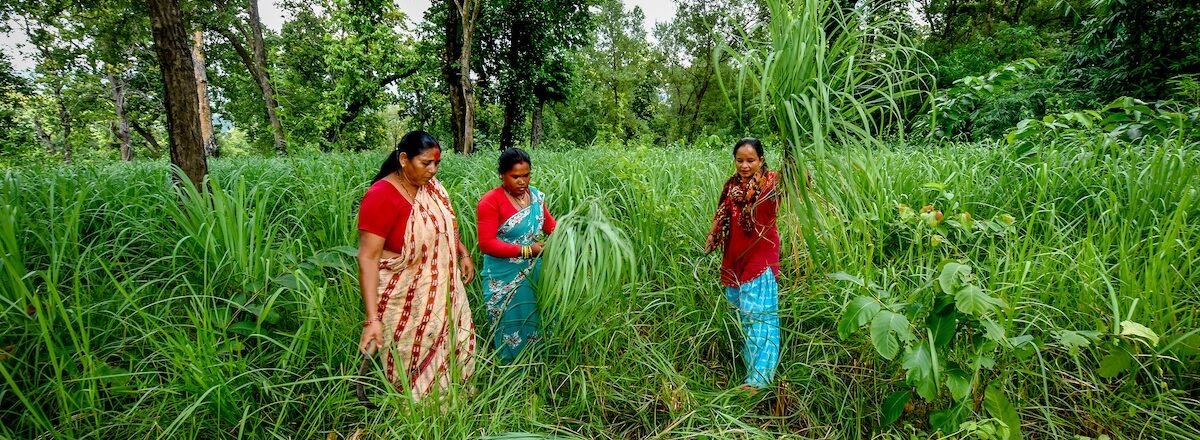
Photo by Chandra Shekhar Karki/CIFOR (CC BY-NC-ND 2.0)
This session explored global efforts in SDG 5.a.2 data and data collection process, initiated by FAO, to assess women’s land rights frameworks which links legal, policy and statistical data. Discussions highlighted how this process fostered broad stakeholder ownership and aided alignment with international instruments. Land Portal underscored the importance of data availability for policy gain, while ILC championed citizen-generated data. Participants learned how comprehensive data including 5.a.2 fuelled evidence-based reforms, as demonstrated in Guinea, where national capacities and embedded multi-actor platforms were crucial. Challenges faced by Land@Scale RVO projects (e.g., Burundi, Chad) regarding government data access and the underutilization of project data were also discussed. The session concluded by showcasing how data collected and disseminated by the FAO, Land Portal, KIT Institute & RVO, supports equitable land governance and scales knowledge to inform national and global debates.
Key Takeaways
- Reliable, disaggregated data serves as the bedrock and critical catalyst for understanding disparities, monitoring progress, raising awareness, influencing policy, establishing baselines, and identifying gaps in women’s land rights.
- Its full potential is unlocked when integrated into inclusive, multi-stakeholder processes that foster dialogue, build shared understanding, and translate legal provisions into tangible, equitable outcomes.
- This complex journey is steadily leading to significant global advancements, marked by a growing demand for data, particularly SDG 5.a.2 data, and technical support in its collection and use from diverse stakeholders, including governments and other data users. FAO’s global reporting further emphasizes this trend, identifying the SDG 5.a.2 process as a critical, recurring multi-stakeholder exercise that fosters shared understanding and dialogue.
- Data availability, even if imperfect or incomplete, is crucial for driving progress and revealing critical insight, as transparency itself fosters improvement and leads to unexpected uses.
- This aligns with Burundi’s underscore of the continuous need for up-to-date, disaggregated data to fuel constructive debates and action, despite challenges like missing baselines. Chad’s experience further exemplifies this, showing how existing population data directly influenced political engagement, and FAO and Oxfam data spurred the “Land at Scale” project, demonstrating the tangible impact of making data accessible.
Presentation
Monitoring and reporting women’s land rights in the law through SDG indicator 5.a.2
Muriel Veldman, Senior Gender and Land Specialist at the FAO (Rome)
“Data is not merely a quantitative output but a fundamental tool for dialogue, empowerment, and tangible progress in securing land tenure rights for women and other groups in a position of vulnerability. Even when navigating initial imperfections and ongoing challenges, generating a shared understanding of the data creates the conditions for change.”
Global SDG 5.a.2 reporting on women’s land rights has grown significantly, from 15 countries in 2019 to 91 by July 2025, demonstrating substantial global advancement. While two-thirds of countries fall short on legal protections, results are national-context specific and all, even those with strong laws, face implementation challenges, highlighting SDG 5.a.2 as a crucial entry point for reforms to ensure tangible results.
Despite data gaps, clear regional patterns are discernible, emphasizing the need to understand effective reform types for specific contexts. Key structural barriers persist in marital property, inheritance, fund allocation, customary law, and participation in land governance.
The SDG 5.a.2 monitoring and reporting process itself is critical: a recurring, multi-stakeholder approach to data collection and analysis undertaken every four years or during legal or policy reforms, it involves diverse Technical Working Groups (NSOs, ministries, civil society, traditional leaders, private sector) leveraging existing platforms. It fosters shared understanding of legal strengths/weaknesses against international and regional standards and instruments, fuels national/regional women’s land rights dialogues, and ensures advocacy is grounded in legal data, as well as governance and citizen insights (e.g., Mozambique and Guinea). Requests for policy contributions from especially sub-Saharan African countries and CEDAW shadow reporting indicate high demand. Knowledge dissemination occurs through various reports (e.g., 2025 SOFA and State of Land Tenure and Governance Report).
Future priorities include improving data coverage, tracking progress in legal reforms, deepening understanding of country/regional drivers, strengthening implementation through enhanced capacity and collaborative efforts, and refining methodologies. This involves shifting to nuanced interpretations, with a refined reporting tool expanding collective tenure and excluding statistics in lieu of affirmative action.
Presentation 2
Open by Default, Useful by Design: Embracing Imperfect Land Data for Transparency and Impact
Charl-Thom H. Bayer, Team Lead, Land Portal Foundation
At the Land Portal Foundation, we believe that publishing imperfect land data is better than waiting for perfect data. Our work is grounded in an ecosystem approach that complements existing efforts and prioritizes openness, usefulness, and impact. Through three key initiatives, namely the Land Projects Database, SDG Land Tracker, and the State of Land Information (SOLI), we aim to make land data more discoverable, interoperable, and usable.
The SOLIndex dashboard visualizes data openness across five categories of land governance, while SOLI Country Reports provide in-depth national analyses. The SOLIndex is not just about ranking or scoring countries, but about using data as a diagnostic tool to spark conversations, drive policy, and encourage better practices in data openness and land governance. The Open Up Guide for Land Governance supports governments in publishing better-quality land data, despite limitations. We consistently encounter reluctance to publish incomplete or unvalidated data. Yet, we emphasize that transparency, even with gaps, can drive improvement and lead to unexpected uses, such as EUDR compliance or digital land data readiness assessments.
Additionally, many South-South development cooperation efforts are underrepresented in global datasets such as the Land Projects Database. This forces us to recognize that using and publishing data exposes gaps, which is a good thing. When countries hesitate to publish data because it’s incomplete or unvalidated, we emphasize that publication itself can drive improvement. Describing data transparently allows users to evaluate its relevance, identify flaws, and contribute to a virtuous cycle of data quality enhancement.
We are working with partners like Transparency International to analyze links between openness and anti-corruption indices and explore how technical capacity in stronger sectors can be leveraged for land data governance improvements. Ultimately, open data is not an end in itself, but a starting point for reform, accountability, and innovation.
Presentation 3
Citizen-generated data on land tenure and governance
Alain Christian Essimi Biloa, Land Governance Specialist at the International Land Coalition (Rome)
“With the data generated, our members and platforms develop outputs such as analytical or thematic Reports, SDG Shadow Reports and country profiles that are used to inform national, regional and global governance processes and guide policy reforms and implementation, providing evidence-based insights. n Cameroon, for example, ILC members held a 2024 national consultation on women’s land rights. They subsequently developed a Shadow Report that pinpointed gaps in the legal framework for SDG 5.a.2 and offered concrete recommendations to enhance women’s access to justice.”
Through its data portfolio, the International Land Coalition (ILC) works with a diversity of sources and methods to generate and use data that makes people and their communities visible, providing valuable inputs into decision-making and accountability processes. With its members, ILC has also championed citizen-generated data, including citizen-led assessments of SDG 5.a.2. Working in partnership with governments and other stakeholders, ILC members can directly contribute with their own knowledge, experiences and data to more responsive policies, especially those addressing the land rights of women.
Presentation 4
SDG 5.a.2 in Agrarian Land Reforms: The Guinean Case
Touré Aboubacar Demba, National Expert in Rural Land Affairs at the Ministry of Agriculture and Livestock in Guinea
“Just as international instruments such as the Voluntary Guidelines, African Union Framework and Guidelines on Land Policy, Sustainable Development Goals (SDG 5.a.2) advocate for inclusive and participatory consultations in developing legitimate land policies, it’s equally essential to train and inform local stakeholders beforehand. This empowers them to articulate their concerns more effectively, for it’s impossible to claim a right one doesn’t know exists.”
Guinea’s Agricultural Land Policy (PFA), currently undergoing validation, strongly highlighted the crucial role of SDG 5.a.2 in land reforms during its development. This process included extensive preparatory work (training 150 individuals, leveraging 37 field experiences) and broad, iterative consultations. Notably, 16 of these consultations focused on ensuring secure land access for women and girls. Two phases involved 21 multi-stakeholder and thematic workshops with over 500 participants, benchmarking against African reforms and international standards.
The PFA consolidates existing legal measures (spousal consent, equal inheritance) and introduces new provisions for women’s land rights. Key measures include reducing land security costs, mandatory spousal consent for transfers, strategic inclusion of women in land commissions, allocating 30% of developed perimeters to vulnerable groups (including women), accelerating judicial procedures, and ensuring their representation in conciliation commissions.
While the PFA provides a strong foundation, full details on women’s land rights will be consolidated in a revised Land and Domain Code. This national ownership of international instruments like SDG 5.a.2 enabled contextually relevant proposals, aiming for Guinea to lead in respecting women’s and girls’ land rights. Reliable data collection and stakeholder consultation were essential for this informed policy-making.
Presentation 5
Experiences from the RVO project ‘Land reform based on rapid evolutions and present crisis’ in partnership with Oxfam, FAO and Kadaster International
Mahamat Abdoulaye Malloum, Land Governance Expert at Kadaster International in Chad
In Chad, the link between data and women’s rights emerged in the 1990s with democracy’s advent. Post-1993 and 1996 censuses revealed women comprised over 50% of the population. Recognizing “one person, one vote,” politicians swiftly incorporated women’s issues to secure votes, leading to increasing female representation across all governance levels.
The movement for women’s rights accelerated in the 2000s, driven by a First Lady who championed their cause. Relying on INSEED projections confirming women’s majority status, her leadership spurred their political prominence and the rise of influential NGOs advocating for women. Data from organizations like FAO, Oxfam, and UNICEF fuelled battles with clear impacts, including advancements in education and combating forced marriage and gender-based violence.
Critically, FAO and Oxfam data highlighted that rural women, though over 53% of the active agricultural population, faced very limited land access. This insight prompted Oxfam’s “Land at Scale” project, focusing on women’s land rights. Influential women championed the project, leading to the acquisition of over 10,000 hectares from traditional chiefs for women. These actions challenged the notion that local land tenure systems impede women’s empowerment, with leaders like Sultan Moussa Bezo of Sarh affirming custom’s protective role and commitment to land allocation for women.
Presentation 6
The Burundian case
Rene-Claude Niyonkuru, Doctoral Researcher (Belgium) and President, Association pour la Paix et les Droits de l’Homme (Burundi)
In the case of Burundi, data collection, processing, and dissemination are essential at both the sectoral and national levels. Several issues and challenges of national interest concerning land matters require up-to-date data, disaggregated by sex or other criteria, to fuel both a constructive debate and concrete actions in terms of advocacy or policy change.
However, several challenges persist in this regard. We can identify: (1) a lack of baseline data: the collected data thus fail to concretely and relevantly show evolutions or trends over key periods and times; (2) an overlap of several data sources: sometimes relevant data are lost in an enormous mass of data that is not centralized or transposable, and therefore unusable in the short or long term; (3) low capitalization of existing data within the national data system, especially those collected within the framework of ad hoc projects supported by external actors.
Program: LAND-at-scale.
Originally published on the Land Portal. Creative Commons Attribution 4.0 International.