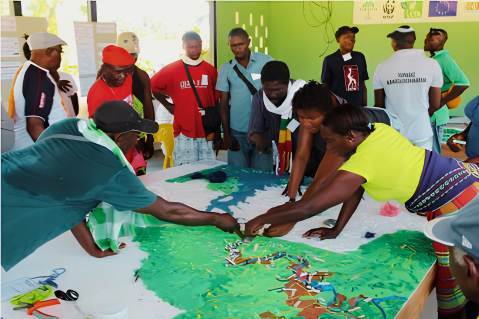
Who Owns the Future We Are Restoring? Women’s Land Rights at UNCCD COP17

At UNCCD COP17 in Ulaanbaatar, where governments, civil society, researchers, and community leaders gathered under the theme “Restoring Land. Restoring Hope,” one side event asked the question that should sit at the center of every land-restoration debate: who is being asked to restore the land, and what rights do they have over the future they are helping to rebuild?

The event, “Secure Tenure Rights: A Stepping-Stone to Build Stronger Food Systems, Resilient Communities and Achieve Climate Goals,” was organized by the Huairou Commission, Oxfam, Women to Kilimanjaro, and Land Rights Now! It brought together women farmers, pastoralist leaders, land-rights advocates, and practitioners from Kenya, Nigeria, Tanzania, Uganda, Burkina Faso, and the wider Sahel. The speakers did not treat women’s land rights as a narrow gender issue. They framed them as a climate issue, a food-systems issue, a governance issue, and a question of dignity.

That framing matters to me personally. I have worked on land issues since 2012, and women’s land rights have been central to my understanding of the field from the beginning. I have spent years helping communicate evidence, build platforms for debate, and support knowledge exchange on land governance. But events like this are a necessary reminder that expertise does not only come from policy papers, legal reviews, or conference rooms. It also comes from women who know what happens when the rain no longer comes on time, when family land is controlled through patriarchal norms, when pastoral routes are blocked, when restoration funding never reaches the groups doing the work, and when the law looks good on paper but remains inaccessible in practice.

The carers of land are not an implementation detail

Pubudini Wickramaratne of Oxfam opened with a deceptively simple question: who cares for the land? Oxfam’s recent briefing note, Who Cares for Carers?, makes the case that climate-induced land degradation falls heavily on women in rural areas, Indigenous Peoples, pastoralists, and smallholder farmers, and that insecure land tenure weakens climate resilience, sustainable land management, and recovery from environmental shocks.

This is more than a moral argument. It is a practical one. If the people closest to the land do not have secure, recognized, and enforceable rights, they are being asked to carry responsibility without authority. They may be expected to plant trees, conserve soil, protect water sources, manage grazing systems, restore degraded fields, maintain food production, and absorb climate shocks. Yet without tenure security, they may lack the confidence, legal standing, finance, and institutional support needed to invest for the long term.

Tenure security is not a side condition for climate action. It is climate infrastructure.

That point came through again and again during the discussion. Land restoration is often measured in hectares restored, trees planted, carbon stored, or funds mobilized. Those measures matter, but they can obscure the central political question: who controls the land after it is restored? If restoration strengthens governments, investors, or elites while the women, pastoralists, Indigenous Peoples, and smallholder farmers who cared for the land remain insecure, then we have not restored hope. We have reorganized inequality.

Grassroots women are already testing the policies others debate

Violet Shivutse of the Huairou Commission and Shibuye Community Health Workers offered one of the clearest examples of why grassroots women must be treated as policy actors, not as “beneficiaries.” Speaking from the experience of western Kenya, she described how many rural women depend on agriculture but struggle to access family land because inheritance and decision-making remain shaped by patriarchal norms.

Her example of land leasing was powerful because it was practical. Leasing is not a substitute for women’s inheritance rights or ownership. It does not solve structural inequality by itself. But in contexts where women are blocked from family land, properly designed lease arrangements can create space for women to farm, restore soil, organize collectively, and strengthen their bargaining power.

Through work with partners, Shibuye helped develop land lease guidelines in Kakamega. According to Violet, more than 1,200 women and youth have used the guidelines, women have formed groups to lease land collectively, and restoration activities have included composting, terracing, agroforestry, water conservation, vegetable production, poultry, fish ponds, and sweet potato cultivation. She also spoke of community learning centers, women serving on land-leasing committees, and community paralegalism as a way to move from temporary access toward a deeper rights agenda.

This is exactly the kind of experience that too often remains invisible in global policy processes. The lesson is not that every country should copy one model. The lesson is that women are already experimenting with ways to make land governance work under difficult conditions. They are building contracts, committees, learning centers, paralegal tools, and soil-restoration practices. They are translating law into usable practice.

A participant from Ghana made a related point: even where land laws are gender responsive, the language of policy can remain too technical for the women whose rights are supposedly protected. Naomi Shadrack, who moderated the event, sharpened that point by asking whether the burden should be on grassroots women to adapt to technical language, or on technical experts to communicate in ways that rights holders can actually use.

That question should unsettle every policy expert in our field. A right that cannot be understood is a right that can be lost.

Pastoralism belongs at the center of the land-restoration agenda

Zainab Arah, speaking from Nigeria and the Kilimanjaro Women’s Initiative, made a crucial intervention on pastoralism. She reminded the room that for a pastoral woman, land is not simply property. It is livelihood, food system, grazing area, water source, children’s future, and community survival.

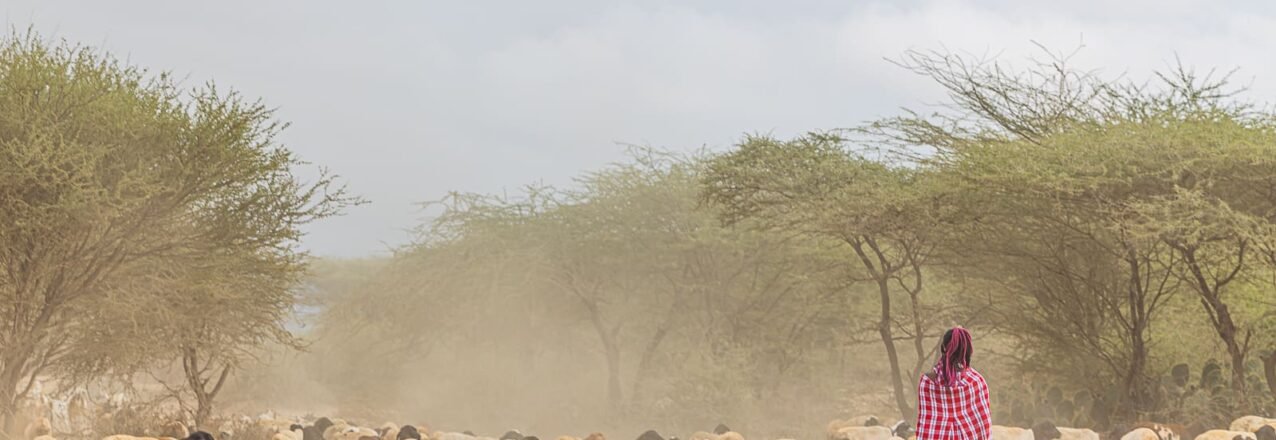
Her most important point was about mobility. Too often, public debate asks whether pastoralism contributes to land degradation. Zainab asked a better question: what happens when pastoralists lose access to the grazing routes, water points, and mobility systems that have historically allowed them to manage variable ecosystems?

That question changes the policy frame. It moves us away from blaming pastoralists for degradation and toward examining the pressures that undermine sustainable pastoral systems: land conversion, blocked routes, insecurity, conflict, shrinking water access, and policies that fail to recognize mobility as a legitimate and adaptive land-use strategy.

Soudata, speaking from Burkina Faso and the Sahel Land Rights Now campaign, deepened this analysis. She described insecurity in rural areas, reduced access to grazing land and water points, pressure from urbanization and land-use conversion, recurring conflict between farmers and pastoralists, and increasingly severe climate impacts. Her recommendations were direct: reform pastoralist law, secure pastoralist land rights, protect freedom of movement, harmonize pastoralist and rural land laws, strengthen conflict-resolution mechanisms, and recognize pastoralists as solution providers rather than passive recipients of development.

That last point deserves to be repeated. Pastoralists are not merely “vulnerable groups” in need of assistance. They are rights holders, knowledge holders, livestock producers, ecosystem managers, and political actors. Their mobility is not backwardness. In many dryland contexts, it is resilience.

Climate action cannot be built on borrowed land

Eva Mageni Daudi of the Kilimanjaro Women’s Initiative in Tanzania brought the climate crisis into daily life. She asked the audience to see rural climate change through the eyes of a woman farmer: waking before sunrise, looking for clouds, wondering whether the seeds already planted will survive, facing delayed rains, sudden floods, soil erosion, drying water sources, longer walks for fuelwood, and failed crops that force women to reduce their own meals so their children can eat.

Her message was clear: without secure land rights, women are asked to adapt while standing on unstable ground. Why invest in trees, water harvesting, soil conservation, or long-term restoration if the land may be taken away tomorrow? Why build climate resilience on land one does not control?

Eva’s call to action was concrete: fix laws and policies so women can inherit and own land safely; make paperwork simpler and less costly; and send climate finance directly to local groups doing the work. Her words echoed a wider evidence base. FAO has reported that women have less secure tenure over land and less access to credit and training, and that men have greater ownership or secure tenure rights over agricultural land than women in 40 of 46 countries reporting on SDG Indicator 5.a.1.

This is why women’s land rights cannot be treated as a social safeguard added to climate programming after the main decisions have been made. They are part of the main decision.

Power decides whether restoration is just

Hood Lubuwa of Oxfam in Uganda asked another question that stayed with me: who owns the future we are restoring?

His framing cut through a great deal of technical language. Secure tenure is not only about access. It is also about control, ownership, and voice. Women may work the land but lack decision-making power. Youth may participate in restoration but lack authority over land use. Communities may conserve ecosystems for generations, only to be displaced or polluted when an investment corridor arrives.

Hood’s example from Uganda pointed to a larger problem. Land restoration cannot be separated from political economy. Mining, oil and gas, agribusiness, infrastructure, urban expansion, and other investment pressures shape who is displaced, who benefits, and whose environmental stewardship is ignored. A restoration project that counts hectares but ignores power may end up legitimizing the same inequalities that caused degradation in the first place.

This is where land governance becomes unavoidable. The issue is not only whether a community has a document. It is whether institutions are accountable, whether women can speak safely, whether pastoral mobility is recognized, whether customary and collective rights are respected, whether free, prior, and informed consent is meaningful, whether land data is transparent, and whether local knowledge has authority in decision-making.

Technology can help, but it cannot answer those questions alone. Digital mapping, land records, artificial intelligence, and open data all have roles to play. But they must serve rights holders. Otherwise, they risk making dispossession more efficient.

We cannot ignore the political moment

It would be dishonest to reflect on this event without naming the wider context. In many ways, the environment for women’s land rights, pastoralist rights, Indigenous rights, and community-led land governance is getting harder.

Development finance is shrinking. The OECD projected a 9 to 17 percent decline in official development assistance in 2025, following a 9 percent drop in 2024. The dismantling of USAID has been especially consequential. U.S. oversight reporting noted that Secretary of State Marco Rubio announced the cancellation of 5,200 USAID awards—83 percent of USAID programs worldwide—in March 2025. Reuters has since reported on continuing difficulties in the State Department’s takeover of former USAID programs, including staffing shortages, delayed guidance, and IT problems.

For people working on land rights, this is not an abstract institutional story. Funding cuts close civic space in practical ways. They weaken community paralegal programs, women’s rights networks, pastoralist platforms, legal empowerment work, land-data initiatives, participatory mapping, and the slow relationship-building that makes reforms real. The people most affected are rarely those who made the budget decisions.

At the same time, democratic space is under pressure. Freedom House reports that global freedom declined for the 20th consecutive year in 2025, with more countries deteriorating than improving. V-Dem’s 2026 Democracy Report found 92 autocracies and 87 democracies at the end of 2025. This matters for land. Authoritarian and undemocratic governments are less likely to tolerate independent land-rights organizing, dissent over land acquisitions, scrutiny of public land deals, or community resistance to forced displacement.

Women, pastoralists, Indigenous Peoples, and local communities suffer when land governance is captured by centralized power. They suffer when public institutions are hollowed out. They suffer when aid cuts remove support for local organizations. They suffer when civic space closes. And they suffer when climate policy treats them as an implementation labor force rather than as rights holders.

Moving beyond the diagnosis

I appreciated everything that was said in the side event. But appreciation is not enough. The land sector has become very good at naming challenges. We know the phrases: insecure tenure, gender inequality, weak implementation, lack of access to finance, climate vulnerability, customary rights, pastoral mobility, data gaps, political will. The danger is that repeated diagnosis becomes a form of delay.

The speakers at this event were not asking for another round of sympathy. They were pointing to an agenda.

First, land restoration and climate adaptation plans must recognize the people who care for land as rights holders and decision-makers. Women, pastoralists, Indigenous Peoples, smallholder farmers, and youth should not be consulted after priorities are set. They should shape the priorities.

Second, governments and partners need to secure rights in forms that match lived realities. That means women’s inheritance and marital property rights. It means accessible registration and dispute-resolution systems. It means recognition of customary and collective tenure where appropriate. It means pastoral mobility, grazing routes, water points, and commons governance. It means protections against land grabbing and displacement in the name of investment or restoration.

Third, law must become usable. Gender-responsive legal provisions matter, but they are not enough if women cannot understand them, afford the process, safely claim their rights, or find institutions willing to enforce them. Community paralegals, translation of technical language, local learning centers, women’s committees, and trusted intermediaries are not soft activities. They are part of the infrastructure of justice.

Fourth, climate and restoration finance must reach the people doing the work. That requires simpler access rules, direct support for women-led and community-based organizations, grant-based funding where debt would deepen vulnerability, and accountability for whether money reaches rights holders. If local groups can restore land, produce food, conserve water, maintain biodiversity, and manage conflict, they should not be forced to survive on project crumbs.

Fifth, we need to defend civic space as part of land governance. There is no meaningful women’s land-rights agenda without freedom of association, freedom of expression, access to information, independent media, functioning courts, and space for communities to challenge power. Land rights do not flourish where fear governs public life.

The question we should carry forward

COP17’s theme is “Restoring Land. Restoring Hope.” It is the right aspiration. But hope is not restored by declarations alone. Hope is restored when a woman farmer can invest in soil because she knows she will not be pushed off the land tomorrow. Hope is restored when a pastoralist community can move with its herds without being criminalized or blocked from water. Hope is restored when Indigenous Peoples and local communities can say yes or no to decisions affecting their territories. Hope is restored when a grassroots woman is not invited merely to tell her story, but to help design the policy.

Since 2012, I have seen women’s land rights move in and out of political fashion. I have seen strong language adopted and weak implementation follow. I have seen inspiring local practice ignored because it did not fit donor reporting categories. I have also seen women’s groups, pastoralist leaders, Indigenous organizations, and community advocates continue to organize with extraordinary clarity despite underfunding, political pressure, and exclusion.

That is why I came away from this event convinced of something simple: the future of land restoration will be decided less by how often we invoke resilience, and more by whether we are willing to redistribute power.

The women who care for land are not asking to be celebrated and then sidelined. They are asking for rights, recognition, finance, law, mobility, voice, and political seriousness.

They are not waiting for the world to discover the solution. They are already building it.

Pastoralism as Land Stewardship: Lessons from Mongolia’s Silk Road Caravan

This article reflects on my experiences and lessons during the long Silk Road Caravan in Mongolia.

From August 8–15, 2026, I joined the UNCCD-supported Silk Road Caravan in Mongolia, visiting pastoralist communities, rangelands, conservation areas, and research institutions. The 6,000-km journey across Eurasia, launched for IYRP 2026, connected pastoralists, scientists, and policymakers to share solutions for healthy rangelands and resilience to drought.

According to the Government of Mongolia Yearbook 2025, the country has about 3.59 million people and 58.1 million livestock, while approximately 110.9 million hectares are classified as permanent meadows and pastures, illustrating the enormous landscape on which nomadic pastoralism depends.

One of the most memorable experiences was visiting Bulgan soum in Arkhangai Province, where herders demonstrated how seasonal mobility remains central to pastoral life. Families move according to the four seasons, using agreed grazing areas and community arrangements. One pastoralist association we visited manages about 316,000 hectares, with herders organizing grazing, negotiating access between communities, and allowing some areas to rest for up to two years. Their work also connects rangeland protection with value addition, including yak meat, milk, wool, and other products.

In Gobi Province, I experienced a very different landscape, where water scarcity, drought, strong winds, and fragile soils create serious challenges for pastoralists. Yet I was impressed by the ability of herders to adapt their livestock management to the availability of pasture and water. I saw how camels, horses, cattle, sheep, and goats remain central to household economies and culture.

“Camel milk, wool, and other livestock products are not simply commodities; they are part of a knowledge system passed from one generation to another,” says an elderly woman of Gobi.

At Husta National Park, I learned another important lesson: conservation can be strengthened when local communities are recognized as partners and collaborators. The park, covering about 50,000 hectares, is internationally known for the successful reintroduction of Przewalski’s wild horses. At the same time, discussions highlighted the importance of supporting local herders and involving them in conservation and restoration initiatives.

At Ojuii Lake, I saw how pastoralism and biodiversity conservation are closely connected. The lake supports hundreds of migratory bird species, yet drought, changing water levels, and human pressure are affecting the ecosystem. The message was clear: protecting wetlands requires cooperation between pastoralists, conservation actors, and local authorities.

The visit to the Mongolia Rangeland Research Center further strengthened my understanding of the importance of science and Indigenous knowledge. The center documents changes, species, and climate data. The researchers use satellite mapping and field data to monitor degradation, restoration, and pastoralist activities, while also working with nomads on rangeland restoration and Indigenous pasture species.

Perhaps my strongest inspiration was the Champion Herder model, a very competitive award position that recognizes outstanding herder families not only for livestock production, but also for animal health, environmental stewardship, social responsibility, knowledge sharing, and community service.

I return to Karamoja convinced that pastoralism is not simply a way of life; it is a dynamic system of food production, culture, knowledge, and land stewardship. The people who live closest to the land often understand its problems and possibilities better than anyone. Our responsibility is to listen to them, protect their rights, strengthen their knowledge, and invest in their solutions. The restoration of land will not be possible without secure land rights for those who use it.

Guardians of the Living Commons: Why Northeast India Needs a Regional Land Consortium

As delegations convene at the United Nations Convention to Combat Desertification (UNCCD) Conference of the Parties to advance Land Degradation Neutrality (LDN), global policy debates frequently fall into an old trap: treating ecological restoration primarily as a financial or technological challenge. It is not. Land stewardship is fundamentally an issue of tenure security, biocultural governance, and collective rights.

Nowhere is this truth more vivid, more precarious, than in Northeast India

Northeast India’s Tenure Realities Governance & Structural Pressures
Customary & Clan (Community Stewardship) Lands        >60–80% of regional forest landscapes
Constitutional Safeguards     Sixth Schedule, Articles 371A & 371G    
Primary Vulnerability Factors Non-cadastral commons, “Unclassed State Forest” tags
Core Paradigm Shift Monoculture cash crops, top-down LDN targets, infrastructure exemptions (FCAA 2023)

The Blind Spot in Global Land Governance

Northeast India forms a vital ecological bridge between the Eastern Himalayas and the Indo-Burma biodiversity hotspot, acting as one of South Asia’s most critical carbon sinks and hydrological anchors. Unlike mainland India, where state agencies hold centralized statutory control, over 60–80% of the Northeast’s forests are stewarded by indigenous communities through their clans, kinship networks, and village councils.

Under constitutional provisions such as the Sixth Schedule and asymmetric protections like Articles 371A (Nagaland) and 371G (Mizoram), communities hold collective tenure over their ancestral domains. Here, land is not a speculative commodity; it is stewarded through interconnected social, cultural, and ecological systems.

Yet, these living commons face mounting structural pressures:

  • The “Wasteland” Fallacy: Because customary lands lack individual cadastral titles, dynamic cyclical swidden systems (jhum) and Community Conserved Areas (CCAs) are routinely logged in official records as “Unclassed State Forests” or “culturable wastelands.” The mosaic of regenerating fallows, vital for soil regeneration and biodiversity corridors, are misdiagnosed as degraded land, exposing community lands to top-down diversion.
  • Commercial Enclosures: The aggressive promotion of commercial monocultures like oil palm and rubber fragments traditional agroecological mosaics, depleting groundwater tables, eroding regional agrobiodiversity, and accelerating soil loss on steep mountain slopes.
  • Statutory and Infrastructure Pressures: Recent legislative shifts, notably the Forest (Conservation) Amendment Act (FCAA) 2023 with its 100-km strategic border exemption, create pathways for linear infrastructure and extractive projects to bypass traditional consultation, a critical vulnerability for a frontier region sharing over 98% of its borders internationally.
  • Top-Down Climate Interventions: Centralized carbon-offset schemes and target-driven afforestation initiatives frequently bypass customary authorities, replacing rich, biodiverse commons with monoculture timber plantations in the name of climate mitigation.

The Institutional Gap: Why a Regional Consortium like CLANS is Critical?

Traditional village councils and customary institutions have safeguarded these landscapes for generations. Yet, as they confront increasingly complex statutory shifts, industrial agribusiness contracts, and international carbon-accounting regimes, isolated village authorities find themselves at a structural disadvantage. Local communities retain deep legitimacy and customary ecological wisdom, but they frequently lack the geospatial tools, regional policy networks, legal scaffolding, and aggregated voice needed to negotiate with top-down enclosures and assert their rights.

This structural gap underscores why the Consortium of Landscape Alliance for Nature Stewardship (CLANS) has emerged.

Mobilizing Regional Capabilities: The CLANS Charter Intent

Rooted in the Northeast and driven by grassroots practitioners, legal experts, and community organizations, CLANS is designed as an institutional backbone to operationalize community-led landscape stewardship. Drawing upon the collective capabilities of its founding members, the alliance is chartered to fulfil three primary intents:

  • Facilitating Landscape-Scale Planning and Action

By combining indigenous knowledge systems with participatory GIS and landscape planning frameworks, CLANS intends to equip traditional village councils to manage contiguous watersheds, fallow mosaics, and biological corridors across village and clan boundaries.

  • Unlocking Flexible, Long-Term, Untied Finance

Recognizing that international climate and UNCCD funding mechanisms rarely reach informal village councils due to bureaucratic compliance hurdles, CLANS is structured to act as an accredited enabling mechanism. Its charter aims to aggregate and channel patient, untied resources directly into community-driven priorities rather than rigid project cycles.

  • Connecting Indigenous Systems with Global Commitments

CLANS provides a platform to bridge local biocultural practices with national policies and multilateral targets (such as UNCCD LDN and the Global Biodiversity Framework). It aims to amplify customary authority in policy spaces while defending community wellbeing, resilience, and cultural continuity as integral dimensions of nature stewardship.

The Imperative for COP UNCCD 

If the UNCCD’s global targets for Land Degradation Neutrality, drought resilience, and ecological restoration are to move beyond performative commitments, international frameworks must acknowledge a fundamental reality: stewardship succeeds only when local institutions are recognized as primary custodians.

In Northeast India, biodiversity and soil vitality have endured because indigenous communities have actively stewarded these territories for centuries. Supporting regional, member-driven alliances like CLANS is not merely an alternative development model, it is the foundational prerequisite for lasting biocultural resilience across the Eastern Himalayas.

CLANS is emerging as a consortium of local CSOs and Communities, led of young and women leaders from ethnic tribal communities (read indigenous people), with facilitation support of some like-minded stewardship-committed actors. Presently CLANS consists of RNBA, RBA, Kenono Foundation, Lemsachenlok, North East Network,  Grassroots, with facilitative support from Foundation of Ecological Security and anchored by Landstack

RRI at UNCCD COP17: Secure Tenure Rights at the Center of Land Restoration

At UNCCD COP17, taking place in Ulaanbaatar, Mongolia, from August 17 to 28, 2026, the Rights and Resources Initiative (RRI) will champion the message that pastoralists, Mobile Peoples, Indigenous Peoples, Afro-descendant Peoples, and local communities—especially women and youth—are proven leaders of land and resource stewardship whose secure tenure rights are essential to achieving global biodiversity, climate, and land restoration goals. 

As governments, donors, the private sector, and civil society gather in Ulaanbaatar, the timing is especially significant as 2026 marks the International Year of Rangelands and Pastoralists. Governments are also facing increasing pressure to deliver on global climate, biodiversity, and land restoration commitments by 2030. 

Across all themes, RRI’s engagements will: (1) promote land tenure recognition as a moral imperative to achieving global goals; (2) elevate the voices of pastoralists and Mobile Peoples as solution-holders; and (3) advocate land governance as a standing UNCCD agenda item. Through evidence, storytelling, and global media outreach, RRI will ensure that the world’s attention remains on those who protect the planet every day: Earth’s defenders.

UNCCD COP17 Delegation

Our UNCCD COP17 delegation brings together Indigenous Peoples, Afro-descendant Peoples and local community leaders from Africa, Asia, and Latin America who are advancing community-led solutions to land degradation, climate resilience, and sustainable livelihoods.


Our 5 Priorities at UNCCD COP17

Mobility Rights and Secure, Flexible Tenure

Promote secure, flexible tenure for Indigenous, Afro-descendant, local community, and Mobile Peoples as the foundation for global climate, biodiversity, and land restoration targets.

Pastoralists as Solution-holders

Amplify the voices, governance systems, and traditional knowledge of pastoralists in Africa, Asia, and Latin America and position them as climate leaders.

Land Governance

Advocate for the inclusion of land governance as a standing agenda item in UNCCD COP17 proceedings, including a dedicated Afro-descendant desertification agenda.

Women and Youth Leadership

Support the recognition of Indigenous, Afro-descendant, local community, pastoralist, and mobile women and youth as leaders and decision-makers within UNCCD negotiations.

Evidence and Unified Advocacy

Publish new evidence and data demonstrating the value add of secure rights, direct funding, and community leadership for achieving land restoration targets.

Events

Join the Conversation—RRI’s COP17 Side and Mainstage Sessions

11 Aug 2026
8:00 – 10:00 a.m. ET

Webinar—Tenure on the Move: Launching a Legal Toolkit for Pastoral and Mobile Land Tenure Reform

Virtual—on Zoom
17 Aug 2026
8:30 – 10:00 a.m. GMT+8

Moving Rights Forward: Advancing Pastoralist Rights and Customary Tenure Through Legal and Policy Change

Blue Zone, MET-04
19 Aug 2026
9:00 – 10:30 a.m. GMT+8

Improving Governance and Combating Land Degradation through Land Rights Research and the Protection of Herders’ Rights in Development Project Impact Areas

Green Zone, Tsagaadai Hall
19 Aug 2026
10:30 – 12:00 p.m. GMT+8

Rethinking Investment in Rangelands: Advancing Inclusive Green Investments and Pastoralist Rights through IYRP 2026 Campaign

Blue Zone, MET-02: 597
19 Aug 2026
02:00 – 03:00 p.m. GMT+8

Land Restoration and Environmental Racism: Addressing Differentiated Vulnerabilities in Degraded Territories

Blue Zone, Brazilian Pavilion – Area C2
19 Aug 2026
03:00 – 04:30 p.m. GMT+8

From Commons to Climate Action: Pastoralist Policy Priorities for Rangeland Restoration in South & Central Asia

Blue Zone, MET-04
21 Aug 2026
10:30 – 12:00 p.m. GMT+8

Realizing the Right to Food in the Rangelands: Rule of Law Solutions for Land Governance and Resource Conflict Management

Blue Zone, MET-05
22 Aug 2026
10:30 – 12:00 p.m. GMT+8

Investing in Pastoralism: Unlocking Climate Finance, Technology, and Partnerships for African Pastoralist Systems

Blue Zone, MET-03
25 Aug 2026
01:00 – 02:30 p.m. GMT+8

From Local Action to Global Negotiations: Connecting Young Leaders for Sustainable Land Management

Blue Zone
26 Aug 2026
11:30 – 01:00 p.m. GMT+8

Shepherding the Future: Advancing Partnership, Direct Access to Finance in Indigenous Peoples and Pastoral Solutions for Implementation

Blue Zone

At UNCCD COP17, Land Restoration Needs a Chair for Care

As Ulaanbaatar opens two weeks of land negotiations under the banner “Restoring Land. Restoring Hope,” the agenda has room for rangelands, tenure, finance and soil. It still doesn’t have a Place or Agenda for Care.

Every COP comes with its furniture. There are chairs for negotiating blocs, chairs for thematic working groups, pavilions for finance, pavilions for youth, side events for every constituency that has learned to organise itself into the room. UNCCD COP17 opens in Ulaanbaatar this week, the first of 2026’s three Rio Convention COPs. It is hosted by a country where nearly 77 percent of the land is already degraded. And it arrives with an unusually full table: soil health gets its own day for the first time, rangelands and pastoralism have a decision of their own after COP16, and land tenure is finally being named as a negotiating theme rather than a footnote.

What still doesn’t have a chair, in any formal sense, is care, the daily, unglamorous, often unpaid work of tending land, water, forest and herd that keeps every one of those other agenda items from being an abstraction. 

Oxfam’s new briefing, “Who Cares for Carers?”, lands at exactly this moment with exactly this argument: that climate-induced land degradation is not only an ecological crisis but a crisis of care. And that the women, pastoralists, Indigenous Peoples and smallholders doing the restoring with their care, despite with the weakest legal claim to the land they restore. 

It’s time we take that argument further. How conservation actually happens on the ground? Why land administration keeps failing to see it?  And where, care might find ally from an unexpected quarter.  How corporate ethics and disclosure law might offer care an opening onto the agenda?


Care was never missing from the land. It was missing from the record.

Start with a number that land economists don’t like to sit with for too long. Indigenous Peoples and local communities customarily hold and use at least half of the world’s land. Legally, they own about 11 percent of it, while they manage or have tenure over at least 32% of the global land area. Yet their lands overlap with 36% of Key Biodiversity Areas (KBAs) worldwide, they harbor up to 80% of the Earth’s remaining biodiversity and over 91% of these lands remain in good, fair, or largely intact ecological condition

This gap is filled, almost entirely, by care: by customary governance and value systems that function de facto, whether or not any state has bothered to recognise or market incentivise them.

The ICCA Consortium, the global network behind the concept of “territories and areas conserved by Indigenous Peoples and local communities,”.  Now more often called territories of life, it is defined by ICCA through three characteristics: a close, often ancestral, association between a people and a place; effective local governance; and outcomes that are good for nature and good for community wellbeing simultaneously. Notice what isn’t in that definition. Title isn’t in it. A registered deed isn’t in it. What’s in it is a relationship that produces care as its ordinary output.

That’s not a romantic claim; it’s an increasingly well-documented one. Research by CIFOR-ICRAF, the Foundation for Ecological Security and Landstack across forest communities in Odisha and Meghalaya found that community stewardship rests on three measurable attributes: intrinsic ecological knowledge, the agency to act on it, and — named explicitly — an ethic of care. They describe this as arising from an understanding of the relationships between social and ecological well-being. Where that ethic held, forests were measurably healthier. Where climate-finance interventions arrived without recognising it, something quietly perverse happened: villagers who had been managing common forests collectively for generations were turned into day-wage labourers, paid to police land-use restrictions written by someone else. The same research team’s blunt summary of the problem, posted more recently to LinkedIn, is worth keeping close at hand through the rest of this piece: “We are measuring nature, more and more. Yet overlook the stewards, behind the numbers.”

This pattern repeats across continents with almost eerie consistency. In Aboriginal Australia, “Caring for Country” is not a metaphor borrowed by conservationists.  It is a body of practice : cultural, spiritual and ecological in the same breath. Built up, in the words of anthropologist Deborah Bird Rose, over a span of time no other management tradition can match: “the notion of caring for country is quintessentially Aboriginal.” It operates on a reciprocal logic (look after Country and Country looks after you) and a planning horizon, commonly cited as seven generations, that most restoration-finance instruments, built around five-year project cycles, cannot even represent. It now underpins 81 formally recognised Indigenous Protected Areas covering more than 87 million hectares, proof that care-based governance can scale into policy when policy chooses to meet it halfway.

In India, an estimated 100,000 to 150,000 sacred groves, of which barely 13,000 have ever been documented, have been kept intact for centuries not by any forest department but by taboo, custom and reverence for local deities and ancestral spirits. Hunting and logging are prohibited inside them by social sanction, not statute. Most have no formal legal status at all; their protection is a governance system with no line item, no ministry and no cadastral entry, yet it has outlasted plenty of governance systems that had all three.

And rangelands, this COP’s other headline theme, are perhaps the clearest case of all. They cover roughly 54 percent of the Earth’s land surface and support more than 500 million pastoralists, whose entire management logic is relational rather than parcel-based: mobility, reciprocity, seasonal access-sharing, and a deep functional dependence on land nobody in the household necessarily “owns.” It is precisely the kind of land-people relationship that a title deed cannot describe. Also precisely the kind that our argument about  fallow-season users, one of five categories of people routinely invisible to the land record, exist to name. 


Why land administration keeps missing it: the Record problem

If care is this well-documented, why does land governance keep walking past it? Because land administration has, for most of its modern history, been built to answer a narrower question: who can sell this, mortgage it, or be compensated for it. As I have argued in this blog, the land record — the Record of Rights, the cadastral map, the parcel boundary — was never designed to tell you who actually farms a plot, who grazes it in the fallow season, whose upstream stewardship of a forest or watershed makes it farmable at all, who really controls decisions on it, or who is bound to it through memory rather than title. 

This framework names five such invisible groups routinely missing from the record — the working tenant and woman farmer, the fallow-season commons-users, the upstream ecological carers, the local power-holders who actually decide outcomes, and communities connected through sacred or ancestral ties. It further and argues that land governance has evolved through four stages: from Revenue (colonial-era extraction), to Reform (rights redistribution), to Record (digitisation and formalisation), and that the imperative frontier ahead is Relation. Recognising land governance as a matter of people and their connections to land is more important, not just documents about it.

However, most land administration investment today is still firmly parked at the Record stage, and digitisation is often mistaken for progress. Precisely because it measures and shows which we are made to believe as progress: more parcels mapped, more titles issued, more records searchable on a phone. But digitising an incomplete or biased record does not fix its bias — it hardens it and moves it faster. 

A recent study of Maharashtra’s tribal Talasari block found that colonial-era cadastral categories, never designed to capture hamlets that expanded organically across forest-adjacent land. Now they being carried wholesale into digital systems, reproducing old exclusions with new institutional force and no correction mechanism built in. 

The bias isn’t only about which land gets recorded — it’s about whose hands hold the tools. Research on land administration technology has found the cadastral profession itself remains heavily skewed toward men in the Global North: women make up roughly 15 percent of surveyors in the UK and just 4 percent in Australia, and the resulting systems, designed by a narrow demographic for a much broader one, are anything but gender-neutral in what they choose to see.

None of this is an argument against digitisation, tenure formalisation, or the survey-and-title machinery that genuinely does protect people against dispossession. It’s an argument that “tenure security” measured only in hectares mapped, records digitised and titles issued is measuring outputs, not the outcome anyone actually wants — which is people, and the land they depend on, being cared for rather than merely counted.


An unlikely ally: corporate ethics traditions that already speak the language of care

Here is where the argument takes an unexpected turn.  Long before “ESG” existed as an acronym, several living ethical traditions in Indian business culture were already organising commerce around exactly the relationship, land governance is now trying to recover: the idea that what you hold, you hold in trust, not outright.

Gandhian Trusteeship is the clearest example. Built on the principles of Aparigraha (non-possession), Ahimsa (non-violence) and Swaraj (self-restraint), trusteeship holds that surplus wealth is never truly owned by the person who accumulates it.  It is held on behalf of society, to be used for common welfare rather than private accumulation. The Tata Group is the most cited modern application of the principle, but its logic maps almost exactly onto customary land tenure: a resource that is managed, not merely possessed; a holder who is accountable to a community rather than free to extract without limit.

Shubh Labh, literally “auspicious gain”, makes a related claim from a different direction. In the swastika symbol still painted above the ledgers of countless Indian businesses at Diwali, Shubh (the ethical means) sits deliberately beside Labh (the gain), a visual reminder that profit was never meant to be separable from the ethics of how it was earned. Even the classical prescription for dividing income, a portion for dharma-oriented deeds, a portion for contingency, a portion for the business, a portion for livelihood, a portion for family and community, reads today like an indigenous precursor to ring-fenced ESG spending, arrived at centuries before the term existed.

Jain business ethics complete the triangle. Aparigraha here means active limitation of acquisition and possession, not just restraint; Ahimsa extends non-violence to ecological harm, not only to living beings directly; and Anekantavada, the doctrine of many-sidedness. In effect, this is a philosophical argument for taking multiple stakeholders’ truths seriously rather than assuming the titled owner’s account of a landscape is the only one that matters. Contemporary scholarship on Jain-influenced businesses points to exactly the behaviours land governance is trying to encourage elsewhere: resource efficiency, minimal extraction, and giving that is structural rather than discretionary.

What unites all three traditions is the same move the ICCA Consortium, Landstack’s five invisible stakeholders, and “Caring for Country” all make in their own vocabularies: land, wealth and nature are relational before they are transactional. Someone is always a trustee, never simply an owner.


From ethics to enforceable disclosure: BRSR and CSDDD offering the chair for care?

The interesting question is whether these older ethical vocabularies can find their way into the newer disclosure regimes now shaping how capital treats land and the people on it.

India’s Business Responsibility and Sustainability Reporting (BRSR), mandated by SEBI for the country’s 1,000 largest listed companies, is built on nine principles drawn from the National Guidelines on Responsible Business Conduct. Several map directly onto the care agenda: Principle 4 requires businesses to be responsive to all stakeholders, not only shareholders; Principle 5 requires respect for human rights; Principle 6 requires effort to protect and restore the environment. The 2026 revision goes further, adding leadership indicators on green credits generated across a company’s top ten value-chain partners, a small but important intent that asks companies to account for what happens beyond their own fence line.

The EU’s Corporate Sustainability Due Diligence Directive (CSDDD) applies a version of the same logic globally.  Large companies, an estimated 5,500 even outside the EU, must now identify, prevent and account for adverse human rights and environmental impacts across their value chains, not just their own operations. 

For land-dependent sectors, that is a meaningful widening of the aperture. But Indigenous rights organisations have been quick to point out the gaps: the directive’s obligations attach to a company’s “established business relationships,” which tends to exempt the small and mid-sized actors, traders, local contractors, land brokers, who are most often responsible for the land grabbing and displacement that these frameworks are meant to prevent. It still lacks a dedicated reference to Indigenous Peoples’ rights instruments, a gap civil society groups have flagged for correction at the first review.

That is the honest state of things. BRSR and CSDDD are the closest instruments global capital currently has to a chair for care.  But they are still, structurally, ledgers of harm avoided rather than registers of stewardship invested in. A company can pass every disclosure test by proving it hasn’t visibly violated anyone’s rights, while never once asking whether the community whose land it touches is a steward worth strengthening rather than a risk worth managing. 

Landstack’s own call to companies captures the distance still to travel. Report honestly what your operations degrade, not only what you protect and recognise women, Adivasi, forest-dependent and pastoral communities not as beneficiaries of sustainability programmes but as the reason many ecosystems still function at all.


What a chair for care could actually mean at COP17

None of this requires inventing a new concept. It requires giving an existing, well-evidenced one a formal seat at four tables that already exist:

  • In the negotiating text, land tenure decisions should be explicitly linked to indicators of community stewardship capacity — who is stewarding a landscape and how well, not only how many hectares have changed legal status.
  • In restoration finance — the STELARR rangeland fund, the EU’s Thrivelands initiative, Great Green Wall financing, the Business4Land forum, money should be designed to strengthen the community arrangements already producing care, rather than to convert stewards into wage-earning monitors of rules written elsewhere.
  • In land administration reform, digitisation programmes should be built around mapping five invisible stakeholders alongside the titled owner, not around the titled owner alone. Consciously moving deliberately from the Record stage to the Relation stage is imperative, rather than assuming one leads automatically to the other.
  • In corporate disclosure, BRSR, CSDDD and whatever follows them should evolve to ask companies not just what they haven’t harmed, but whose stewardship they have strengthened, influenced or displaced. Important to recover, in modern regulatory language, the trusteeship logic that Gandhian, Shubh Labh and Jain business ethics had already articulated a century or more ago.

A conference themed “Restoring Land, Restoring Hope” cannot restore land by counting it more precisely. The land was never short of people caring for it : sacred groves, country, forest commons and rangelands prove that, continent after continent. What has been short, consistently, is a governance architecture willing to see that care, name it, fund it and protect the people doing it. Ulaanbaatar has two weeks and a full agenda. It’s worth finding room for one more chair.


Further reading and sources

Who Will Restore the Land? Women’s Land Rights in Karamoja

This blog was developed in collaboration with Hannah Longole of the Ateker Cultural Center and Stella Akol Lokeris, Stand for Her Land Uganda Coalition in advance of the UNCCD Conference of Parties 17.

Pastoralist women in Karamoja are running out of land and running out of time. The answer to the land crisis is already in the community. But women need rights to take effective action.

“We shall shift and go to another area.”

For generations, movement has been the answer in Karamoja, Uganda: when the rains failed, when the soil dried and cracked, when the grasses withered and the livestock grew thin. Pastoralist communities are mobile by design – their way of life is an adaptation to the land’s rhythms. But those rhythms are breaking down.

The dry seasons stretch longer. The single short wet season from May to July brings less and less rain. The stronger winds follow accompanied with high temperatures which fail crops.

“Now rainfall comes after the crops have already failed because of the heat,” says Nate Betty from Ngoleriet Sub County, Napak District.

And the places people can go to find fertile land are shrinking due to both climate change and a rush to convert customary grazing lands. Powerful elites and land speculators are claiming communal rangeland for mineral extraction and private use. The customary lands are not protected by law; the law, in fact, encourages their conversion from customary to freehold.

As Dr. Mark Ilukol, a local veterinary doctor and researcher, warns: “The areas to shift to when the dry conditions bite hard have diminished – the grazing land is gone.”

When men follow the cattle to distant pastures, women are left behind. Farming – the alternative when herding becomes impossible – is barely viable on increasingly exhausted, degraded soil. Women are often pushed off the land entirely. Without legal rights to the family’s land, a woman’s home, her fields, and her livelihood depends on the goodwill of her husband’s family. When that goodwill runs out, she has nothing.

In this environment, hunger in Karamoja is not exceptional. It is the season. The staple crop is sorghum, but heat and drought cause it to fail. Women gather wild bush fruits to feed their children. Both women and children skip meals. According to national data, 62.9 percent of households in Karamoja are food insecure as a result of climate-related challenges.

“There is a lot of hunger due to high temperatures, which dry up crops in gardens even before flowering,” says Achia Lucy from Nadunget Sub-county, Moroto District.

This is one story from Karamoja, Uganda. It is also the story of millions of women across the drylands of Africa, Asia, and Latin America – women who are simultaneously the most affected by land degradation and the most capable of reversing it. She is the user of the land. Her rights must be enforced to steward it, protect it, restore it.

The Answer Is Already Here

Ask any pastoralist woman in Karamoja what the land needs and she will tell you. She has watched the soil for decades. She knows which grasses hold it together. She knows where the water used to pool. She knows what the land looked like before, and she can imagine what it could look like again.

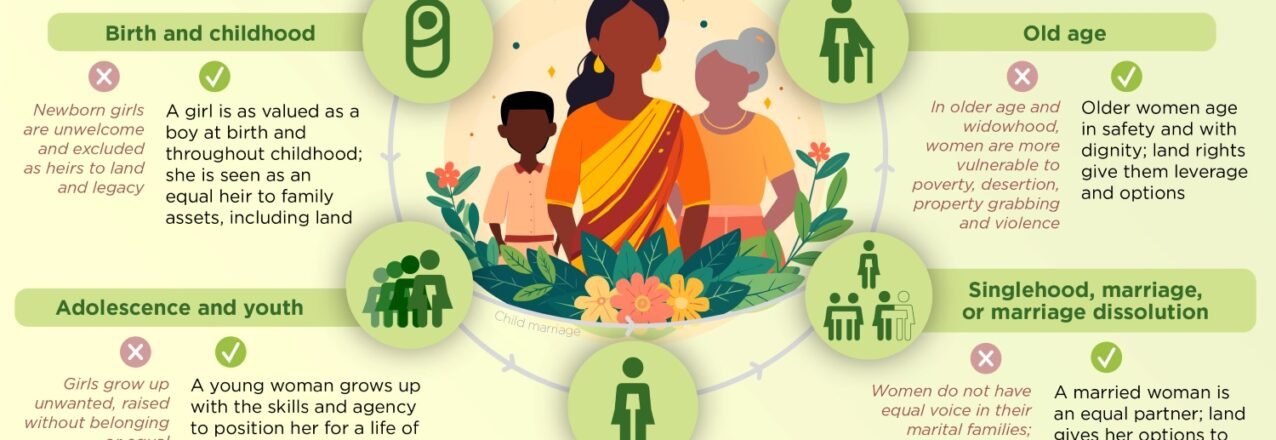
Research and field evidence consistently confirm what these women already know: when women have secure rights to land, they invest in it. They plant trees. They protect soil. They adopt sustainable practices and pass them to their daughters. They can more effectively adapt to drought and other climate change impacts. Women’s land tenure security is central in the fight against land degradation.

The United Nations Convention to Combat Desertification (UNCCD) recognizes this. Its core target, land degradation neutrality (LDN), cannot be achieved without women’s meaningful participation in land governance. The UNCCD’s own Gender Action Plan (2022–2030) calls for integrating women’s land rights into national land restoration strategies.

The framework exists. The evidence is clear. What is missing is implementation.

Three Things That Must Change

Hannah Longole and Stella Akol Lokeris, leaders from the Stand for Her Land Uganda Coalition, have spent years working in Karamoja, advocating for the rights of women pastoralists, connecting the realities of the land to the decisions of governments. They are clear about what needs to happen.

First, awareness. Community sensitization, including dialogue with elders and traditional leaders, is essential to shift the norms that keep women off land and out of decision-making. We need to work on the mindset and change behavior in communities. Women cannot effectively steward land they are not allowed to own.

Second, policy that reaches the ground. Uganda has laws protecting women’s land rights. In Karamoja, and in communities across the Global South, those laws remain paper promises. Strong national policies must be translated into local practice through sustained advocacy, monitoring, and accountability. The law should say women and girls have a right to inherit and own family land and that a woman has a right to pass that inheritance to both her daughter and her son.

Third, technical support and learning spaces. Women need demonstration sites and learning centers where they can train in land restoration practices — and train each other. A place of their own, where knowledge grows collectively and skills are passed on. An example of this can be seen from the remarks of Vice President Jessica Alupo at the launch of the African Pastoralist Women Network (ARPWN ) and Learning Centre which advance gender justice, climate resilience and equitable land governance.

What Is Possible: A Story of Land Restored

Proof of what women can achieve when given the rights and resources exists close to home. Kaynela Farms, established by Ms. Peace Kayesu in Uganda, began as a family farm and has grown over ten years into a model of sustainable and organic agriculture.

Using crop rotation, companion planting, and a closed-loop system that converts livestock manure into biogas and fertilizer, Peace has transformed her land into a space that produces high-quality food, supports ecotourism, and keeps alive pastoralist culture and traditional foodways. It is what becomes possible when a woman has the right to stay on the land, invest in it, and build from it.

Climate Change, Land Restoration, and Gender Equality Are One Fight

Climate change, food insecurity, and gender inequality are connected problems requiring connected solutions. In Karamoja, they arrive together: the drought that dries the pasture is the same force that displaces a woman from her home when her husband leaves and does not return. The degraded soil that cannot grow crops is the same soil a woman could restore, if she had the right to stay on it, the legal protection to invest in it, and the community support to do so.

This is why Stand for Her Land exists: to make the connection visible, and to drive governments and global institutions to address them both together.

Take Action

The women of Karamoja are not waiting to be rescued. They are organizing, advocating, and restoring land – every day, with whatever they have. What they need is the world to match their commitment.

Support grassroots women’s organizations and pastoralist communities doing land restoration work. Advocate for women’s land rights to be included in your country’s land degradation neutrality plans. Demand that global climate and land funding reaches the women who are already doing this work, such as through the Pan-African Women’s Charter for Rangelands and Pastoralists.

Protect communal grazing land through environmental and grazing land practices that promote rangeland conservation. Support the review of legal frameworks on land management, such as the Ugandan Land Act and National Land Policy, to strengthen women’s ownership of land.

Create a mindset change within the communities on women’s land rights and ownership of land to promote land restoration. This mindset change will calm the rigid cultures that prohibit women from owning land.

Because the answer to “Who will restore the land?” is already standing in the field, carrying water, gathering fruit, and waiting for the world to catch up.

Join the Stand for Her Land network using the form below and see S4HL Uganda’s work here.

This blog was originally posted on the Landesa website and is posted here with the permission of Landesa.

Adaptive Governance Begins With Land Realities

At LANDac 2026, the session “Tenure Renegotiation as Adaptive Governance at the Intersection of Climate and Conflict” brought together sharply different examples of how climate change is reshaping land governance.

Chaired by Carolien Jacobs, Assistant Professor at the University of Leiden, the session included Maria Muianga from Terra Firma on community-led tenure responses to climate displacement in Mozambique, Gaynor Paradza from the Public Affairs Research Institute on municipalities and the land dimensions of South Africa’s just transition, and Francesca Marzatico from the University of Otago on land-use change, environmental governance, and Indigenous Peoples in Aotearoa New Zealand.

The discussion was valuable not because the cases were directly comparable, but because they were not. They showed how easily the language of “adaptive governance” can flatten very different realities.

In an advanced economy such as New Zealand, debates over Indigenous rights, conservation, carbon sequestration, and land-use change take place within a relatively strong institutional environment. That does not mean the issues are simple, or that historical injustices have been resolved. But the legal, fiscal, administrative, and political context is fundamentally different from the situation facing many communities in Mozambique or South Africa.

That distinction matters. If we treat all cases of adaptive governance as variations of the same problem, we risk missing the conditions that determine whether adaptation strengthens rights or weakens them.

Mozambique: adaptation as negotiation under pressure

Maria Muianga’s case showed adaptation in its most immediate form. Floods, cyclones, droughts, displacement, and changing wildlife dynamics are altering where people live, how they access land, and how communities relate to conservation areas.

In Nhamatanda, communities near Gorongosa National Park are increasingly facing conflict with elephants. This is not an abstract environmental issue. Elephants damage crops, threaten lives, and change how people move, farm, and plan settlements. Climate change does not only affect rainfall or temperature. It changes relationships between people, land, water, forests, and wildlife.

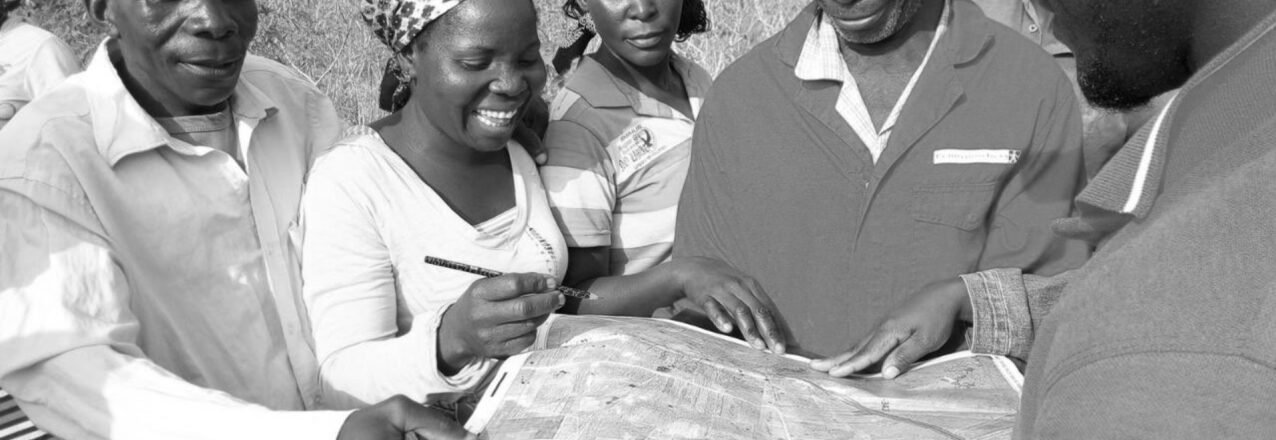
Muianga presented CaVaTeCo as a community-led approach that combines participatory delimitation, community validation, rapid documentation, and territorial planning. What stood out was not only the use of maps, but the way mapping becomes part of local governance. Community members gather information, identify vulnerable areas, map household parcels and water sources, and use that evidence to discuss future settlement and land-use options.

This is the kind of work that deserves more attention. Too often, land governance is treated as if the main challenge is to formalize rights from above. But in many rural areas, people are already negotiating access through local rules, customary institutions, neighbor-to-neighbor arrangements, and social recognition. These systems can be unequal and contested, especially for women, young people, displaced people, and households with weaker social standing. But they are not empty or chaotic spaces waiting for formal systems to arrive.

The Mozambique example also challenges a simplistic view of resettlement. Formal resettlement may be part of the story, but it is not always how people actually access land. Communities may rely on local leaders, household arrangements, borrowing, purchase, donation, or negotiated access. If climate adaptation ignores these practices, it may undermine the very arrangements that are helping people manage displacement and pressure.

The point is not to romanticize customary systems. The point is to understand them before intervening.

South Africa: the just transition is also a land transition

Gaynor Paradza’s presentation brought another essential dimension into focus: the just transition cannot be understood only as an energy issue.

Renewable energy infrastructure, transmission corridors, mining transitions, carbon projects, conservation offsets, and new investment zones all require land. Each one raises practical questions: whose land is being used, whose rights are recognized, who is consulted, who benefits, and who carries the risks?

In South Africa, these questions are inseparable from the country’s history of dispossession and spatial inequality. Land is not just a planning resource. It is a site of unresolved justice.

Paradza emphasized the role of municipalities because they are often closest to communities and responsible for spatial planning, land-use management, infrastructure, and local development. Yet municipalities may not control much of the land in their jurisdictions. They may also lack integrated land information systems, staff capacity, financing, or clear authority to manage competing claims.

This creates a dangerous gap. Municipalities are expected to respond to climate change and help facilitate transition investments, but they may not have the tools to protect people whose rights are legitimate but undocumented or poorly recorded.

A just transition that ignores tenure insecurity is not just incomplete. It risks becoming unjust in practice. If land is treated as “available” because people do not hold registered title, the transition can reproduce historical exclusion under the banner of climate action.

That is why public participation, consent, and recognition of unregistered rights cannot be treated as administrative steps at the end of a planning process. They must shape the process from the beginning.

New Zealand: useful lessons, limited transferability

Francesca Marzatico’s case raised important questions about how law, environmental policy, carbon incentives, conservation tools, and land-use decisions interact over time. That kind of analysis is useful. It reminds us that climate and conservation policies can produce unintended land-use outcomes, even in countries with stronger administrative systems.

But the comparison has limits.

New Zealand’s experience with Indigenous rights, Treaty processes, land-use regulation, and environmental governance may offer insights into how legal frameworks shape landscapes. It should not, however, be treated as a model that can be applied directly to communities facing climate displacement, poverty, weak services, limited legal access, or immediate livelihood insecurity.

This was the central tension I took from the discussion. In New Zealand, the question may be how to align environmental incentives, legal obligations, and Indigenous rights within a relatively well-resourced system. In Mozambique, communities may be deciding whether to preserve trees for a future carbon benefit or cut them now for fuel, food, income, or shelter. In South Africa, municipalities may be asked to plan a just transition while still grappling with apartheid-era land inequality and fragmented authority.

Those are different problems. They require different forms of governance.

The lesson from New Zealand is not irrelevant. It is simply not sufficient. It can help us ask better questions about law, incentives, evidence, and accountability. But it should not become a template for places where the social contract, institutional capacity, and everyday risks are profoundly different.

Context is not a footnote

The most useful conclusion from the LANDac session is that climate adaptation will increasingly involve tenure renegotiation. People will move. Land uses will change. Wildlife patterns will shift. Conservation areas will come under pressure. Carbon and renewable energy projects will expand. Local governments will be asked to manage competing claims with limited resources.

The question is whether this renegotiation happens with rights holders or to them.

For TenureSecurity.org, this is where the land governance debate needs to be sharper. We should ask who has rights, who has information, who has authority, who gets heard, who benefits, and who bears the costs. We should be careful with language that sounds progressive but hides unequal power. “Participation” is not the same as consent. “Benefit sharing” is not the same as timely and accessible benefits. “Recognition” is not the same as implementation. “Adaptive governance” is not the same as asking communities to absorb the costs of climate action.

Climate adaptation is rewriting land relations. But it should not write over the people already living with the consequences.

If adaptive governance is to mean anything, it must begin with land realities: the rights people hold, the institutions they trust or contest, the livelihoods they depend on, and the unequal conditions under which they are being asked to adapt.

Indigenous Resistance and Climate Justice in Arunachal Pradesh

Indigenous Resistance Is Not a Footnote to Climate Action. It Is a Form of Governance.

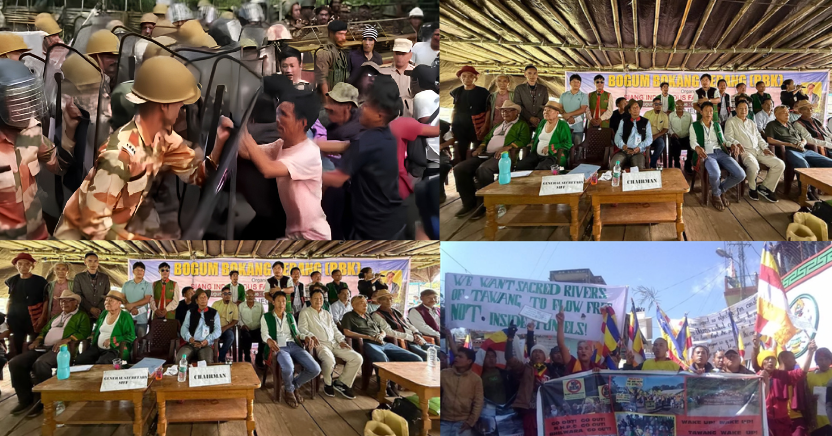
At the LANDac conference in early July, Atribh Deka presented a powerful paper on hydropower, climate risk, and the renegotiation of land rights in Arunachal Pradesh, India. His research focused on three Indigenous and tribal communities—the Adi, Idu Mishmi, and Monpa—and the ways they have resisted large hydropower projects framed by the state as climate action, renewable energy, development, and national security.

The presentation raised a question that reaches far beyond India’s eastern Himalayas: when governments describe large infrastructure projects as necessary for the climate transition, whose land is made available, whose law is recognized, and whose authority counts?

Atribh’s answer is unsettling and important. In Arunachal Pradesh, resistance is not simply opposition to dams. It is a struggle over legal visibility. It is a challenge to the assumption that state law alone defines land, development, legitimacy, and the future of Indigenous territories.

Climate action on contested land

Arunachal Pradesh sits in India’s eastern Himalayas and holds an estimated 40 percent of the country’s hydropower potential. The state has signed more than 160 memoranda of understanding for large dams, with projected capacity of roughly 63,000 megawatts. Yet Arunachal Pradesh’s own electricity demand is far smaller. This imbalance raises serious questions about who benefits from hydropower development and who bears its social, ecological, and territorial costs.

The state’s case for hydropower rests on several overlapping arguments. Dams are presented as renewable energy infrastructure, a contribution to India’s national climate goals, a source of development, and, in a border region with China, an assertion of national security. Each of these arguments carries political weight. Together, they can make opposition appear unreasonable, anti-development, anti-environment, or even anti-national.

This is where Atribh’s analysis is especially valuable. He shows that “green development” is not a neutral category. Climate urgency can become a language through which dispossession is made harder to contest. When hydropower is treated as an unavoidable technical necessity, Indigenous concerns about land, forests, rivers, sacred sites, and customary authority are easily recast as obstacles to progress.

The issue is not whether renewable energy matters. It does. The issue is whether climate action can be considered just when it proceeds by weakening or ignoring the rights of the people whose territories make that action possible.

Law from below

Atribh uses the concept of “law from below” to describe how communities mobilize customary legal orders, collective institutions, spiritual obligations, public refusal, conservation strategies, and litigation to challenge the state’s monopoly over law and territorial governance.

This framing matters. Too often, Indigenous resistance is described as protest, grievance, or reaction. Atribh’s research asks us to see something more precise: communities are not merely resisting state law from the outside. They are asserting their own legal and political authority.

This is not a romantic claim that customary systems are simple, pure, or uncontested. Like all legal systems, they are shaped by power, history, gender, generation, and conflict. But they are legal orders nonetheless. They structure decision-making, allocate responsibilities, define relationships to land and water, and determine what can or cannot be done in a territory.

The state may fail to see these systems, but that does not mean they do not exist.

Three communities, three forms of resistance

Atribh’s presentation examined three cases. Each community used a different strategy. Together, they show that resistance does not take one form.

The Adi, in the Siang Valley, have resisted the proposed Upper Siang Multipurpose Project, an 11,200-megawatt project that Atribh noted would threaten 27 Adi villages. Their resistance has centered on the Kebang, a long-standing system of community governance. The Kebang is not merely a meeting format. It is a legal and political institution through which collective decisions are made and binding obligations are established.

In the Adi case, resistance has included collective resolutions, refusal to negotiate, blocking survey operations, dismantling temporary access routes, and ritual practices connected to the Siang River. These actions are often read externally as protest or disruption. Atribh invites us to read them differently: as forms of legal enforcement grounded in Adi authority, moral obligation, and territorial responsibility.

The Idu Mishmi, in the Dibang Valley, pursued a different path in relation to the Etalin Hydroelectric Project. Rather than relying primarily on direct protest, they drew on customary stewardship and conservation law. In 2022, community clans declared the Elopa-Etugu Eco-Cultural Preserve over 70 square kilometers of ancestral territory. This move connected Indigenous governance with international conservation frameworks, including principles recognized under the Convention on Biological Diversity.

This is a striking example of strategic legal engagement. The Idu Mishmi did not simply say no. They advanced a different vision of conservation: one grounded in customary taboos, ecological knowledge, and community authority. In December 2022, India’s Forest Advisory Committee declined forest clearance for the Etalin project, citing biodiversity concerns and Indigenous representations. This did not permanently settle the larger political question, but it did change the administrative terrain on which the project could proceed.

The Monpa, in the Tawang Valley, mobilized sacred geography and formal legal procedure against the Nyamjang Chhu project. The proposed project threatened landscapes associated with Buddhist pilgrimage, including areas connected to the black-necked crane, revered locally and linked to the 6th Dalai Lama, who was born in Tawang. The Save Mon Region Federation used the Right to Information Act to obtain government documents and expose omissions in environmental assessments. The case then moved through the National Green Tribunal, which suspended environmental clearance in 2016 and criticized the failure to properly assess impacts on the crane and its habitat.

Here again, resistance operated across registers: sacred law, ecological concern, administrative transparency, and formal litigation. The project remains stalled.

Effectiveness is not only victory

One of the most important contributions of Atribh’s research is that it does not measure resistance only by whether a project is permanently stopped.

That is too narrow a test.

Resistance can be effective when it delays destructive decisions. It can be effective when it forces environmental assessments to take Indigenous knowledge seriously. It can be effective when it exposes flawed procedures. It can be effective when it compels officials to justify actions that might otherwise have been imposed without meaningful scrutiny. It can be effective when it creates time for alliances, documentation, public debate, and legal strategy. It can be effective when it changes the terms of what the state must recognize.

In the three cases Atribh presented, Indigenous resistance produced tangible effects. Survey operations were suspended. Forest clearance was denied. Environmental clearance was stayed. The state was required to respond, reassess, explain, and negotiate.

These are not symbolic outcomes. They are governance outcomes.

This matters because communities facing land-based infrastructure often confront impossible standards. If they block a project, they are dismissed as anti-development. If they go to court, they are told they are relying on the same system that marginalizes them. If they use conservation law, they risk entering alliances that have historically excluded Indigenous Peoples from their own territories. If they perform rituals, invoke sacred relationships, or rely on oral legal traditions, their claims may be treated as culture rather than law.

Atribh’s research shows that each of these forms of resistance can matter. Direct action, customary assemblies, ritual authority, conservation designations, transparency laws, administrative complaints, and litigation are not separate from governance. They are ways communities force governance to happen.

The danger of climate language without tenure justice

The climate transition is increasing pressure on land. Hydropower, solar parks, wind corridors, carbon markets, conservation areas, restoration initiatives, and transition mineral supply chains all require territory. Many are justified in the name of urgent global goals. Some may be necessary. But none should be allowed to bypass the rights of Indigenous Peoples, local communities, pastoralists, smallholders, or others whose land and resource rights are insecure or weakly recognized.

Atribh’s presentation makes clear that climate language can become a technology of dispossession when it narrows public debate. If a project is labeled “green,” questions about land, consent, governance, sacred sites, forests, fisheries, livelihoods, and identity are too often pushed aside. The urgency of climate action is then used not to deepen democracy, but to compress it.

That is a mistake.

Climate action that ignores tenure security is not only unjust. It is fragile. Projects imposed without recognition, consent, transparency, and credible safeguards generate conflict, delay, reputational risk, ecological harm, and legal uncertainty. The lesson from Arunachal Pradesh is not that every hydropower project must be rejected. The lesson is that no climate project should proceed by pretending that Indigenous law, authority, and territorial relationships are invisible.

From recognition to negotiation

Atribh’s central insight is that law from below does not necessarily replace state law. Instead, it forces state law to confront what it has excluded. It compels the state to govern through negotiation rather than unilateral authority.

That distinction is crucial.

The demand is not simply for consultation after decisions have already been made. It is not a request for compensation after land has already been categorized as available. It is not a plea for cultural sensitivity at the margins of infrastructure planning. It is a deeper challenge: who has the authority to define land, climate responsibility, development, and the future of a territory?

For TenureSecurity.org, this is exactly the kind of question that must sit at the center of global land governance debates. Land rights are not only about documentation, registration, or administrative reform, although those can matter. They are also about power. They are about whose knowledge shapes decisions, whose institutions are recognized, whose histories are treated as legally relevant, and whose futures are negotiable.

The resistance of Indigenous Peoples is often portrayed as a barrier to development. Atribh’s research suggests the opposite. Resistance can be a diagnostic tool. It shows where governance has failed. It reveals what official procedures have ignored. It exposes the distance between climate rhetoric and territorial justice. And, in many cases, it creates the only meaningful opportunity for better decisions to emerge.

What this research asks of us

Atribh ended with open questions about the durability of procedural wins and the future of customary authority across generations. These questions are important. A stalled project can be revived. An administrative victory can be narrowed. A court ruling can remain unenforced. Customary institutions can be weakened by internal inequality, state co-optation, demographic change, or generational erosion.

But uncertainty should not lead us to underestimate what these communities have already achieved.

The Adi, Idu Mishmi, and Monpa cases show that resistance is not one act, one lawsuit, one blockade, or one declaration. It is a field of practice. It is legal, political, ecological, spiritual, and strategic. It can happen inside the system, outside the system, and across systems at the same time.

That is why it can be effective.

In a world racing to build the infrastructure of the climate transition, this research offers a necessary warning and a constructive path forward. The warning is that climate urgency can become a cover for dispossession. The path forward is that just climate governance must begin with the recognition of Indigenous and customary authority, not as an accommodation granted by the state, but as a structural requirement for legitimate decision-making.

Secure land and resource rights are not an obstacle to climate action. They are one of the conditions that make climate action just, durable, and accountable.

Tilling without Title: Why Millions of Women are Left Out as Farmers

By Shipra Deo, My-Lan Dodd, and Jennifer Brown

We thrive because farmers provide! Farmers nurture the land with love and trust so we can all get our meals.

Of the 1.23 billion people employed in the world’s agri food systems, nearly half are women. While these women work on the soil all their life, they remain invisible and unheard as farmers. And their journey in agriculture is very different from that of men.

For a woman farmer to truly thrive, her relationship with land must be seen across her life – not only during the times she cultivates. From birth through her adolescence and into adulthood and her twilight years, land can be a cornerstone for agency, opportunity, and dignity. A lifecycle approach to women’s land rights ensures that the protections they confer do not appear only at moments of crisis – such as at death or divorce — but accompany women throughout their lives.

But social perceptions, family dynamics, and cultural practices too often place her on a different path, limiting what should rightfully be hers.

A girl born into a farming family

She may have been unwanted in her family, as farming communities in many parts of the world usually prefer a newborn to be a boy rather than a girl. Born unwanted, she grows up amid neglect and indifference.

She helps her mother and the family sow seeds, fetch water, tend goats, or harvest produce. She also takes care of younger siblings as her mother works the farm. Her labor is essential for the household, as is her mother’s, but is rarely recognized as “real farming.”

While she grows up hearing that she will marry and move out of the birth family one day, her brother may grow up hearing that the land on which the family lives and farms will belong to him, not to his sister.

This early message shapes everything that follows. She internalises that she is of lesser value than the men.

A landless worker in adolescence and adulthood

As she enters adolescence, instead of looking forward to managing the family’s land and dreaming big, she prepares to leave her family’s land and house, anxious about what lies ahead. Without the security of assets to build her life on, her future choices narrow. Her education may stop early, and she may be married before she reaches the legal age of marriage, often without her consent or choice.

In her husband’s family, she continues to do labor on the farm, but her work is seen as the extension of household work. The land and farm she sustains still does not belong to her. She is not seen as a farmer and is largely absent from farmer census data or land statistics.

The pattern is the same across regions and cultures: girls and women contribute significantly to agriculture but remain invisible as farmers.

Because of her invisibility as a farmer, she is rarely the subject of or considered in agricultural policies or farm laws. Research in agriculture is not attuned to her needs or contexts. Men’s needs and realities aren’t merely prioritized, they are the default.

Without ownership or secure rights, she faces constant and compounding constraints. She cannot easily access credit, subsidies or insurance, which are all linked to land ownership. She is overlooked for training and extension services. She is unable to make sustainable investments in agriculture – either to control soil erosion or to increase water use efficiency.

She farms every day, but decisions about land and livelihoods are made by others — husbands, fathers, sons or community leaders. She has no security.

She is more vulnerable to violence in the fields and on the way to fields and markets – by landowners or farm managers and in public places. She is also more vulnerable to abuse in her own family – by intimate partners, in-laws, or extended family.

Meanwhile, men are much more likely to have agency over their land and livelihoods, and can move freely through the world.

When marriage, divorce, or widowhood hits

If her marriage ends — through divorce, separation, or abandonment — she may lose access to the very fields she cultivated for years. If widowed, she may face eviction by in-laws or relatives claiming the land or home. In either case, she may struggle to feed her children and to sustain herself.

When she doesn’t have land, old age brings dependence and insecurity. Without assets, she is at the mercy of others for her livelihood and care.

A different future is possible

Now imagine a different story.

A girl in a farming family grows up knowing she will inherit land equally with her brother. She learns farming not just as labor, but as a skill and business, and this knowledge makes her confident in taking decisions.

As an adult, she holds land in her own name, accesses credit, joins cooperatives, and invests confidently in her soil and the opportunities that spring from it.

She takes informed decisions about marriage. She negotiates her space with dignity and confidence.

She doesn’t endure abusive relationships because she has meaningful options. She stands up for herself throughout her adulthood and in old age, her land sustaining her with dignity.

When women have this kind of security and assurance, communities around the world are positioned to fully thrive.

As we mark the International Year of the Women Farmer, it is important to recognise that land rights are the cornerstone of a more stable and peaceful future for women farmers. They are rights and protections that give women a firm, legally recognized foundation that accompanies them throughout their life, allowing them to live a life with strength and dignity. By adopting a lifecycle approach to land rights, we keep this important reality firmly in sight and help millions more women and their families thrive.

Download Land Shapes Her Life [Infographic] Read Land Empowers: Life-cycle approach to girls’ and women’s land rights [Issue Brief]

This blog was originally posted on the Landesa website and is posted here with the permission of Landesa.

Land Governance in a Post-Aid World: Why the Sector Must Stop Waiting to Be Invited

ODI Global’s North Stars for Northern Donors in a Post-Aid World is not a report about land governance. It does not set out a tenure agenda. It does not discuss cadastral reform, customary land, land administration, restitution, land markets, Indigenous territories, women’s land rights, or land conflict in any direct or sustained way.

That is exactly why the land sector should take it seriously.

The report is concerned with a larger question: what becomes of development cooperation when the political, financial, and moral architecture of aid no longer commands the same confidence? ODI describes a “post-aid” world not as the end of aid, but as a sign that the old social contract between Northern governments, taxpayers, and recipient countries has fractured. The opportunity, the report argues, is to think differently about why, how, and over what countries cooperate.

For those of us working on land and resource tenure security, this is more than a debate about donor reform. It is a warning and an opening.

The warning is that land governance cannot depend on the old machinery of donor-funded projects, short funding cycles, and technical assistance alone. The opening is that the next generation of global cooperation will need exactly what good land governance can offer: accountable institutions, legitimate decision-making, secure rights, trusted information, local voice, and ways to manage conflict over resources under pressure.

The land sector should not respond by asking how to preserve its place in yesterday’s aid model. We should ask what public purpose land governance must serve in the world now taking shape.

Land is where global transitions become local realities

The ODI report calls on Northern governments to widen the development cooperation toolbox beyond financial transfers, using diplomacy, technical knowledge, political capital, and regulatory influence to address structural barriers that leave countries exposed to climate vulnerabilities and constrained in their energy, food, and health sovereignty.

Land is not foregrounded in that argument. But it sits underneath it.

Climate adaptation happens on land. Food systems depend on land. Energy transitions require land. Forest protection, biodiversity conservation, mineral extraction, urban expansion, infrastructure, and disaster recovery all involve decisions about land and natural resources. Those decisions determine who is recognized, who is consulted, who is displaced, who benefits, and who can seek remedy when harms occur.

This is why land governance cannot be treated as a quiet technical specialty. It is part of the political infrastructure of transition.

A climate strategy that ignores tenure rights can deepen insecurity. A food-security strategy that overlooks women’s land rights can reproduce inequality. A renewable energy investment that fails to address consent, compensation, and local benefit-sharing can generate conflict. A conservation initiative that treats communities as threats rather than rights holders can undermine both justice and ecological outcomes.

The land sector’s message should be simple: no major transition is credible if the rights, claims, knowledge, and institutions connected to land are treated as afterthoughts.

The end of donorship should push us beyond project logic

One of ODI’s most important propositions is that ending Northern donorship requires more than replacing the word “donor” with “partner.” The report argues that former donors will need a different organizational template and mindset, with greater emphasis on policy change, diplomatic cooperation, knowledge initiatives, and control by others. It also argues that transition planning should begin at project design, with attention to how core functions, institutional responsibilities, resource flows, policy decisions, knowledge exchange, and relationships will be sustained after external support ends.

This should resonate deeply in the land sector.

Land governance work often takes place through projects, but land governance itself is not a project. It is a long-term public function. It involves laws, institutions, social norms, records, dispute-resolution systems, public information, political negotiation, and the everyday ability of people to claim and defend rights.

The sector has produced useful tools, pilots, methodologies, platforms, and reform processes. But we should be honest about the limits of project logic. Too often, success is measured through outputs that are visible within a funding cycle: parcels mapped, certificates issued, meetings held, laws drafted, officials trained, databases launched. These may matter. But they are not the same as durable tenure security.

The harder questions come later. Can records be updated? Can disputes be resolved fairly? Can women use documented rights in practice? Can communities challenge unlawful land allocations? Can public agencies maintain systems without external consultants? Can land information be accessed and understood by those most affected? Can reforms survive a change in government, budget, or political incentive?

A post-aid approach to land governance should begin with these questions, not end with them.

Country leadership must include the people whose rights are at stake

ODI’s fifth “North Star” calls for inclusive country leadership. It states clearly that state institutions are essential and cannot be bypassed, but should not be romanticized. It also argues that local actors closest to problems should have the most influence in defining and implementing solutions.

For land governance, this distinction is fundamental.

“Country-led” cannot mean central-government-led alone. Land is tied to sovereignty, but it is also tied to belonging, inheritance, gender relations, customary authority, livelihoods, housing, identity, and political power. The people most affected by land decisions are often those with the least influence over formal policy processes.

Women may hold rights that are legally recognized but socially constrained. Indigenous Peoples and local communities may govern territories that are mapped as state land. Pastoralists may depend on mobility that fixed-boundary systems fail to recognize. Informal settlement residents may live in places that public authorities describe primarily as problems to be cleared. Displaced people may face housing, land, and property claims that outlast the emergency phase. Smallholders may confront investment decisions negotiated far from the land itself.

The land sector should therefore argue for country leadership that is nationally anchored, locally accountable, and rights-aware.

This means working with public institutions, not around them. But it also means investing in civic space, legal empowerment, community organizations, women’s rights advocates, Indigenous and local knowledge, independent research, public-interest data, and media capable of scrutinizing land decisions.

ODI rightly notes that in fragile and conflict-affected contexts there is little room for romantic assumptions about state benevolence, and that external actors need patience, presence, risk tolerance, flexible support to local actors, and courage to raise civic space in policy dialogue.

That is not a footnote for land governance. It is often the center of the work.

The land sector needs a wider toolbox too

ODI’s call for a wider development cooperation toolbox should prompt a similar shift within our own sector.

Land governance support cannot be limited to land administration, even though land administration remains important. The next phase of land governance work must bring together law, public finance, political economy, open and responsible data, institutional reform, dispute resolution, community capacity, safeguards, and accountability.

That means supporting transparent public land allocation. It means scrutinizing land-based concessions. It means strengthening safeguards for carbon markets, biodiversity finance, mining, infrastructure, and renewable energy. It means ensuring that grievance mechanisms are usable, not merely present. It means protecting land and environmental defenders. It means helping journalists, researchers, and civil society organizations access and interpret land information. It means improving compensation, resettlement, and restitution processes where displacement has occurred. It means placing women’s land rights and collective tenure at the center, not as thematic additions.

It also means being more careful with technology.

Digital land systems, geospatial tools, satellite imagery, and artificial intelligence can improve transparency and efficiency. They can also accelerate exclusion if rights are poorly defined, data governance is weak, or affected people cannot see, question, correct, or use the information that shapes decisions about their land.

Land data is not neutral simply because it is digital. It is part of governance. It should be treated as public-interest infrastructure, with clear rules for accessibility, privacy, accountability, interoperability, and community protection.

Multilateral reform should give land a clearer home without creating another silo

ODI argues that a reformed multilateral development system should be grounded in a shared vision, and that bilateral financing should no longer be the default. The report notes that multilateral institutions can offer reach, scale, and expertise no individual donor can replicate alone, while also questioning whether the UN Development System has a sufficiently clear purpose for the next era.

Land governance has long suffered from a related problem: it is everywhere and nowhere.

It appears in food systems, forests, climate, cities, conflict, gender equality, investment, Indigenous rights, disaster recovery, and biodiversity. It is relevant to FAO, IFAD, UN-Habitat, UNDP, UNEP, human rights mechanisms, climate funds, regional development banks, and the World Bank. Yet because it is spread across so many mandates, it often lacks sustained political priority.

The answer is not necessarily to create another institutional silo. The answer is to make land governance more coherent across the systems that already shape land outcomes.

Multilateral institutions can help where they provide normative guidance, safeguards, technical standards, peer learning, long-term capacity, and public goods. But the value of multilateralism should not be judged by the size of the channel. It should be judged by whether it strengthens legitimate tenure rights, improves accountability, reduces harm, supports local institutions, and makes land-related decisions more transparent and contestable.

We must rebuild the public case for land governance

ODI argues that donors should stop looking for public support for development cooperation and start building it. Development cooperation, the report notes, is often a low-salience issue, vulnerable to political pressure and public misunderstanding. It calls for credible messengers, stronger stories, public education, and people-to-people connections.

The land sector has the same challenge.

We often speak to each other in technical language and then wonder why land governance is missing from broader political debates. We say land rights are foundational, but we do not always show what that means in terms that matter to people outside the sector.

We need a stronger public narrative.

Not a simplistic narrative. Not a donor-branded success story. Not another generic claim that land is “critical.” We need to explain how land governance shapes decisions people can understand: whether a family can stay in its home; whether a farmer can invest in soil and trees; whether a woman can inherit; whether a community can negotiate with an investor; whether a city can upgrade settlements without forced eviction; whether conservation respects rights; whether renewable energy projects build trust or conflict; whether displaced people can return, resettle, or rebuild.

The future of land governance depends not only on better evidence, but on better public meaning.

Governance reform starts with us

ODI’s final and perhaps most important proposition is that Northern donors should commit to governance reform of the development cooperation system. The report argues that more equitable governance is the foundation for a shared, legitimate, and broadly supported post-aid system.

The land sector should apply that challenge to itself.

Who sets the agenda? Who defines evidence? Who controls data? Who receives flexible funding? Who is invited to speak, and who is asked only to validate decisions already made? Which languages dominate? Which forms of local knowledge are taken seriously? Which organizations are treated as strategic actors, and which are treated as implementers?

If we want development cooperation to move beyond donorship, land governance must move beyond consultation as performance.

Rights holders and local institutions should help shape priorities, research questions, risk assessments, data governance, monitoring, and accountability. This is not only an ethical point. It is a practical one. Land reforms that do not reflect lived realities often fail in implementation. Land data that people cannot access or trust will not support accountability. Land investments that ignore power will produce conflict.

What the land sector should say now

The ODI report does not give the land sector an agenda. We should not pretend that it does.

It gives us something more useful: a challenge to define our own agenda in a changing development landscape.

The land sector should respond by saying that tenure security is not a niche concern, a project category, or a technical deliverable. It is part of the governance foundation for climate resilience, food security, gender equality, responsible investment, biodiversity, peace, urban development, and fair economic opportunity.

We should say that future land governance work must be less donor-centered and more durable. Less focused on short-term visibility and more focused on public systems, civic capacity, and rights that can be used in practice. Less comfortable with technical fixes and more honest about power. Less fragmented across sectors and more fluent in the transitions reshaping land and resource use.

And we should say that land governance deserves investment not because it fits neatly into the old aid model, but because it helps answer the defining question of the post-aid era: how can societies make legitimate, accountable, and equitable decisions about the resources on which their futures depend?

That is where the land sector belongs.

Not at the margins of development cooperation, waiting to be included.

At the center of the choices that will determine whether cooperation has public purpose at all.