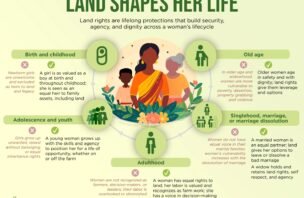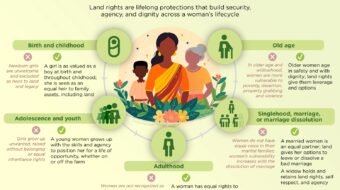


Securing and strengthening women’s land and resource rights is essential to advancing gender equality, reducing poverty, improving food security, and building more resilient communities. Secure rights to access, use, own, inherit, manage, and control land and natural resources can shape household income, livelihoods, opportunity, and wellbeing.
Women play a critical role in food production, natural resource management, household resilience, and local economies. Yet in many countries, they remain less likely than men to own, control, or benefit from land. Legal barriers, discriminatory social norms, unequal inheritance practices, limited access to documentation, and exclusion from decision-making can all weaken women’s tenure security.
According to the Food and Agriculture Organization of the United Nations, if women had the same access to productive resources as men, farm output could increase by 20 to 30 percent. Strengthening women’s land rights is therefore not only a matter of justice and equality. It is also central to food security, economic development, climate resilience, and sustainable land governance.
Why Women’s Land Rights Matter
Ownership and control over assets are central to women’s economic empowerment and their ability to contribute to local, national, and global economies. For many women, land and natural resources are among the most valuable assets they can hold. They provide a foundation for earning a living, feeding families, building resilience, participating in markets, and investing in future generations.
Evidence suggests that strengthening women’s land and resource rights can improve women’s bargaining power and decision-making within households and communities. Secure rights can influence decisions about household expenditures, children’s health and education, agricultural investments, inheritance, and the use and management of natural resources.
Women’s land rights also matter for broader governance and development outcomes. When women are able to claim, document, inherit, use, and benefit from land, communities are better positioned to reduce poverty, improve food security, strengthen social inclusion, and manage natural resources more sustainably.
The goal is to improve women’s access to and control over land and natural resources in ways that expand concrete and inclusive economic, social, and political opportunities.
Strengthening Women’s Land and Resource Rights
Across the land sector, governments, civil society organizations, women’s rights advocates, community leaders, researchers, development partners, and private sector actors are working to address the barriers women face in accessing and controlling land. Effective approaches often combine legal reform, community engagement, documentation, awareness raising, institutional strengthening, and evidence-based advocacy.
Strategies to strengthen women’s land and resource rights include:
- Supporting law and policy reforms that recognize and protect women’s land and resource rights.
- Promoting gender and social inclusion in land documentation, registration, and administration.
- Addressing discriminatory gender and social norms that limit women’s access to land.
- Supporting inclusive land use planning and community decision-making.
- Ensuring women’s needs and priorities are reflected in agricultural value chains and land-based investments.
- Raising awareness of women’s legal rights to own, inherit, use, and control land.
- Strengthening women’s agency, leadership, and participation in land governance.
- Gathering and sharing evidence, best practices, and lessons learned on what works.
Where Working on Women’s Land Rights Is a Top Priority
Women’s land rights are a priority in many countries where tenure insecurity, legal pluralism, discriminatory norms, conflict, climate pressures, or land-based investments affect women’s access to and control over land and natural resources.
Priority countries include:
Colombia, Ethiopia, Ghana, India, Liberia, Mozambique, Tajikistan, Tanzania, Zambia
Explore the evidence and country context
Read the preserved fact sheet on land tenure and women’s empowerment (2016) for its discussion of livelihoods, agricultural productivity and strategies for strengthening rights. The customary and community tenure guide helps explain the institutions within which rights are exercised. Use the linked country profiles with their publication dates to understand the research context.