
Strengthening Women’s Land Rights in Rural Tanzania: Results from an Impact Evaluation of USAID’s Land Tenure Assistance Activity

In rural Tanzania, as in many other low- and middle-income countries, land is a crucial asset that supports livelihoods and enables individuals and households to expand their economic opportunities. Most Tanzanians in rural areas are farmers who obtained their land through long-standing customary norms. However, weak land rights protections and a lack of documented ownership or use rights have long been seen as a source of local disputes, a constraint to how farmers use and invest in their land, and a barrier to household economic growth. A lack of land documentation can limit the participation of women and other vulnerable groups in agribusiness, and women often face higher risk of disenfranchisement of their land rights. How can the development community help?

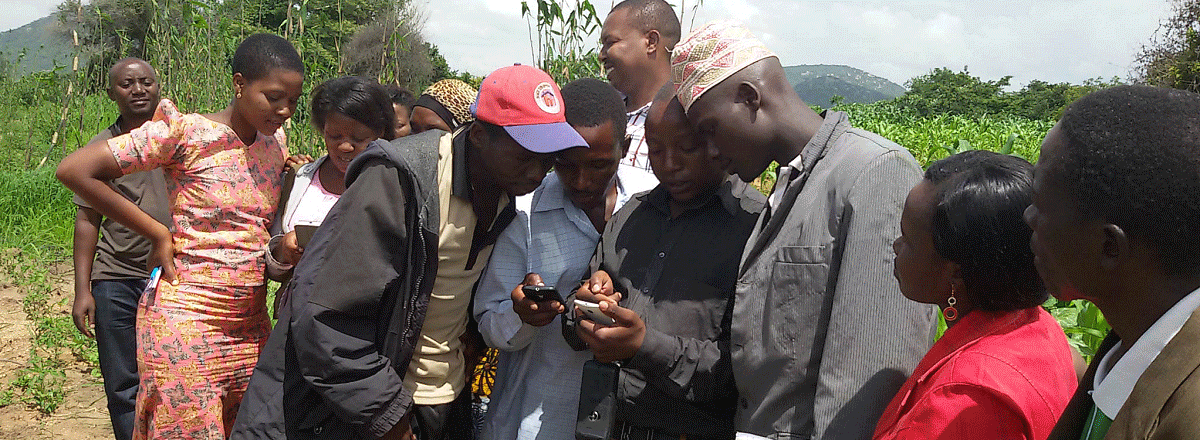
Since 2015, USAID has worked in rural Iringa District, the heart of Tanzania’s southern agricultural region, to strengthen land rights and systematically address the lack of land documentation. Over the past five years, USAID/Tanzania’s Land Tenure Activity (LTA) helped villages and the district land office demarcate more than 70,000 land parcels and register more than 60,000 land certificates (known as CCROs), all using USAID’s digital Mobile Application to Secure Tenure (MAST) technology. LTA represents one of the first times that MAST, which supports mapping and facilitation of the land documentation process using a mobile phone, was implemented on such a large scale.

A key question is whether this innovative approach to create stronger customary land rights has an impact on key development outcomes, such as tenure security (i.e., whether people feel confident no one will take their land or displace them), land disputes, and women’s empowerment. To assess LTA’s impacts on these outcomes, USAID commissioned Management Systems International and NORC at the University of Chicago to design and implement a rigorous impact evaluation. This IE is one of only two USAID land evaluations using a randomized control trial design.

LTA’s Impacts on Land Rights and Tenure Security
The impact evaluation of LTA has helped USAID measure the activity’s effect on land-related outcomes and understand how systematic certification of customary land rights affects smallholder farmers’ tenure security, investment decisions, empowerment, and broader livelihoods. With increasing land pressures and widespread concerns about land grabbing, knowing the impacts of formalized customary use rights is relevant to both farmers and policymakers.

The evaluation collected data via a panel survey of 1,361 households across 30 LTA villages and 30 control villages as part of a ‘gold standard’ randomized control trial design. The first round of data collection took place right before LTA began implementation in 2017. Endline data collection took place in February 2020, around 18 months after most households received their CCROs with LTA’s support. To understand how CCROs affect perceptions of land tenure security, land use, empowerment, and other key outcomes, the evaluation team interviewed the head of household and primary spouse.

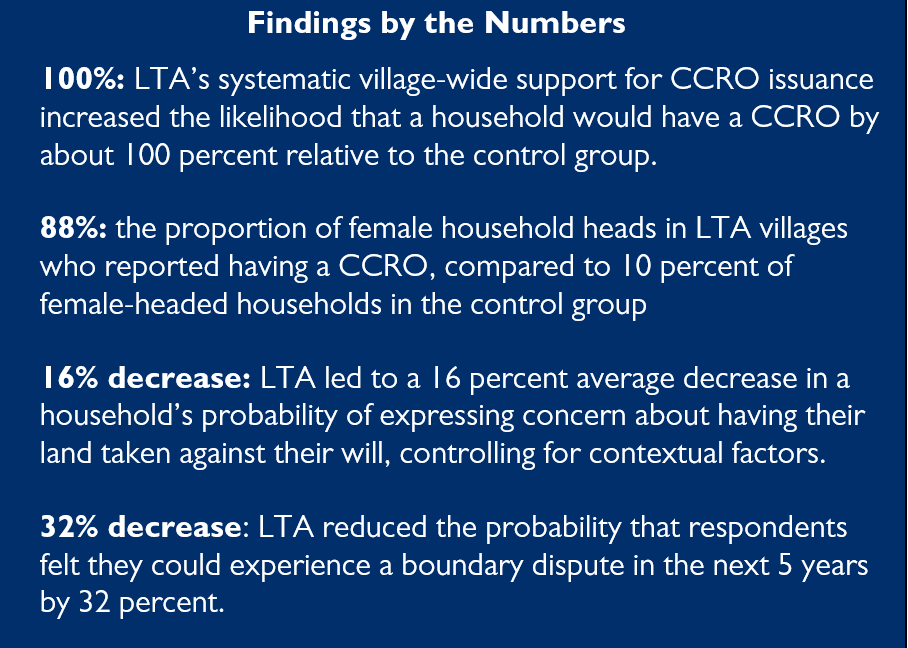
A key evaluation finding is that LTA’s systematic, village-wide support was successful in helping most households obtain a CCRO. The proportion of respondents in LTA-supported villages with a CCRO in the evaluation sample rose from 3 percent at baseline to 86 percent at endline, compared with only 12 percent of control group respondents at endline. This underscores that CCROs remain largely out of reach for typical rural Tanzanian households in the absence of a systematic village-wide support program like LTA.
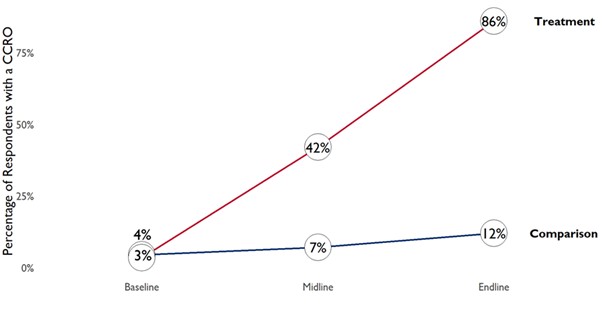
LTA’s support also led to a similarly large increase in formally documented land rights for women in LTA-supported villages as compared with the control group.

The evaluation results suggest that the increase in formalized land documentation also improved household tenure security. To look at common measures of tenure security, we asked household respondents how worried they felt about the risk of land being taken without permission in their community generally and for the land they personally use. The evaluation found significant improvements on both measures due to LTA’s support: an 18 percent decrease on average in a household’s probability of expressing community-wide concern over land expropriation and a 16 percent decrease on average in a household’s probably of feeling tenure insecure.

Tenure security improved for both men and women, and to a greater extent for female relative to male households heads. The evaluation also found a substantial increase in tenure security for female primary spouses supported by LTA. These improvements are especially important in the rural Tanzanian context, where women often have a harder time claiming and defending their land rights or exercising control over land decisions. Based on the evaluation results, USAID/Tanzania’s support for formalized customary land documentation seems to have not only expanded people’s access to CCROs but also led to more equitable access to land documentation in ways that allay gender-based concerns around land grabbing.

Among households that received CCROs, self-reported familiarity with land laws was also higher for female primary spouses than for the male household heads. This finding appears to reflect LTA’s emphasis and awareness raising around women’s land rights, together with opportunities for women to participate in trainings, meetings, and activities in Iringa related to land documentation.

LTA’s Impacts on Credit Access

The evaluation results related to credit are more nuanced and provide important learning around the role of CCROs in expanding rural villagers’ access to credit and economic opportunities. The evaluation found no evidence of a change in credit access (stable at around 13 percent for both groups and survey rounds) or amount (around 200,000 Tanzanian shillings or $86) as a result of the CCRO. Iringa District is similar to much of rural Tanzania in that borrowing from formal sources such as commercial banks is low and villagers are stymied by a lack of creditworthy business activities (as perceived by banks), poor business skills, and complicated loan processes. These results also point to wide gender disparities in borrowing sources and amount of credit obtained, underscoring opportunities for targeted programming to bring women’s economic empowerment on par with men. The null results on credit and differential access by gender suggest future programming should address these issues in conjunction with CCRO provisioning, and USAID’s Land Evidence for Economic Rights and Gender Empowerment (LEVERAGE) activity is conducting targeted learning on this topic.

Looking Ahead

USAID/Tanzania’s support to Iringa villages and the district land office in recognizing customary land rights has been critical in helping rural farmers protect their land, expand their livelihoods, and stave off uncompensated expropriation in the face of rapid urbanization and rural land use change. LTA’s achievements – including helping register around 60,000 CCROs across 30 villages, providing training to 220 women’s groups, and supporting the district land office to lead the technological and administrative process – are notable. The impact evaluation of LTA provides robust evidence of the initial impacts of CCROs to farmer tenure security and other near-term effects, and suggests the foundation has been laid for longer-term benefits to come. This rigorous evaluation suggests that formalizing customary land rights in the rest of Iringa District, and thousands of other villages across Tanzania, is well worth the effort.


“A successful land governance strategy requires political will” Q&A with Fuentedeoro, Colombia mayor

After several years spent to improve the municipal land office in Fuentedeoro, USAID and the National Land Agency are supporting a massive land titling and cadastre updating strategy that will cover the entire municipality. The mayor of Fuentedeoro, Diana Patricia Mancera speaks on the next steps for creating a culture of land formalization and on how to maintain a sustainable and legitimate land market.

Land titles delivered in 2020 with Mancera (center) thanks to the USAID-supported Municipal Land Office.

Over the year, Fuentedeoro made the formalization of public lands a priority and implemented a strategy to build its capacity for titling public lands within the municipality. How has Fuentedeoro changed during this process?

The perception of property has changed. It’s clear to us now that it is important to be able to own a property, and that owning it means having the deed. And it is understood that the deed not only serves to prove your ownership of the property, but also allows you to access other opportunities such as credit and subsidies.

How does public land titling help the municipality?

Today, a deed is required to prove that the property is in fact owned by the municipality so that the government can invest in it. Here, thanks to our work, the majority of schools and health centers now have land titles. One specific example is that the Ministry of Education, through the Infrastructure Financing Fund, has allocated resources for the Juan Bosco branch of the General Santander Rural School in Puerto Limón, which without a land title never would have been eligible. A total of 150 million pesos have been allocated to improve the conditions for preschool children.

In 2020, the mayor’s office is continuing its strategy to improve land titling in Fuentedeoro. What are the first steps of the new strategy?

We have three fundamental activities that are underway with USAID’s support. First, we are improving the Municipal Land Office, which is staffed by land experts and open every day. Next, we want to improve and prepare for the upcoming massive land formalization activity with the National Land Agency (ANT).

Fuentedeoro’s leaders have shared their experience of creating a municipal land office with dozens of municipalities: from the first step of passing an ordinance, in which the city council grants the Mayor the faculties to adjudicate urban parcels, to registering land titles at one of the regional offices of the Superintendence Notary and Registry.

What do you plan to do with the National Land Agency?

With the support of USAID and through the ANT, the first step is to develop and consolidate Fuentedeoro’s Participatory Rural Land Use Management Plan, a big job that the municipality alone would never have been able to do alone due to costs. And that, of course, is followed by the parcel sweep and massive land titling exercise.

What can Fuentedeoro offer the rest of Colombia in terms of land titling?

Although we are not a PDET municipality, we are fortunate to be implementing a strong land governance approach. We are proud that Fuentedeoro, which is a category six municipality (population: <10,000), can show category four and five municipalities (population: 10-30,000) that it is possible to lead a land strategy with the necessary political will. From this perspective, things can get done and we can attract other programs.

Do you believe the people of Fuentedeoro are ready for a massive land formalization intervention?

I think so, I think they are ready, because they are crying out for it! The fact is the citizenry has requested land formalization services in the formulation of the Municipal Development Plan. The people know the importance of land titling. People know the advantages to having a deed in order to access other benefits and programs.

In Colombia, municipalities have traditionally lacked the capacity, in part due to insufficient funds and capacity. Further, decades of informality have meant that there are few records in place documenting each property’s history.

And are you ready to support massive land formalization?

Municipal leadership is aware it must continuing to support the local land office and titling, not only for schools and public properties, but for longevity and sustainability’s sake, so that people stop informally selling their houses. Between these two components: people’s awareness about the importance of the deed and the municipality’s dedication to improve the land office, we will be ready.

How do you show a landowner that land titling has benefits?

We must show people that when they sell a property, they must do so with a deed. This way, the seller will no longer have to pay property taxes, and the buyer, by having the deed, will be able to access the benefits of being an owner.


This story was originally published on Exposure.

RVO and FAO Round Table on Land Consolidation in the Arab World: Experiences from Egypt, Morocco, Sudan and Tunisia

By Gemma Betsema, Lisette Meij

What are the state-of-the-art and new approaches to land consolidation as part of integrated rural development strategies in North Africa and Near East? That was the main question around which several experts from Egypt, Morocco, Sudan, Tunisia, and Turkey joined the FAO/ RVO roundtable discussion on land consolidation during the Second Arab Land Conference last February; a session which 110 participants attended – both in person and online.

Land consolidation is a topic of particular interest to LAND-at-scale since the program’s portfolio is developing projects in both Egypt and Vietnam on this approach. Participatory decision making and more sustainable and efficient land use planning are amongst the main objectives for LAND-at-scale. Read more about the LAND-at-scale program here.

Throughout the conference, the land consolidation theme was confirmed to be of high importance and interest for the Arab World. The objective of the roundtable was to initiate a dialogue and to share experiences between countries in North Africa and Middle East, while also bringing in lessons from Europe on land consolidation building on lessons learned from FAO and RVO. Countries in the MENA region are facing many similar challenges, which include fragmentation of agricultural land, need for improved and more efficient irrigation, and strong impacts of climate change on agricultural production.

The discussion highlighted that land consolidation is an instrument, which, in addition to traditional agricultural objectives, can contribute to the implementation of nature restoration, environmental and infrastructure projects. Important side effects of land consolidation include clarification of ownership and registration of property rights (creating opportunities for recognizing and formalizing women’s rights), formalization of inheritance, and updating the cadaster records. 

There is an increased demand from the countries for democratic and participatory approaches to land consolidation focusing inter alia on youth, women, and vulnerable groups. The examples brought in by the different speakers during the roundtable demonstrated the importance of transparency and communication for the success of land consolidation and the satisfaction of landowners and farmers. 

From this roundtable discussion, it became evident that there is a lot to be gained by sharing experiences across regions. The call that came from the discussions was to deepen cooperation and continue exchanging about ongoing land consolidation projects and programs, for example through the establishment of a community of practice. Such a community of practice could unite participants from different countries in the Arab region, as well as across different regions. As part of the new LAND-at-scale intervention in Egypt, continuous exchange and learning amongst other countries in the region will be part of the agenda.

If you are interested in further information, please reach out to us at landatscale@rvo.nl.

Photo source: IWMI (via Flickr Creative Commons)

Program: LAND-at-scale.

Related projects: LAND-at-scale Egypt: Participatory land use consolidation.

Originally published on the Land Portal. Creative Commons Attribution 4.0 International.

Land Formalization in Colombia: introducing the LAND-at-scale project

LAND-at-scale has started to work in Colombia on land formalization through a Fit for purpose approach in Indigenous and Afro-Colombian communities. The project is based on previous work by Kadaster International, who piloted the Fit for Purpose methodology successfully in Colombia. In this LAND-at-scale project, Kadaster is joining forces with ICCO Cooperation/ Cordaid and Tropenbos International who add their expertise and network on sustainable income generating activities and protection and use of natural resources. Together, the 3 partners will work on an integrated approach towards land formalization, and use their networks with government and donors, civil society organizations and financial institutions, to scale up this approach throughout Colombia.

Mathilde Molendijk, project coordinator from Kadaster International, says: “I am thrilled that in this project we have the opportunity to go beyond our field of land tenure security to explore the linkages between land rights and socio-economic development in an environmentally sustainable way. We will gain experiences at the local level and we are particularly interested on how these local experiences can be scaled-up.”


You can find more information on this and other LAND-at-scale projects on the program page on the Land Portal.

Program: LAND-at-scale.

Related projects: LAND-at-scale Colombia: Fit-for-purpose land formalization, LAND-at-scale Colombia: Land formalization, livelihoods and conservation.

Originally published on the Land Portal. Creative Commons Attribution 4.0 International.

LAND-at-scale Tender Announcement: Mali

The Netherlands Enterprise Agency (RVO) is seeking (an) organization(s) to implement the LAND-at-scale intervention in Mali.


Background


LAND-at-scale is a land governance support programme for developing countries. A large part of the world’s population depends on having secure access to land for their incomes. LAND-at-scale aims to contribute to fair and sustainable tenure security, access to land and natural resources for all.


The Netherlands Embassy in Bamako, Mali submitted a proposal that was positively evaluated by the LAND-at-scale Advisory Committee. Together with the Embassy, RVO further developed this idea and consulted with the relevant authorities in Mali, which results in the following invitation to tender.


Intervention summary


In Mali, farmers and pastoralists need land tenure security to sustainably manage and collectively use natural resources and to undertake investments with long-run pay-offs needed for climate smart investment in productivity, diversification, and resilience. Over 90% of these farmers and pastoralists depend on customary tenure systems to access land and natural resources.


By reinforcing customary land rights the LAND-at-scale project “Boosting local capacity to manage land conflicts and protect customary rights in Mali” contributes to sustainable development and improved tenure security. This will be done through strengthening of rural communities’ capacity for conflict mediation and integrating inclusive innovations towards customary tenure security through Land Commissions (Commissions Foncières). Operational and inclusive Land Commissions are a key structure in the Agricultural Land Act- Loi sur le Foncier Agricole. The Land Commissions contribute to the establishment of a transparent and sustainable legal and institutional framework for a customary land tenure system.


The intervention strategy and envisaged outputs are to arrive at an effective and sustainable (multi-stakeholder) approach that results in establishing capacity for building effective, inclusive and transparent Land Commissions that can implement the law in support of conflict mediation and local tenure security for all. A second objective aims at promoting innovations in customary tenure systems adjusted to local needs and circumstances. Establishment of functional, inclusive, legitimate and accountable Lands Commissions at local government and village level will expand capacity for conflict mediation and customary land tenure management.


Intervention goal


To contribute to stability, food security, climate resilient agricultural development and natural resources management by strengthening security of access to and rights over land and natural resources, with special attention for inclusivity (especially women and pastoralists), through establishing and capacitating Land Commissions.  


Please refer to the official tender documents for a complete description of the proposed assignment, as well as tender procedure and requirements. In case of any differences between those documents and this announcement, the information in the official tender documents on Tenderned prevail.


Tender timeline


April 12th 2021 (12 PM CEST) – Deadline questions and clarifications about the tender


May 6th 2021 – Deadline tender submissions


May 19th 2021 – Announcement of the award of contract


July 1st 2021 – Start of contract


For the complete list of deadlines, please refer to the official tender documents on Tenderned.


Participating in this Tender requires a Tenderned account. Please contact landatscale@rvo.nl if you are unable to register.


Photo source: Treeaid (Flickr Creative Commons)


Program: LAND-at-scale.

Related projects: LAND-at-scale Mali: Managing land conflicts and protecting customary rights.

Originally published on the Land Portal. Creative Commons Attribution 4.0 International.

Sweet Taste of Development

Hundreds of families in Bajo Cauca take on beekeeping to improve their living conditions and contribute to the licit economic development of the region.

The Bajo Cauca Priority

Bajo Cauca region is an example of all the negative things that are read in the news about Colombia: violence, illicit crops, illegal mining, and criminal groups feeding off these activities and disputing control over the territory. The Government of Colombia (GOC) has prioritized the region —which is located in the northeast corner of Antioquia— to implement a package of comprehensive development activities known as PDET (Development Program with a Territorial Approach). PDET interventions seek to build and promote peace and ‘stabilization’ by implementing the Comprehensive Rural Reform established in the Peace Agreement with the FARC.

In Bajo Cauca, USAID is working in line with the government’s PDET strategy to increase opportunities for economic development through private sector investment and the presence of government services and actors, such as land administration entities, which are fundamental to strengthening the basis of trust of the citizenry in state leaders.

The Community is Abuzz

Through its Land for Prosperity Activity, USAID brokered a Public-Private Partnership (PPP) in the honey value chain that seeks to promote beekeeping as a sustainable and legal economic activity with the potential to benefit rural inhabitants in seven municipalities in Bajo Cauca. The PPP, which is valued at an estimated $5 billion pesos (USD$1.3mn) links 26 producer associations with training to improve honey production and processing. Under the partnership, the producer associations —which represent 631 families—have the opportunity to market their honey with local conglomeration of honey producers, Campo Dulce.

A Forest of Opportunity

Bajo Cauca’s climatic conditions are ideal for the production of honey and other products derived from bees. Beekeeping gives producers the chance to achieve economic potential in less time than crops like cacao, which can take an average of five years to reach harvest levels that generate returns. After setting up beehives, it will take just a couple of months for the first honey harvest, and beekeeping requires a relatively low level of effort in terms of maintenance. In addition, bees play a key role in pollination, thus contributing to the preservation of ecosystems.

Campo Dulce made a commitment to work with all 29 producer associations and purchase 100 percent of their honey.

“USAID arrived just when Bajo Cauca needed it most. Now, it is important to recognize their roles and work hand-in-hand with these communities, the companies, and producer associations who are already involved in beekeeping.”-Sandra Márquez, manager of Campo Dulce.

Bee in the Forum

USAID’s principle role is facilitator. Bajo Cauca’s security complexities make coordination and teamwork even more critical in promoting a successful strategy that can provide licit economic alternatives to rural families, improve their livelihoods, and contribute to the region’s economic development. USAID is the catalyst that brings local, regional, and national government actors, the private sector, producer associations, and communities together. To make these new relationships sustainable, the PPP actors have created a Beekeeping Roundtable that meets quarterly to follow up on commitments and the needs of producers.

“The coordination process has been easy because all the participants are interested in the same thing.” – Henry Hernández, Beekeeping Roundtable coordinator and representative from the regional Government of Antioquia.

Women Stepping

Lilia Castro, a single mother in the municipality of Cáceres, sees beekeeping as an activity that can help her create more income requiring just a part of her time so she can attend to other household tasks. Through the honey PPP, Lilia and other women in the region are receiving training on how to create and maintain their hives to offer higher quality honey to Colombia’s market.

“My son used to be afraid of bees, but now he goes with me to feed them. He also wants to learn from this job, so that is why he is going to be part of the training,” Lilia assured.


This story was originally published on USAID exposure.

Introducing the Newest Member of the Links Family: BiodiversityLinks

BiodiversityLinks, USAID’s newly refreshed and relaunched knowledge portal for biodiversity conservation, features key USAID tools and resources, as well as new evidence and learning.

Many long-time users likely remember BiodiversityLinks’ predecessors, the Natural Resources Management and Development (RM) Portal and the Biodiversity Conservation Gateway. BiodiversityLinks takes the best of these sites forward into a platform that fuels learning to improve biodiversity programming.

The site features a redesigned homepage and updated navigation throughout. Landlinks users are now able to explore biodiversity’s interactions and systems-based approaches to improve land and property rights and cross-sectoral connections. You can discover successfully completed projects like Biodiversity Understanding in Infrastructure and Landscape Development (BUILD) and Forest Carbon, Markets and Communities (FCMC), or explore organizations such as Landesa and resources on land or marine tenure, while also taking advantage of the new Library functionality to more easily share curated resources with colleagues and partners. 

Enjoy exploring the new site, and please contribute your resources, learning, and stories related to biodiversity! We will continue adding resources and adapting the site based on your feedback so please reach out to the site managers with any submissions, thoughts, or questions so we can address them and better meet your needs.


From Challenge Comes Change: Empowering Women Farmers in West Bengal to See Their Future in Sustainable Supply Chains

This post is written by the Integrated Land and Resource Governance (ILRG) team and originally published in Agrilinks. 

On March 8, 2021, International Women’s Day (IWD) marks a day where people across the world celebrate women’s achievements, raise awareness against bias, and take action to forge a more gender-inclusive world. USAID and PepsiCo recently partnered in West Bengal, India to support women in the PepsiCo potato supply chain in an effort to equalize their access to essential resources as their male counterparts, which is critical to agricultural success.

The USAID-PepsiCo partnership is designed to engage women as critical partners by empowering them, and thus challenging and transforming prevailing gender norms in the region, to build greater resilience in these rural farming communities and improve yields and performance in agricultural supply chains.

In West Bengal, India women are rarely seen as farmers, even though they typically spend as much time as their husbands working on the farm: preparing fields, planting seeds, harvesting crops, and managing animals.

“We knew almost nothing except cutting seeds. Now we have learned everything about farming. Additionally, we have learned about dealing with people like tractor operators, landowners, and how to do accounting.” – Anwara Begam

When Anwara Begam and her women’s group, Eid Mubarak, were approached in October 2019 by the staff of a new joint initiative funded by the U.S. Agency for International Development (USAID) and PepsiCo to participate in potato farming as lead farmers, the group enthusiastically jumped at the chance. This was the first time many of these women had the opportunity to participate in agricultural extension; they received training and knowledge on a broad range of topics to apply to their agricultural practices to increase their yields and productivity. Through the support of this partnership, the group participated in a land-leasing activity to identify land and negotiate leasing terms; it was the first time many of these women had ever accessed farmland on their own.

With reliable land access, Anwara Begam and the women in the group attended agronomy training, improved their skills in potato farming and financial literacy, and became formal contributors to the PepsiCo potato value chain. During extension training sessions, Anwara learned how to improve her crop yields through land preparation, seed treatment, soil health and nutrition management, and pest and disease control. In its first year, the USAID-PepsiCo initiative conducted technical training with 48 women’s groups, bringing over 500 women into PepsiCo’s supply chain.

Using information from the agronomy training, Anwara recently recognized the signs of potato blight on her family’s farm and knew what measures to take to prevent it from spreading; however, her husband initially did not believe her. While he questioned her knowledge, she advocated that their family take swift action, and her initiative ended up saving her family’s crop.

Empowered with her enhanced skills and knowledge, Anwara is currently talking with other women about the positive benefits of improving women’s knowledge in agricultural practices, and at the same time, her bolstered ability to advocate and influence others has built her personal confidence and leadership skills.

Invaluable Women

The partnership’s initial success shows that empowering women with the knowledge, land, and access to PepsiCo’s value chain directly benefits the women and their families, while also meeting PepsiCo’s business goals to expand their supplier network and increase productivity.

“For the very first time, I have taken an effort to provide seeds on credit to women farmers. I want to see them taking responsibility and getting empowered,” says Pintu Ghosh, a potato buyer in West Bengal who participated in the USAID PepsiCo gender-awareness training.

PepsiCo agronomist Abdul Alim attended gender sensitization workshops and discussions on the role of women in agriculture alongside over 30 other PepsiCo staff. In his native village of Bhagaldighi, West Bengal, Abdul and PepsiCo aggregators have already hired women to sort and grade potatoes—jobs typically done by men.

Since Abdul’s training, seven women with experience growing PepsiCo potatoes participated in sorting and grading opportunities, where each worker can earn up to $4 per day. This pay is more than twice what a woman makes in an eight-hour day as an agricultural laborer, and the job offers women more flexibility to work around their household responsibilities, as they are paid on output rather than the number of hours worked.

Since the partnership began in mid-2019, USAID and PepsiCo have provided potato agronomy training for more than 1,000 women, as well as gender equality and women’s empowerment training to all PepsiCo local staff in West Bengal. From the partnership’s initial gender assessment, it was clear that economically empowering women requires more than teaching improved farming practices. Building on the success of the first year, the partnership will begin implementing household and community level dialogues on gender norms that hinder women’s access to and control over resources and income and further recognition of their role as farmers. Interventions that aim to change harmful gender norms, strategically engage men and community leaders, and increase women’s personal agency and empowerment are critical to mitigating unintended consequences, including gender-based violence.

Reporting from the field has shown that for Anwara Begam and the women of the Eid Mubarak group, access to land and knowledge provided by the USAID PepsiCo partnership led to increased self-confidence and recognition from their community, and they now see themselves as valuable potato farmers who contribute to their families’ livelihoods and the PepsiCo supply chain. This demonstrates that empowering women makes social and economic sense both for businesses and for rural communities.

Scaling through PepsiCo Agricultural Value Chains

Building on this initial success in West Bengal, PepsiCo and USAID are expanding the partnership through a Global Development Alliance (GDA) focused on proving the business case for women’s economic empowerment in Colombia, Pakistan, and Vietnam, and further into India in Uttar Pradesh.

The GDA will target PepsiCo farming communities with a gender-transformative approach that tests and pilots women’s economic empowerment solutions on PepsiCo demonstration farms, as well as scales up promising practices demonstrated in the initial project in West Bengal. The partnership aims to ensure that women farmers and workers benefit from being directly or indirectly involved within PepsiCo’s supply chains while also being empowered within their households and communities. Integrating women’s economic empowerment into PepsiCo’s sustainable agriculture approach will strengthen livelihoods and community resilience while improving the performance and sustainability of the supply chain.

PepsiCo will use data and insights from this partnership with USAID to show that investing in women makes business sense and should be scaled within PepsiCo’s supply chains and adopted by other leading companies. Read more about our work in West Bengal here and the GDA here.


5 Ways USAID Empowers Women as Leaders Against the Climate Crisis

This blog was originally published in USAID Medium.

With a seat at the table, women contribute to decision making on natural resources and climate solutions

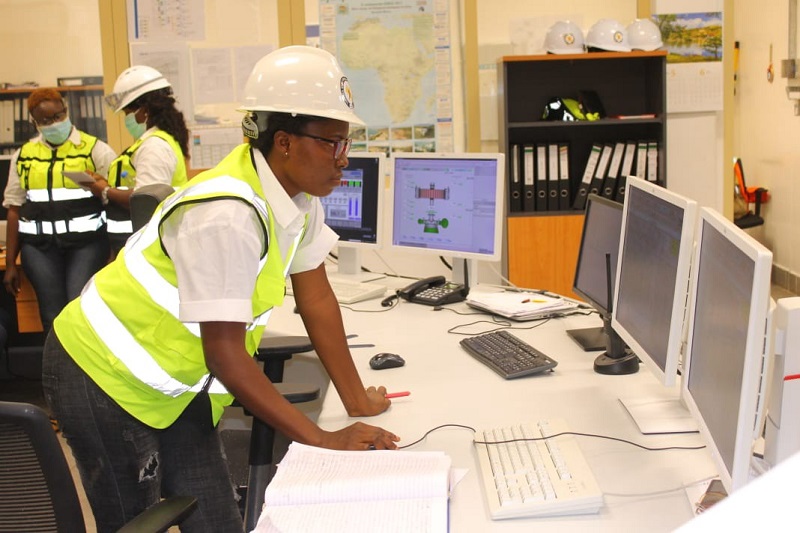
Frances D. Blanyon is a mechanical engineer and plant operator at Mt. Coffee Hydro Power Plant in Liberia. / Liberia Electricity Corporation

One of the greatest threats to our global community is climate change, and research shows women are more vulnerable than men to its consequences. Women and children are 14 times more likely than men to die due to climate disasters such as droughts and floods, and they make up 80 percent of those displaced by climate change. Climate change can also exacerbate gender-based violence, including early and forced child marriage.

But women and girls are not just victims of climate change ― they are leading the way in designing and implementing climate change solutions, and their valuable and unique knowledge on natural resource management and adaptation strategies are critical. The tools we use to combat climate change are more effective when women are meaningfully empowered at the household, community, national, and international levels. Fueled by a women’s economic empowerment fund at USAID, here are five ways we are empowering women in the fight against climate change:

The Advancing Gender in the Environment (AGENT) partnership between USAID and the International Union for the Conservation of Nature has recognized women as agents of change in the climate change sector for nearly a decade. Through AGENT, we conduct research and publish our findings on how climate change affects women, and help countries develop climate change gender action plans to ensure climate solutions are more effective and inclusive. One of our recent studies found that climate change, state fragility, and gender inequality are interconnected issues and that USAID and other development partners should approach these issues together so solutions are more effective and can have impact in all three areas.

With USAID’s support, AGENT is working to increase gender equality and women’s empowerment in the fisheries sector, where women make up nearly half the workforce, but their ability to advance economically is limited. This exclusion holds women back from earning income and reaching new markets, and can thwart efforts to increase the sustainability of the fishery overall.

Through this partnership, USAID has supported knowledge and tools that have helped build the capacities of over 25,000 women and men policy makers and practitioners around the world on how gender and environment are linked, so they can create more sustainable and equitable policies and programs to fight climate change.

Two newly-designed Nestlé Aldo Dispensers at the Wala-Usik (“nothing wasted”) convenience store of Nanay Lilian Gordoncillo in Bacolod City, Philippines. The store is testing refillable product delivery modes that will reduce the use of plastic sachets. / USAID Municipal Waste Recycling Program

A 16-year partnership between USAID and NASA, SERVIR supports local decision-makers across the developing world to use geospatial technology to manage the effects of climate change. SERVIR’s data helps countries anticipate droughts, floods and forest fires, so officials can respond quickly before lives are lost.

Since 2019, USAID has worked to ensure SERVIR’s geospatial services consider the ways climate change affects women in particular and design solutions that specifically meet their needs, such as ensuring that disaster information is shared through communication channels that women are able to easily access. We also have created opportunities for women to work and grow their careers in the geospatial sciences workforce by providing technical and leadership skills training and mentorship opportunities. A more diverse and well-equipped workforce can better tackle the problems and priorities of different types of community members that SERVIR and its partners serve.

Plastic waste pollution doesn’t just spread microplastics around the globe — it contributes to climate change by clogging mangroves that help regulate the ecosystem, and releasing high quantities of carbon dioxide when incinerated.

USAID’s Clean Cities, Blue Ocean program halts ocean plastic pollution in rapidly urbanizing areas of Asia and Latin America that contribute to the estimated 8 million metric tons of plastic that flow into the ocean each year. As part of this program, we are investing in new business approaches led by women entrepreneurs that reduce single-use plastics, and we are supporting the economic advancement of women who work as informal waste collectors.

Blessing Oyeniyi and Adeyemi Opeyemi, the first female line workers at Eko Electricity Distribution Company (EKEDC) in Nigeria. / EKEDC

Effective and high-functioning utilities are critical to achieving climate change goals, particularly by introducing clean and renewable energy to reduce emissions and encouraging the efficient use of resources in the communities they serve.

USAID’s Engendering Utilities program creates economic opportunities for women working in traditionally male-dominated energy and water utilities, ultimately strengthening utility performance. The program has trained over 6,000 women to advance their careers, and over 1,000 women have been hired in the energy and water sectors, including in management and technical positions.

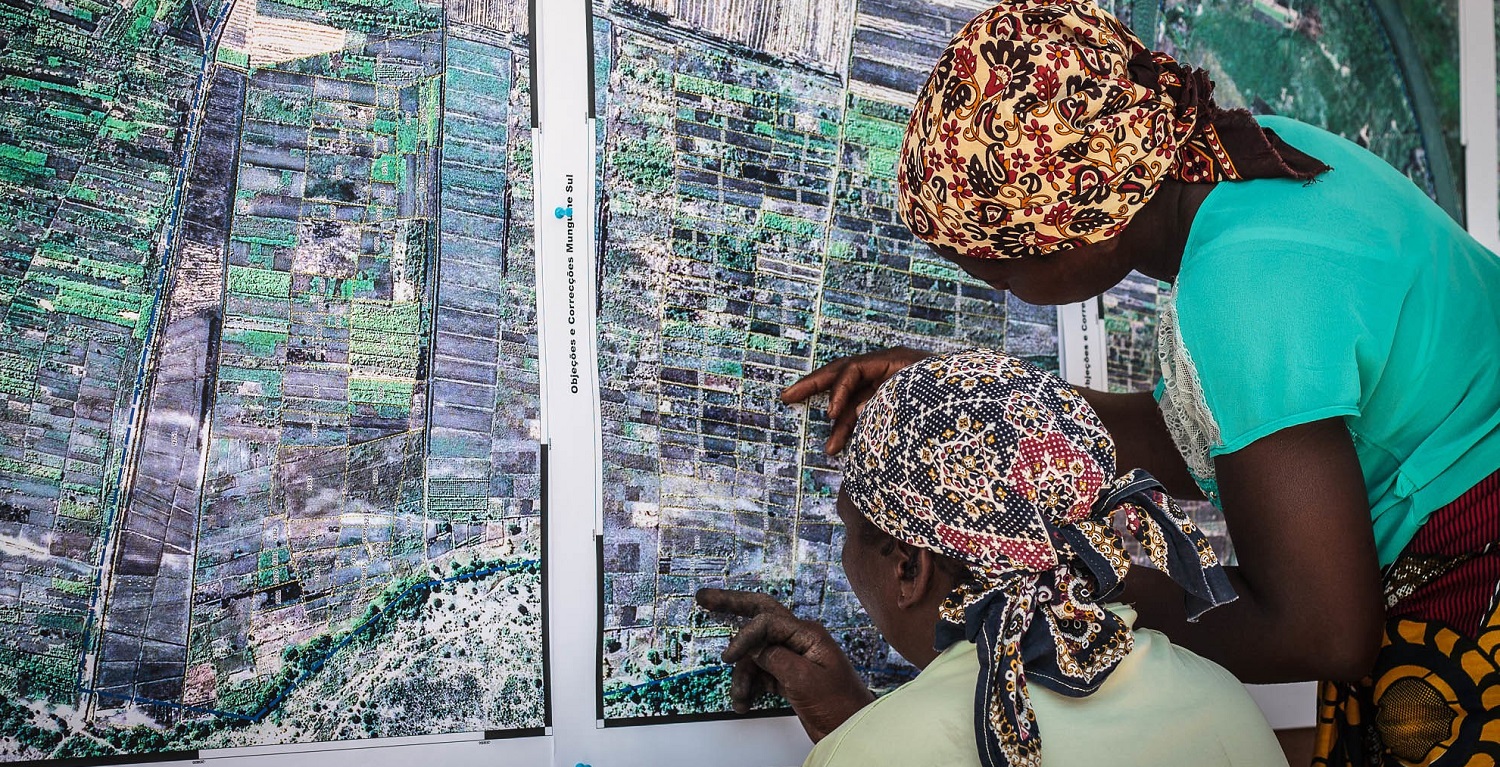
Women in Mozambique examine a map. USAID works in the country to support reforms around women’s land rights. / Sandra Coburn for USAID

When women have secure land rights, their resilience to climate change increases, as does their communities’ resilience overall. But women who rely on customary land tenure systems that disadvantage them are the most impacted by climate change, especially as forest and water sources are depleted and soil on land degrades. Without secure land rights, they are less able to prevent overgrazing of pastureland and deforestation, which worsen greenhouse gas emissions.

USAID works to implement practices such as joint titling and land registration to ensure women have secure land rights. USAID works in Ghana, Malawi, Mozambique, Zambia, and India to support legal and land resource governance reforms around women’s land rights.

The climate crisis is acute and shows no sign of abating. Economically empowering women leverages their innovation and expertise and enables their transformational power to increase climate resilience. With a seat at the table, women contribute to decision making on natural resources and advocate for climate solutions that meet their needs and are more likely to be adopted by all people — benefiting our shared planet and our global community.

Corinne Hart is the Senior Gender Advisor for Energy and Environment and Georgia Hartman is a Technical Advisor for Gender and Environment, both in USAID’s Bureau for Development, Democracy, and Innovation.


Improving land governance for Palestinian farmers

Palestinian farmers in the West Bank mainly engage in low intensity agriculture. Despite great agricultural potential, the prospect of losing access to the land impacts negatively on the willingness of farmers to invest in sustainable agricultural intensification. Moreover, prior investments in agriculture could be under pressure as well when farmers do not have the documents to proof their tenure rights. Women in particular are often unable to claim rights to the land they are using, importantly caused by discriminatory inheritance practices. The project aims to increase land tenure security for Palestinian farmers, by improvement of the land governance system through the provision of technical and legal support. Special attention will be given to formal and informal inheritance practices and raising awareness of women’s land rights.

In December 2020, a subsidy was granted to the Land Research Centre (LRC), to execute the LAND-at-scale project in the Palestinian Territories. LRC will support farmers in strengthening their land tenure security as part of building more resilient and sustainable livelihoods, while contributing to an enabling investment climate. LAND-at-scale supports the ‘Improving land governance for Palestinian farmers’ project with 2 million euros of funding.

Sustainable land management and food production

Over the coming years, the project will provide tailor made support to Palestinian farmers to strengthen their security of tenure, contributing to more sustainable land management practices and improved food production. By offering tailor-made technical and/ or legal support to farmers, security of tenure for existing farmlands will be strengthened. In relation to the position of women, the project will analyse existing inheritance practices, its impacts on women’s access to land, and provide recommendations for empowering women’s abilities to access farmland.

LAND-at-scale

LAND-at-scale is a government programme that helps to improve land governance. The programme supports better food and nutrition security, economic development and peace and stability in developing countries. It also contributes to sustainable incomes and social justice. The Dutch Ministry of Foreign Affairs funds LAND-at-scale.

Program: LAND-at-scale.

Related projects: LAND-at-scale Palestinian Territories: Improving land governance for Palestinian farmers.

Originally published on the Land Portal. Creative Commons Attribution 4.0 International.