
Securing women’s land rights means finishing the work and staying involved

A woman can take part in a land registration program, have her land surveyed, and have a title issued in her name, yet still have no document she can use to defend her rights. Sometimes she cannot afford the final fee. Sometimes the document remains in a government office. Sometimes she receives it and still faces a relative who refuses to recognize that the land belongs to her.

These were concrete situations described during From Rights on Paper to Rights in Practice: What It Takes to Secure Women’s Land Rights, the webinar TenureSecurity.org convened with LandBridge International on October 15, the International Day of Rural Women.

I chose women’s land rights as the subject of TenureSecurity.org’s first webinar because this is an issue I care deeply about and have prioritized in my work for many years. We examined what happens between recognizing a right and being able to rely on it. The experiences shared from Tanzania, Uganda, and Zambia showed how much can depend on steps that land programs leave unfinished.

My strongest conclusion is that we need to take responsibility for the whole process women encounter. Targeted assistance can make an immediate difference when a fee or an administrative requirement is preventing someone from obtaining her document. The same work also exposes weaknesses that governments and development partners need to address. A woman should be able to complete registration, understand what has been registered, and find effective help when her rights are challenged.

Why LandBridge focuses on the final steps

Rania Ahmed, one of LandBridge’s three co-founders, began with her own family. Her grandmother had bought property for her daughters in Sudan, but the ownership had not been registered in their names. Watching the emotional strain of completing that process helped her understand the consequences of a gap that can look administrative from a distance.

Later, discussing land titling in Zambia with fellow co-founder Ailey Kaiser Hughes, she encountered a similar problem: women had participated in registration but had not received their titles.

“How many other women have a recognized claim to land and have even begun the documentation process, but couldn’t complete the final steps needed to secure legal ownership?” Ahmed asked.

LandBridge’s response is to work through local partners to identify women facing those obstacles and provide targeted support. As Kaiser Hughes explained, the organization enters where a legal pathway already exists and governments, communities, and other organizations have done much of the groundwork. Its assistance builds on that investment.

That focus has practical value. I have seen land programs reach the end of their funding with crucial work still incomplete. The survey or registration exercise may have advanced, while the person whose rights it was supposed to strengthen is still waiting.

But Kaiser Hughes also cautioned against assuming that the remaining problem is always money: “A fee is rarely the entire story.”

She illustrated this through earlier work she supported in Liberia, where obtaining an official identity document cost about US$5 and required travel to a government office. Without identification, people could not enter the land titling process. Bringing identification services into the community helped more people participate.

The lesson I draw is that support needs to follow the actual obstacle. A grant for a registration fee will accomplish little if the woman also needs identification, transport, information, or someone to help navigate an office that repeatedly sends her away. Local partners matter because they can identify those differences.

Tanzania and Zambia show what an unaffordable fee can do

Mustapha Issa, CEO of Tanzania Land Tenure Assistance, described work to help women obtain Certificates of Customary Right of Occupancy, or CCROs. In the communities where his organization works, he reported substantial progress in women’s awareness of their land rights and interest in documentation. The continuing difficulty was paying for it.

Issa described a cost-recovery approach intended to sustain registration services, with charges rising from about US$10 toward US$20 per certificate. For women with very limited income, especially older women and widows, that remained a serious barrier.

“We only issue the certificate to those who can manage to pay,” he said.

That sentence deserves attention. A fee can be modest in relation to the technical cost of registration and still determine who receives the benefit of the investment. If a woman cannot pay, her willingness to participate and the work already completed do not get her across the final step.

In Zambia, Kamiji Malasha, LandBridge’s gender specialist, described a similar interruption in the government’s land titling process. Households move through information sessions, enumeration, verification, and an offer letter setting out the payment needed for a certificate of title. Women can complete the earlier stages and become stuck when payment falls due.

Malasha put the initial payment at approximately 1,000 kwacha, or US$50, with a total cost of about US$150 in the cases she described. These were her estimates during the webinar, rather than a uniform fee schedule for every applicant. Her central point was the pressure such costs place on households already struggling to cover daily needs.

I find it difficult to regard the resulting failure to complete registration as a lack of commitment. A woman choosing food or school expenses over a title fee is making a decision under severe constraints. The design of the service needs to account for that reality.

Issa proposed a targeted fund for women unable to afford documentation, with support progressively incorporated into local government financing. That is a useful direction: immediate assistance can address exclusion now while helping establish a more durable way to finance access.

Uganda shows why paying the fee may still leave women waiting

Christine Kajumba, Research Manager at Associates Research Trust Uganda, described a different obstacle in Oyam District. Freehold titles had already been produced through a government program, but women still needed to complete payments and an administrative process to remove the fee-related caveat recorded against their titles.

The sums involved were approximately US$28–30, she reported. Yet even when her organization paid, the documents could remain unavailable for months.

“For six months, the titles were not coming out,” Kajumba said of one batch.

Her account made the administrative burden tangible. Women could face journeys between district and regional offices, including a trip of around 70 kilometers to Lira after collecting a title from the district office. Some traveled farther from their own villages. Repeated visits competed with farming, care responsibilities, and other demands on their time.

Digitization had not removed those difficulties. Kajumba described delays involving electricity, internet access, and a broken scanner. A digital process still depends on an office being equipped and able to complete the work.

For me, this was one of the webinar’s clearest lessons about institutional capacity. We need to assess improvements through the experience of the person using the service. How many visits are required? How much does transport cost? Can she find out what is happening? Does paying actually lead to receiving her document?

A system that transfers these costs and uncertainties to women is making access depend on much more than the official fee. Targeted assistance can help them navigate that system, but resolving persistent delays remains a public responsibility.

What changes when women receive their documents

The discussion also offered encouraging accounts of what documentation can make possible.

Lungowe Chintu, a women’s land and resource rights advocate working in Zambia, urged us to examine the changes in women’s lives: “We really have to look at what actually shifts in a woman’s everyday life once she holds that title.”

She reported that seven of nine women surveyed were generating steady rental income. She described women expanding rental accommodation, improving their homes, and reinvesting income in businesses and savings activities. One woman, Miriam, had added a rental unit and improved her home. Chintu also described women expressing greater confidence that they could answer someone who challenged their ownership, and plans among women surveyed to pass land to their daughters.

These accounts matter. They suggest how greater confidence in a property claim can connect with investment, household security, and expectations about inheritance.

They also need to be understood at their scale. A follow-up involving nine women provides valuable experience to investigate further; it cannot establish the average effect of titling or demonstrate that documentation alone caused the changes reported. I would like to see these experiences followed over time, including women whose circumstances improve less, whose rights are challenged, or who encounter new difficulties.

Kajumba was similarly careful about Uganda. She reported that 340 titles had been delivered through the work she described, while emphasizing that it was too early to make claims about changes in income or longer-term impact.

What she could describe was women’s relief at having evidence of their rights, including women with ongoing disputes. Her organization had also begun spending time at distribution meetings explaining what a title means, how transactions must be handled, and how the document can support a claim.

Some women were beginning to assert greater authority over decisions about their land. Kajumba called this an emerging “veto voice.” That is an observation worth following closely: whether a woman can refuse a proposed use or transfer of her land tells us something important about her ability to exercise her rights.

Issa also reported changes in women’s participation in decisions in Tanzania, while warning that family relationships, social norms, and control over money continue to influence whose voice counts. Documentation can strengthen a woman’s position within those relationships. Its effect still depends on how others respond and what support she can access.

A title needs institutions willing to uphold it

Kajumba’s account of a woman called Maureen brought this difficulty into sharp focus. Land had been registered in Maureen’s and her mother’s names, but her mother died before the title arrived. An uncle then allocated the land to his son. Maureen feared confronting him.

The document provided evidence. It did not remove the fear or resolve the dispute.

This is where the question of women’s land rights becomes inseparable from power. A woman may know her rights and possess documentation while facing someone able to intimidate her, ignore her claim, or make seeking help costly and unsafe.

Kajumba called for sustained engagement with men and cultural leaders so that they understand and respect women’s documented rights. Chintu described work with traditional leaders in Zambia, using discussions about what happens to widowed daughters to challenge practices that leave women without land. Some traditional leaders were becoming advocates for women’s land rights themselves.

The audience discussion raised the relationship between women’s rights and customary governance. The country experiences showed why we need to understand the institutions and relationships involved rather than treat customary systems as uniform. The documents under discussion also differed: CCROs in Tanzania and certificates of title in the Uganda and Zambia interventions.

My conclusion is that community engagement and accessible remedies need to reinforce each other. Dialogue can help change expectations and practices. Women also need somewhere effective to turn when dialogue fails or when someone refuses to respect their rights. Their security cannot depend indefinitely on maintaining a relative’s goodwill.

Measure completion and follow what happens afterward

Amanda Richardson, LandBridge co-founder and founder of Resource Equity, offered a useful starting point for assessing results.

“Our first responsibility is to measure completion, not just participation,” she said.

She recalled evaluating an earlier project in India that reported substantial numbers of women’s land registrations. On visiting, she found that many documents remained in government offices and women did not know they were waiting there.

Counting participation would have missed that failure. So would counting documents produced without checking whether women received them.

Richardson identified immediate questions that programs can answer: Was the correct document issued? Are its details accurate? Does the woman understand it? Does she know where to seek help?

She also drew a distinction that should guide the longer-term assessment: “Documenting a woman’s right is not the same as her being able to exercise that right fully.”

Those further questions require follow-up. Does she retain control of the land? Can she defend her rights in a dispute? What changes in household decisions? Does she feel secure? Are there livelihood benefits?

I was glad that the discussion left room for security and peace of mind as meaningful outcomes. Being able to remain in one’s home or pass land to one’s children matters in its own right. Access to credit may be useful for some women, but borrowing should remain a choice, with its risks understood. It is a poor universal test of whether a land right has become more secure.

Audience questions about mapping added another consideration. Knowing how many documents bear women’s names can help identify gaps and track progress. Understanding whether those women can use and defend their rights requires evidence beyond the registry.

What I would like practitioners and funders to do differently

The discussion strengthened my view that land programs should plan and budget for completion from the outset. That includes getting accurate documents into women’s hands, helping them understand those documents, and ensuring that the institutions responsible for the remaining steps can carry them out.

Malasha expressed a practical principle for making services accessible: “Services must come to the women, other than requiring the women to come to the system.”

She proposed mobile titling clinics, community outreach, and trusted local women trained to explain procedures. These approaches respond directly to the distance, time, and information barriers described across the discussion.

Local organizations also need resources for the work that continues afterward: following up with offices, explaining documents, identifying disputes, and helping women reach appropriate support. During the discussion on scaling, Kaiser Hughes identified funding as LandBridge’s immediate constraint. The country accounts showed why financing needs to recognize the time and knowledge involved in making assistance work.

I would also like governments and development partners to treat repeated obstacles as evidence for improving the service itself. If women consistently need outside help to pay the same fee, make the same journey, or obtain the same response from an office, that experience should inform budgets and administrative reform.

LandBridge and its partners are addressing a concrete gap that can otherwise leave years of work unfinished. The webinar showed the value of that contribution while making clear how much remains after a document is delivered.

For me, the next question is whether a woman can rely on the right that document records. Can she make decisions about her land, remain on it when challenged, and determine its future? Following those questions over time is how we will understand whether the work is delivering the security women are entitled to expect.

This article reflects the discussion at the October 15, 2026 webinar convened by TenureSecurity.org and LandBridge International. Country figures and examples are attributed to the speakers who presented them.

Watch the webinar recording

Building Resilience to a Changing Climate under Insecure Tenure

By Julius Bright Ross and Amanda Clark

In a sunny field in El Salvador’s Usulután Department this August, approximately twenty members of a Farmer Field School gathered around a plot containing six different varieties of maize. As they discussed the comparative advantages of the varieties, they keenly appraised their likelihood of withstanding both dry spells and heavy precipitation events. Heavy precipitation, in particular, was top-of-mind after intense storms fell on much of El Salvador this June, flattening young crops and stripping fields of topsoil and organic matter. Another tool for improving resilience wound its way through the maize plants: jack bean (Canavalia ensiformis), planted alongside maize as beans have been for millennia to enrich the soil and provide ground cover. Using funding from the United States Agency for International Development’s (USAID) Bureau for Humanitarian Assistance (BHA), Catholic Relief Services (CRS) is promoting Canavalia ground cover as part of a suite of climate-smart agriculture (CSA) practices, which aim to sustainably increase agricultural productivity and incomes, adapt and build resilience to climate change, and (where possible), reduce or remove greenhouse gas emissions. CRS’ suite of CSA approaches in El Salvador, which they term “water-smart agriculture”, focuses primarily on increasing and stabilizing yields sustainably to improve food security during intermittent droughts. One farmer, Adonis, has enthusiastically adopted Canavalia and other CSA techniques, emphasizing to the BHA team that the ground cover keeps his soil moist during brief dry spells.

Nevertheless, greater adoption of Canavalia and, in particular, more laborious soil and water conservation measures such as in-field infiltration trenches by Salvadoran farmers is heavily curtailed by the trade-off between near-term results and how long a farmer can count on farming the same plot of land — that is, how secure their land tenure is. In El Salvador, a high percentage of farmers do not own their land, often paying a landowner for the usage rights in-kind through crop residues to feed cattle with during the dry season. When unofficially surveyed, only about half of the CRS farmer field school members reported owning the land they farmed, and only half of those that rented (including Adonis) were confident they would be able to farm the same land the next year.

Land tenure refers to the relationship individuals and groups have with land and its resources, including trees, minerals, pastures, and water. These relationships are defined by land tenure systems – the rules, customs, and laws that define how property rights to land are allocated, transferred, used, or managed. More broadly, the field of land and resource governance (LRG) describes the complex relationships between land and societal elements such as culture, politics, economics, and history. The unique LRG context that describes a community’s land tenure varies both geographically and over time, but is of crucial importance to understanding challenges to economic development.

Insecure land tenure is linked in complex ways to food insecurity. The possession of secure tenure over land can itself be a marker of wealth and permanency, which can affect food security in myriad ways including the ability to invest in inputs, the time to acquire knowledge of the land’s idiosyncrasies for growing crops, and social capital with long-term neighbors that might provide coping mechanisms during shortages. In some cases, land tenure security may provide greater access to credit, directly driving the agricultural investments (including both assets and financial mechanisms such as insurance) that cushion the effects of climatological drivers of crop failure such as drought. These factors encourage smallholders with secure land rights to make longer-term decisions for themselves, their families, and their lands.

USAID is a leader in developing evidence at the juncture of land tenure security and CSA adoption. A follow-on impact evaluation of the USAID-funded Tenure and Global Climate Change Project in Zambia found strong links between land tenure security and increased uptake of Climate-smart Agriculture practices, although it is worth noting that the strength of these links varies geographically. Many CSA practices have long-term payouts that require significant upfront investments. For farmers with insecure access to land, these costs can be a significant barrier to adopting such practices. Farmers will likely avoid the high investment incurred by practices that improve long-term sustainability if they cannot count on benefitting from them in the short-term. Conversely, LRG improvements such as strengthening land tenure and investing in governance of communal resources can provide the scaffolding farmers need to embrace CSA approaches, which, despite their initial costs, can improve soil health, increase biodiversity, and build resilience against climate change, thereby increasing the stability of productivity over time.

USAID works to improve land and resource governance and strengthen property rights in 23 countries globally. In each of these countries, the agency ensures that programming is context-specific and responds directly to the needs of those most vulnerable to land exploitation. In Ethiopia, issues such as farmer-herder conflict and unequal land access for women and youth hinder equitable adaptation to climate challenges. The Ethiopia Land Governance Activity aims to address these issues by strengthening land governance systems, expanding communal land tenure security in pastoral areas by facilitating policy reforms, and creating opportunities for more women to serve in land administration entities. In Colombia, unclear land tenure and property rights obstruct economic growth, generate violence and social tension, and fuel illicit activities that lead to increased deforestation and land-based carbon emissions. By providing access to land titles, supporting land restitution, strengthening local government capacity for land administration, and integrating citizens into licit socioeconomic opportunities, the Land for Prosperity Activity aims to protect members of rural communities from climate and socioeconomic risks.

In El Salvador, Canavalia ground cover is a tenure-conscious component of CRS’ Climate-smart Agriculture: short-term enough to produce results within a growing season, but with long-term value for those with surer land tenure. Nevertheless, Canavalia works best in concert with other CSA practices, including mulching crop residues that often go towards paying rent and establishing trenches or live barriers to reduce loss of soil and organic matter on steep farmed slopes. CRS is exploring alternative arrangements to make these investments possible for tenant farmers, such as through promoting herbaceous live barriers paired with silage training to provide an alternative value proposition for landowners.

Whether through increasing land tenure security or finding creative solutions to increase the feasibility of soil and water conservation on rented land, long-term stewardship can make a substantial difference. The BHA team visited Santos Franco Reyes’ farm in the department of Morazán, which he has owned for twenty years and which he has steadily improved over that time. Despite a 12 to 13 percent slope, the field’s maize plants were growing strong in clearly healthy soil, with ample mulch from the well-pruned trees growing throughout the field and worm-castings every few inches. Santos proudly showed off the infiltration trenches that he had dug to capture heavy rainfall and infiltrate it into downslope maize over subsequent days, telling us he has been digging these for half a decade already. Santos has farmed this slope since his daughter Sulma, standing out with us, was a young girl. As Santos put it, “I do everything I can to make sure this farm is here for her when I move on.”

Cross posted from Agrilinks

Putting Customary Land on the Map

USAID is supporting small-scale, gender-responsive land documentation to secure farmers’ rights to customary land in Malawi.

“Here, men want to control everything and don’t allow women to talk. If we are aware of our land rights we can act and defend, and if we get divorced, we can still rely on the land to continue feeding our children.” -Margaret Dyson, landowner in TA Mwansambo

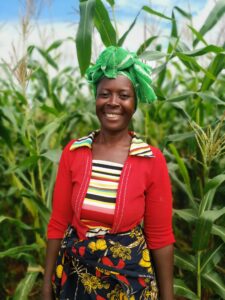
Margaret Dyson on her land in TA Mwansambo.
Margaret Dyson on her land in TA Mwansambo. Credit: Nico Parkinson

Margaret Dyson, a single mother of three, inherited her four-acre farm from her parents, who were granted the land by the village head person when they moved to the Traditional Land Management Area (TLMA) of Mwansambo 30 years ago.

Since then, her family has relied on natural boundary markers such as trees and streams to define their property and keep their land separate from adjacent farms. As local populations grow and land becomes increasingly scarce, these natural boundaries that have worked for decades may be removed or become less effective. As a result, formally documenting land ownership has become a critical part of the government’s strategy to promote inclusive sustainable development.

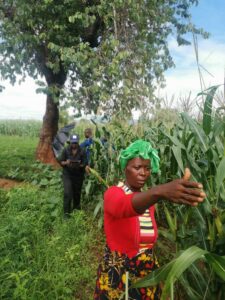
Margaret Dyson leads data collectors and CLC members on a walk around the boundaries of her land to map her parcel during the land documentation process.
Margaret Dyson leads data collectors and CLC members on a walk around the boundaries of her land to map her parcel during the land documentation process. Credit: Nico Parkinson.

In Malawi, 70 percent of the population lives on customary land, held by communities and administered by traditional leaders, as smallholder farmers. Less than 10 percent have some form of land documentation. These rates are significantly worse for women due to gender norms that view men as the default heads of households who wield decision-making power over valuable assets like land. Though many parts of the country are matrilineal, meaning that land is passed down from mother to daughter, male relatives often still control day-to-day decisions about land use. Furthermore, though TLMA Mwansambo is matrilineal, it does not follow the traditional custom where men who marry move to the land of their wives’ clan; instead, women typically move to their husband’s village after marriage. Since they are assumed to have land rights in their own village under the matrilineal tradition, they are given no rights to the land in their husband’s village.

Because navigating these customary land rights traditions can be challenging, documenting and formalizing these rights is important. Land documentation not only provides rural populations with greater tenure security, it creates incentives for them to invest in their farms and can provide a source of collateral for expanded access to finance. Land documentation can also reduce land conflict and promote gender equality.

Inclusive Land Documentation Process

Following the 2016 Customary Land Act, the Government of Malawi launched several land documentation pilots across the country, permitting customary landholders to formalize ownership. In TLMA Mwansambo, the USAID-funded Integrated Land and Resource Governance (ILRG) program is partnering with the Ministry of Lands to roll out the country’s most ambitious customary land formalization campaign to date, with an explicit focus on women’s land rights. Using participatory methods and socially inclusive approach , the land documentation campaign is targeting outreach to approximately 40,000 people. The activity expects to document upward of 10,000 land parcels in under one year.

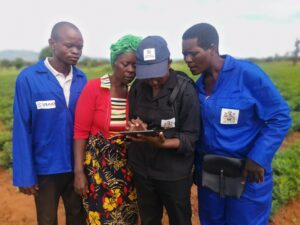
Margaret Dyson walks the boundaries of her land with data collector Alefa Kwenda and two CLC members from her community (in blue).
Margaret Dyson walks the boundaries of her land with data collector Alefa Kwenda and two CLC members from her community (in blue). Credit: Nico Parkinson.

The land demarcation process is gender-responsive, ensuring that both women and men are able to participate at each stage.

Following a comprehensive gender assessment in TLMA Mwansambo, ILRG sensitized all stakeholders on gender and social inclusion (GESI) issues before and during the land registration process and developed a series of tools to guide GESI integration across all steps of the process.

Over the course of eight months, teams of university graduates visit each village to carry out the land documentation work. After holding community sensitization events, they physically walk the boundaries of each parcel with landholders and use GPS enabled mobile devices to map the precise coordinates. Once the data are collected, a village map is produced and posted in a central area for community members to review and bring any corrections or objections forward. These sessions are held during times and locations that are accessible and safe for women to participate. Once maps are validated and finalized, the local government issues land titles to customary landholders.

“We know that we are gender focal points in the land documentation process,” says data collector Sylvia Kasiaya, 28. “When a man wants to only register his name to the land, we ask ‘What about your wife?’ They often say ‘No, she has her own land’, so we push back and inform them about the advantages of joint documentation, such as ‘What if you die, how will your wife and children survive?’ Sometimes it works and we see very little resistance.”

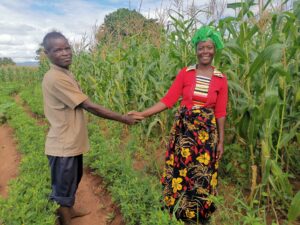
Margaret and her neighbor Phale Jabes agree on the boundary between their two parcels during the land documentation process in TA Mwansambo.
Margaret and her neighbor Phale Jabes agree on the boundary between their two parcels during the land documentation process in TA Mwansambo. Credit: Nico Parkinson.

ILRG is also promoting shifts in harmful gender norms that hinder women’s land rights through a series of workshops and dialogue sessions. Now, women and men have opportunities to sit together to reflect on harmful gender norms—such as local marriage traditions which give women no rights to land in their husband’s village—and discuss how to change them in order to promote equal land rights, equal decision-making over land, and equal sharing of benefits from land. ILRG is also holding gender norms dialogues with traditional leaders like village head persons, who tend to be men, to identify the harmful gender norms that might hinder women’s land rights and devise concrete strategies to initiate change.

Promoting Community Leadership in Land and Natural Resource Governance

Another way women can be empowered is through engagement in land institutions. The 2016 Customary Land Act creates Customary Land Committees (CLCs), a group of community members elected to help oversee and resolve disputes that occur within the local land documentation process. CLCs are critical to guide data collectors, land surveyors, and government officials in their villages. By law, the CLCs must be gender balanced. ILRG is improving leadership skills for women elected to these bodies so they can meaningfully participate.

Group Village Mwansambo CLC Member Rose Zuze participates in a boundary walk during the land documentation process in her community.
Group Village Mwansambo CLC Member Rose Zuze participates in a boundary walk during the land documentation process in her community. Credit: Nico Parkinson.

Rose Zuze has four children and was elected as a CLC member in Group Village Mwansambo. She accompanied Margaret and her neighbors to define the boundaries of her property.

“Single mothers have no power, so they need the CLC to defend their rights. Since I am a woman, I know their problems. In addition, women like Maragaret are empowered by the CLC. They see women in positions of leadership and believe that if I can be on the CLC, then they can also be in positions of power.”

These efforts help ensure that women’s names are included on land titles, which aligns with the joint objectives of the Government of Malawi and USAID to advance gender equality in land rights as a pathway for women’s empowerment.

“I put the farm in my name with the three children on the document,” said Margaret Dyson. “It is important because it gives us protection from eviction. With this document, I can prove this is my land.”

Margaret Dyson on her land in TA Mwansambo.
Margaret Dyson on her land in TA Mwansambo. Credit: Nico Parkinson.

The campaign in Mwansambo is establishing the precedent for a socially inclusive and gender-responsive approach to land registration. This scalable approach may influence how the government carries forward the important work of ensuring secure land tenure as a pathway for sustainable development, building on Malawi Vision 2063’s goal to fully harness the potential of land as a catalyst for economic self-reliance, and the USAID/Malawi Country Development Cooperation Strategy to support gender-equitable and accountable development.

Five Lessons from Using MAST to Advance Women’s Land and Resource Rights

Research shows that strengthening women’s land and resource rights has a striking and positive impact on women’s empowerment. And yet, across much of the world, formal and informal laws and customs hinder women’s access to land and resources, leaving them unable to fulfill their full potential as agents of economic and social change. 

USAID is helping to address this longstanding inequity through its Mobile Applications to Secure Tenure (MAST), a blend of participatory mapping approaches and flexible technology tools that allows communities to document and secure their land and resource rights using a smartphone. MAST’s participatory mapping methodology emphasizes on-the-ground engagement and extensive training to empower citizens as data collectors and administrators and build their capacity to maintain land information and manage their land and resources.  

MAST engages local communities—with specific focus to the inclusion of women and youth as trusted local community members—who are trained to use maps and mobile devices to identify and record individual and communal land boundaries, land use, and ownership information. Mapping and information gathering takes place in the presence of land rights’ holders and neighbors and also engages marginalized groups, such as pastoralists. 

Across several countries where it has been deployed, MAST has already been effective in strengthening women’s land tenure and promoting the empowerment of women in communities where it has been implemented. In Tanzania, for example, the Land Tenure Assistance (LTA) activity employed a MAST approach to help women register their rights at the same rate as their male counterparts during the issuance of more than 100,000 customary land certificates (CCROs). In Zambia, the Integrated Land and Resource Governance (ILRG) project used MAST to ensure that half of all land documents in the project area were issued to women. And in Mozambique, the ILRG project implemented activities to help shift attitudes to be more supportive of women’s ownership of land. 

In March, USAID convened a learning exchange with partners from Tanzania, Mozambique, and Zambia who are actively using a MAST approach to document community land rights. Participants attending the exchange discussed the role of MAST in strengthening women’s land tenure and resource rights and how MAST might be made an even more powerful tool for promoting women’s empowerment. Here are five things that we learned from the discussion:

Meaningfully and directly engage women as project implementers

MAST allows for the direct involvement of citizens to map and register their land. Implementers in Tanzania, Mozambique, and Zambia have all found that including women in training, discussions, and mapping can help ensure that their rights are accounted for during the registration process. Recruiting women as para-surveyors and dispute adjudicators ensures that their perspectives and land claims are taken into account, while also providing them with short-term employment, transferable skills, and stronger feelings of confidence and empowerment. Although gender inequalities and gender norms that govern the behavior of girls and women (such as the division of household responsibilities) can make it difficult to recruit women to implement MAST, it is critical to encourage and promote their participation in these important community processes.

Intentionally cultivate women’s participation in meetings and training to promote their engagement

A key component of the MAST approach is training and actively engaging community members in discussions about community land resources, land use planning, land laws, and the importance of securing land rights. These trainings and discussions, which provide an important foundation for any mapping process, build important community awareness and buy-in to the process that is necessary for systematic land documentation. They also ensure greater participation and uptake by community members. Implementers have found that without employing specific means to intentionally engage women, these important, initial community sensitization meetings that seek to clarify land holdings and traditional rules are often dominated by men. Holding separate, female-only trainings can provide more space for women and youth to meaningfully engage with the MAST process and share their own thoughts, questions, and concerns. 

Tailor the engagement of women to the local context

Where MAST has been implemented in Tanzania, Mozambique, and Zambia, local groups and communities maintain their own customs, matrilineal or patrilineal inheritance processes, familial structures, and class dynamics. Women often have responsibilities that are unique from men, which include childcare duties and domestic household management. Hence, it is important throughout the mapping process to engage women in ways that adequately account for their unique social roles, needs, and schedules. In addition, it is important to understand traditional customs and social rules that might prevent women from accessing and owning land. In some communities, for example, traditional customs and norms prohibit women from owning land in their own right. In these communities, encouraging joint registration between spouses (where both the husband and wife have their names listed on a land certificate) may be the best option to provide women with some level of tenure security.

Account for the time and effort required to change attitudes during project implementation 

Implementers across all three countries stressed that changing attitudes toward more positive perceptions of women’s land ownership takes time and effort. Since the laws and regulations governing women’s land ownership are not always known or well understood, it can take significant time to educate communities about these rules, which include the nuances of how strengthening women’s property rights can benefit entire households and communities. Multiple training sessions on the same topic might be required. Although this deliberate engagement can lengthen the time frame for land documentation using a MAST approach as compared to on-demand, targeted, and rapid land documentation, education is likely one of the most critical components to securing women’s land rights for the long-term. 

Engage men as champions of women’s participation and equality

It is well known that teaching men and boys to become champions for gender equality and women’s empowerment is essential to achieving gender-related development objectives and long-lasting social change. In fact, one of the eight operating principles listed in USAID’s Gender Equality and Women’s Empowerment Policy is to engage men and boys. Similarly, MAST implementers have found that cultivating male champions to support women’s participation in MAST, especially during early phases of the community mapping process, can help ensure greater and more meaningful participation by women. In addition, because MAST often challenges traditional gender norms around land ownership, there is a risk that women’s participation in the MAST process may encounter resistance in communities that might traditionally prevent women from accessing and owning land. Male champions, especially those in leadership positions, have been helpful in transforming traditional attitudes to promote more active participation of women and helping communities avoid pushback toward women and girls during and after the mapping process.

Five Ways Women Lead on Addressing Climate Change

And Three Ways We Can Empower them to Lead More

Climate change poses incredible challenges for women and girls in the developing world. The impacts of climate change disproportionately impact women and girls by barring them from accessing increasingly scarce natural resources, leaving them more vulnerable to extreme weather events and limiting their opportunities for education and income-generating activities, which harms their overall health and wellbeing. 

Research shows that women’s participation improves the efficacy of climate change adaptation and mitigation programs. Yet, women are often barred from participating in climate action; an unfortunate fact that USAID’s Climate Strategy 2022-2030 hopes to counteract by centering the role of women and other marginalized groups on climate action. 

Last month, I had the pleasure of moderating an event entitled “Frontiers: Women Leading Solutions to Climate Change” to discuss a critically important question: How can we empower women to continue to lead the fight against climate change? 

This webinar, co-hosted by USAID and New America on the sidelines of the 66th session of the Commission on the Status of Women (CSW), hosted seven powerful women in conversation about how climate change poses unique threats to women, and the ways in which women are uniquely positioned to find and deliver solutions to this critical challenge. 

Here, in the event participants’ own words, are five ways women are already leading on climate change solutions, and five ways we can help them become an even stronger voice in this fight.

  1. Women uniquely understand the challenge, because they live it 

To quote American public interest attorney and author, Bryan Stevenson: “We cannot create justice without getting close to places where injustices prevail. We have to get proximate.” 

Women around the world are uniquely proximate to the impacts of climate change. Indeed, as USAID Chief Climate Officer Gillian Caldwell pointed out, climate change disproportionately impacts women and girls, limiting their opportunities for education and income-generating activities, harming their health and wellbeing, and increasing their exposure to gender-based violence and exploitation. Women and children are significantly more likely than men to die from climate disasters such as droughts and floods. 

But this inequity creates an opportunity: women understand from firsthand experience the impacts of climate change, and they see opportunities to address them on the ground. 

As an Agency, we are helping provide platforms and channels for women and girls to turn this proximity into power, by sharing their unique perspectives and the solutions they have developed. USAID’s new Climate Strategy prioritizes partnering with women and other marginalized groups on climate action and the U.S. Government’s new  Gender Equity and Equality Action (GEEA) Fund, is expanding resources for this work, helping advance women’s and girls’ leadership and participation to help tackle the climate crisis.  

2. Women see distinct signals, based on the role they play in the household

The division of responsibilities in a household gives women and men unique insights into opportunities to combat climate change. For example, Jamille Bigio, USAID’s Senior Coordinator for Gender Equality and Women’s Empowerment, pointed out that women and girls often collect water and firewood for the household, and can therefore see changes to forests and water resources in a way that men do not. As they go about their lives, women frequent places within climate-vulnerable urban centers that men do not, and therefore have unique perspectives about infrastructure and affordable housing needs to make urban areas more resilient. And, women have distinct perspectives on green economic opportunities, based on the jobs they hold. 

These perspectives can serve as components of early warning systems for climate impacts and also allow us to spot opportunities for climate action. One example of compelling work at this nexus of gender and climate action is USAID’s partnership with the International Union for the Conservation of Nature, called AGENT, which recognizes women as agents of environmental change.

Our challenge as an Agency is to learn how to share and amplify the climate threat signals picked up by women and girls, and the unique solutions they propose.

3. Female leaders help communities better manage their natural resources

Studies show that when women are engaged as decision-makers —not just on climate action but on any aspect of community planning—their communities do a better job at managing resources and protecting against climate shocks. 

Rights and Resources Initiative Coordinator Solange Bandiaky-Badji shared that when Indigenous women manage community forests, they step up to protect land more effectively. Bandiaky-Badji shared a recent experience in Nepal, where Indigenous women worked collaboratively through the 2021 monsoon season to plant lime trees on over 25 hectares of government and privately owned farmland, and restore degraded land through aquaculture. The combination of these women’s traditional knowledge of land and focus on collaboration allowed them to ensure a productive harvesting season in the midst of a drought and a pandemic. The Nepalese government was so impressed with this effort that it has since provided these women with grants and subsidies to scale up their efforts. 

To echo Bandiaky-Badji’s words: “When we support initiatives that are conceived and implemented by women themselves, we allow them to lead instead of just being bystanders in climate solutions.”

4. Women are on the climate activism front line

As New America CEO Anne-Marie Slaughter said: Women are often the ‘rule takers’, men are the ‘rule makers’ … but, women regularly become the ‘rule breakers.’  Indeed, women are often the ones speaking out against entrenched interests and large polluters, even when doing so subjects them to threats and gender-based violence, and imperils their livelihoods and lives. 

Many of the most outspoken climate activists and land and environmental defenders, from Berta Caceres to Greta Thunberg, are female. Women have formed grassroots organizations, like Fuerza de Mujeres Wayuu in Colombia and the Mujeres Amazónicas in Ecuador, to mobilize against environmental threats, and have organized nonviolent protests on climate challenges ranging from deforestation in India to mining activities endangering water access for rural households in Latin America.

As Gillian Caldwell observed during the panel: “Many of these brave women are standing up against powerful companies that are threatening the survival of the planet and in many cases these companies are working in close coordination with governments.” 

5. Women don’t’ just speak up for themselves, they speak up for the vulnerable

Gillian Caldwell made the point that women are better equipped to speak to the justice and equity considerations of climate action, whether those relate to gender, or to the protection of other vulnerable groups. Tracy Farrell, Director, North American Region, International Union for Conservation of Nature, echoed this observation, pointing to a study of 300 forest groups across the world that found that groups run by women were more inclusive and just.

Women leaders don’t just promote people-centered policies; studies find that their decisions are more planet-centered. In her remarks Farrell pointed to USAID’s AGENT project, which found that female parliamentarians tend to make policies that are more inclusive of the environment. 

Three Ways We Can Empower the Leadership of Women on Climate Action

There is so much more we can do to support and amplify women’s leadership on climate, and help empower a new generation of climate leaders. As Jamille Bigio rightly pointed out: “There are women leaders on the ground already advancing solutions, and they just need our support to help amplify their work.”

Event participants shared three ways in which we can further empower women to become leaders in the fight against climate change. 

  1. Ensure the women’s tenure rights are secure 

Research shows that strengthening women’s land and resource rights has a striking and positive impact on women’s empowerment, allowing them to play a leading role in mitigating and adapting to climate change. Secure tenure rights also make women more resilient to climate shocks.

Yet, as Bandiaky-Badji explained, women legally own less than one fifth of the world’s agricultural land, and in Africa, fifty percent of legal frameworks governing land and forests do not contain community-level provisions specific to women. Farrell pointed out that this lack of land ownership limits women’s access to finance and other resources to implement climate change solutions.   

To equip women to lead on climate change, we must invest in ensuring women have equal and secure rights to land and natural resources within their communities. USAID is supporting work to strengthen women’s land rights in a number of countries, including new work in Cote d’Ivoire to help women exercise and protect legal rights to land and through its Mobile Applications to Secure Tenure (MAST) approach.  MAST is helping women in three countries register land rights at the same rate as their male counterparts. 

  1. Train women to be leaders, and build their decision-making capacity 

Rili Djohani, Co-Founder and Executive Director, Coral Triangle Center, stressed that if we want women to lead on climate change, we must provide them with leadership training and mentorship opportunities. These efforts give women the confidence to demand a seat at the table, and also help shift gender norms and normalize women’s participation and leadership in rooms typically dominated by men. 

For example, the Coral Triangle Initiative has created an intergenerational mentor program that links senior female leaders with up and coming leaders. 

And while leadership training is a critical component of building up women’s voices, so is job training and other support that empowers women economically. The Coral Triangle Initiative has engaged women in seaweed cultivation and trained them to make seaweed snacks to sell on the local market. Djohani shared that training women to make and sell these products not only helps them improve livelihoods and empower economically, but also gives them the skills to engage in other decisions in the village. 

USAID has also focused on building the leadership skills of women who work in industries at the front lines of climate change. For example, through the Engendering Industries program, USAID supports women’s meaningful participation in male-dominated water and power sectors to improve gender equity and improve business outcomes.

  1. Explicitly define the role of women in national and international climate policies 

Farrell pointed out that a critical piece of empowering women to lead on climate change is explicitly including them in national and international frameworks, policies and mechanisms aimed at curbing emissions, reducing deforestation, adapting to climate impacts and financing climate solutions. USAID’s AGENT initiative found that 80% of newly revised Nationally Determined Contributions include gender in some way. This is a significant stride that must be taken up by other climate frameworks and policies. 

Farrell recommended that countries adopt Climate Change Gender Action Plans to ensure women are included holistically in climate action, and that their participation is tracked with indicators. 

—

As this panel made clear, while women face disparate impacts from climate change, they bring unique solutions and the courageous leadership that we need. Supporting women with secure rights, training, funding, and opportunities to shape policy can in turn increase women’s engagement and empowerment to make the necessary progress we need to tackle the climate crisis. 

Growing a Wildlife Industry in Zambia

In partnership with USAID, community owned and managed game ranches are sharpening their skills in wildlife resource management

Zambia’s landscape is ideal for antelope. Between the rainy and dry seasons, over 25 species—from the fox-sized duiker to the 1,500-pound eland—graze across Zambia’s landscape. These unique scenes bring tourism revenues to the country from visitors, photographers, and hunters seeking out these animals in and around the national parks. But there is another way these animals can provide revenue for the population: through the sale of wild game meat.

Puku
Puku, a type of antelope, in South Luangwa National Park, Zambia. Photo: Matt Sommerville, ILRG

As the demand for legal game meat increases both locally and abroad, and as climate change puts increasing pressure on arable land, Zambia’s land managers are learning that some areas are better suited to raising antelope than cattle. Rather than clearing forests for crops or establishing pasture for cattle, antelope can live and thrive off the natural landscape. Better land and wildlife management can help reduce poaching, increase revenue, and protect valuable forests and watersheds.

In order for a community to have complete user rights of wildlife, a game ranch generally needs to be fenced, which is an extremely expensive undertaking. Animals need to be protected from poaching, and in many locations animals must be restocked or habitats need to be improved in order for animals to thrive. USAID partners with the Wildlife Producers Association of Zambia (WPAZ) to support the legal game meat value chain and increase the number of communities on private and customary land that raise game meat. WPAZ, with USAID support, can help fledgling community game ranches navigate this process, building on their work with over 60 successful wildlife game ranches in the country. Community game ranches offer communities the chance to earn additional revenue from better land and wildlife management, benefitting both community wellbeing and the country’s larger conservation and biodiversity goals.

As the number of commercial game ranches increases across Zambia’s countryside, several rural communities are attempting to secure their forested land and manage it for wildlife production rather than converting it to cropland. These community game ranches are typically located in areas outside of national parks, but in locations where wildlife are present. WPAZ helps these communities increase management capacity and navigate regulatory processes related to using wildlife in a sustainable way.

2 impala
The game ranching industry is well developed in South Africa and Namibia, but has long been nascent in Zambia. Impala, a type of antelope, in South Luangwa National Park, Zambia. Photo: Matt Sommerville, ILRG

Nyalugwe Community Game Ranch is located in the Luangwa Valley in Eastern Province and operates with help from Community Markets for Conservation (COMACO), a WPAZ supported social enterprise that supports wildlife conservation and small-scale farmers in Eastern Zambia. Communities in the area have registered as a Community Forest Management Group to secure community rights over 45,000 hectares of land, which will be utilized to protect forests, promote the return of wildlife to the area, and support a community game ranch. The chance to diversify how it uses land, including by raising wildlife, could bring opportunities for Nyalugwe’s community, which is already well versed in sustainable agriculture practices. Nyalugwe game ranch leaders recently participated in a weeklong peer-to-peer exchange visit where WPAZ members and existing commercial and community game ranch operators shared information and lessons learned with newcomers about how to develop a sustainable game ranching model.

people with sign at launch event
Launch of of Nyalugwe Community Game Ranch with COMACO, ILRG, and Chief Nyalugwe. Photo: Russell Ndumba

“Nyalugwe has great potential considering their location and habitat,” explained Thawanda Masiye, Projects and Administration officer at Wildlife Producers Association of Zambia (WPAZ). “Until now, what they knew about game ranching, they learned by word of mouth and trial and error. Now, Nyalugwe would like to see continued support from WPAZ, but first we would like to see the chief’s buy-in to the community game ranch project.”

The week-long workshop included three days of intensive seminars dealing with topics like wildlife management, animal welfare, on-farm income generation activities and alternative land use diversification potential. The seminars were led by WPAZ members, WPAZ Secretariat, and their Livestock Services team. In order to reinforce messaging, after each seminar, summaries were made in the Lunda and Chewa local languages.

Thawanda
Thawanda Masiye is the Projects & Admin Officer at WPAZ.

“The creation of a community game ranch can be slow, and there are no returns for at least five years. That is why it is important to think about what you are doing with your land and consider alternative land uses to provide income during those initial set-up years,” said Masiye.

Participants also visited Kushiya Game Farm, a private wildlife estate, and the Simahala Community Conservancy, a 23,000+ hectare preserve home to water buffalo, wildebeest, waterbuck, impala, and zebra, to learn from the experience of others.

cape buffalo
Cape buffalo are part of the species mix in Simalaha Community Conservancy Photo: Matt Sommerville, ILRG

“It is clear that at Simalaha, the community understands the value of wildlife, not just as a commodity that can be grown and eaten, but as an investment. They have a sense of community, ownership, and responsibility,” explained Masiye.

The exchange visit was the final push the community needed to convince them that game ranching can be a viable business undertaking and a good use for land in their community.

Daka
Elisa Daka from Nyalugwe Community Game Ranch attended the WPAZ training, which helped them learn from the experiences of others and assess the viability of their new game ranch operation.

According to Elisa Daka from the Nyalugwe Community Game Ranch who attended the training, “The training was good as it imparted new knowledge that we needed for us to run our new community game ranch and we are grateful to WPAZ for organizing the training and hope it can be extended to all community game ranches in the country.”

With the help of WPAZ and USAID, Zambia’s natural resources can be preserved while empowering the local communities.

Women’s Land Rights Champion: Corinne Hart

This series features Women’s Land Rights Champions within USAID to learn more about their work. We’re pleased to share this interview with Corinne Hart, USAID’s Senior Gender Advisor for Energy, Environment, and Climate.

Corinne Hart, USAID
Corinne Hart, USAID

Tell us about yourself

I am the Senior Gender Advisor for Energy, Environment, and Climate in USAID’s Gender Equality and Women’s Empowerment Hub within the Development, Democracy, and Innovation (DDI) Bureau. I lead a team of gender advisors tasked with providing technical assistance across the Agency to support gender integration in a range of environmental sectors, including land and resource governance. I also oversee Gender Equity and Equality Action (GEEA) Fund resources available to advance women’s land rights in partnership with the Land and Resource Governance division in DDI. 

Why are women’s land rights and resource governance important to your work? And to other USAID development work?

As one of the Agency’s advisors responsible for gender integration in environment and climate sectors, I’ve seen firsthand that women’s land rights and their secure land tenure is a critical component to achieving the Agency’s overall goals on gender equality, women’s empowerment, climate change, the environment, and natural resource management. When women have secure rights to land, including by law and in customary systems, they have a critical asset that they can rely on for their livelihoods, and it can increase their decision-making power and agency. 

What are some of the biggest challenges in helping women secure land rights and what are some things being done to overcome them?

While there is a strong body of evidence connecting women’s secure land rights to many different development outcomes, such as food security, climate change, and natural resource management, it is still necessary to make the case to a range of stakeholders that advancing women’s land rights must be a key part of their approaches. Partnering with governments at the local and national levels, private sector actors, local implementing partners, and women and men in communities is one strategy that we use to ensure that women’s land rights interventions are woven into a range of sectors and approaches, including in policies, customary tenure arrangements, agriculture, and economic growth. USAID has also created the Resilient, Inclusive, Sustainable Environments (RISE) Challenge to provide small grants to environment, gender, and development organizations to address gender-based violence (GBV) related to natural resource management, including land. These grants enable our partners to apply best practices in GBV mitigation and response related to women’s land rights and to share the learnings across a large network of practitioners through the USAID-funded GBV-Environment Linkages Center hosted by the International Union for the Conservation of Nature (IUCN). Together with our partners from all sectors around the world, we are building the evidence, testing promising practices, providing technical assistance, and working directly with communities to ensure that women are able to access and control the land that is so critical for their overall health, wellbeing, and economic stability. 

What are some of USAID’s successes in the area of women’s land rights?

USAID is on the forefront of implementing gender-transformative women’s land rights programs that are addressing a wide range of issues that can impede equal rights to land. For example, our activities not only focus on land laws, but they also work to increase women’s meaningful participation and leadership in community natural resource management bodies, address gender-based violence concerns connected to land rights, change harmful gender norms, engage men and boys as gender equality champions, and increase women’s personal agency and empowerment. This robust approach ensures that USAID’s women’s land rights activities tackle the broad range of challenges that women face when accessing and controlling land. 


​​Building a Healthy Land Market in Colombia

A capacity building strategy is guiding budding professionals towards careers in land administration

When the Colombian government and USAID teamed up to formalize more than 3,000 parcels in the municipality of Ovejas, sourcing qualified professionals figured high on the list of challenges. Unable to fill vacant positions from the local workforce, the campaign had to field more than 50 professionals from around the country to support the endeavor.

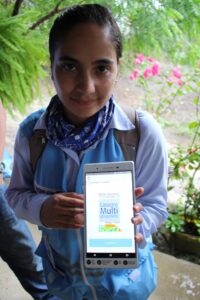
woman holding out cell phonePositions included land surveyors, legal experts, knowledge management specialists, and social workers with a unique set of skills related to land rights. Ten teams made up of four diverse professionals used their skills and tools to reach rural communities, effectively communicate, formalize a property, and register a land title. The pilot employed some 60 qualified professionals, but only 6 of them were actually from Ovejas.
The lessons are manifold. In a region with an already weak land market, students and young professionals do not consider careers in land administration. In places like Ovejas, the national cadaster—the plot map of land ownership—is out of date and does not reflect the reality of who is occupying what parcel. Instead of registering land titles and paying property taxes, land is bought and sold informally with a paper receipt and a handshake. Few, if any, land titles exist.

Thanks to these lessons gained through the Ovejas land formalization campaign, the USAID-funded Land for Prosperity Activity is targeting young professionals in rural municipalities with the skills and knowledge to select career paths related to land formalization, restitution, and administration.

In its first two years of implementation, Land for Prosperity has held over 200 workshops and trained more than 8,000 people on skills and knowledge related to land formalization. Among them are 80 law students in their final year at the Corporación Universitaria Remington, located in Montería, Córdoba.

group of people standing

Under the USAID partnership, the law students have reviewed academic material about Colombia’s land policies and land formalization processes. The students then have the option to select an internship at the regional offices of land entities, like the National Registry Superintendence–SNR, the land cadaster entity IGAC, or they can work with municipal administrations at one of the USAID-supported municipal land offices. In Córdoba, there are currently three Municipal Land Offices in the towns of Puerto Libertador, Tierralta, and Valencia. The internship is a requirement for graduation and must be related to legal services for their communities.

“In Southern Córdoba the public sector is in need of skilled workers and funding. We need more social workers and lawyers,” explains María Angélica Sakr, coordinator of Remington University’s legal clinic in Montería. “USAID is filling a need by creating a skilled workforce and motivating professionals towards these niche areas.”

Community Mediator

Andris
“Universities do not reach small towns like Puerto Libertador and accessing quality education is something that only certain families can manage. I have always dreamed of a law degree and I have made many sacrifices to reach this point.” -Andris Salgado, Law student (Remington University), Puerto Libertador, Córdoba

Andris Salgado, 38, plans to graduate with a law degree from Remington next year. He’s currently fulfilling his internship duties at the legal clinic in his hometown of Puerto Libertador. Since 2015, Salgado has worked as a community mediator and conciliator with support from USAID’s Access to Justice Program and the Ministry of Justice. This year, he participated in USAID-supported land administration workshops to learn more about current land policies and goals related to the 2016 Peace Accords.

“Knowing Colombia’s land laws can support rural communities with all kinds of services, from land conflicts to assigning parcels to farmers who have been in possession of their farms for over ten years,” says Salgado.

A legal expert with experience moderating many types of conflicts among families and neighbors, Salgado can now provide the people of Puerto Libertador with counsel and legal advice related to land formalization and access to land.

Following graduation, Salgado hopes to continue working with vulnerable populations as an advocate.

“There are lawyers in Puerto Libertador, but none have this kind of experience. I have always wanted to help the community and aimed my support at young people who cannot afford higher education.”

Land Market = Job Market

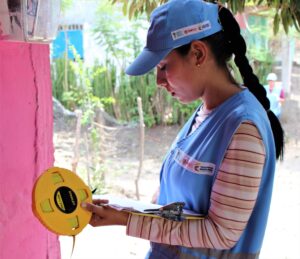
woman wearing hat holding tape measure
Photo by USAID Land for Prosperity

By this time next year, there will be two major massive land formalization campaigns underway in the Montes de María region, located just over 100 kilometers north of Córdoba. The two campaigns, which are taking place in San Jacinto and Carmen de Bolívar, will create at least 100 skilled jobs for legal land experts, social workers, and land surveyors.

In one of the regional capitals, Sincelejo, USAID is partnering with the Corporación Universitaria del Caribe, known as CECAR. Over the last 6 months, the program has reached more than 200 law students and 80 future social workers with workshops related to land policies and land formalization and restitution processes. All the students are in their final years of university.

“The learning spaces created by USAID are enriching for students who don’t have much experience with topics on land. They have generated curiosity and motivation for students to continue with these topics. Students benefit, the region benefits, and the university benefits,” explains Ana Claudia Castro, the workshop coordinator, who runs the CECAR’s Victim’s Justice Center in Sincelejo.

Over the next year, each semester the academic partnership will provide the students with new material. Topics include formalizing urban parcels in the name of the municipality, legal analysis of land parcels, land restitution policies, and conflict mediation related to land ownership.

The land formalization campaigns and the local land offices represent a significant part of USAID’s strategy to help the government untangle land conflicts that persisted for several generations.

In the Caribbean departments of Córdoba, Sucre, and Bolívar, thousands of victims of the conflict will benefit from land formalization services. If enough new professionals are trained, the jobs of land administration will be in the hands of the next generation.

USAID is supporting 11 municipal-wide land titling campaigns across Colombia. Each campaign depends on a variety of factors and is expected to require an average of two years to complete implementation. By 2025, the government will have updated more than 115,000 parcels in the national cadaster with the possibility of delivering up to 40,000 land titles.

“Having a home doesn’t make you rich, but not having one makes you very poor”

Q&A with Patricia Castro, Tumaco’s Secretary of Women’s Affairs

In January 2021, the municipal administration of Tumaco created its first Secretary of Women and Gender Equality. The entity represents a new view of equality and the strengthening of women’s rights. In this interview the Secretary, Patricia Castro, talks about the entity’s strategy and the challenges that women in Tumaco face when accessing property due to gender violence.

Why was the Secretary of Women created in Tumaco?

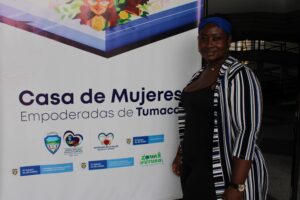
Patricia Castro, Tumaco's Secretary of Women's Affairs
Patricia Castro, Tumaco’s Secretary of Women’s Affairs

The Secretary was created last year with the aim of working on five pillars: equality, education, health (both promotion and prevention), entrepreneurship, and the last one where we have worked with the Land for Prosperity Activity, housing. It is called the Secretary of Women, but we work on different processes that promote gender equality and the rights of the LGBTI community. It is essential that we work with a very diverse group of people.

What is patrimonial and economic violence?

We call it patrimonial violence, but women do not call it that. When we are with women in our workshops and we hear a woman say, “I have to put up with so much from him because I depend economically on him” or “if I report him, who will sustain me?” or “I can’t separate from him because he is the owner of the house or the parcel where the house is, and I won’t get my part”. When they tell us about these situations, we explain to them that these are examples of patrimonial and economic violence.

What challenges do the women that go to these workshops face?

The women that go to these workshops do not have this information. For example, when it comes to land and property, the best way to overcome these barriers is motivating women to participate in formalization processes, and that is what we are doing with the Municipal Land Office and with USAID’s support.

What should women understand about land titling and their rights?

Titling in favor of women is decreasing the uncertainties they have. They ask themselves what would happen if they separated from their husbands. We explain to them that under the law, even under de facto marital unions (uniones maritales de hecho), women have the right to split all property in half because they have the same rights as formal unions. But there are other types of unions, and we explain that there are successive unions and multiple unions. There are a lot of multiple unions in Tumaco, when the man has parallel relationships with several women.

How do you reach women with these campaigns?

This is done with open calls, focused on certain neighborhoods, and with female leaders that know the communities. We train them on how to get their property title and we connect them to the Municipal Land Office. And because a lot of neighborhoods were built over landfills or are under the jurisdiction of the General Maritime Directorate (DIMAR), the Municipal Land Office guides them on which parcels can or cannot be titled. Thanks to this support, a lot of women that have been waiting for 30 or 40 years to be owners now have the opportunity.

What benefits does a title bring to women? 

With the property titles they can access housing credits or can apply for bank loans to adapt and improve their home now that they are sure it is theirs. When it comes to their heritage, we tell them a lot about inheritance and that they can leave their home to their children. Finally, these women are being empowered and have a feeling of belonging. One of the women once told me that ‘having a home doesn’t make you rich, but not having one makes you very poor.’

How does land ownership favor men over women?

In my own family you have an example. My grandfather had a lot of land, and before he died, he left a clause in his will that stated that only his male children with the same last name, Castro, could inherit the land. So my dad inherited the land, but if he separated from my mum, she would not get any property. And that is what happened, they separated, and the family house was left to my dad only. My mum had to leave. That is why we are working to raise awareness among women and to promote land titling.

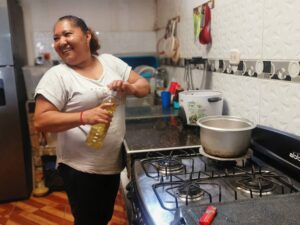
woman in kitchen
Gloria Criollo, 53, is a single mother of three who works for a government program supporting pregnant women, nursing mothers, and children under the age of two. She received a land title last year.

With what other topics is the Secretary of Women involved, to support women in Tumaco?

From the Secretary of Women we are working with women on entrepreneurship, to gradually eliminate economic dependence and in this way mitigate violence. We are strengthening women associations in tourism and gastronomy. Because there are a lot of women that have restaurants and can cook the delicious typical food of Tumaco, but they tell me that apart from cooking they do not have any other tools. We are also looking at creating a tourist trail in El Morro so that tourists and visitors can enjoy regional food.

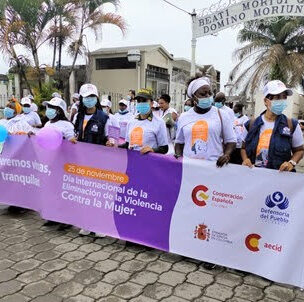
What did the Secretary do for the Day for the Elimination of Violence Against Women on November 25?

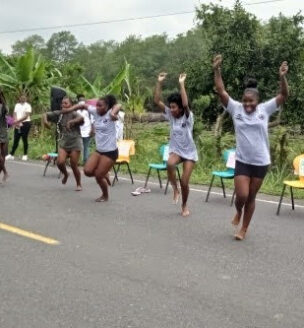
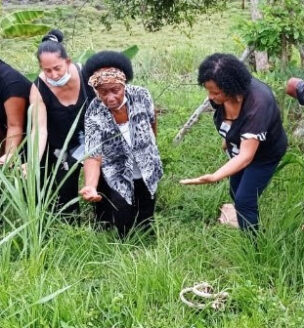
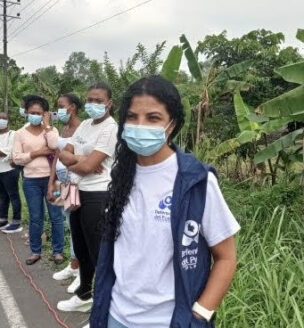
With support from the Women’s Committee (Mesa de la Mujer) and USAID, we coordinated several institutional actors to launch the Week for the Elimination of Violence Against Women. There were activities to commemorate victims of gender violence and remind everyone that we cannot normalize violence. We also organized a street theater installation on the main road to Tumaco, in an area called Tigre, where several women were taken to be killed. We also had a symbolic act where we planted trees to remove the stigma around the victims. Finally, we also held various neighborhood film screenings and painted a mural overlooking the beach at El Bajito, paying homage to a young woman that was raped and killed when she was eight months pregnant.

Photos of activities from the Day for the Elimination of Violence Against Women on November 25

Cross posted from Land for Prosperity Exposure site

Using land rights to promote gender equality and fight gender-based violence

Secure land rights for women are a crucial part of a USAID gender responsive strategy to strengthen land tenure, and is making an impact on promoting gender equality and protecting one’s patrimony.

Tumaco, whose population is overwhelmingly Afro-Colombian, is one of Colombia’s most dangerous areas with high levels of gender-based violence (GBV). Due to a complex web of narco mafia groups in its territory and deep-seated, toxic gender norms, Tumaco is often the municipality with the highest number of crimes against sexual integrity, many of which target young women, according to Colombia’s Victims’ Registry.

Before the onset of the pandemic, GBV—including crimes of rape and sexual abuse—was on the rise in the department of Nariño, where Tumaco is located. And then in 2020 the number of cases dropped sharply, but so did the government services to assist victims.

In 2021, the number of GBV cases in Nariño again increased by 51% compared to 2020, reaching more than 2,000 cases in one year, according to Colombian human rights advocate, Fundapaz. Tumaco registered 260 cases, or 13% of the total.

The Secretary of Women’s Affairs was created in January 2021 to take gender-based violence head on, and represents a bold step put forward by Tumaco’s first woman mayor. Patricia Castro’s job as the Secretary leader is to move women’s initiatives into the forefront.

In reality, the Secretary is helping to do the work of the Mesa de la Mujer, or Women’s Committee, which is a Tumaco-based victim’s advocate group that has worked over 10 years to raise awareness around gender equality and promote Afro-Colombian culture.

Gender violence in the context of an ongoing conflict causes widespread damage to women in a number of ways. Fear and intimidation reduce access to government services, including education and healthcare, and chronic violence weakens family relationships, disconnecting people from their cultural traditions.

GBV is also used as a tool for displacement and disproportionately affects Afro-Colombian and indigenous communities. In Colombia, an estimated 40% of women have experienced some form of gender-based violence. Since the 2016 Peace Accords, thousands of rural and urban families in Tumaco have been forced to leave their homes. Studies show that displaced women are at higher risks of abuse by their partners, and the risk for violence is compounded by the inability to escape situations of displacement.

Secure land rights for women are a crucial part of a gender responsive strategy to strengthen land tenure, and can have an outstanding impact on promoting gender equality and protecting one’s patrimony. When women have access to land and property, studies show they are more likely to earn higher incomes, enjoy increased decision-making power, and feel more protected in marital conflicts.

Land Rights are Women’s Rights

In Tumaco, the USAID Land for Prosperity Activity works closely with the municipal government to streamline gender equality and social inclusion in local land policies and activities. The USAID-supported Municipal Land Office developed an articulated gender and land titling strategy to target women-headed households in urban settings. Every month, small teams of land experts visit neighborhoods around Tumaco to explain the benefits of land titling and the rights of the women who live there.

“Thanks to USAID, housing is one of the main pillars of the Secretary of Women’s Affairs’ mandate.” –  Patricia Castro, Tumaco’s Women’s Affairs Secretary

Since 2020, the Tumaco Municipal Land Office has delivered 137 land titles. Of the total, approximately 75%, or 101 land titles, are either women-headed households or joint-titled with a spouse.

“We are motivating our women to participate in land formalization workshops that are visiting their neighborhoods. Many women have the same questions about what happens if they separate from their husbands. The best way to share this information is through the workshops,” explains Patricia Castro, the Women’s Affairs Secretary.

Over the last two years, dozens of municipalities throughout Colombia have adopted effective strategies, such as Municipal Land Offices, that advance gender equality and social inclusion. In matters related to land formalization and restitution, USAID and local leaders are implementing training for staff, sub-contractors, and residents.

USAID-supported municipal land offices across Colombia have delivered approximately 800 land titles since 2020, and over 600 of those land titles are in the name of women-headed households or joint titles.

Adapted from the Land for Prosperity Exposure site.