Pastoralism as Land Stewardship: Lessons from Mongolia’s Silk Road Caravan

This article reflects on my experiences and lessons during the long Silk Road Caravan in Mongolia.

From August 8–15, 2026, I joined the UNCCD-supported Silk Road Caravan in Mongolia, visiting pastoralist communities, rangelands, conservation areas, and research institutions. The 6,000-km journey across Eurasia, launched for IYRP 2026, connected pastoralists, scientists, and policymakers to share solutions for healthy rangelands and resilience to drought.

According to the Government of Mongolia Yearbook 2025, the country has about 3.59 million people and 58.1 million livestock, while approximately 110.9 million hectares are classified as permanent meadows and pastures, illustrating the enormous landscape on which nomadic pastoralism depends.

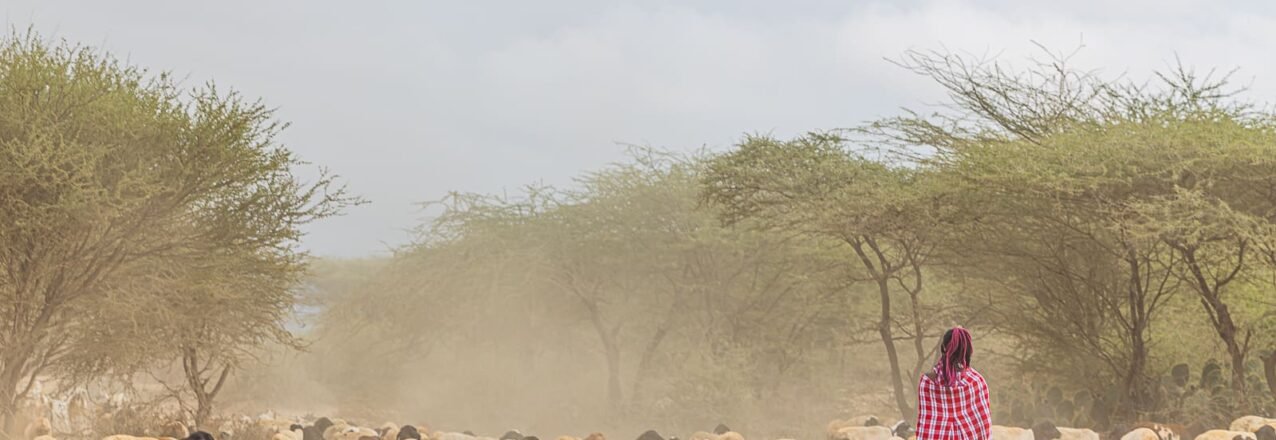
One of the most memorable experiences was visiting Bulgan soum in Arkhangai Province, where herders demonstrated how seasonal mobility remains central to pastoral life. Families move according to the four seasons, using agreed grazing areas and community arrangements. One pastoralist association we visited manages about 316,000 hectares, with herders organizing grazing, negotiating access between communities, and allowing some areas to rest for up to two years. Their work also connects rangeland protection with value addition, including yak meat, milk, wool, and other products.

In Gobi Province, I experienced a very different landscape, where water scarcity, drought, strong winds, and fragile soils create serious challenges for pastoralists. Yet I was impressed by the ability of herders to adapt their livestock management to the availability of pasture and water. I saw how camels, horses, cattle, sheep, and goats remain central to household economies and culture.

“Camel milk, wool, and other livestock products are not simply commodities; they are part of a knowledge system passed from one generation to another,” says an elderly woman of Gobi.

At Husta National Park, I learned another important lesson: conservation can be strengthened when local communities are recognized as partners and collaborators. The park, covering about 50,000 hectares, is internationally known for the successful reintroduction of Przewalski’s wild horses. At the same time, discussions highlighted the importance of supporting local herders and involving them in conservation and restoration initiatives.

At Ojuii Lake, I saw how pastoralism and biodiversity conservation are closely connected. The lake supports hundreds of migratory bird species, yet drought, changing water levels, and human pressure are affecting the ecosystem. The message was clear: protecting wetlands requires cooperation between pastoralists, conservation actors, and local authorities.

The visit to the Mongolia Rangeland Research Center further strengthened my understanding of the importance of science and Indigenous knowledge. The center documents changes, species, and climate data. The researchers use satellite mapping and field data to monitor degradation, restoration, and pastoralist activities, while also working with nomads on rangeland restoration and Indigenous pasture species.

Perhaps my strongest inspiration was the Champion Herder model, a very competitive award position that recognizes outstanding herder families not only for livestock production, but also for animal health, environmental stewardship, social responsibility, knowledge sharing, and community service.

I return to Karamoja convinced that pastoralism is not simply a way of life; it is a dynamic system of food production, culture, knowledge, and land stewardship. The people who live closest to the land often understand its problems and possibilities better than anyone. Our responsibility is to listen to them, protect their rights, strengthen their knowledge, and invest in their solutions. The restoration of land will not be possible without secure land rights for those who use it.

Guardians of the Living Commons: Why Northeast India Needs a Regional Land Consortium

As delegations convene at the United Nations Convention to Combat Desertification (UNCCD) Conference of the Parties to advance Land Degradation Neutrality (LDN), global policy debates frequently fall into an old trap: treating ecological restoration primarily as a financial or technological challenge. It is not. Land stewardship is fundamentally an issue of tenure security, biocultural governance, and collective rights.

Nowhere is this truth more vivid, more precarious, than in Northeast India

Northeast India’s Tenure Realities Governance & Structural Pressures
Customary & Clan (Community Stewardship) Lands        >60–80% of regional forest landscapes
Constitutional Safeguards     Sixth Schedule, Articles 371A & 371G    
Primary Vulnerability Factors Non-cadastral commons, “Unclassed State Forest” tags
Core Paradigm Shift Monoculture cash crops, top-down LDN targets, infrastructure exemptions (FCAA 2023)

The Blind Spot in Global Land Governance

Northeast India forms a vital ecological bridge between the Eastern Himalayas and the Indo-Burma biodiversity hotspot, acting as one of South Asia’s most critical carbon sinks and hydrological anchors. Unlike mainland India, where state agencies hold centralized statutory control, over 60–80% of the Northeast’s forests are stewarded by indigenous communities through their clans, kinship networks, and village councils.

Under constitutional provisions such as the Sixth Schedule and asymmetric protections like Articles 371A (Nagaland) and 371G (Mizoram), communities hold collective tenure over their ancestral domains. Here, land is not a speculative commodity; it is stewarded through interconnected social, cultural, and ecological systems.

Yet, these living commons face mounting structural pressures:

  • The “Wasteland” Fallacy: Because customary lands lack individual cadastral titles, dynamic cyclical swidden systems (jhum) and Community Conserved Areas (CCAs) are routinely logged in official records as “Unclassed State Forests” or “culturable wastelands.” The mosaic of regenerating fallows, vital for soil regeneration and biodiversity corridors, are misdiagnosed as degraded land, exposing community lands to top-down diversion.
  • Commercial Enclosures: The aggressive promotion of commercial monocultures like oil palm and rubber fragments traditional agroecological mosaics, depleting groundwater tables, eroding regional agrobiodiversity, and accelerating soil loss on steep mountain slopes.
  • Statutory and Infrastructure Pressures: Recent legislative shifts, notably the Forest (Conservation) Amendment Act (FCAA) 2023 with its 100-km strategic border exemption, create pathways for linear infrastructure and extractive projects to bypass traditional consultation, a critical vulnerability for a frontier region sharing over 98% of its borders internationally.
  • Top-Down Climate Interventions: Centralized carbon-offset schemes and target-driven afforestation initiatives frequently bypass customary authorities, replacing rich, biodiverse commons with monoculture timber plantations in the name of climate mitigation.

The Institutional Gap: Why a Regional Consortium like CLANS is Critical?

Traditional village councils and customary institutions have safeguarded these landscapes for generations. Yet, as they confront increasingly complex statutory shifts, industrial agribusiness contracts, and international carbon-accounting regimes, isolated village authorities find themselves at a structural disadvantage. Local communities retain deep legitimacy and customary ecological wisdom, but they frequently lack the geospatial tools, regional policy networks, legal scaffolding, and aggregated voice needed to negotiate with top-down enclosures and assert their rights.

This structural gap underscores why the Consortium of Landscape Alliance for Nature Stewardship (CLANS) has emerged.

Mobilizing Regional Capabilities: The CLANS Charter Intent

Rooted in the Northeast and driven by grassroots practitioners, legal experts, and community organizations, CLANS is designed as an institutional backbone to operationalize community-led landscape stewardship. Drawing upon the collective capabilities of its founding members, the alliance is chartered to fulfil three primary intents:

  • Facilitating Landscape-Scale Planning and Action

By combining indigenous knowledge systems with participatory GIS and landscape planning frameworks, CLANS intends to equip traditional village councils to manage contiguous watersheds, fallow mosaics, and biological corridors across village and clan boundaries.

  • Unlocking Flexible, Long-Term, Untied Finance

Recognizing that international climate and UNCCD funding mechanisms rarely reach informal village councils due to bureaucratic compliance hurdles, CLANS is structured to act as an accredited enabling mechanism. Its charter aims to aggregate and channel patient, untied resources directly into community-driven priorities rather than rigid project cycles.

  • Connecting Indigenous Systems with Global Commitments

CLANS provides a platform to bridge local biocultural practices with national policies and multilateral targets (such as UNCCD LDN and the Global Biodiversity Framework). It aims to amplify customary authority in policy spaces while defending community wellbeing, resilience, and cultural continuity as integral dimensions of nature stewardship.

The Imperative for COP UNCCD 

If the UNCCD’s global targets for Land Degradation Neutrality, drought resilience, and ecological restoration are to move beyond performative commitments, international frameworks must acknowledge a fundamental reality: stewardship succeeds only when local institutions are recognized as primary custodians.

In Northeast India, biodiversity and soil vitality have endured because indigenous communities have actively stewarded these territories for centuries. Supporting regional, member-driven alliances like CLANS is not merely an alternative development model, it is the foundational prerequisite for lasting biocultural resilience across the Eastern Himalayas.

CLANS is emerging as a consortium of local CSOs and Communities, led of young and women leaders from ethnic tribal communities (read indigenous people), with facilitation support of some like-minded stewardship-committed actors. Presently CLANS consists of RNBA, RBA, Kenono Foundation, Lemsachenlok, North East Network,  Grassroots, with facilitative support from Foundation of Ecological Security and anchored by Landstack

RRI at UNCCD COP17: Secure Tenure Rights at the Center of Land Restoration

At UNCCD COP17, taking place in Ulaanbaatar, Mongolia, from August 17 to 28, 2026, the Rights and Resources Initiative (RRI) will champion the message that pastoralists, Mobile Peoples, Indigenous Peoples, Afro-descendant Peoples, and local communities—especially women and youth—are proven leaders of land and resource stewardship whose secure tenure rights are essential to achieving global biodiversity, climate, and land restoration goals. 

As governments, donors, the private sector, and civil society gather in Ulaanbaatar, the timing is especially significant as 2026 marks the International Year of Rangelands and Pastoralists. Governments are also facing increasing pressure to deliver on global climate, biodiversity, and land restoration commitments by 2030. 

Across all themes, RRI’s engagements will: (1) promote land tenure recognition as a moral imperative to achieving global goals; (2) elevate the voices of pastoralists and Mobile Peoples as solution-holders; and (3) advocate land governance as a standing UNCCD agenda item. Through evidence, storytelling, and global media outreach, RRI will ensure that the world’s attention remains on those who protect the planet every day: Earth’s defenders.

UNCCD COP17 Delegation

Our UNCCD COP17 delegation brings together Indigenous Peoples, Afro-descendant Peoples and local community leaders from Africa, Asia, and Latin America who are advancing community-led solutions to land degradation, climate resilience, and sustainable livelihoods.


Our 5 Priorities at UNCCD COP17

Mobility Rights and Secure, Flexible Tenure

Promote secure, flexible tenure for Indigenous, Afro-descendant, local community, and Mobile Peoples as the foundation for global climate, biodiversity, and land restoration targets.

Pastoralists as Solution-holders

Amplify the voices, governance systems, and traditional knowledge of pastoralists in Africa, Asia, and Latin America and position them as climate leaders.

Land Governance

Advocate for the inclusion of land governance as a standing agenda item in UNCCD COP17 proceedings, including a dedicated Afro-descendant desertification agenda.

Women and Youth Leadership

Support the recognition of Indigenous, Afro-descendant, local community, pastoralist, and mobile women and youth as leaders and decision-makers within UNCCD negotiations.

Evidence and Unified Advocacy

Publish new evidence and data demonstrating the value add of secure rights, direct funding, and community leadership for achieving land restoration targets.

Events

Join the Conversation—RRI’s COP17 Side and Mainstage Sessions

11 Aug 2026
8:00 – 10:00 a.m. ET

Webinar—Tenure on the Move: Launching a Legal Toolkit for Pastoral and Mobile Land Tenure Reform

Virtual—on Zoom
17 Aug 2026
8:30 – 10:00 a.m. GMT+8

Moving Rights Forward: Advancing Pastoralist Rights and Customary Tenure Through Legal and Policy Change

Blue Zone, MET-04
19 Aug 2026
9:00 – 10:30 a.m. GMT+8

Improving Governance and Combating Land Degradation through Land Rights Research and the Protection of Herders’ Rights in Development Project Impact Areas

Green Zone, Tsagaadai Hall
19 Aug 2026
10:30 – 12:00 p.m. GMT+8

Rethinking Investment in Rangelands: Advancing Inclusive Green Investments and Pastoralist Rights through IYRP 2026 Campaign

Blue Zone, MET-02: 597
19 Aug 2026
02:00 – 03:00 p.m. GMT+8

Land Restoration and Environmental Racism: Addressing Differentiated Vulnerabilities in Degraded Territories

Blue Zone, Brazilian Pavilion – Area C2
19 Aug 2026
03:00 – 04:30 p.m. GMT+8

From Commons to Climate Action: Pastoralist Policy Priorities for Rangeland Restoration in South & Central Asia

Blue Zone, MET-04
21 Aug 2026
10:30 – 12:00 p.m. GMT+8

Realizing the Right to Food in the Rangelands: Rule of Law Solutions for Land Governance and Resource Conflict Management

Blue Zone, MET-05
22 Aug 2026
10:30 – 12:00 p.m. GMT+8

Investing in Pastoralism: Unlocking Climate Finance, Technology, and Partnerships for African Pastoralist Systems

Blue Zone, MET-03
25 Aug 2026
01:00 – 02:30 p.m. GMT+8

From Local Action to Global Negotiations: Connecting Young Leaders for Sustainable Land Management

Blue Zone
26 Aug 2026
11:30 – 01:00 p.m. GMT+8

Shepherding the Future: Advancing Partnership, Direct Access to Finance in Indigenous Peoples and Pastoral Solutions for Implementation

Blue Zone

At UNCCD COP17, Land Restoration Needs a Chair for Care

As Ulaanbaatar opens two weeks of land negotiations under the banner “Restoring Land. Restoring Hope,” the agenda has room for rangelands, tenure, finance and soil. It still doesn’t have a Place or Agenda for Care.

Every COP comes with its furniture. There are chairs for negotiating blocs, chairs for thematic working groups, pavilions for finance, pavilions for youth, side events for every constituency that has learned to organise itself into the room. UNCCD COP17 opens in Ulaanbaatar this week, the first of 2026’s three Rio Convention COPs. It is hosted by a country where nearly 77 percent of the land is already degraded. And it arrives with an unusually full table: soil health gets its own day for the first time, rangelands and pastoralism have a decision of their own after COP16, and land tenure is finally being named as a negotiating theme rather than a footnote.

What still doesn’t have a chair, in any formal sense, is care, the daily, unglamorous, often unpaid work of tending land, water, forest and herd that keeps every one of those other agenda items from being an abstraction. 

Oxfam’s new briefing, “Who Cares for Carers?”, lands at exactly this moment with exactly this argument: that climate-induced land degradation is not only an ecological crisis but a crisis of care. And that the women, pastoralists, Indigenous Peoples and smallholders doing the restoring with their care, despite with the weakest legal claim to the land they restore. 

It’s time we take that argument further. How conservation actually happens on the ground? Why land administration keeps failing to see it?  And where, care might find ally from an unexpected quarter.  How corporate ethics and disclosure law might offer care an opening onto the agenda?


Care was never missing from the land. It was missing from the record.

Start with a number that land economists don’t like to sit with for too long. Indigenous Peoples and local communities customarily hold and use at least half of the world’s land. Legally, they own about 11 percent of it, while they manage or have tenure over at least 32% of the global land area. Yet their lands overlap with 36% of Key Biodiversity Areas (KBAs) worldwide, they harbor up to 80% of the Earth’s remaining biodiversity and over 91% of these lands remain in good, fair, or largely intact ecological condition

This gap is filled, almost entirely, by care: by customary governance and value systems that function de facto, whether or not any state has bothered to recognise or market incentivise them.

The ICCA Consortium, the global network behind the concept of “territories and areas conserved by Indigenous Peoples and local communities,”.  Now more often called territories of life, it is defined by ICCA through three characteristics: a close, often ancestral, association between a people and a place; effective local governance; and outcomes that are good for nature and good for community wellbeing simultaneously. Notice what isn’t in that definition. Title isn’t in it. A registered deed isn’t in it. What’s in it is a relationship that produces care as its ordinary output.

That’s not a romantic claim; it’s an increasingly well-documented one. Research by CIFOR-ICRAF, the Foundation for Ecological Security and Landstack across forest communities in Odisha and Meghalaya found that community stewardship rests on three measurable attributes: intrinsic ecological knowledge, the agency to act on it, and — named explicitly — an ethic of care. They describe this as arising from an understanding of the relationships between social and ecological well-being. Where that ethic held, forests were measurably healthier. Where climate-finance interventions arrived without recognising it, something quietly perverse happened: villagers who had been managing common forests collectively for generations were turned into day-wage labourers, paid to police land-use restrictions written by someone else. The same research team’s blunt summary of the problem, posted more recently to LinkedIn, is worth keeping close at hand through the rest of this piece: “We are measuring nature, more and more. Yet overlook the stewards, behind the numbers.”

This pattern repeats across continents with almost eerie consistency. In Aboriginal Australia, “Caring for Country” is not a metaphor borrowed by conservationists.  It is a body of practice : cultural, spiritual and ecological in the same breath. Built up, in the words of anthropologist Deborah Bird Rose, over a span of time no other management tradition can match: “the notion of caring for country is quintessentially Aboriginal.” It operates on a reciprocal logic (look after Country and Country looks after you) and a planning horizon, commonly cited as seven generations, that most restoration-finance instruments, built around five-year project cycles, cannot even represent. It now underpins 81 formally recognised Indigenous Protected Areas covering more than 87 million hectares, proof that care-based governance can scale into policy when policy chooses to meet it halfway.

In India, an estimated 100,000 to 150,000 sacred groves, of which barely 13,000 have ever been documented, have been kept intact for centuries not by any forest department but by taboo, custom and reverence for local deities and ancestral spirits. Hunting and logging are prohibited inside them by social sanction, not statute. Most have no formal legal status at all; their protection is a governance system with no line item, no ministry and no cadastral entry, yet it has outlasted plenty of governance systems that had all three.

And rangelands, this COP’s other headline theme, are perhaps the clearest case of all. They cover roughly 54 percent of the Earth’s land surface and support more than 500 million pastoralists, whose entire management logic is relational rather than parcel-based: mobility, reciprocity, seasonal access-sharing, and a deep functional dependence on land nobody in the household necessarily “owns.” It is precisely the kind of land-people relationship that a title deed cannot describe. Also precisely the kind that our argument about  fallow-season users, one of five categories of people routinely invisible to the land record, exist to name. 


Why land administration keeps missing it: the Record problem

If care is this well-documented, why does land governance keep walking past it? Because land administration has, for most of its modern history, been built to answer a narrower question: who can sell this, mortgage it, or be compensated for it. As I have argued in this blog, the land record — the Record of Rights, the cadastral map, the parcel boundary — was never designed to tell you who actually farms a plot, who grazes it in the fallow season, whose upstream stewardship of a forest or watershed makes it farmable at all, who really controls decisions on it, or who is bound to it through memory rather than title. 

This framework names five such invisible groups routinely missing from the record — the working tenant and woman farmer, the fallow-season commons-users, the upstream ecological carers, the local power-holders who actually decide outcomes, and communities connected through sacred or ancestral ties. It further and argues that land governance has evolved through four stages: from Revenue (colonial-era extraction), to Reform (rights redistribution), to Record (digitisation and formalisation), and that the imperative frontier ahead is Relation. Recognising land governance as a matter of people and their connections to land is more important, not just documents about it.

However, most land administration investment today is still firmly parked at the Record stage, and digitisation is often mistaken for progress. Precisely because it measures and shows which we are made to believe as progress: more parcels mapped, more titles issued, more records searchable on a phone. But digitising an incomplete or biased record does not fix its bias — it hardens it and moves it faster. 

A recent study of Maharashtra’s tribal Talasari block found that colonial-era cadastral categories, never designed to capture hamlets that expanded organically across forest-adjacent land. Now they being carried wholesale into digital systems, reproducing old exclusions with new institutional force and no correction mechanism built in. 

The bias isn’t only about which land gets recorded — it’s about whose hands hold the tools. Research on land administration technology has found the cadastral profession itself remains heavily skewed toward men in the Global North: women make up roughly 15 percent of surveyors in the UK and just 4 percent in Australia, and the resulting systems, designed by a narrow demographic for a much broader one, are anything but gender-neutral in what they choose to see.

None of this is an argument against digitisation, tenure formalisation, or the survey-and-title machinery that genuinely does protect people against dispossession. It’s an argument that “tenure security” measured only in hectares mapped, records digitised and titles issued is measuring outputs, not the outcome anyone actually wants — which is people, and the land they depend on, being cared for rather than merely counted.


An unlikely ally: corporate ethics traditions that already speak the language of care

Here is where the argument takes an unexpected turn.  Long before “ESG” existed as an acronym, several living ethical traditions in Indian business culture were already organising commerce around exactly the relationship, land governance is now trying to recover: the idea that what you hold, you hold in trust, not outright.

Gandhian Trusteeship is the clearest example. Built on the principles of Aparigraha (non-possession), Ahimsa (non-violence) and Swaraj (self-restraint), trusteeship holds that surplus wealth is never truly owned by the person who accumulates it.  It is held on behalf of society, to be used for common welfare rather than private accumulation. The Tata Group is the most cited modern application of the principle, but its logic maps almost exactly onto customary land tenure: a resource that is managed, not merely possessed; a holder who is accountable to a community rather than free to extract without limit.

Shubh Labh, literally “auspicious gain”, makes a related claim from a different direction. In the swastika symbol still painted above the ledgers of countless Indian businesses at Diwali, Shubh (the ethical means) sits deliberately beside Labh (the gain), a visual reminder that profit was never meant to be separable from the ethics of how it was earned. Even the classical prescription for dividing income, a portion for dharma-oriented deeds, a portion for contingency, a portion for the business, a portion for livelihood, a portion for family and community, reads today like an indigenous precursor to ring-fenced ESG spending, arrived at centuries before the term existed.

Jain business ethics complete the triangle. Aparigraha here means active limitation of acquisition and possession, not just restraint; Ahimsa extends non-violence to ecological harm, not only to living beings directly; and Anekantavada, the doctrine of many-sidedness. In effect, this is a philosophical argument for taking multiple stakeholders’ truths seriously rather than assuming the titled owner’s account of a landscape is the only one that matters. Contemporary scholarship on Jain-influenced businesses points to exactly the behaviours land governance is trying to encourage elsewhere: resource efficiency, minimal extraction, and giving that is structural rather than discretionary.

What unites all three traditions is the same move the ICCA Consortium, Landstack’s five invisible stakeholders, and “Caring for Country” all make in their own vocabularies: land, wealth and nature are relational before they are transactional. Someone is always a trustee, never simply an owner.


From ethics to enforceable disclosure: BRSR and CSDDD offering the chair for care?

The interesting question is whether these older ethical vocabularies can find their way into the newer disclosure regimes now shaping how capital treats land and the people on it.

India’s Business Responsibility and Sustainability Reporting (BRSR), mandated by SEBI for the country’s 1,000 largest listed companies, is built on nine principles drawn from the National Guidelines on Responsible Business Conduct. Several map directly onto the care agenda: Principle 4 requires businesses to be responsive to all stakeholders, not only shareholders; Principle 5 requires respect for human rights; Principle 6 requires effort to protect and restore the environment. The 2026 revision goes further, adding leadership indicators on green credits generated across a company’s top ten value-chain partners, a small but important intent that asks companies to account for what happens beyond their own fence line.

The EU’s Corporate Sustainability Due Diligence Directive (CSDDD) applies a version of the same logic globally.  Large companies, an estimated 5,500 even outside the EU, must now identify, prevent and account for adverse human rights and environmental impacts across their value chains, not just their own operations. 

For land-dependent sectors, that is a meaningful widening of the aperture. But Indigenous rights organisations have been quick to point out the gaps: the directive’s obligations attach to a company’s “established business relationships,” which tends to exempt the small and mid-sized actors, traders, local contractors, land brokers, who are most often responsible for the land grabbing and displacement that these frameworks are meant to prevent. It still lacks a dedicated reference to Indigenous Peoples’ rights instruments, a gap civil society groups have flagged for correction at the first review.

That is the honest state of things. BRSR and CSDDD are the closest instruments global capital currently has to a chair for care.  But they are still, structurally, ledgers of harm avoided rather than registers of stewardship invested in. A company can pass every disclosure test by proving it hasn’t visibly violated anyone’s rights, while never once asking whether the community whose land it touches is a steward worth strengthening rather than a risk worth managing. 

Landstack’s own call to companies captures the distance still to travel. Report honestly what your operations degrade, not only what you protect and recognise women, Adivasi, forest-dependent and pastoral communities not as beneficiaries of sustainability programmes but as the reason many ecosystems still function at all.


What a chair for care could actually mean at COP17

None of this requires inventing a new concept. It requires giving an existing, well-evidenced one a formal seat at four tables that already exist:

  • In the negotiating text, land tenure decisions should be explicitly linked to indicators of community stewardship capacity — who is stewarding a landscape and how well, not only how many hectares have changed legal status.
  • In restoration finance — the STELARR rangeland fund, the EU’s Thrivelands initiative, Great Green Wall financing, the Business4Land forum, money should be designed to strengthen the community arrangements already producing care, rather than to convert stewards into wage-earning monitors of rules written elsewhere.
  • In land administration reform, digitisation programmes should be built around mapping five invisible stakeholders alongside the titled owner, not around the titled owner alone. Consciously moving deliberately from the Record stage to the Relation stage is imperative, rather than assuming one leads automatically to the other.
  • In corporate disclosure, BRSR, CSDDD and whatever follows them should evolve to ask companies not just what they haven’t harmed, but whose stewardship they have strengthened, influenced or displaced. Important to recover, in modern regulatory language, the trusteeship logic that Gandhian, Shubh Labh and Jain business ethics had already articulated a century or more ago.

A conference themed “Restoring Land, Restoring Hope” cannot restore land by counting it more precisely. The land was never short of people caring for it : sacred groves, country, forest commons and rangelands prove that, continent after continent. What has been short, consistently, is a governance architecture willing to see that care, name it, fund it and protect the people doing it. Ulaanbaatar has two weeks and a full agenda. It’s worth finding room for one more chair.


Further reading and sources

Launch of the Land Facility at World Bank Land Conference 2024

By Land Facility

The Foreign, Commonwealth and Development Office’s global Land Facility was launched at the World Bank Land Conference in May 2024 in Washington DC, by UK Deputy Foreign Secretary, Andrew Mitchell.

The Land Facility will provide support to partner governments to strengthen land and forest tenure reforms, with a focus on more effective land administration and governance systems, protecting land and forest tenure rights.

A team from the European operations of Tetra Tech International Development and Land Equity International Pty Ltd are leading a consortium to deliver the programme through 2030.

Watch the Land Facility launch at the 2024 World Bank Land Conference

Originally published by the Land Facility on .

Related project: The Land Facility.

World Bank headquarters in Washington, DC, where the 2024 Land Conference took place. Context photograph by AgnosticPreachersKid, CC BY-SA 3.0, via Wikimedia Commons. Web copy resized. Image source. CC BY-SA 3.0.

Article text republished under a Creative Commons license.

Why land governance is at the heart of a landscape approach

By Anne M. Larson and Daniella Silva ·

Our new name, Landscape Alliance, signals a shift in how we do science — a whole-of-landscape approach shaped by interdisciplinary research and the need for long-term investments in the people and institutions that understand their landscapes best.  

The idea of “landscape approaches” originated in landscape ecology but was reborn as a conceptual framework for research and development work in an influential paper by Jeffrey Sayer and his colleagues (2013). Since then, it’s had over a decade to take shape and grow in meaning and influence.  

For the Landscape Alliance, a shift towards landscape approaches means catalysing systemic change, tackling root causes rather than symptoms and combining urgent environmental action with rights, livelihoods and well-being. And as an Alliance, it means working together to generate that change.

Land governance is central to this shift. Its rules, processes and structures determine who makes decisions about land, how those decisions are made and how they’re carried out. Yet research and development work on land governance and tenure is often fraught with misunderstandings, as well as social and political challenges.

In our respective roles as theme lead for Governance, Equity and Wellbeing (GEW) and communications specialist, our recent experience advising the Land Facility Decision Support Unit (DSU), funded by the UK Government’s Foreign, Commonwealth & Development Office (FCDO), suggests ways forward for our organization and others conducting land tenure and governance research for impact.

Photo by Aulia Erlangga / Landscape Alliance

Land: A charged topic

Land is associated with life and livelihood, culture and rights, wealth, inequity, exploitation and expropriation. 

Land tenure security — which includes clarity about who can use the bundle of rights associated with land and under what conditions — is widely seen as a necessary condition for landscape governance that supports positive environmental and social outcomes.  

People differ over how to obtain tenure security and even what effective or successful land governance looks like. The stakes can be enormous, especially for people whose livelihoods and communities are rooted in land and territory.  

Many “land governance” programmes focus on land regularization through technical land administration, such as improving cadastres and titling procedures; the underlying thinking is most often shaped by ideals of private land ownership. These interventions may ignore broader political and economic factors such as customary and communal systems, equity and gender relations and the fragility or stability of the state — all of which affect landscape governance more broadly.

A political economy approach (PEA), especially thinking and working politically (TWP), can help bridge these two worlds and focus research and action on meaningful and lasting change. 

Learning partnerships to address gaps 

From 2024 to 2026, we worked with the DSU to support outputs that help the Land Facility and other projects think and work politically for lasting land governance and administration reforms. 

“[W]hether it’s reframing a narrative, changing budget allocation or changing how individuals and institutions function, politically informed action is key to bringing about change,” write the authors of Good Practices for Political Engagement and Influencing. 

From 2024 to 2026, Landscape Alliance (formerly CIFOR-ICRAF) worked with the Land Facility Decision Support Unit to facilitate knowledge production and exchange for adaptive, outcome-focused and evidence-informed decision-making.

The recently published guide distils good practices, tips, tactics and case studies, including Landscape Alliance’s forest policy work in Ethiopia. It recommends taking a long view while working incrementally, understanding the roots of the problem you’re trying to address and being ready to seize opportunities.

Given the evidence, it is striking how few land programmes (those focused on rights, registration and formalization) have examined or even acknowledged political and economic levers of change. A recent DSU brief on evaluations of land programmes found that only 11 percent assessed project implementation strategies and contextual factors influencing outcomes. Although the review found strong evidence that titling supported tenure security, there was very little analysis of the “approaches … best suited to achieving successful reform.” The wider study also found that most project outcomes were recorded at household or community level rather than at national or institutional level. Evaluations gave little attention to causal mechanisms, political economy, governance reform processes or cross-sector links.

The analysis also calls for recognition of the limits of rigorous quantitative impact evaluations in understanding “complex, context-dependent governance reforms.” The authors argue that such reforms are better understood through “theory-based, realist, and mixed-methods approaches,” particularly if the goal is to influence policy rather than fund land titling. 

Implications for Landscape Alliance 

The DSU’s political economy work contributes to understanding and supporting land governance in line with the Landscape Alliance 2025–2035 strategy, which states that change requires “understanding power relations through political economy and political ecology approaches, in order to create the enabling conditions to scale impactful solutions and support long-term transformation.”  

Land tenure and land governance research that is embedded and co-created with partners can help secure rights and livelihoods for Indigenous Peoples, local communities and smallholders over time. 

In the current “post-aid” context, identifying context-specific strategic solutions requires an understanding of political and economic obstacles and opportunities, along with a long-term commitment to partners on the ground.


Acknowledgements 

For additional insights and publications from the DSU, visit its landing page on the Land Portal Foundation’s website. Good reads include the Ground Rules blog series and a recent piece by Esther Obaikol on land governance in fragile and conflict-affected situations (FCAS). 

From 2024 to 2026, Landscape Alliance served as a partner of the Land Facility’s Decision Support Unit (DSU), funded by the UK Government’s Foreign, Commonwealth & Development Office (FCDO). The Land Facility provides technical support to country governments tackling land governance challenges. Led by Abt Global Britain, the DSU supported adaptive decision-making through knowledge production and exchange political economy analysis and learning approaches for adaptive management.

Originally published by Landscape Alliance Forests News on 29 July 2026. Article text reproduced unchanged. Formatting and image presentation adapted. Republished for noncommercial use under Creative Commons Attribution–NonCommercial–ShareAlike 4.0 International.

The Krui coast and Bukit Barisan Selatan National Park in Pesisir Barat, Lampung, Indonesia. Context photograph by Hutanrimba366, CC BY-SA 4.0, via Wikimedia Commons. Web copy resized. Image source. CC BY-SA 4.0.

Related program The Land Facility.

Who Will Restore the Land? Women’s Land Rights in Karamoja

This blog was developed in collaboration with Hannah Longole of the Ateker Cultural Center and Stella Akol Lokeris, Stand for Her Land Uganda Coalition in advance of the UNCCD Conference of Parties 17.

Pastoralist women in Karamoja are running out of land and running out of time. The answer to the land crisis is already in the community. But women need rights to take effective action.

“We shall shift and go to another area.”

For generations, movement has been the answer in Karamoja, Uganda: when the rains failed, when the soil dried and cracked, when the grasses withered and the livestock grew thin. Pastoralist communities are mobile by design – their way of life is an adaptation to the land’s rhythms. But those rhythms are breaking down.

The dry seasons stretch longer. The single short wet season from May to July brings less and less rain. The stronger winds follow accompanied with high temperatures which fail crops.

“Now rainfall comes after the crops have already failed because of the heat,” says Nate Betty from Ngoleriet Sub County, Napak District.

And the places people can go to find fertile land are shrinking due to both climate change and a rush to convert customary grazing lands. Powerful elites and land speculators are claiming communal rangeland for mineral extraction and private use. The customary lands are not protected by law; the law, in fact, encourages their conversion from customary to freehold.

As Dr. Mark Ilukol, a local veterinary doctor and researcher, warns: “The areas to shift to when the dry conditions bite hard have diminished – the grazing land is gone.”

When men follow the cattle to distant pastures, women are left behind. Farming – the alternative when herding becomes impossible – is barely viable on increasingly exhausted, degraded soil. Women are often pushed off the land entirely. Without legal rights to the family’s land, a woman’s home, her fields, and her livelihood depends on the goodwill of her husband’s family. When that goodwill runs out, she has nothing.

In this environment, hunger in Karamoja is not exceptional. It is the season. The staple crop is sorghum, but heat and drought cause it to fail. Women gather wild bush fruits to feed their children. Both women and children skip meals. According to national data, 62.9 percent of households in Karamoja are food insecure as a result of climate-related challenges.

“There is a lot of hunger due to high temperatures, which dry up crops in gardens even before flowering,” says Achia Lucy from Nadunget Sub-county, Moroto District.

This is one story from Karamoja, Uganda. It is also the story of millions of women across the drylands of Africa, Asia, and Latin America – women who are simultaneously the most affected by land degradation and the most capable of reversing it. She is the user of the land. Her rights must be enforced to steward it, protect it, restore it.

The Answer Is Already Here

Ask any pastoralist woman in Karamoja what the land needs and she will tell you. She has watched the soil for decades. She knows which grasses hold it together. She knows where the water used to pool. She knows what the land looked like before, and she can imagine what it could look like again.

Research and field evidence consistently confirm what these women already know: when women have secure rights to land, they invest in it. They plant trees. They protect soil. They adopt sustainable practices and pass them to their daughters. They can more effectively adapt to drought and other climate change impacts. Women’s land tenure security is central in the fight against land degradation.

The United Nations Convention to Combat Desertification (UNCCD) recognizes this. Its core target, land degradation neutrality (LDN), cannot be achieved without women’s meaningful participation in land governance. The UNCCD’s own Gender Action Plan (2022–2030) calls for integrating women’s land rights into national land restoration strategies.

The framework exists. The evidence is clear. What is missing is implementation.

Three Things That Must Change

Hannah Longole and Stella Akol Lokeris, leaders from the Stand for Her Land Uganda Coalition, have spent years working in Karamoja, advocating for the rights of women pastoralists, connecting the realities of the land to the decisions of governments. They are clear about what needs to happen.

First, awareness. Community sensitization, including dialogue with elders and traditional leaders, is essential to shift the norms that keep women off land and out of decision-making. We need to work on the mindset and change behavior in communities. Women cannot effectively steward land they are not allowed to own.

Second, policy that reaches the ground. Uganda has laws protecting women’s land rights. In Karamoja, and in communities across the Global South, those laws remain paper promises. Strong national policies must be translated into local practice through sustained advocacy, monitoring, and accountability. The law should say women and girls have a right to inherit and own family land and that a woman has a right to pass that inheritance to both her daughter and her son.

Third, technical support and learning spaces. Women need demonstration sites and learning centers where they can train in land restoration practices — and train each other. A place of their own, where knowledge grows collectively and skills are passed on. An example of this can be seen from the remarks of Vice President Jessica Alupo at the launch of the African Pastoralist Women Network (ARPWN ) and Learning Centre which advance gender justice, climate resilience and equitable land governance.

What Is Possible: A Story of Land Restored

Proof of what women can achieve when given the rights and resources exists close to home. Kaynela Farms, established by Ms. Peace Kayesu in Uganda, began as a family farm and has grown over ten years into a model of sustainable and organic agriculture.

Using crop rotation, companion planting, and a closed-loop system that converts livestock manure into biogas and fertilizer, Peace has transformed her land into a space that produces high-quality food, supports ecotourism, and keeps alive pastoralist culture and traditional foodways. It is what becomes possible when a woman has the right to stay on the land, invest in it, and build from it.

Climate Change, Land Restoration, and Gender Equality Are One Fight

Climate change, food insecurity, and gender inequality are connected problems requiring connected solutions. In Karamoja, they arrive together: the drought that dries the pasture is the same force that displaces a woman from her home when her husband leaves and does not return. The degraded soil that cannot grow crops is the same soil a woman could restore, if she had the right to stay on it, the legal protection to invest in it, and the community support to do so.

This is why Stand for Her Land exists: to make the connection visible, and to drive governments and global institutions to address them both together.

Take Action

The women of Karamoja are not waiting to be rescued. They are organizing, advocating, and restoring land – every day, with whatever they have. What they need is the world to match their commitment.

Support grassroots women’s organizations and pastoralist communities doing land restoration work. Advocate for women’s land rights to be included in your country’s land degradation neutrality plans. Demand that global climate and land funding reaches the women who are already doing this work, such as through the Pan-African Women’s Charter for Rangelands and Pastoralists.

Protect communal grazing land through environmental and grazing land practices that promote rangeland conservation. Support the review of legal frameworks on land management, such as the Ugandan Land Act and National Land Policy, to strengthen women’s ownership of land.

Create a mindset change within the communities on women’s land rights and ownership of land to promote land restoration. This mindset change will calm the rigid cultures that prohibit women from owning land.

Because the answer to “Who will restore the land?” is already standing in the field, carrying water, gathering fruit, and waiting for the world to catch up.

Join the Stand for Her Land network using the form below and see S4HL Uganda’s work here.

This blog was originally posted on the Landesa website and is posted here with the permission of Landesa.

Adaptive Governance Begins With Land Realities

At LANDac 2026, the session “Tenure Renegotiation as Adaptive Governance at the Intersection of Climate and Conflict” brought together sharply different examples of how climate change is reshaping land governance.

Chaired by Carolien Jacobs, Assistant Professor at the University of Leiden, the session included Maria Muianga from Terra Firma on community-led tenure responses to climate displacement in Mozambique, Gaynor Paradza from the Public Affairs Research Institute on municipalities and the land dimensions of South Africa’s just transition, and Francesca Marzatico from the University of Otago on land-use change, environmental governance, and Indigenous Peoples in Aotearoa New Zealand.

The discussion was valuable not because the cases were directly comparable, but because they were not. They showed how easily the language of “adaptive governance” can flatten very different realities.

In an advanced economy such as New Zealand, debates over Indigenous rights, conservation, carbon sequestration, and land-use change take place within a relatively strong institutional environment. That does not mean the issues are simple, or that historical injustices have been resolved. But the legal, fiscal, administrative, and political context is fundamentally different from the situation facing many communities in Mozambique or South Africa.

That distinction matters. If we treat all cases of adaptive governance as variations of the same problem, we risk missing the conditions that determine whether adaptation strengthens rights or weakens them.

Mozambique: adaptation as negotiation under pressure

Maria Muianga’s case showed adaptation in its most immediate form. Floods, cyclones, droughts, displacement, and changing wildlife dynamics are altering where people live, how they access land, and how communities relate to conservation areas.

In Nhamatanda, communities near Gorongosa National Park are increasingly facing conflict with elephants. This is not an abstract environmental issue. Elephants damage crops, threaten lives, and change how people move, farm, and plan settlements. Climate change does not only affect rainfall or temperature. It changes relationships between people, land, water, forests, and wildlife.

Muianga presented CaVaTeCo as a community-led approach that combines participatory delimitation, community validation, rapid documentation, and territorial planning. What stood out was not only the use of maps, but the way mapping becomes part of local governance. Community members gather information, identify vulnerable areas, map household parcels and water sources, and use that evidence to discuss future settlement and land-use options.

This is the kind of work that deserves more attention. Too often, land governance is treated as if the main challenge is to formalize rights from above. But in many rural areas, people are already negotiating access through local rules, customary institutions, neighbor-to-neighbor arrangements, and social recognition. These systems can be unequal and contested, especially for women, young people, displaced people, and households with weaker social standing. But they are not empty or chaotic spaces waiting for formal systems to arrive.

The Mozambique example also challenges a simplistic view of resettlement. Formal resettlement may be part of the story, but it is not always how people actually access land. Communities may rely on local leaders, household arrangements, borrowing, purchase, donation, or negotiated access. If climate adaptation ignores these practices, it may undermine the very arrangements that are helping people manage displacement and pressure.

The point is not to romanticize customary systems. The point is to understand them before intervening.

South Africa: the just transition is also a land transition

Gaynor Paradza’s presentation brought another essential dimension into focus: the just transition cannot be understood only as an energy issue.

Renewable energy infrastructure, transmission corridors, mining transitions, carbon projects, conservation offsets, and new investment zones all require land. Each one raises practical questions: whose land is being used, whose rights are recognized, who is consulted, who benefits, and who carries the risks?

In South Africa, these questions are inseparable from the country’s history of dispossession and spatial inequality. Land is not just a planning resource. It is a site of unresolved justice.

Paradza emphasized the role of municipalities because they are often closest to communities and responsible for spatial planning, land-use management, infrastructure, and local development. Yet municipalities may not control much of the land in their jurisdictions. They may also lack integrated land information systems, staff capacity, financing, or clear authority to manage competing claims.

This creates a dangerous gap. Municipalities are expected to respond to climate change and help facilitate transition investments, but they may not have the tools to protect people whose rights are legitimate but undocumented or poorly recorded.

A just transition that ignores tenure insecurity is not just incomplete. It risks becoming unjust in practice. If land is treated as “available” because people do not hold registered title, the transition can reproduce historical exclusion under the banner of climate action.

That is why public participation, consent, and recognition of unregistered rights cannot be treated as administrative steps at the end of a planning process. They must shape the process from the beginning.

New Zealand: useful lessons, limited transferability

Francesca Marzatico’s case raised important questions about how law, environmental policy, carbon incentives, conservation tools, and land-use decisions interact over time. That kind of analysis is useful. It reminds us that climate and conservation policies can produce unintended land-use outcomes, even in countries with stronger administrative systems.

But the comparison has limits.

New Zealand’s experience with Indigenous rights, Treaty processes, land-use regulation, and environmental governance may offer insights into how legal frameworks shape landscapes. It should not, however, be treated as a model that can be applied directly to communities facing climate displacement, poverty, weak services, limited legal access, or immediate livelihood insecurity.

This was the central tension I took from the discussion. In New Zealand, the question may be how to align environmental incentives, legal obligations, and Indigenous rights within a relatively well-resourced system. In Mozambique, communities may be deciding whether to preserve trees for a future carbon benefit or cut them now for fuel, food, income, or shelter. In South Africa, municipalities may be asked to plan a just transition while still grappling with apartheid-era land inequality and fragmented authority.

Those are different problems. They require different forms of governance.

The lesson from New Zealand is not irrelevant. It is simply not sufficient. It can help us ask better questions about law, incentives, evidence, and accountability. But it should not become a template for places where the social contract, institutional capacity, and everyday risks are profoundly different.

Context is not a footnote

The most useful conclusion from the LANDac session is that climate adaptation will increasingly involve tenure renegotiation. People will move. Land uses will change. Wildlife patterns will shift. Conservation areas will come under pressure. Carbon and renewable energy projects will expand. Local governments will be asked to manage competing claims with limited resources.

The question is whether this renegotiation happens with rights holders or to them.

For TenureSecurity.org, this is where the land governance debate needs to be sharper. We should ask who has rights, who has information, who has authority, who gets heard, who benefits, and who bears the costs. We should be careful with language that sounds progressive but hides unequal power. “Participation” is not the same as consent. “Benefit sharing” is not the same as timely and accessible benefits. “Recognition” is not the same as implementation. “Adaptive governance” is not the same as asking communities to absorb the costs of climate action.

Climate adaptation is rewriting land relations. But it should not write over the people already living with the consequences.

If adaptive governance is to mean anything, it must begin with land realities: the rights people hold, the institutions they trust or contest, the livelihoods they depend on, and the unequal conditions under which they are being asked to adapt.

Indigenous Resistance and Climate Justice in Arunachal Pradesh

Indigenous Resistance Is Not a Footnote to Climate Action. It Is a Form of Governance.

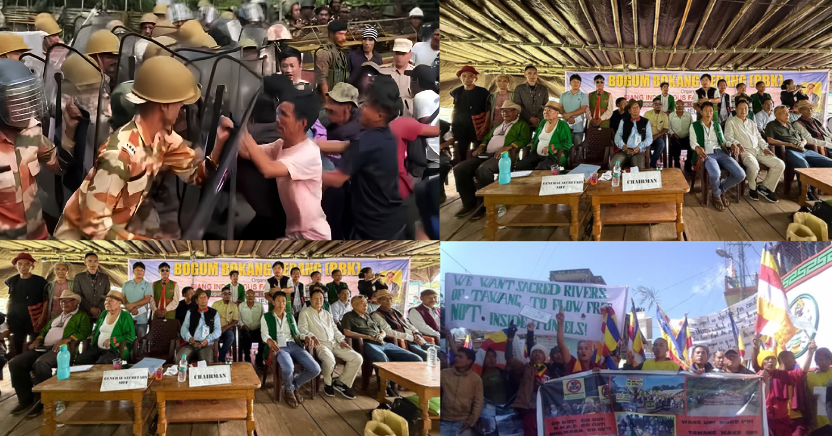
At the LANDac conference in early July, Atribh Deka presented a powerful paper on hydropower, climate risk, and the renegotiation of land rights in Arunachal Pradesh, India. His research focused on three Indigenous and tribal communities—the Adi, Idu Mishmi, and Monpa—and the ways they have resisted large hydropower projects framed by the state as climate action, renewable energy, development, and national security.

The presentation raised a question that reaches far beyond India’s eastern Himalayas: when governments describe large infrastructure projects as necessary for the climate transition, whose land is made available, whose law is recognized, and whose authority counts?

Atribh’s answer is unsettling and important. In Arunachal Pradesh, resistance is not simply opposition to dams. It is a struggle over legal visibility. It is a challenge to the assumption that state law alone defines land, development, legitimacy, and the future of Indigenous territories.

Climate action on contested land

Arunachal Pradesh sits in India’s eastern Himalayas and holds an estimated 40 percent of the country’s hydropower potential. The state has signed more than 160 memoranda of understanding for large dams, with projected capacity of roughly 63,000 megawatts. Yet Arunachal Pradesh’s own electricity demand is far smaller. This imbalance raises serious questions about who benefits from hydropower development and who bears its social, ecological, and territorial costs.

The state’s case for hydropower rests on several overlapping arguments. Dams are presented as renewable energy infrastructure, a contribution to India’s national climate goals, a source of development, and, in a border region with China, an assertion of national security. Each of these arguments carries political weight. Together, they can make opposition appear unreasonable, anti-development, anti-environment, or even anti-national.

This is where Atribh’s analysis is especially valuable. He shows that “green development” is not a neutral category. Climate urgency can become a language through which dispossession is made harder to contest. When hydropower is treated as an unavoidable technical necessity, Indigenous concerns about land, forests, rivers, sacred sites, and customary authority are easily recast as obstacles to progress.

The issue is not whether renewable energy matters. It does. The issue is whether climate action can be considered just when it proceeds by weakening or ignoring the rights of the people whose territories make that action possible.

Law from below

Atribh uses the concept of “law from below” to describe how communities mobilize customary legal orders, collective institutions, spiritual obligations, public refusal, conservation strategies, and litigation to challenge the state’s monopoly over law and territorial governance.

This framing matters. Too often, Indigenous resistance is described as protest, grievance, or reaction. Atribh’s research asks us to see something more precise: communities are not merely resisting state law from the outside. They are asserting their own legal and political authority.

This is not a romantic claim that customary systems are simple, pure, or uncontested. Like all legal systems, they are shaped by power, history, gender, generation, and conflict. But they are legal orders nonetheless. They structure decision-making, allocate responsibilities, define relationships to land and water, and determine what can or cannot be done in a territory.

The state may fail to see these systems, but that does not mean they do not exist.

Three communities, three forms of resistance

Atribh’s presentation examined three cases. Each community used a different strategy. Together, they show that resistance does not take one form.

The Adi, in the Siang Valley, have resisted the proposed Upper Siang Multipurpose Project, an 11,200-megawatt project that Atribh noted would threaten 27 Adi villages. Their resistance has centered on the Kebang, a long-standing system of community governance. The Kebang is not merely a meeting format. It is a legal and political institution through which collective decisions are made and binding obligations are established.

In the Adi case, resistance has included collective resolutions, refusal to negotiate, blocking survey operations, dismantling temporary access routes, and ritual practices connected to the Siang River. These actions are often read externally as protest or disruption. Atribh invites us to read them differently: as forms of legal enforcement grounded in Adi authority, moral obligation, and territorial responsibility.

The Idu Mishmi, in the Dibang Valley, pursued a different path in relation to the Etalin Hydroelectric Project. Rather than relying primarily on direct protest, they drew on customary stewardship and conservation law. In 2022, community clans declared the Elopa-Etugu Eco-Cultural Preserve over 70 square kilometers of ancestral territory. This move connected Indigenous governance with international conservation frameworks, including principles recognized under the Convention on Biological Diversity.

This is a striking example of strategic legal engagement. The Idu Mishmi did not simply say no. They advanced a different vision of conservation: one grounded in customary taboos, ecological knowledge, and community authority. In December 2022, India’s Forest Advisory Committee declined forest clearance for the Etalin project, citing biodiversity concerns and Indigenous representations. This did not permanently settle the larger political question, but it did change the administrative terrain on which the project could proceed.

The Monpa, in the Tawang Valley, mobilized sacred geography and formal legal procedure against the Nyamjang Chhu project. The proposed project threatened landscapes associated with Buddhist pilgrimage, including areas connected to the black-necked crane, revered locally and linked to the 6th Dalai Lama, who was born in Tawang. The Save Mon Region Federation used the Right to Information Act to obtain government documents and expose omissions in environmental assessments. The case then moved through the National Green Tribunal, which suspended environmental clearance in 2016 and criticized the failure to properly assess impacts on the crane and its habitat.

Here again, resistance operated across registers: sacred law, ecological concern, administrative transparency, and formal litigation. The project remains stalled.

Effectiveness is not only victory

One of the most important contributions of Atribh’s research is that it does not measure resistance only by whether a project is permanently stopped.

That is too narrow a test.

Resistance can be effective when it delays destructive decisions. It can be effective when it forces environmental assessments to take Indigenous knowledge seriously. It can be effective when it exposes flawed procedures. It can be effective when it compels officials to justify actions that might otherwise have been imposed without meaningful scrutiny. It can be effective when it creates time for alliances, documentation, public debate, and legal strategy. It can be effective when it changes the terms of what the state must recognize.

In the three cases Atribh presented, Indigenous resistance produced tangible effects. Survey operations were suspended. Forest clearance was denied. Environmental clearance was stayed. The state was required to respond, reassess, explain, and negotiate.

These are not symbolic outcomes. They are governance outcomes.

This matters because communities facing land-based infrastructure often confront impossible standards. If they block a project, they are dismissed as anti-development. If they go to court, they are told they are relying on the same system that marginalizes them. If they use conservation law, they risk entering alliances that have historically excluded Indigenous Peoples from their own territories. If they perform rituals, invoke sacred relationships, or rely on oral legal traditions, their claims may be treated as culture rather than law.

Atribh’s research shows that each of these forms of resistance can matter. Direct action, customary assemblies, ritual authority, conservation designations, transparency laws, administrative complaints, and litigation are not separate from governance. They are ways communities force governance to happen.

The danger of climate language without tenure justice

The climate transition is increasing pressure on land. Hydropower, solar parks, wind corridors, carbon markets, conservation areas, restoration initiatives, and transition mineral supply chains all require territory. Many are justified in the name of urgent global goals. Some may be necessary. But none should be allowed to bypass the rights of Indigenous Peoples, local communities, pastoralists, smallholders, or others whose land and resource rights are insecure or weakly recognized.

Atribh’s presentation makes clear that climate language can become a technology of dispossession when it narrows public debate. If a project is labeled “green,” questions about land, consent, governance, sacred sites, forests, fisheries, livelihoods, and identity are too often pushed aside. The urgency of climate action is then used not to deepen democracy, but to compress it.

That is a mistake.

Climate action that ignores tenure security is not only unjust. It is fragile. Projects imposed without recognition, consent, transparency, and credible safeguards generate conflict, delay, reputational risk, ecological harm, and legal uncertainty. The lesson from Arunachal Pradesh is not that every hydropower project must be rejected. The lesson is that no climate project should proceed by pretending that Indigenous law, authority, and territorial relationships are invisible.

From recognition to negotiation

Atribh’s central insight is that law from below does not necessarily replace state law. Instead, it forces state law to confront what it has excluded. It compels the state to govern through negotiation rather than unilateral authority.

That distinction is crucial.

The demand is not simply for consultation after decisions have already been made. It is not a request for compensation after land has already been categorized as available. It is not a plea for cultural sensitivity at the margins of infrastructure planning. It is a deeper challenge: who has the authority to define land, climate responsibility, development, and the future of a territory?

For TenureSecurity.org, this is exactly the kind of question that must sit at the center of global land governance debates. Land rights are not only about documentation, registration, or administrative reform, although those can matter. They are also about power. They are about whose knowledge shapes decisions, whose institutions are recognized, whose histories are treated as legally relevant, and whose futures are negotiable.

The resistance of Indigenous Peoples is often portrayed as a barrier to development. Atribh’s research suggests the opposite. Resistance can be a diagnostic tool. It shows where governance has failed. It reveals what official procedures have ignored. It exposes the distance between climate rhetoric and territorial justice. And, in many cases, it creates the only meaningful opportunity for better decisions to emerge.

What this research asks of us

Atribh ended with open questions about the durability of procedural wins and the future of customary authority across generations. These questions are important. A stalled project can be revived. An administrative victory can be narrowed. A court ruling can remain unenforced. Customary institutions can be weakened by internal inequality, state co-optation, demographic change, or generational erosion.

But uncertainty should not lead us to underestimate what these communities have already achieved.

The Adi, Idu Mishmi, and Monpa cases show that resistance is not one act, one lawsuit, one blockade, or one declaration. It is a field of practice. It is legal, political, ecological, spiritual, and strategic. It can happen inside the system, outside the system, and across systems at the same time.

That is why it can be effective.

In a world racing to build the infrastructure of the climate transition, this research offers a necessary warning and a constructive path forward. The warning is that climate urgency can become a cover for dispossession. The path forward is that just climate governance must begin with the recognition of Indigenous and customary authority, not as an accommodation granted by the state, but as a structural requirement for legitimate decision-making.

Secure land and resource rights are not an obstacle to climate action. They are one of the conditions that make climate action just, durable, and accountable.


Tilling without Title: Why Millions of Women are Left Out as Farmers

By Shipra Deo, My-Lan Dodd, and Jennifer Brown

We thrive because farmers provide! Farmers nurture the land with love and trust so we can all get our meals.

Of the 1.23 billion people employed in the world’s agri food systems, nearly half are women. While these women work on the soil all their life, they remain invisible and unheard as farmers. And their journey in agriculture is very different from that of men.

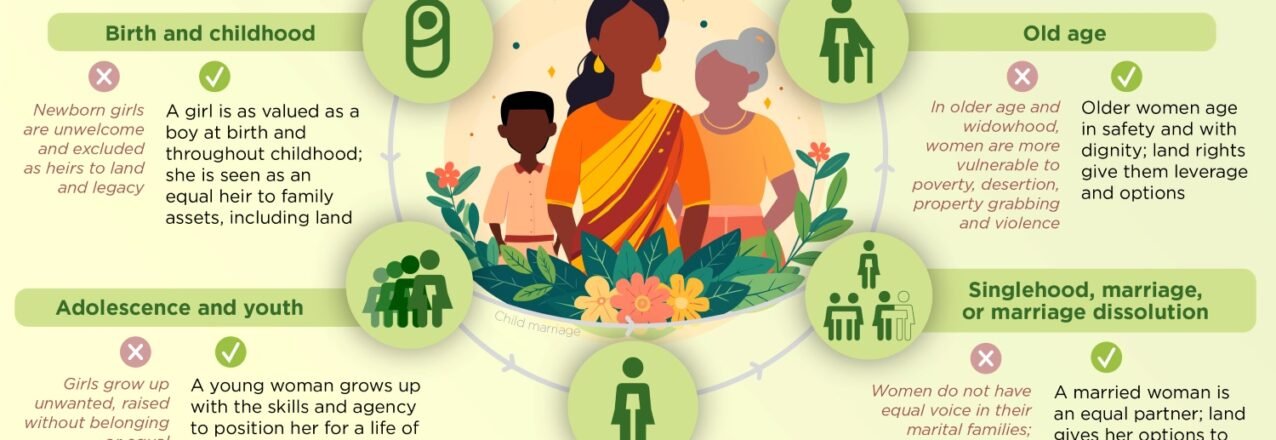
For a woman farmer to truly thrive, her relationship with land must be seen across her life – not only during the times she cultivates. From birth through her adolescence and into adulthood and her twilight years, land can be a cornerstone for agency, opportunity, and dignity. A lifecycle approach to women’s land rights ensures that the protections they confer do not appear only at moments of crisis – such as at death or divorce — but accompany women throughout their lives.

But social perceptions, family dynamics, and cultural practices too often place her on a different path, limiting what should rightfully be hers.

A girl born into a farming family

She may have been unwanted in her family, as farming communities in many parts of the world usually prefer a newborn to be a boy rather than a girl. Born unwanted, she grows up amid neglect and indifference.

She helps her mother and the family sow seeds, fetch water, tend goats, or harvest produce. She also takes care of younger siblings as her mother works the farm. Her labor is essential for the household, as is her mother’s, but is rarely recognized as “real farming.”

While she grows up hearing that she will marry and move out of the birth family one day, her brother may grow up hearing that the land on which the family lives and farms will belong to him, not to his sister.

This early message shapes everything that follows. She internalises that she is of lesser value than the men.

A landless worker in adolescence and adulthood

As she enters adolescence, instead of looking forward to managing the family’s land and dreaming big, she prepares to leave her family’s land and house, anxious about what lies ahead. Without the security of assets to build her life on, her future choices narrow. Her education may stop early, and she may be married before she reaches the legal age of marriage, often without her consent or choice.

In her husband’s family, she continues to do labor on the farm, but her work is seen as the extension of household work. The land and farm she sustains still does not belong to her. She is not seen as a farmer and is largely absent from farmer census data or land statistics.

The pattern is the same across regions and cultures: girls and women contribute significantly to agriculture but remain invisible as farmers.

Because of her invisibility as a farmer, she is rarely the subject of or considered in agricultural policies or farm laws. Research in agriculture is not attuned to her needs or contexts. Men’s needs and realities aren’t merely prioritized, they are the default.

Without ownership or secure rights, she faces constant and compounding constraints. She cannot easily access credit, subsidies or insurance, which are all linked to land ownership. She is overlooked for training and extension services. She is unable to make sustainable investments in agriculture – either to control soil erosion or to increase water use efficiency.

She farms every day, but decisions about land and livelihoods are made by others — husbands, fathers, sons or community leaders. She has no security.

She is more vulnerable to violence in the fields and on the way to fields and markets – by landowners or farm managers and in public places. She is also more vulnerable to abuse in her own family – by intimate partners, in-laws, or extended family.

Meanwhile, men are much more likely to have agency over their land and livelihoods, and can move freely through the world.

When marriage, divorce, or widowhood hits

If her marriage ends — through divorce, separation, or abandonment — she may lose access to the very fields she cultivated for years. If widowed, she may face eviction by in-laws or relatives claiming the land or home. In either case, she may struggle to feed her children and to sustain herself.

When she doesn’t have land, old age brings dependence and insecurity. Without assets, she is at the mercy of others for her livelihood and care.

A different future is possible

Now imagine a different story.

A girl in a farming family grows up knowing she will inherit land equally with her brother. She learns farming not just as labor, but as a skill and business, and this knowledge makes her confident in taking decisions.

As an adult, she holds land in her own name, accesses credit, joins cooperatives, and invests confidently in her soil and the opportunities that spring from it.

She takes informed decisions about marriage. She negotiates her space with dignity and confidence.

She doesn’t endure abusive relationships because she has meaningful options. She stands up for herself throughout her adulthood and in old age, her land sustaining her with dignity.

When women have this kind of security and assurance, communities around the world are positioned to fully thrive.

As we mark the International Year of the Women Farmer, it is important to recognise that land rights are the cornerstone of a more stable and peaceful future for women farmers. They are rights and protections that give women a firm, legally recognized foundation that accompanies them throughout their life, allowing them to live a life with strength and dignity. By adopting a lifecycle approach to land rights, we keep this important reality firmly in sight and help millions more women and their families thrive.

Download Land Shapes Her Life [Infographic] Read Land Empowers: Life-cycle approach to girls’ and women’s land rights [Issue Brief]

This blog was originally posted on the Landesa website and is posted here with the permission of Landesa.