

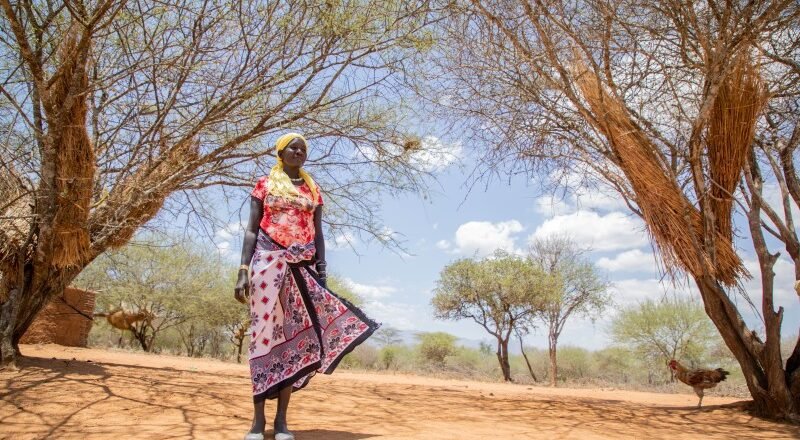
This blog was developed in collaboration with Hannah Longole of the Ateker Cultural Center and Stella Akol Lokeris, Stand for Her Land Uganda Coalition in advance of the UNCCD Conference of Parties 17.
Pastoralist women in Karamoja are running out of land and running out of time. The answer to the land crisis is already in the community. But women need rights to take effective action.
“We shall shift and go to another area.”
For generations, movement has been the answer in Karamoja, Uganda: when the rains failed, when the soil dried and cracked, when the grasses withered and the livestock grew thin. Pastoralist communities are mobile by design – their way of life is an adaptation to the land’s rhythms. But those rhythms are breaking down.
The dry seasons stretch longer. The single short wet season from May to July brings less and less rain. The stronger winds follow accompanied with high temperatures which fail crops.
“Now rainfall comes after the crops have already failed because of the heat,” says Nate Betty from Ngoleriet Sub County, Napak District.
And the places people can go to find fertile land are shrinking due to both climate change and a rush to convert customary grazing lands. Powerful elites and land speculators are claiming communal rangeland for mineral extraction and private use. The customary lands are not protected by law; the law, in fact, encourages their conversion from customary to freehold.
As Dr. Mark Ilukol, a local veterinary doctor and researcher, warns: “The areas to shift to when the dry conditions bite hard have diminished – the grazing land is gone.”
When men follow the cattle to distant pastures, women are left behind. Farming – the alternative when herding becomes impossible – is barely viable on increasingly exhausted, degraded soil. Women are often pushed off the land entirely. Without legal rights to the family’s land, a woman’s home, her fields, and her livelihood depends on the goodwill of her husband’s family. When that goodwill runs out, she has nothing.
In this environment, hunger in Karamoja is not exceptional. It is the season. The staple crop is sorghum, but heat and drought cause it to fail. Women gather wild bush fruits to feed their children. Both women and children skip meals. According to national data, 62.9 percent of households in Karamoja are food insecure as a result of climate-related challenges.
“There is a lot of hunger due to high temperatures, which dry up crops in gardens even before flowering,” says Achia Lucy from Nadunget Sub-county, Moroto District.
This is one story from Karamoja, Uganda. It is also the story of millions of women across the drylands of Africa, Asia, and Latin America – women who are simultaneously the most affected by land degradation and the most capable of reversing it. She is the user of the land. Her rights must be enforced to steward it, protect it, restore it.
The Answer Is Already Here
Ask any pastoralist woman in Karamoja what the land needs and she will tell you. She has watched the soil for decades. She knows which grasses hold it together. She knows where the water used to pool. She knows what the land looked like before, and she can imagine what it could look like again.
Research and field evidence consistently confirm what these women already know: when women have secure rights to land, they invest in it. They plant trees. They protect soil. They adopt sustainable practices and pass them to their daughters. They can more effectively adapt to drought and other climate change impacts. Women’s land tenure security is central in the fight against land degradation.
The United Nations Convention to Combat Desertification (UNCCD) recognizes this. Its core target, land degradation neutrality (LDN), cannot be achieved without women’s meaningful participation in land governance. The UNCCD’s own Gender Action Plan (2022–2030) calls for integrating women’s land rights into national land restoration strategies.
The framework exists. The evidence is clear. What is missing is implementation.
Three Things That Must Change
Hannah Longole and Stella Akol Lokeris, leaders from the Stand for Her Land Uganda Coalition, have spent years working in Karamoja, advocating for the rights of women pastoralists, connecting the realities of the land to the decisions of governments. They are clear about what needs to happen.
First, awareness. Community sensitization, including dialogue with elders and traditional leaders, is essential to shift the norms that keep women off land and out of decision-making. We need to work on the mindset and change behavior in communities. Women cannot effectively steward land they are not allowed to own.
Second, policy that reaches the ground. Uganda has laws protecting women’s land rights. In Karamoja, and in communities across the Global South, those laws remain paper promises. Strong national policies must be translated into local practice through sustained advocacy, monitoring, and accountability. The law should say women and girls have a right to inherit and own family land and that a woman has a right to pass that inheritance to both her daughter and her son.
Third, technical support and learning spaces. Women need demonstration sites and learning centers where they can train in land restoration practices — and train each other. A place of their own, where knowledge grows collectively and skills are passed on. An example of this can be seen from the remarks of Vice President Jessica Alupo at the launch of the African Pastoralist Women Network (ARPWN ) and Learning Centre which advance gender justice, climate resilience and equitable land governance.
What Is Possible: A Story of Land Restored
Proof of what women can achieve when given the rights and resources exists close to home. Kaynela Farms, established by Ms. Peace Kayesu in Uganda, began as a family farm and has grown over ten years into a model of sustainable and organic agriculture.
Using crop rotation, companion planting, and a closed-loop system that converts livestock manure into biogas and fertilizer, Peace has transformed her land into a space that produces high-quality food, supports ecotourism, and keeps alive pastoralist culture and traditional foodways. It is what becomes possible when a woman has the right to stay on the land, invest in it, and build from it.
Climate Change, Land Restoration, and Gender Equality Are One Fight
Climate change, food insecurity, and gender inequality are connected problems requiring connected solutions. In Karamoja, they arrive together: the drought that dries the pasture is the same force that displaces a woman from her home when her husband leaves and does not return. The degraded soil that cannot grow crops is the same soil a woman could restore, if she had the right to stay on it, the legal protection to invest in it, and the community support to do so.
This is why Stand for Her Land exists: to make the connection visible, and to drive governments and global institutions to address them both together.
Take Action
The women of Karamoja are not waiting to be rescued. They are organizing, advocating, and restoring land – every day, with whatever they have. What they need is the world to match their commitment.
Support grassroots women’s organizations and pastoralist communities doing land restoration work. Advocate for women’s land rights to be included in your country’s land degradation neutrality plans. Demand that global climate and land funding reaches the women who are already doing this work, such as through the Pan-African Women’s Charter for Rangelands and Pastoralists.
Protect communal grazing land through environmental and grazing land practices that promote rangeland conservation. Support the review of legal frameworks on land management, such as the Ugandan Land Act and National Land Policy, to strengthen women’s ownership of land.
Create a mindset change within the communities on women’s land rights and ownership of land to promote land restoration. This mindset change will calm the rigid cultures that prohibit women from owning land.
Because the answer to “Who will restore the land?” is already standing in the field, carrying water, gathering fruit, and waiting for the world to catch up.
Join the Stand for Her Land network using the form below and see S4HL Uganda’s work here.
This blog was originally posted on the Landesa website and is posted here with the permission of Landesa.