

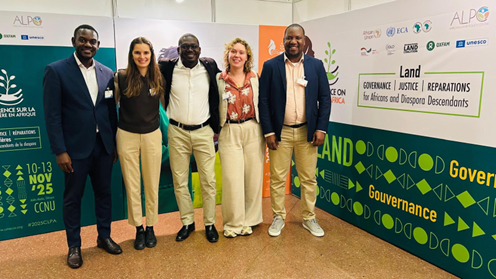
By Aoife Ossendorp, Simon Peter Mwesigye, Borges Chivambo, Mahamat Abdoulaye Malloum
Introduction
Across Africa, conflict, climate change, and political instability continue to drive forced displacement at unprecedented levels. As people are uprooted, whether as refugees or internally displaced persons (IDPs), questions of land access, tenure security, and coexistence with host communities become central to peace, resilience, and long-term development. Yet land governance systems are often ill-equipped to manage these pressures, particularly in fragile contexts where customary and formal systems overlap. There are clear opportunities to not only respond to displacement through strengthened land governance, but also reduce future displacement by addressing the cycle between land insecurity, conflict, and environmental stress.
This challenge was at the heart of a recent side session hosted at the Conference on Land Policy in Africa (CLPA 2025) on “Strengthening Land Governance for Displaced Communities”, which brought together experiences from the LAND-at-scale programme in Uganda, Mozambique, and Chad. The session created space for practitioners, policymakers, and civil society actors to reflect on what works and what still needs to change when land governance meets displacement.

Displacement and Land: A Shared Challenge, Diverse Contexts
Despite the diversity of country contexts, a common thread emerged: displacement places immense strain on land systems, often exposing gaps in policy, regulation, and practice. These gaps disproportionately affect women, youth, and other vulnerable groups whose land rights are frequently informal, unrecognised, or contested.
The LAND-at-scale programme works at this intersection, supporting fit-for-purpose land administration, participatory land use planning, policy development, and addressing tenure security in fragile and displacement-affected settings. Through country case studies, the session highlighted how tailored, context-specific approaches can contribute to conflict prevention and social cohesion.
Chad: Pastoralism, Conflict, and Inclusive Land Delimitation
In Chad, Mahamat Abdoulaye Malloum (Kadaster International) shared insights from work in pastoral areas where land use is highly dynamic and deeply embedded in social relations. The coexistence of farmers, pastoralists, and refugees,particularly those fleeing conflict in neighbouring Sudan, is increasingly under pressure. Where in the past pastoralists respected local laws, now new groups of agro-pastoralists has increased tension between communities. Furthermore, this is heightened by the existing pressure on natural resources in the face of climate change.
Land governance provides an entry-point to addressing these tensions. Fit-for-purpose land administration has been used as an entry point to address displacement by integrating social data, recognising pastoral corridors, and mapping sacred and shared-use areas often excluded from formal systems. This approach goes beyond technical mapping, focussing on dialogue and participation across these different stakeholders. Malloum stressed that land delimitation must be sensitive to power dynamics and evolving social norms, especially as new actors enter pastoral systems and traditional conventions weaken. Strengthening dispute resolution mechanisms is therefore critical as communities and land use patterns continue to change.
Mozambique: Conflict, Climate, and the Absence of Regulation
Borges Chivambo (Centro Terra Viva – CTV) highlighted Mozambique’s dual displacement drivers: armed conflict in the north and climate-related disasters such as floods and cyclones. While both IDPs and host communities have rights, Mozambique lacks clear regulations governing resettlement and compensation for displacement caused by conflict or natural disasters. Regulations currently focuss on compensations for (private) investments alone. In practice, this regulatory vacuum leaves government authorities improvising, often without consulting host communities on the exact terms and rights of IDPs and hosts.
Secondly, in the face of disaster, individuals and communities without tenure security have spoken of apprehension to leaving their homes in the fear of someone occupying or claiming the land in their absence. This has resulted in situations where people have kept themselves in unsafe areas, despite encouragement to leave. In cases where people have fleed and been provided shelter in hosts communities, many displaced people then fear returning to their land due to the probable risk of others having claimed it, with little ability to prove prior rights. Thus, situations arise where after 10 years, IDPs are still part of hosts communities and never return, which contrasts to initial expectations of host communities. Adding to that, it is worth mentioning that according to the land law in use, one of the ways to acquire the Land Use Rise is through occupation in good faith for a period of 10 years by individual nationals.
LAND-at-scale’s contribution in Mozambique has focused on prevention and advocacy – strengthening land use planning, raising legal awareness, and pushing for regulatory reforms that clarify responsibilities, compensation, and tenure security. As Chivambo emphasised, without clear legal frameworks, even well-intentioned humanitarian responses can sow the seeds of future conflict.
Uganda: Hosting Refugees and Managing Growing Pressure on Land
Uganda’s progressive refugee policy was a focal point of Simon Peter Mwesigye’s (GLTN/UN-Habitat) presentation. Refugees are integrated into host communities and allocated land to support self-reliance – a model widely praised internationally. However, with over 1.5 million refugees, pressure on customary land, forests, and water resources is intensifying. Plot sizes have shrunk, competition over resources is increasing, and host communities often feel that refugees receive disproportionate support, heightening tensions.
LAND-at-scale is addressing these challenges by securing host community land rights, supporting participatory land use planning that includes both refugees and hosts, and strengthening joint refugee and host community conflict resolution committees. Importantly, the Uganda case also highlighted the link between land governance and climate resilience. Secure land rights encourage sustainable land use practices and long-term investments in land- such as tree planting, wise use of wetlands and soil conservation practices- which can help prevent land degradation and future climate-induced displacements. Thus, by protecting the resources for future generation, possible future displacement can be mitigated.
A Chief’s Perspective: Our Joint Responsibility of Care
The session was enriched by His Highness – Stephen Drani Izakare, who has received and hosted refugees in his own Madi Chiefdom in West-Nile, Uganda. Recognising the challenges mentioned in the three presentations, he stressed the importance of our responsibility of care towards each other. It should not be seen as optional to take ones neighbour into your home in their time of need, especially since many are fleeing from hunger and/or violence. We should have empathy, and to be a host is an honour. He therefore stressed the importance that land governance should have a clear integration of traditional authorities to adress tensions between groups and strengthen dispute resolution mechnanisms, while keeping humanity central.
Cross-Cutting Reflections: Balancing Rights and Social Dynamics
A critical reflection running through the session was that providing assistance without formalisation can unintentionally create conflict. When displaced people stay for extended periods without clear tenure arrangements, informal hospitality can evolve into contested claims. At the same time, granting rights to one group without addressing the needs of others risks deepening tensions.
Participants emphasised the need to balance legal rights with social realities, recognising that land governance is not only about rules and titles but also about relationships, trust, and long-term co-existence. Strengthening dispute resolution, aligning humanitarian, land, and environmental policies, and ensuring development benefits all groups – not just displaced populations – are essential steps forward.
Land Governance as Transformative Role in Displacement Contexts
The experiences shared from Chad, Mozambique, and Uganda show that strenghened land governance can play a transformative role in displacement contexts – supporting peacebuilding, resilience, and social justice. But this requires political will, coherent legal frameworks, and sustained collaboration between governments, communities, and international partners.
As displacement continues to shape Africa’s development landscape, initiatives like LAND-at-scale offer valuable lessons on how land governance can be part of the solution – rather than another source of conflict.

A special thanks to the speakers Simon Peter Mwesigye (GLTN/UN-Habitat), His Highness, Stephen Drani Izakare, Borges Chivambo (CTV), and Mahamat Abdoulaye Malloum (Kadaster International) and moderator Aoife Ossendorp (RVO).
The LAND-at-scale programme is a land governance support programme financed by the Ministry of Foreign Affairs of the Netherlands and managed by The Netherlands Enterprise and Development Agency (RVO). Want to hear more about the session or about the work of the LAND-at-scale programme? Get in contact via landatscale@rvo.nl or follow us on LinkedIn.
Program: LAND-at-scale.
Related projects: LAND-at-scale Chad: Land reform and tenure security, LAND-at-scale Chad: Towards inclusive land governance, LAND-at-scale Uganda: Community-based land registration and land use planning, LAND-at-scale Knowledge management: LANDac contribution, LAND-at-scale Knowledge management: International Land Coalition contribution, LAND-at-scale Knowledge management: KIT support to country partners, LAND-at-scale Knowledge management: Land Portal strategy support, LAND-at-scale Mozambique: Community land rights and climate resilience, LAND-at-scale Mozambique: Community land rights certification in municipal areas.
Original image CLPA LAS.
Originally published on the Land Portal. Creative Commons Attribution 4.0 International.