

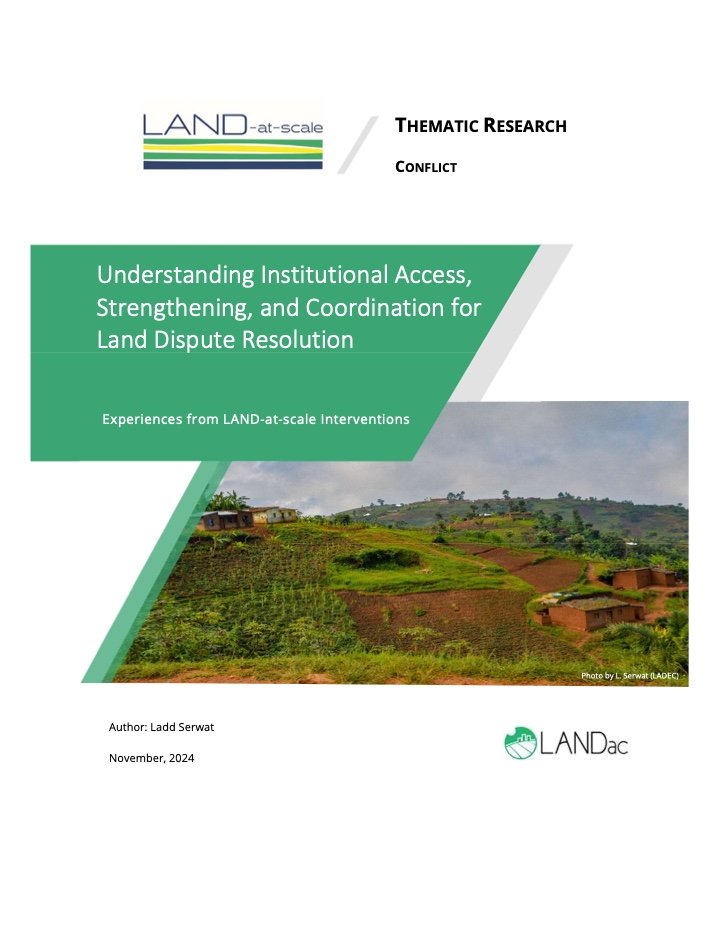
Experiences from LAND-at-scale Interventions
Download the complete publication (PDF)
Abstract
Considering the challenges of conflict management, mediation, and dispute resolution in numerous countries, several LAND-at-scale (LAS) interventions aim to strengthen and improve access to institutions of dispute resolution. Recent LAS interventions build on previous efforts since 2002 by the Netherlands Ministry of Foreign Affairs to strengthen land tenure security, increasingly recognising durable and equitable solutions, especially for marginalised people.
Further, LAS acknowledges the need for flexible interventions to fit differing local contexts, the importance of institutions beyond the statutory judicial system, and necessary support from numerous stakeholders. Drawing on feminist and institutional perspectives, this paper conducts a literature review on dispute resolution and access to justice in settings of legal pluralism and uses desk-based research of LAS project documents from seven selected countries and interviews with key stakeholders to distil emerging insights on conflict resolution mechanisms and access to justice, identifying ways forward for land governance interventions.
Considering the challenges faced by past development programming to operate within pluralistic land tenure regimes, the review considers how LAS policies have uniquely navigated these environments or fallen into similar patterns.
Building on feminist institutional understandings of power dynamics, this paper shifts actors and power to the forefront of analysis. I argue the capacity of an institution to resolve a land dispute is primarily dependent on the power relations between actors involved as disputing parties and mediators. This argument considers the rate of dispute resolution with the actors who can(not) access these institutions and coordination of institutions at different administrative levels. Far from ignoring the type of land, competing interests, or uses of a parcel, this argument relies on perspectives from legal pluralism to better understand the specific factors which influence the number, geography, and resolution rate of disputes. The findings allow for further tailored policy approaches and potential changes to support these groups and highlight challenges.
Publication details
- Author
- Ladd Serwat
- Publisher and contributing organizations
- LANDac, Netherlands Enterprise & Development Agency
- Publication date
- November 2024
- Language
- English
- Extent
- 29 pages
- Geographic focus
- Global
- Subjects
- Land & Conflicts Land & Gender · gender equity in access to land land governance post-conflict settings conflicts land conflicts land dispute resolution women
- Resource type
- Reports & Research
Program: LAND-at-scale.
Related projects: LAND-at-scale Burundi: Amahoro at Scale, LAND-at-scale Chad: Towards inclusive land governance, LAND-at-scale Mali: Managing land conflicts and protecting customary rights, LAND-at-scale Mozambique: Community land rights and climate resilience, LAND-at-scale Rwanda: Access to justice and land dispute resolution, LAND-at-scale Somalia: Saameynta – Scaling up solutions to displacement, LAND-at-scale Uganda: Community-based land registration and land use planning.
Original publication credited to Ladd Serwat. Cover reproduced from the first page. Creative Commons Attribution–NonCommercial 4.0. Land Portal source record.