

At LANDac 2026, the session “Tenure Renegotiation as Adaptive Governance at the Intersection of Climate and Conflict” brought together sharply different examples of how climate change is reshaping land governance.
Chaired by Carolien Jacobs, Assistant Professor at the University of Leiden, the session included Maria Muianga from Terra Firma on community-led tenure responses to climate displacement in Mozambique, Gaynor Paradza from the Public Affairs Research Institute on municipalities and the land dimensions of South Africa’s just transition, and Francesca Marzatico from the University of Otago on land-use change, environmental governance, and Indigenous Peoples in Aotearoa New Zealand.
The discussion was valuable not because the cases were directly comparable, but because they were not. They showed how easily the language of “adaptive governance” can flatten very different realities.
In an advanced economy such as New Zealand, debates over Indigenous rights, conservation, carbon sequestration, and land-use change take place within a relatively strong institutional environment. That does not mean the issues are simple, or that historical injustices have been resolved. But the legal, fiscal, administrative, and political context is fundamentally different from the situation facing many communities in Mozambique or South Africa.
That distinction matters. If we treat all cases of adaptive governance as variations of the same problem, we risk missing the conditions that determine whether adaptation strengthens rights or weakens them.
Mozambique: adaptation as negotiation under pressure
Maria Muianga’s case showed adaptation in its most immediate form. Floods, cyclones, droughts, displacement, and changing wildlife dynamics are altering where people live, how they access land, and how communities relate to conservation areas.
In Nhamatanda, communities near Gorongosa National Park are increasingly facing conflict with elephants. This is not an abstract environmental issue. Elephants damage crops, threaten lives, and change how people move, farm, and plan settlements. Climate change does not only affect rainfall or temperature. It changes relationships between people, land, water, forests, and wildlife.
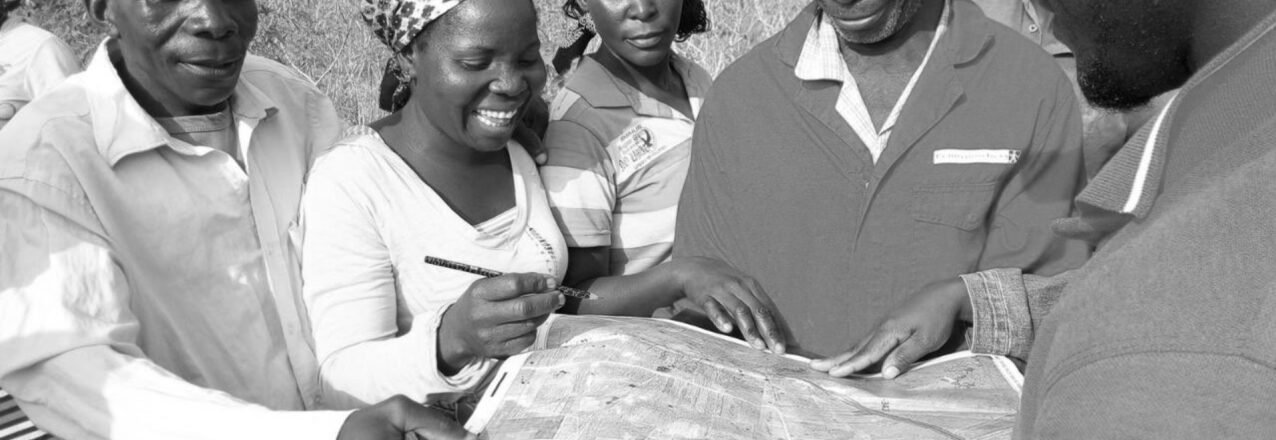
Muianga presented CaVaTeCo as a community-led approach that combines participatory delimitation, community validation, rapid documentation, and territorial planning. What stood out was not only the use of maps, but the way mapping becomes part of local governance. Community members gather information, identify vulnerable areas, map household parcels and water sources, and use that evidence to discuss future settlement and land-use options.
This is the kind of work that deserves more attention. Too often, land governance is treated as if the main challenge is to formalize rights from above. But in many rural areas, people are already negotiating access through local rules, customary institutions, neighbor-to-neighbor arrangements, and social recognition. These systems can be unequal and contested, especially for women, young people, displaced people, and households with weaker social standing. But they are not empty or chaotic spaces waiting for formal systems to arrive.
The Mozambique example also challenges a simplistic view of resettlement. Formal resettlement may be part of the story, but it is not always how people actually access land. Communities may rely on local leaders, household arrangements, borrowing, purchase, donation, or negotiated access. If climate adaptation ignores these practices, it may undermine the very arrangements that are helping people manage displacement and pressure.
The point is not to romanticize customary systems. The point is to understand them before intervening.
South Africa: the just transition is also a land transition
Gaynor Paradza’s presentation brought another essential dimension into focus: the just transition cannot be understood only as an energy issue.
Renewable energy infrastructure, transmission corridors, mining transitions, carbon projects, conservation offsets, and new investment zones all require land. Each one raises practical questions: whose land is being used, whose rights are recognized, who is consulted, who benefits, and who carries the risks?
In South Africa, these questions are inseparable from the country’s history of dispossession and spatial inequality. Land is not just a planning resource. It is a site of unresolved justice.
Paradza emphasized the role of municipalities because they are often closest to communities and responsible for spatial planning, land-use management, infrastructure, and local development. Yet municipalities may not control much of the land in their jurisdictions. They may also lack integrated land information systems, staff capacity, financing, or clear authority to manage competing claims.
This creates a dangerous gap. Municipalities are expected to respond to climate change and help facilitate transition investments, but they may not have the tools to protect people whose rights are legitimate but undocumented or poorly recorded.
A just transition that ignores tenure insecurity is not just incomplete. It risks becoming unjust in practice. If land is treated as “available” because people do not hold registered title, the transition can reproduce historical exclusion under the banner of climate action.
That is why public participation, consent, and recognition of unregistered rights cannot be treated as administrative steps at the end of a planning process. They must shape the process from the beginning.
New Zealand: useful lessons, limited transferability
Francesca Marzatico’s case raised important questions about how law, environmental policy, carbon incentives, conservation tools, and land-use decisions interact over time. That kind of analysis is useful. It reminds us that climate and conservation policies can produce unintended land-use outcomes, even in countries with stronger administrative systems.
But the comparison has limits.
New Zealand’s experience with Indigenous rights, Treaty processes, land-use regulation, and environmental governance may offer insights into how legal frameworks shape landscapes. It should not, however, be treated as a model that can be applied directly to communities facing climate displacement, poverty, weak services, limited legal access, or immediate livelihood insecurity.
This was the central tension I took from the discussion. In New Zealand, the question may be how to align environmental incentives, legal obligations, and Indigenous rights within a relatively well-resourced system. In Mozambique, communities may be deciding whether to preserve trees for a future carbon benefit or cut them now for fuel, food, income, or shelter. In South Africa, municipalities may be asked to plan a just transition while still grappling with apartheid-era land inequality and fragmented authority.
Those are different problems. They require different forms of governance.
The lesson from New Zealand is not irrelevant. It is simply not sufficient. It can help us ask better questions about law, incentives, evidence, and accountability. But it should not become a template for places where the social contract, institutional capacity, and everyday risks are profoundly different.
Context is not a footnote
The most useful conclusion from the LANDac session is that climate adaptation will increasingly involve tenure renegotiation. People will move. Land uses will change. Wildlife patterns will shift. Conservation areas will come under pressure. Carbon and renewable energy projects will expand. Local governments will be asked to manage competing claims with limited resources.
The question is whether this renegotiation happens with rights holders or to them.
For TenureSecurity.org, this is where the land governance debate needs to be sharper. We should ask who has rights, who has information, who has authority, who gets heard, who benefits, and who bears the costs. We should be careful with language that sounds progressive but hides unequal power. “Participation” is not the same as consent. “Benefit sharing” is not the same as timely and accessible benefits. “Recognition” is not the same as implementation. “Adaptive governance” is not the same as asking communities to absorb the costs of climate action.
Climate adaptation is rewriting land relations. But it should not write over the people already living with the consequences.
If adaptive governance is to mean anything, it must begin with land realities: the rights people hold, the institutions they trust or contest, the livelihoods they depend on, and the unequal conditions under which they are being asked to adapt.