
Property Rights and Resource Governance Issues and Best Practices

This short course provided the USG Foreign Assistance Community in Washington DC and posts with concepts, approaches and tools aimed at improving the programming of land tenure and property rights in donor programs involving natural resources, climate change, economic growth, food security and governance.

The course was for USG foreign assistance practitioners interested in strengthening their knowledge and skills in applying LTPR in their economic, food security, governance, climate change, and natural resource, portfolios. The course objectives:


  1. Exchange experiences and strengthen understanding of LTPR issues, best practices and their application to USG programming;
  2. Introduce LTPR concepts and approaches at improving programmatic interventions;
  3. Teach USG foreign assistance practitioners tools to address land tenure and property rights issues, or use land tenure and property rights interventions to strengthen economic, food security, governance and natural resource management objectives. This course also includes cross-cutting foci on the rights of women and other vulnerable populations.

Through presentations, video, discussion and practical exercises based on country case studies, participants shared experience and strengthened their skills and expertise in the following:


  • LTPR concepts, current issues and interventions
  • Land and resource tenure for women and other vulnerable groups
  • Secure land rights as a critical factor for land markets, investment and agricultural growth
  • LTPR in natural resource management, biodiversity conservation, and climate change
  • Land and resource-based conflict and post-conflict stabilization
  • Competing priorities for land (food security, climate change and commercial pressures)

Training materials are available for this course on the Training page of this website.

PRADD Direct Marketing Workshop

Please be advised: this training event has been cancelled. This interactive course is intended for USG foreign assistance practitioners interested in strengthening their knowledge and skills in applying land tenure and property rights in their portfolios. Through presentations, video, discussion and practical exercises, participants will share experience and strengthen their skills and expertise in the following:

  • Land tenure and property rights concepts, current issues and interventions
  • Land and resource-based conflict and post-conflict stabilization
  • Land and resource tenure for women and other vulnerable groups
  • Land markets and administration
  • Land tenure in natural resource management, biodiversity conservation, and climate change

The course has three objectives: (1) Exchange experiences and strengthen understanding of Land Tenure and Property Rights (LTPR) issues, best practices internationally and their application to USAID programming (2) Introduce LTPR concepts and approaches aimed at improving programmatic interventions in economic growth, food security, governance, conflict mitigation, natural resource management, food security, and climate change; and (3) Teach USG foreign assistance practitioners tools to address land tenure and property rights issues.

REDD+ Presentation

On October 20, 2011, USAID’s Land Tenure and Property Rights Unit hosted a presentation on the results of a study titled “Research and Analysis of Carbon Rights and Institutional Mechanisms for Receiving and Distributing REDD+ Payments.”

The presentation was delivered by a team of researchers from TetraTech ARD and covered the research findings and tools developed as a result of a multitude of case studies and analyses across Africa, Asia and Latin America on approaches to defining carbon rights and related benefit sharing institutions.

The specific deliverables that were produced and were discussed included:

A report on opportunities to expand the devolution of rights to communities for forest management, including case studies;
A report on REDD+ and carbon rights, including case studies;
A guidebook on carbon rights legislation for USAID missions and technical staff;
A report on institutions for receiving and distributing carbon payments, including case studies;
An analytical tool for assessing current institutions and designing new institutions for REDD+ responsibilities.
Below are documents containing the presentations and supporting research.

Presentation Slides

Devolution of Forest Rights and Sustainable Forest Management
Presentation by Steven Lawry and Rebecca McLain

REDD+ and Carbon Rights: Lessons Learned from the Field
Presentation by Darryl Vhugen

Institutional Mechanisms for Sharing REDD+ Benefits
Presentation by Anne-Gaelle Javelle

Research Documents

New Publications on Climate Change, Carbon Rights, and Forest Governance

PRADD Partnership Workshop

USAID and the State Department hosted an event on December 12, 2011 at the Tiffany Foundation in New York City to continue discussions about potential partnerships between artisanal miners in Africa, NGOs and the American diamond industry.

This event was designed to continue discussions began in October 2011 exploring options for a model that had a syndicate of buyers and a cooperative of miners. The model would be part of of the Property Rights and Artisanal Diamond Development (PRADD), a joint USAID and State Department project, that works with mining communities and the governments of Liberia and CAR to increase the amount of alluvial diamonds entering the formal chain of custody while improving the benefits accruing to mining communities.

Workshop Agenda (7kb PDF download)
Workshop Summary (114kb PDF download)

Below are links to PDF Versions of presentations and other materials from the event.

Property Rights and Artisanal Diamond Development Household Survey Results from Liberia(1093kb PDF download)
Presentation by Tim Fella
Full Report (1044kb PDF download)

Summary of the Alluvial Diamond Resource Potential and Production Capacity Assessment of the Central African Republic (1.7mb PDF download)
Presentation by Peter Chirico
Presentation Handout (81kb PDF download)

Artisanal Diamond Trading Schemes Lessons from the Peace Diamond Alliance Co-ops in Sierra Leone (1539kb PDF download)
Presentation by Estelle Levin

Fairtrade and Fairmined Gold (1.4mb PDF download)
Presentation by Gemma Cartwright

Expression of Interest Form (71kb PDF download)

Property Rights and Resource Governance Issues and Best Practices–CANCELLED

Please be advised: this training event has been cancelled. This interactive course is intended for USG foreign assistance practitioners interested in strengthening their knowledge and skills in applying land tenure and property rights in their portfolios. Through presentations, video, discussion and practical exercises, participants will share experience and strengthen their skills and expertise in the following:
  • Land tenure and property rights concepts, current issues and interventions
  • Land and resource-based conflict and post-conflict stabilization
  • Land and resource tenure for women and other vulnerable groups
  • Land markets and administration
  • Land tenure in natural resource management, biodiversity conservation, and climate change

The course has three objectives: (1) Exchange experiences and strengthen understanding of Land Tenure and Property Rights (LTPR) issues, best practices internationally and their application to USAID programming (2) Introduce LTPR concepts and approaches aimed at improving programmatic interventions in economic growth, food security, governance, conflict mitigation, natural resource management, food security, and climate change; and (3) Teach USG foreign assistance practitioners tools to address land tenure and property rights issues.

Legitimate Land Rights

Join experts from USAID, Illovo Sugar Ltd., International City/County Management Association, the Millennium Challenge Corporation, Namati, and the World Bank for an online discussion about the meaning and applications of the concept “legitimate land rights.”

Moderator

Richard Gaynor, Millennium Challenge Corporation

Panel

Brian Keane, USAID
Kate Mathias, Illovo Sugar Ltd.
David Grossman, International City/County Management Association
Jonathan Lindsay, World Bank

The Voluntary Guidelines for the Responsible Governance of Tenure of Land, Fisheries and Forests in the Context of National Food Security (VGGTs), unanimously adopted by the Committee on World Food Security (CFS) in 2012, are among the most significant global land agreements to date, providing a framework that governments, civil society, and the private sector can utilize to create policies and programs in support of land tenure, natural resources, and sustainable urbanization.

Throughout the VGGTs, the term “legitimate tenure rights” is used to describe a range of rights without defining what those rights actually are or what they mean in different contexts. The notion of legitimate land rights takes on a variety of legal and policy implications, allowing for context-specific applications that potentially could provide greater tenure security for people living in informal, undocumented, and customary systems.

This panel event will explore the complexities of this concept. We will look at how the meaning and application of legitimate may vary in urban and rural settings, as well as how ideas of legitimacy can be used to serve different populations, such as indigenous people, women, and slum dwellers. And we will examine the challenges development professionals, private sector actors, and governments face in securing legitimate land rights through policies and programs.

This event is over, but you can watch the recording here.

World Bank Land and Poverty Conference 2016


Every year, the World Bank Conference on Land and Poverty brings together representatives from governments, the development community, civil society, academia, and the private sector to discuss issues of concern to communities, land practitioners and policymakers worldwide. The growing importance of this event highlights the increasing recognition that clear, secure land rights are central to alleviating poverty, promoting economic development, improving food security, limiting conflicts, and increasing stability.

At this year’s conference, USAID will be highlighting new research, technologies and tools that focus on three key themes:

  1. Strengthening customary tenure systems
  2. Using innovative mobile applications to secure land rights and improve land management
  3. Improving evidence-based programming in the land sector through rigorous impact evaluations

You can also learn more about each of these issues and access research and resources below.

Learn More About:
COMMUNITY LAND TENURE
Through pilot programs, research, and evaluations, USAID is developing practical tools and methods to strengthen community tenure systems. View research, case studies, success stories and other resources on community tenure.
LAND RIGHTS AND TECHNOLOGY
Learn how USAID is developing and testing technologies to make it easier for governments and local communities to more easily map, document, and maintain records of land rights and improve sustainable land management.
EVALUATIONS AND RESEARCH
There is a growing body of evidence that suggests that stronger land tenure security has a positive impact on important development outcomes. View survey designs and tools being used in impact evaluations in Ethiopia, Guinea, Liberia, and Zambia.
Featured Resources:
MOBILE APPLICATIONS TO SECURE TENURE
USAID has developed a suite of low-cost, open-source Mobile Applications to Secure Tenure (MAST), that help people and communities secure rights—whether customary or formal—to their most important asset: land.
View the brochure »
VIDEO: MAST TANZANIA
In Tanzania, USAID trains youth to map and record rural land rights with an easy-to-use smartphone app—MAST.
Watch the video »
CERTIFYING ZAMBIA’S FUTURE
A photo essay on using mobile technology to document customary land rights to reduce conflict, address climate change.
View the gallery »
USAID Papers Presented:

Tuesday Presentations

Wednesday Presentations

Thursday Presentations

Panel Discussion: Ag Sector Council

On July 29, 2015, the Ag Sector Council will host the panel discussion, “This Land Is Whose Land? Navigating Issues of Land Rights and Governance.” Panelists will include:

Yuliya Neyman
Land Governance and Legal Advisor, USAID

Anthony Piaskowy
Land Tenure, Communications and Learning Specialist, USAID

Delilah Rothenberg
Managing Director, Development Capital Strategies

As the private sector increases investments in agricultural areas, the impacts on smallholder farmers as a result of weak land governance structures can compromise household resilience and even community food security.

Despite these challenges, USAID acknowledges that agricultural investments in land and other resources are happening in many developing areas and will likely continue into the foreseeable future.

This Ag Sector Council webinar will introduce USAID’s “Operational Guidelines for Responsible Land-Based Investment,” a new tool to help practitioners and private sector partners navigate the complex issues surrounding local land rights. Additionally, we will explore ways that practitioners can mitigate the negative effects of large-scale land acquisitions and ensure that smallholders and their communities remain food secure.

World Bank Land and Poverty Conference 2015

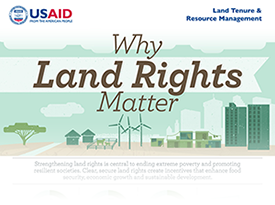
Why Land Rights Matter InfographicView USAID’s infographic on “Why Land Rights Matter.”

Every year, the World Bank Conference on Land and Poverty brings together representatives from governments, the development community, civil society, academia, and the private sector to discuss issues of concern to communities, land practitioners and policymakers worldwide. The growing importance of this event highlights the increasing recognition that resource governance is central to alleviating poverty, promoting economic development, improving food security, limiting conflicts, and increasing stability.

To keep up with the advancing global dialogue on land and resource rights, follow news and events from the 2015 World Bank Conference on Land and Poverty on this page.