

How Tumaco is overcoming legal and cultural barriers to formalize properties
Tumaco’s Municipal Land Office (MLO) is celebrating five years of operation and Nidia Díaz, who works as a local land administrator, has been there since the beginning. She remembers that in the beginning, the MLO was not as successful as they had hoped.
“The office was far from the people and had no advertising”, she says. People did not know about the land office or understand what services it provided. So in 2020, when the office was relocated to be closer to its users, the story changed.


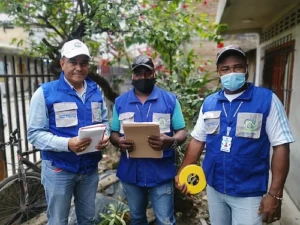
Each day, the Municipal Land Offices receives dozens of visitors searching for information on how to formalize ownership of their properties.
Municipal Land Offices are part of a USAID strategy to develop the capacity of municipal governments in land administration and promote a culture of formal land markets. Local land offices provide citizens with information and work directly with Colombia’s land entities like the National Land Agency to formalize urban parcels and public property. Since 2020, the Land for Prosperity Activity, financed by USAID, has launched or relaunched 20 of these offices around the country.
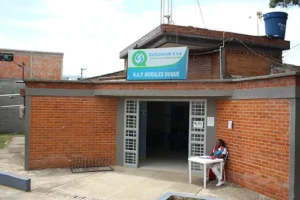
In October 2020, USAID partnered with Tumaco’s municipal leaders to relaunch the MLO in the city’s new Integrated Service Center, located close to downtown. Now the MLO sits next to other important services for citizens and is visible to hundreds of people every day.
Since its relaunch, the Tumaco MLO has delivered 142 property titles to families living in urban neighborhoods. In addition, the office has provided training related to land formalization and administration for over 1,850 citizens. The MLO has also formalized 10 public entities including schools and health centers.
 “Now we are better organized, we divide responsibilities and are more effective. We provide good user support, and the processes are more efficient, mostly because we have a vision and compass,” says Nidia Díaz.
Through the Land for Prosperity Activity, the MLO hired more staff and trained the entire team so they can improve services, outreach, and guide citizens through the process of titling their properties. Today, Tumaco’s MLO has 10 staff members, including land surveyors, cadastral engineers, social workers, and lawyers.
“Thanks to USAID’s support, I have seen the MLO grow. They have trained us with technical skills so we can provide quality services, both virtually and in-person.”
Cultural Barriers
In Tumaco, the Municipal Land Office also faces cultural barriers. Due to a history of violence linked to drug trafficking, the community has reservations when it comes to giving out their information, even when it is to municipal leaders. To combat this, the office holds workshops to raise awareness about formal land ownership.
“During these workshops, we can show people the importance of titling their parcels. There are a lot of people who have heard rumors and think that if they title their land, the government will take away their houses or their subsidies, and we tell them that is not true,” says Hugo Lopez, the office manager.
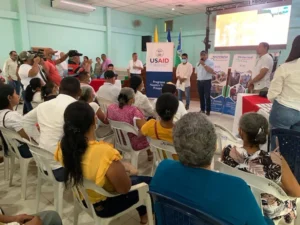
Since the relaunch of the MLO in Tumaco, 46 culture of formality workshops have been held, in which more than 1.640 people participated.


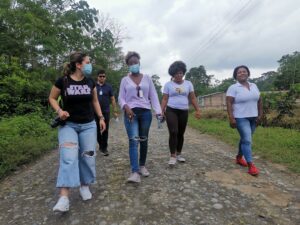
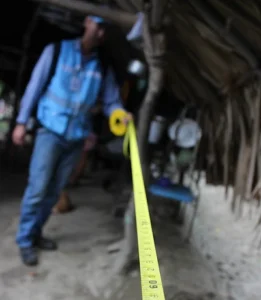
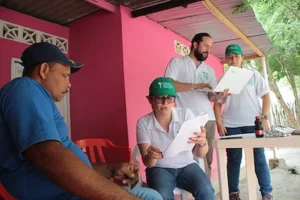
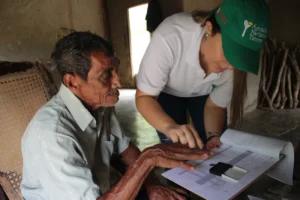
Employees from Tumaco’s Land Office follow up with landowners during the process of titling urban properties.
A Dream Come True
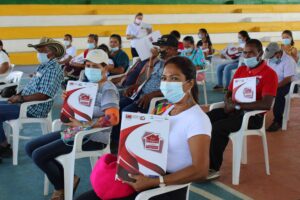
The MLO also leads outreach sessions called MLO in Your Neighborhood, where staff spend a whole day in one neighborhood answering questions, dispelling doubts, and collecting documents from the local residents who want to title their parcels. Once documents that prove they occupy their residence are submitted, MLO staff help residents fill out the forms and look for their cadastral information so they can immediately start the titling process.
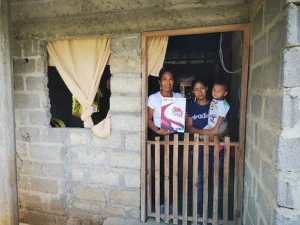
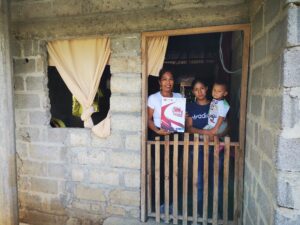
Gloria Criollo, 53, is a single mother of three who works for a government program supporting pregnant women, nursing mothers, and children under the age of two. One of her neighbors told her about the land titling sessions in her neighborhood, Union Victoria.
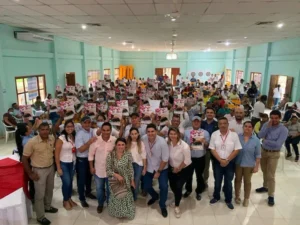
In September 2021, a total of 45 families, some of whom have lived in the neighborhood for decades, received their land titles, at a municipal event led by Tumaco’s mayor. Most of the people interested in titling their properties are women heads of households like Gloria. Thanks to the work of the MLO disseminating information and providing training, they now understand the importance of being owners, so they have something their children can inherit.
“The USAID Land for Prosperity Activity has been very important for me and my family. Now I feel like I have have a house of my own that my children can inherit.” -Gloria Criollo, landowner in Tumaco.


Tumaco’s mayor, María Emilson Angulo, delivers property titles to residents of Tumaco in 2021.
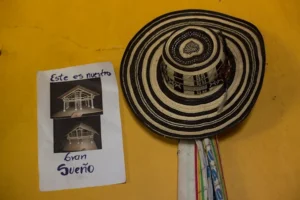
“It is a joy to have this title. They told us that with it we can get bank loans. My dream is to finish building the front garden and the backyard and finish some work inside because we have had a lot of rain and we have water leaks.” Gloria Criollo
 USAID and the Government of Colombia plan to begin implementation of a massive parcel sweep in Tumaco, which will formalize the entire rural area of the district. The MLO is supporting this process and provides the the local link between the municipal administration, USAID specialists, and Colombia’s National Land Agency. The MLO has already supported dissemination and social mapping sessions, in preparation for the massive formalization campaign.
 “Tumaco won the lottery with the parcel sweep. For many years this region has suffered because of the armed conflict and national institutions have abandoned farmer families. But with the parcel sweep, they will be able to have their titles, improve their quality of life, and have credibility. Here, the true beneficiaries will be the farmers and the families from Tumaco.”
-Hugo Lopez, coordinator of the Municipal Land Office, Tumaco.
Footnotes
Photos by LFP/USAID
Tumaco, San Andres de Tumaco, Narino, Colombia
© 2022 Land for Prosperity
Cross posted from Land for Prosperity Exposure site



 A boost for economic development



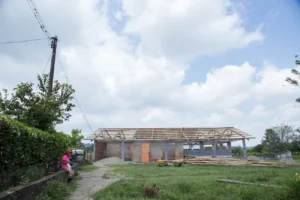
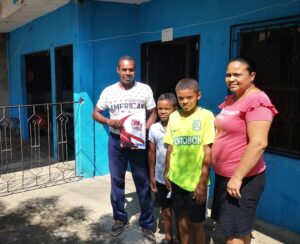
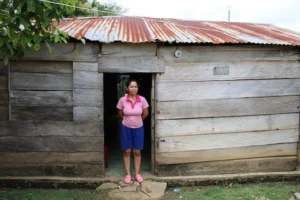
 Ana Espitia has made improvements on her childhood home, located in Valencia, Córdoba in Northern Colombia.






 A massive property sweep
 Helping to bring the massive titling endeavor is a team of more than 100 land formalization experts that coordinates with community leaders and triangulates information to the ANT and other agencies. The team is composed of land surveyors, legal experts, and social workers who are well into year two of operation.


 Cáceres has long been of strategic importance to USAID and the government, and this attention has led to a cluster of initiatives. Joint efforts in the territory go beyond the municipality-wide land formalization campaign. USAID’s comprehensive rural development strategy is also developing the capacity of rural producers, such as honey producers in Bajo Cauca, and engaging the private sector to invest in conflict-affected municipalities. By focusing on general issues in rural development, USAID land tenure programming addresses property-related challenges while opening financing routes to reach underfunded areas. This approach bridges the gap between a land title and rural development and helps the government achieve its goals to build self-reliance and promote a more stable, peaceful, and prosperous Colombia.
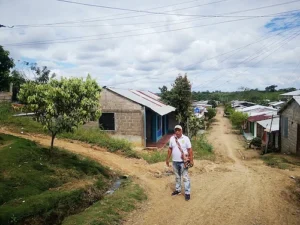
 Nuevo Jerusalem paints an accurate picture of how towns are created in today’s Colombia: through invasiones or informal settlements created by internally displaced people (IDP). Colombia is home to a population of more than 6 million IDP—second only to Syria—and has the unfortunate distinction of being the world’s country with the highest number of IDPs and the least number of refugee camps.


 How can Municipal Land Offices support Puerto Libertador?



 USAID provided the mayor and his council with expertise and consulting to get the ordinance across the finish line. As part of the negotiation, the council agreed that newly formalized landowners would be exempt from taxes in 2022 and will only begin paying property taxes in 2023.
 The Story of Tax Collection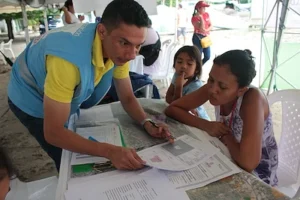
 Foundational Diagnostics
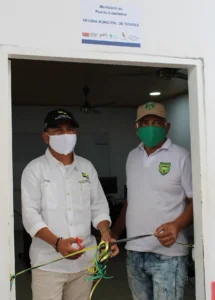 The Municipal Land Office’s first task is carrying out a diagnostic of Puerto Libertador’s existing properties. The analysis has revealed that at least 3,600 parcels are able to be formalized by the office, including 240 public parcels that should be formalized in the name of the municipality, such as schools, health clinics, municipal parks, and city buildings.
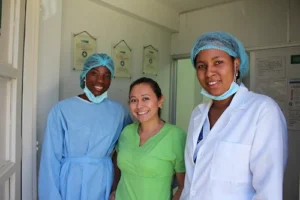
 “By supporting the Municipal Land Office and land formalization, USAID is also supporting rural development, a in this particular case, improving the local health clinic,” said Héctor Sepúlveda, LFP’s Regional Coordinator of Bajo Cauca Antioqueño, where Valencia is located.