Calling all photographers! Share your photos highlighting USAID’s work in the Biodiversity sector in the Biodiversity 2023 Photo Contest.
The contest has been extended to February 13, 2023. Winning photos will be announced in spring 2023. You may submit up to five images complying with the contest rules and requirements. Entries will be judged on relevance, composition, originality, and technical quality.
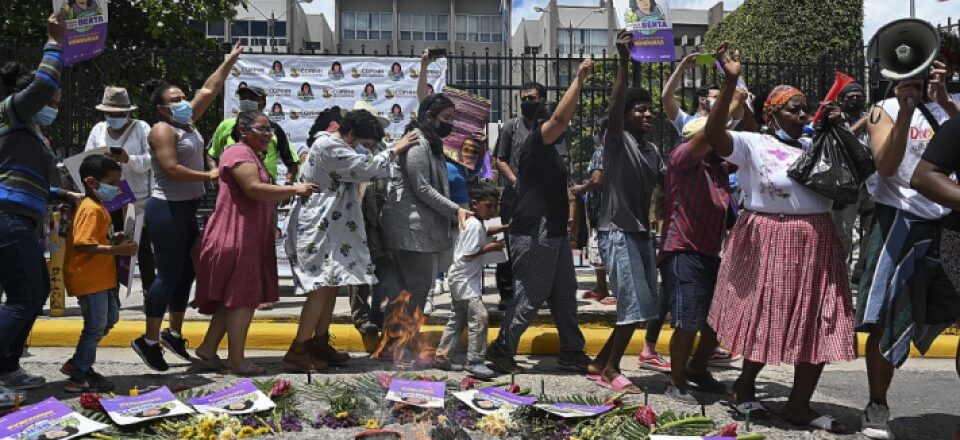
On January 7th of this year, environmental defenders Aly Domínguez and Jairo Bonilla were shot dead by unidentified gunmen on the street in Guapinol, Honduras. Activists and the U.N. special rapporteur on human rights immediately called for an investigation to determine if the killings were retaliation for Domínguez and Bonilla’s activities protesting a nearby mine. Though it’s too early to know the motives in this case, we’ve seen extreme violence against environmental defenders before, both in Honduras and around the world, and I join the calls for an independent investigation.
Just last June, the world was shocked by the dual assassination of Dom Phillips, a British journalist, and Bruno Araújo Pereira, a Brazilian environmental defender and advocate for the country’s most isolated and vulnerable Indigenous communities. Before his death, Pereira had received frequent death threats–most recently from fishermen who illegally encroached on Indigenous territories in the Amazon. The incident put a global spotlight on the risks faced by the courageous people who fight to protect land, water, forests–and the cultural ways of life built on and around them. Brazilian authorities conducted an extensive investigation and ultimately charged three men with murder, but the case underlined a hard truth: institutions worldwide often do too little, too late to protect environmental defenders.
Environmental defenders–defined as those who “take a stand and peaceful action against the unjust, discriminatory, corrupt, or damaging exploitation of natural resources or the environment”–are on the frontlines of ecological and social justice. They can be members of local communities, conservation and forest monitors, environmental activists, human rights advocates, religious leaders, journalists, lawyers, or youth leaders. Many are women or Indigenous, and these groups suffer disproportionate amounts of violence. In 2021, Indigenous People were subject to over 40 percent of fatal attacks against environmental defenders, even though they make up only five percent of the world’s population. That’s not a coincidence; these are precisely the groups who are most affected by the loss of livelihoods, social support networks, sacred spaces, and cultural identities caused by environmental dispossession and destruction.
The assassination of Pereira–and now potentially of Domínguez and Bonilla–is among the latest in a tragic string of environmental defenders killed for taking a stand against powerful companies, governments, and other interests. Perhaps the most well-known was Berta Cáceres, an internationally renowned Lenca Indigenous leader and environmental defender in Honduras. Cáceres was murdered in her home by hitmen on March 3, 2016 after having received at least 33 prior death threats. In a rare instance of having masterminds rather than the people pulling the trigger facing prosecution, the president of Desarrollos Energeticos Sociedad Anonima (DESA), a hydroelectric company whose efforts to build a dam on Lenca Indigenous lands Cáceres opposed, was convicted of ordering her murder after a sustained international campaign demanding justice. And yet, in the six years since Cáceres’s murder, the plight of environmental defenders has become even more precarious.
Between 2002 and 2022, Global Witness, the organization I led from 2014-2019, identified more than 2,100 documented killings of land and environmental defenders. In 2020 alone there were 227 reported killings, a rate of nearly five per week. It was the worst year on record. The actual number of murders is likely significantly higher given the burden of proof required to connect a murder to earth and land defense. And, as John Knox, the former UN Special Rapporteur on Human Rights and the Environment has noted, “Murder is not the only way environmental defenders are persecuted; for every one killed, there are 20 to 100 others harassed, unlawfully and lawfully arrested, and sued for defamation, among other intimidations.”
This wave of violence adds to the urgent imperative to connect global action on the environment and human rights. In November and December 2022, experts from the UN Human Rights Council emphasized “rights to life, health, food, water, culture, and a healthy environment” at the Conference of Parties meetings for both Climate Change and Biodiversity, demanding that environmental frameworks “safeguard the security and rights of all people, in particular Indigenous and environmental human rights defenders.”
As USAID’s recent Environmental Defenders brief focused on the Colombian Amazon describes, land and resource grabbing–often by multinational companies with the tacit approval of country governments–is at the root of many environmental defenders’ grievances. These lands and resources are often acquired illegally through corruption, deepening communities’ sense of injustice and contributing to perceptions of impunity.
Given the critical and gravely dangerous work that environmental defenders undertake, USAID and other multilateral and donor organizations must do more to support them. Fortunately, our Agency has strong policies and strategies in place that enable us to provide this sort of support. For example, USAID’s Strategy on Democracy, Human Rights, and Governance calls for “responding to human rights violations by supporting and protecting human rights defenders and other watchdog groups.” USAID’s Biodiversity Policy advocates for an inclusive approach, emphasizing that “a strong [environmental] constituency will include all groups within society, with special attention given to Indigenous Peoples, women, the disabled, and other traditionally excluded groups [to] promote rights-based approaches, collective action, and stewardship.” USAID’s Policy on Promoting the Rights of Indigenous Peoples instructs the Agency to partner with Indigenous Peoples and their representative organizations to ensure that our work centers those most impacted, amplifies local perspectives, and does no harm. USAID’s 2022-2030 Climate Strategy explicitly calls for the promotion of safe political spaces for Indigenous Peoples, local communities, and environmental defenders to express their concerns and participate as leaders in environmental decision-making. And finally, USAID’s localization goals–calling for 25 percent of USAID assistance to go to local partners within the next four years and 50 percent of programming to be led by local communities by the end of the decade–will ensure this work is driven from the ground up.
Building on this increasingly strong policy backbone, USAID is well-positioned to take decisive action to protect environmental defenders from further violence while elevating their voices and supporting their concerns. There are several core strategies that USAID and its peer institutions can follow to more effectively safeguard environmental defenders.
Perhaps the most important action we can take is to build more direct partnerships with Indigenous Peoples and local communities. As stewards of the Earth’s most biodiverse lands, they have centuries of knowledge and land management practices to share. It is because of this frontline role in the global fight to sustain our planet’s natural resources that they are disproportionately targeted by violence. Their inclusion at all levels of environmental decision-making helps reinforce their rights and recognizes their position as environmental leaders.
Additionally, USAID, its peer donors, and other multilateral organizations can:
Help support and highlight the important work of environmental defenders, connecting them with broader international environmental, peace, and human rights initiatives (for example, the Geneva Roadmap) and insulating them against smear campaigns designed to discredit them.
Use our convening power to facilitate multi-stakeholder dialogues on topics related to environmental defenders, working in partnership with the many local and international civil society organizations, governments, and traditional authorities already working on these issues. Environmental defenders’ own voices must always be at the center of these dialogues. USAID is committed to including our partners from these communities in critical conversations while also being mindful that public attention can sometimes increase their exposure to harm.
Work with national, regional, and local governments to build capacity, reduce impunity, and bolster the rule of law. This includes working with local legal institutions and judicial systems to better prepare them for preventing, investigating and prosecuting environmental crimes.
Partner with responsible members of the private sector to implement norms such as the Guiding Principles on Business and Human Rights and the OECD Guidelines for Multinational Enterprises. The embrace of these principles by influential private sector coalitions will increase pressure for corporations to engage ethically with local communities and insist on accountability for those who don’t. As outlined in USAID’s Private Sector Engagement Policy, all partnerships must be grounded in thorough due diligence and procedures for identifying and minimizing potential environmental and human rights risks.
Support and strengthen protection programs, following do-no harm principles and protocols, to ensure at-risk and threatened environmental defenders are effectively protected. Advocating for environmental defenders’ land and resource rights and helping them build organizational capacity will aid communities’ efforts to protect themselves.
By implementing these forward-leaning strategies, USAID and other multilateral and donor organizations can engage and support environmental defenders directly and proactively, working to prevent threats and violence before they begin.
Learn more about environmental defenders, the challenges they face, and how donor agencies like USAID can best support them in our Environmental Defenders Under Threat issue brief.
USAID is empowering community leaders to increase women’s participation in the process of land titling.
That Wednesday morning, Soledid Rosillo, 48, woke up before the roosters, earlier than usual. She silently reviewed the list of her activities making sure not to wake anyone: prepare breakfast for her two children and her husband, pack a snack to take to school, iron school uniforms, clean the house…
For Soledid it seemed like just another day working and taking care of her family, another day without receiving any salary for all the housework she does, day in and day out, including Sundays and holidays. Homemaker is a job that goes unnoticed and is invisible to a large part of Colombian society.
Soledid had an additional incentive that made her smile and feel solidarity with the women of southern Meta: she would be in charge of taking care of a group of children while their mothers, who also take care of their homes and do not receive any compensation for their domestic work, attend an event with the National Land Agency to participate in the process of titling their properties.
Childcare services are an important part of the ongoing strategy to ensure the participation of rural women in land administration processes and the titling of their property. For these women, seeing their names on a registered property title, which is guaranteed by the nation, is the fulfillment of a dream and the vindication of all the effort they have put into raising their families and building a future for their families.
“If we did not have this space, many women would not have been able to come and participate,” says Soledid, who also helped set up the tents, tables, chairs, and organize information for the more than 120 people who came out to ensure their properties get titled.
“The children are happy here, drawing and playing. But the most important thing is that the mothers are calm and filling out the required forms. These women are reassured, knowing their children are under our care.”
The USAID Land for Prosperity program in Colombia has trained community managers like Soledid to reach out to her community about the benefits of land formalization and titling their properties. Soledid works with the women to raise awareness of women’s property rights.
A temporary daycare provides rural women time and space to fulfill their obligations as property owners to formalize their land.
“Without these types of services, mothers do not come, or if they come with their children, they are stressed because the children are small and are not comfortable among the people or in the heat,”
-Carmen Fernández Bolívar, a land expert working on the property sweep in Puerto Lleras, Meta.
The municipality of Puerto Lleras (Meta) is one of 11 massive land titling initiatives being supported and promoted by the USAID Land for Prosperity program. In partnership with the Government of Colombia, these property sweeps update a municipality’s rural cadaster and title thousands of parcels. Each of the 11 parcel sweeps is focused on an entire municipality and seeks to ensure that rural women recognize their property rights, a key part of stimulating rural development and promoting a formal land market.
Guaranteeing land rights for women is part of a gender-differentiated approach to strengthen land tenure and can have a very high impact on the promotion of equality and the protection of their patrimony.
When women have access to land and property, studies show that they are more likely to earn higher incomes, enjoy greater decision-making power, and feel more protected in marital conflicts. In addition, by owning property, women are less vulnerable to gender-based violence, both in marital conflicts and through their children and other family members.
USAID has created similar childcare spaces in the other parcel sweeps in Ataco (Tolima), San Jacinto (Bolivar), and Cáceres (Antioquia). Just a few hours of free childcare have helped to increase the participation of women. In Cáceres, for example, nearly half of all participants were women, and one out of five women filled out a form as joint owners with their husbands.
The workshops are a mandatory step in the process of land formalization where the future owners fill out the forms required by the National Land Agency to identify them as property owners.
“Land for Prosperity has managed to involve everyone, and the community has been part of the process. USAID has linked rural women to land issues in an area where machista attitudes and beliefs prevail. As a result, the women are more organized, more responsible and committed.” – Marly Gutierrez, Mayor of Puerto Lleras, Meta
In Puerto Rico, Meta, seven out of 10 urban properties lack a registered land title. Informal property ownership is a very common phenomenon in southern Meta and is largely due to a history of violence and the absence of state services. In 2022, the municipality’s Mayor’s partnered with USAID to create a Municipal Land Office, a local land administration strategy that prioritizes land titling as a key to boost rural investment and improve the quality of life of its 12,000 inhabitants. In this interview, Mayor Diana Navarro, talks about what it means to legalize property in Puerto Rico and how USAID is supporting this strategy.
Puerto Rico’s Mayor, Diana Navarro
How do you describe your rural development strategy for Puerto Rico?
Puerto Rico has a hard and difficult history, but as a municipality we value very much what we have, the natural wealth is incomparable. There is productive potential and human capital with a lot of hope and desire to move forward. We are focusing on three fundamental pillars: the legalization of land, the construction of tertiary roads, and the development of electric power. With these three issues, people can understand and begin to believe in what we are doing in the territory.
Why is land legalization so important?
During the campaign I went all over the territory, even into the most remote areas. It is not easy, and one of the challenges is to reach and listen to the people who live far away. In my visits, I met many displaced people and many stories, and we decided that we have to evaluate how to make people feel more comfortable and secure on their land. So, one of the strategies is to legalize their property. In terms of property, Puerto Rico is in a state of informality: 70 percent of the land is not titled.
Municipal Land Offices provide information for residents
How did the creation and support for the Municipal Land Office come about?
With the support of USAID and the Land for Prosperity program, we have created what we are calling the Green Municipal Land Office, which is part of the Mayor’s Office under the Planning Secretariat. It is called Green because it is important to recognize the natural resources of the municipality, including the water sources, morichales (wetlands), and the Ariari River. Recently, through the Land Office, we delivered the first 32 titles, which correspond to urban private and public properties. Our first goal is to title 400 properties. In addition, with USAID we are in the process of strengthening the culture of formal land ownership among the people so that they improve their understanding of what is possible.
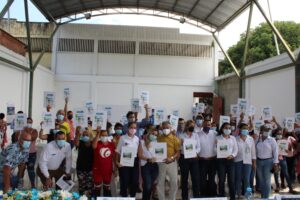
Mayor Navarro delivers land titles to residents.
For a Puerto Rican, what does it mean to have a title to your property?
What does it mean to be a landowner? It is being rooted to your land, it is being able to defend your property and not be afraid, but also being able to access bank loans and make secure investments in something that you know belongs to you. At the first land title event, I spoke with a 70-year-old man who has spent 40 years trying to legalize his property. He was emotional and told me that he finally felt that his plot of land was his. With land issues, it is necessary to understand the connotations and emotions of a family when they receive a land title after so many years of living in informality.
USAID helped to create and set up the Land Office. How can the Municipality guarantee its sustainability in the future?
Just as the Municipal Land Office is giving us a hand with the titling of property, it will give us a hand when it comes to collecting property taxes. I have a year and a half left in my term, but the land office is under a long-term agreement. My aim is to leave office with a plan for the future budgets, an investment by the municipality, and a percentage of the collected land taxes is destined to fund the staff and technology required for the office to continue operating.
With USAID support, Colombia’s National Land Agency made history by adopting guidelines to approach families who cultivate illicit crops like coca with land titling services.
Cáceres, Antioquia is famous for all the wrong reasons. The municipality, which is home to more than 30,000 people in the lower Cauca river basin, is known for harsh violence, illegal mining, and criminal groups fighting for control of land. Nearly half of the population is registered as victims of Colombia’s protracted conflict, and after compiling more than 200 land restitution applications, the government’s Land Restitution Unit suspended its work due to inherent risk.
In Cáceres, where an estimated 8 of 10 parcels lack land titles or official documentation, land rights are weak. The culture of informal land ownership is pervasive and the reasons are many: one, beyond the municipality’s urban center, the Colombian government has never had much presence in rural villages; and two, families who may have once held land titles for their land, have since inherited land to their children and grandchildren, reverting to informal land ownership.
On top of this, the municipality is home to more than 1,000 hectares of coca crops.
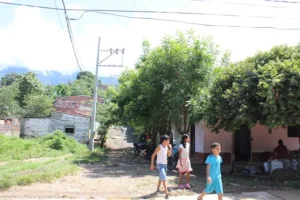
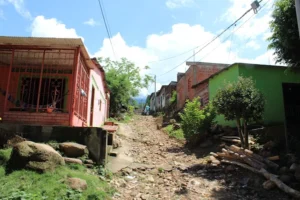
Informal land ownership is typical in Cáceres, Antioquia
For the last decade, Cáceres has been of strategic importance to USAID and the government, and this attention has led to a cluster of initiatives and joint efforts in the territory. Perhaps the most important of these is a current municipality-wide land formalization campaign overseen by Colombia’s National Land Agency (ANT). With USAID financing and technical support, the government is poised to title more than 2,000 parcels, update the cadaster for the 10,000 plus parcels in the municipality’s cadaster, and build local capacity to maintain an operable land market. But, in its endeavour to title every parcel in Cáceres, the Agency is on a collision course with coca crops and is adapting its land governance strategy to offer land titles as an incentive for illicit crop substitution.
Cauca River is Colombia’s second longest river at 800+ miles. Below Cáceres, the river is navigable for steamers.
The USAID-funded Land for Prosperity Activity and the ANT are working with the National Program for the Substitution of Illicit Crops (PNIS) and the Agency for Territorial Renovation (ART) to craft the road map and implement land formalization plans in the context of illicit crop cultivation. Earlier this year, the ANT made history when they adopted guidelines that enable the government to approach families who cultivate illicit crops like coca with land administration services like titling.
Illicit Crop Guidelines
The guidelines recently adopted by the ANT for titling parcels with the presence of illicit crops include the following:
Promote and ensure cooperation among government agencies
Guarantee the inclusion of all parcels with illicit crops
Consider environmental issues and ethnic populations
Communicate transparently with communities
Report security conditions and illegal activity to corresponding government agencies
Establish monitoring and evaluation mechanisms following the titling process
The new guidelines are centered on a philosophy of “do-no-harm” and within its main principles are government cooperation, ethnic group inclusion, and community dialogue. The adoption of the guidelines is remarkable, however, because it marks the first time the Colombian government has formally accepted a strategy that considers formalizing land rights as an incentive to reduce illicit cropping.
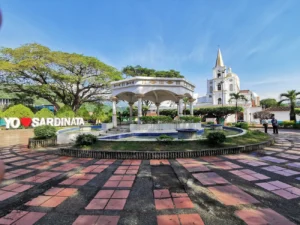
USAID is supporting massive land formalization campaigns in an additional four municipalities with the presence of illicit crops. In Tumaco, Nariño, the campaign’s social awareness component is already underway, and the work plans are still in development for Sardinata, Norte de Santander, Santander de Quilichao, Cauca, and Puerto Rico, Meta. Together, the four municipalities represent more than 14,000 hectares of illicit crops.
In many ways, the initial experience working with families and farmers and titling parcels with illicit crops in Cáceres will provide lessons and modifications for the strategy in the other four municipalities.
“This is an opportunity to demonstrate that property formalization can be an incentive for substituting illicit crops, and we will see the challenges around inter- agency teamwork and cooperation. What we learn from Cáceres about crop substitution and land titling will help us shape the strategy in Tumaco. Both municipalities are complex, and each has its own context.” – Natali Buitrago, the project manager of the massive land formalization campaign in Cáceres and Tumaco.
“Land titles are long term assets that provide families access to public and private resources aimed at rural landowners and allow the government the additional benefit of managing land use and organizing land for rural development that maintains an environmental balance.” – Hernando Londoño, Director of Illicit Crop Substitution at the Agency for Territorial Renovation
In Sardinata, Colombia, women are the driving force behind land formalization and are the main beneficiaries
For the women of Sardinata, Norte de Santander, having a land title had been unimaginable for decades. Their dreams of owning property were crushed every time unscrupulous people arrived with false promises.
“People came here and told us things, made us spend money, but in the end, nothing ever came out of it,” according to Belcy Veloza, a woman from Sardinata’s El Baho barrio.
In Catatumbo, a complex region in Norte de Santander where Sardinata is located, half of the properties are informal. This fact—coupled with the large presence of illicit crops, armed groups, and anti-personnel landmines—has hindered the arrival of the peace this region has been craving for years. In addition, a limited presence of the State has resulted in a community who distrust government actions to combat violence and promote economic development.
In 2021, when the Municipal Land Office (MLO) team arrived in El Baho to begin the property characterization process, they initially contacted Hernando Gómez, Belcy’s husband and vice-president of the Community Action Board. At that moment, inspired by the possibilities of formalization, Belcy volunteered to join the team in visiting each of her neighbors’ properties—neighbors she has known since she and her husband arrived in the area 25 years ago.
Since then, Belcy has played a leading role from start to finish in the urban land formalization process in Sardinata, which has turned 140 families into legal owners of the homes they have lived in for years.
Sardinata’s El Baho Neighborhood
“It motivated me because I saw that it was a serious project—they weren’t trying to pull a fast one on us. That is why I also wanted to be part of the Multipliers Network, because I wanted to be a guide for the program, for the MLO, and help many families in my neighborhood,” added Belcy.
For her, the process does not end with a property title. Learning about the benefits of maintaining formality in land transactions—both for citizens and for the municipality—inspired her to invite her neighbors to be part of the Multipliers Network. Belcy wanted to spread her knowledge of the culture of formality to the entire community, especially among women.
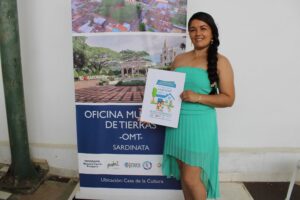
Belcy Veloza, pictured left with the title to her property
“It is not only men who need to be concerned about getting the title to their property. Women are also part of this process, as both they and their children become owners of the property.”
Belcy Veloza, Community leader from Sardinata
Women play an invaluable role
Sardinata is one of the municipalities prioritized by the Government of Colombia and USAID to implement the massive land formalization strategy in the country. Launching the MLO in Sardinata was the first step on the road to formalization in this municipality. USAID and the municipal mayor’s office launched the MLO in October 2020, and over one year later, it has already shown results.
Sardinata’s Mayor Hermides Moncada
“The USAID Land for Prosperity Activity is one of Sardinata’s great achievements in recent decades. People have the possibility of obtaining a property title that will guarantee them access to credit. Registered land titles provide them legal security in terms of the possession of their properties.”
The mayor is aware that a successful formalization strategy in the municipality would not have been possible without the support of the community and, to a large extent, the women. For years, Sardinata had been hoping to achieve massive land titling, and he wanted to be remembered as the mayor who supported this initiative.
“Women’s support in this process is invaluable. Mrs. Belcy was an icon in El Baho for the support she gave to the Municipal Office. When she received that property title and held it in her hands, I remember seeing the happiness in her face. Women have played a very important role in this project,” the mayor emphasized.
More and more women citizens are becoming interested in land issues in Sardinata. Of the 470 women in Catatumbo who have been trained on the culture of formality, 390 are from this municipality. Interest in claiming their land rights has grown so much that 102 of the 140 urban property titles issued by the MLO are in women’s names.
Training women on the culture of formality helps many more of them become owners of their own land, take advantage of opportunities to increase their income (not clear how), and thus improve their children’s nutrition and their families’ living conditions. Keeping land in the formal market provides sustainability to these households.
7 of 10 urban property titles issued by the MLO are in women’s names.
Formalization for Rural Land
Deploying this formalization strategy in the rural areas of a municipality that has 8,000 rural properties—half of them informal—is an ambitious task. In addition, there are 4,602 hectares of illicit crops in Sardinata. This results in the need to adapt the parcel sweep for formalization using methodologies that promote voluntary crop substitution. This way, the communities themselves will be the most interested in developing licit activities on the lands that will eventually become their property after formalization.
“With the parcel sweep, the municipality’s finances will be improved, and the community will be even more rooted in their properties. We are a pilot project in Norte de Santander, and it was USAID and the national government’s decision to support us as a municipality. Farmers should be aware that with the property titles they receive, they must use their land for legal, licit economic production. Property sweeps are costly, and decades ago, the thought of this was not even a remote possibility,” stated Hermides Moncada.
Property titles that were once a dream for many of these women are now a reality.
Q&A with landowner and Tumaco neighbor, Nancy Lucrecia Valencia
Nancy Valencia, famous in Tumaco for her delicious sancocho
Nancy Lucrecia Valencia says she has an “irresistible personality.” She arrived in Tumaco 25 years ago, where she lives in the Tres Cruces neighborhood. She has always felt like family of the many children in her neighborhood because she used to cook for them in a nearby school. Today she has a small restaurant in her home, which became famous when she cooked sancocho for Colombia’s President. She is the proud owner of her home, but she never obtained a land title that shows her as the property’s owner. Last year, Nancy and more than 100 of her neighbors in Tumaco received registered property titles for their homes. The ceremony was led by the mayor, and the titles were made possible thanks to USAID’s support and the work of Tumaco’s Municipal Land Office (MLO). In this interview, Nancy talks about her life and the process to get her long awaited land title.
Why hadn’t you gone and processed your property title before?
Because people told me that it costs a lot of money and a lot of work, one thing and the other. But having a land office in Tumaco is important, because people don’t have to go looking for information in different places. You go, they answer your questions and get things done the way they should be done. Now with my title, I feel like I am at another stage in life.
What impact does owning your home have on your life?
It gives me great satisfaction because I went through a lot of inconveniences paying rent. This is very positive for me. Sometimes we get this idea that people are humiliating us, and we don’t understand that we can also participate and have the deed to our home if we want to.
Many of Tumaco’s neighborhoods are located in tidal areas and cannot be titled by Tumaco’s Municipal Land Office.
How did you learn that the municipality was helping citizens obtain their property titles?
I found out through a neighbor that asked me if I already had my property’s deed. She explained that through the mayor’s office they were processing property titles for free. I went to the Municipal Land Office in the Ciudadela neighborhood. There they gave me all the information about the process, about what I had to do and the documents I needed.
How was your experience with the Municipal Land Office?
I knew I met all the requirements to get my title. The land office provided a good service at the office, and today I couldn’t be happier. Thanks to Tumaco’s Land Office, I have the title to my home and property!
Secure land rights for women are a crucial part of a gender responsive strategy to strengthen land tenure, and can have an outstanding impact on promoting gender equality and protecting one’s patrimony. When women have access to land and property, studies show they are more likely to earn higher incomes, enjoy increased decision-making power, and feel more protected in marital conflicts.
What would you say to the women who want to formalize their parcels but do not know how?
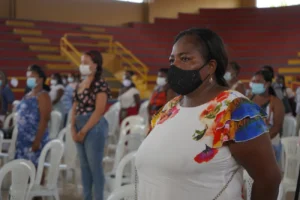
I invite them from the bottom of my heart and soul to be strong women that we are and to go to the Tumaco Municipal Land Office. That the women who have been through these horrible situations, always feeling crushed, need to know that we too can receive many benefits. Even when the men are the ones who work, we also have rights because we are also part of the home.
Land Rights are Women’s Rights
In Tumaco, the USAID Land for Prosperity Activity works closely with the municipal government to streamline gender equality and social inclusion in local land policies and activities. The USAID-supported Municipal Land Office developed an articulated gender and land titling strategy to target women-headed households in urban settings. Every month, small teams of land experts visit neighborhoods around Tumaco to explain the benefits of land titling and the rights of the women who live there.
USAID-supported municipal land offices in Colombia have delivered approximately 800 land titles since 2020. Over 600 land titles in the name of women-headed households or joint titles have been delivered to Colombian women.
USAID-supported local land offices are leading land administration campaigns and delivering land titles to rural Colombians
When Nuri Jaramillo won three million pesos in the lottery she wondered if it was a bad omen. She chose the number 666 for the winning lottery ticket. She used the winnings to buy clothing for her three children and then invested in the small store that she set up inside her home in the town of Cáceres, located in north-central Colombia. Through a barred window, she served customers groceries, snacks, and sodas.
“My store was full. It was proof that I had worked hard and achieved something for me and my family,” says Nuri.
The dream ended in 2018 when men from the Clan del Golfo—an ex-paramilitary group involved in drug trafficking—killed a neighbor and then drove her family away, fearing she could have witnessed the massacre. In a matter of minutes, Nuri and her children escaped, still barefoot, and then walked over 50 kilometers to the neighboring municipality of El Bagre.
The men invaded Nuri’s house and ransacked the store. The groceries kept them fed for months. Some of the men moved into her home. On the shutter of the window where she sold candies to neighborhood children, the men wrote ‘you cannot live here’ in stark, white spray paint. The words kept Nuri and her family away for three years and reminded the rest of the neighborhood that in a place like Cáceres owning a home can be unpredictable, and above all, that everything can disappear in a moment’s notice
Who Owns What?
The urban center of Cáceres is home to more than 5,000 people, but the majority has no registered land title for their property. In fact, most of the land in town is said to belong to either the local dioceses of the Catholic Church or to an ex-mayor. The latter bought 415 hectares in 2005 and a decade later was investigated for fraud. His property Candilejas is like a mysterious celebrity, i.e. most neighbors know of the property, but none are sure exactly where it lies.
The problem is that Cáceres has no reliable cadaster—or plot map. The cadaster used by the Colombian Government has not been updated for 17 years. As a result, much of the truth about land ownership is based on word of mouth and on knowledge passed from parents to children or from door to door. Sometimes a property’s perimeter is nothing more than an educated guess.
“There could be one thousand landowners living in Candilejas,” explains Wilmer Molina, the social worker employed by the Caceres Municipal Land Office. “This town has no working property map. Why? Because that is usually the most costly part of the process. Land surveys require a budget, and none of the municipalities in Bajo Cauca can afford it.”
A History of Violence
Bajo Cauca is the name of the sub-region located in the upper reaches of the department of Antioquia and includes the municipalities Cáceres, Tarazá, El Bagre, Zaragoza, Nechi, and the sub-region’s main city, Caucasia. Since the early 90s, Bajo Cauca has been a caricature of Colombia’s conflict: leftist guerrillas, paramilitaries, and narco-trafficking groups have all roamed and controlled the green hills and valleys surrounding the Cauca River. The groups, who sometimes work together, also fight violent turf wars. They rely on artisanal gold mining and drug trafficking for financing and use violence and displacement as tools of control.
In Bajo Cauca, times of peace come in small increments.
Under these conditions, the last thirty years have seen large portions of Cáceres territory bought and sold, and ultimately ending up in the hands of fewer and fewer people. Underlying the accumulation of land is violence, which has displaced the majority of Caceres’ population, some more than once. Just in the last three years, over 1,500 families have fled their homes.
Putting it on the Map
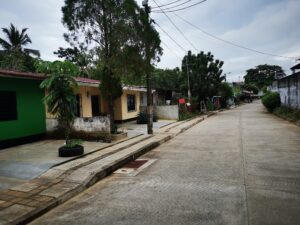
The Caceres Municipal Land Office is slowly trying to change this situation. Embedded in the municipal administration, the land office is the most effective tool for clearing up historical confusion around land ownership in the urban areas of Cáceres. With support from the mayor and financial support from USAID, social worker Wilmer Molina and the land office’s legal expert, Carlos Ávila, are following through on a strategy that expects to formalize hundreds of urban properties, not to mention dozens of public properties like schools, health clinics, and parks.
Molina and Ávila are the boots-on-the-ground team and play a critical role in facilitating the work of Colombia’s land administration agencies. Over the last year, the duo has studied a universe of more than 3,300 parcels subject to titling. By analyzing historical data, they determined that approximately one of every three properties is actually owned by the ex-mayor. After filtering the Candilejas properties, they analyzed the remaining properties according to whether they have been registered and whether the owners were still living on the property or in the area. The analysis yielded some 300 properties with the conditions to be formalized.
From the heart of Cáceres, the Municipal Land Office is steering the ship: preparing the paperwork and triangulating formalization procedures with notaries, judges, the IGAC, and finally, with the National Land Agency (ANT) and Colombia’s national land registry (SNR). In Colombia’s complicated land formalization processes, each of these stakeholders is instrumental in legalizing and formalizing urban properties.
More important for neighbors like Nuri Jaramillo, Molina and Ávila are the face of land administration. Most of the people living in the region of Bajo Cauca lack either the means to travel to the nearest land registry office or to Bogotá or lack the basic understanding of how land is titled under Colombia’s arcane laws. It was Wilmer Molina who brought land administration services to Nuri Jaramillo, first by way of the property analyses and then through the office’s social outreach strategy.
Through visits, Molina learned that years before that frightening night when she and her family were chased away from their home, Nuri Jaramillo had tried to formalize her property. When she purchased the property in 1993, she immediately went and legalized it with Colombia’s cadaster management authority, known as the IGAC. However, when she tried to process her land title, it was too costly and too difficult to muster.
Sleepless Nights
Nuri Jaramillo returned to her home in early 2021. Most of the furniture had been taken, and the entryway door jamb was destroyed. As she cautiously settled back into her home, the Municipal Land Office began formalizing the property. In July 2021, she was one of the first 40 residents of Cáceres to receive a land title, free of cost, through the local government.
In March 2022, the mayor and the Cáceres Land Office delivered another 54 land titles. Meanwhile, they continue to study the histories of properties in Cáceres. Molina and Ávila are quickly discovering that each property has its own story, which must be studied and legally documented.
Mayor of Cáceres, Juan Carlos Rodriguez
“Some of these families have waited 40 years to have a land title that accredits them as registered property owners, and we have achieved that thanks to the Municipal Land Office. A land title is a fundamental aspect of guaranteeing the patrimony of home ownership.”
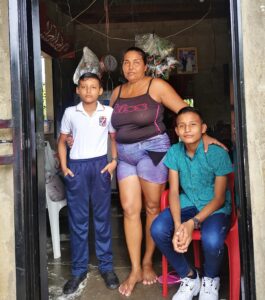
Despite having her land title, Nuri Jaramillo still has not spent a night in her home. The trauma of being attacked and displaced has affected her entire family. Every night, she gathers her children and walks down the street to sleep at a friend’s house. She has restocked her store and painted the window’s shutter with a couple words of her own: open for business.
“Maybe I still can’t sleep here, but now I have my land title and to the men who told me that I can’t live here, I say ‘yes, I can live here’, because this is my house.
Q&A with Ana Cristina Marchena, a community leader from Guarumo, Cáceres
Since 2020, with support from the Government of Colombia, the Land for Prosperity Activity is leading a massive land formalization campaign in the municipality of Cáceres, in the Bajo Cauca region. Due to the presence of armed groups, illicit crops, land mines, and artisanal gold mining, the initiative depends on community mobilizers for several important steps of the property formalization process. In this interview, Ana Cristina Marchena, a community leader from Guarumo, Cáceres, talks about her role and the value community mobilizers add.
How would you describe the lives of the families in your town, Guarumo?
Guarumo has been badly hit by violence. Here, people depend on informal economies because there are no industries. We have artisanal gold mining, and with that come other problems and bad actors. There are moments of abundance when there is gold, and moments of scarcity. It is a very vulnerable situation. When it comes to education, if people want to go to university, they have to leave. Here, most young people who finish high school end up going to the river, to the mines. If they don’t end up in mining, there is a culture of choosing between “I’ll join the army, or I’ll join the other side”, and they end up being recruited by armed groups. Almost all families I know have been victims or have had problems with these groups. It is very common.
How does the violence affect the population?
There are many displaced people in Guarumo. The violence was hard between 2018 and 2020, and many of the victims were forcefully displaced from their homes. We’ve only had six months of peace recently. During those years, I was one of the few who stayed in the community, in the area, because we couldn’t get out or didn’t have anywhere to go. With a big family, where can you go? It is very difficult. In Cáceres, the violence has taught us to be resilient and to take care of our own while praying, because God is the only one who protects us.
What are your tasks as community mobilizer, as part of the land formalization process in Cáceres?
My tasks consist of supporting the land formalization teams. In Cáceres, people can’t just go approach a community alone; they always need someone with them. The community recognizes me as a leader, because I have worked with women and children. When I invite people to participate, they believe me because they know I support programs and projects for the community. I also help to explain the land formalization process to farmers, in our language. That you can’t own land in certain areas, like close to the river, or that the government cannot award a property that is right next to the highway.
Why are community mobilizers valuable to the program?
We are an important part of the parcel sweep because we know our land and we know our community. We have experienced first-hand the difficulties and needs of the community. And as mobilizers, we do our job without expecting any compensation, we do it from the heart because we know that we have big problems that are related to land tenure.
As a community mobilizer, how do you approach and interact with armed groups?
First, they know about our work and know that we are trying to help the community and trying to not affect them. These programs greatly benefit the community, so they respect us as leaders and as mobilizers. Sometimes we do have to ask for authorization to allow the program to enter certain areas, because these are areas where they haven’t allowed strangers or people outside the community in. We are forced to interact with them, there is no other way.
And when there are properties occupied by them that are going to be formalized, what do you do?
We have had difficulties in some places that we know are occupied by them and where they don’t let us go. But we don’t try to force them either. With the parcel sweep, they are going to have to let us enter because we know all areas will be formalized.
What topics were you trained in as community mobilizers?
They taught us about land tenure, like who is an owner and who is an occupant. They taught us basic concepts about land formalization so we can explain it to farmers. They also taught us about land mines, because we go to rural areas and have to know how to walk and avoid being a victim. They taught us about ‘agricultural productive units’. We usually have an agronomist with us, and we explain to people that their crops can also be sold. A lot of them grow cacao and we get there and tell them “look, you can sell these products in town” so they know they can access other sources of income.
Luis Hernandez (r) also works as a community leader for the massive land formalization pilot
What challenges have you faced with the communities?
There are challenges for the same reason that the community is vulnerable. Many people live in places where they shouldn’t, and they have been there for many years and already have their dream based on the houses they have built. For us to go there and tell them that they won’t receive a property title is not easy. Their reaction is understandable. These people need a housing subsidy and must be relocated to another area. But Cáceres is very poor and that is a big challenge.
Do you think land formalization can change the way you face illicit crops?
For us, illicit crops are part of our economy. Many people come to this sector to collect them and they bring money and investment to the community. They see them as a source of income and not as something illegal. It is one of the few job opportunities there are. If they come to offer projects to replace these crops, they need to make sure they are just as profitable.



 That Wednesday morning, Soledid Rosillo, 48, woke up before the roosters, earlier than usual. She silently reviewed the list of her activities making sure not to wake anyone: prepare breakfast for her two children and her husband, pack a snack to take to school, iron school uniforms, clean the house…


 The municipality of Puerto Lleras (Meta) is one of 11 massive land titling initiatives being supported and promoted by the USAID Land for Prosperity program. In partnership with the Government of Colombia, these property sweeps update a municipality’s rural cadaster and title thousands of parcels. Each of the 11 parcel sweeps is focused on an entire municipality and seeks to ensure that rural women recognize their property rights, a key part of stimulating rural development and promoting a formal land market.



 The new guidelines are centered on a philosophy of “do-no-harm” and within its main principles are government cooperation, ethnic group inclusion, and community dialogue. The adoption of the guidelines is remarkable, however, because it marks the first time the Colombian government has formally accepted a strategy that considers formalizing land rights as an incentive to reduce illicit cropping.



 In 2021, when the Municipal Land Office (MLO) team arrived in El Baho to begin the property characterization process, they initially contacted Hernando Gómez, Belcy’s husband and vice-president of the Community Action Board. At that moment, inspired by the possibilities of formalization, Belcy volunteered to join the team in visiting each of her neighbors’ properties—neighbors she has known since she and her husband arrived in the area 25 years ago.




 Secure land rights for women are a crucial part of a gender responsive strategy to strengthen land tenure, and can have an outstanding impact on promoting gender equality and protecting one’s patrimony. When women have access to land and property, studies show they are more likely to earn higher incomes, enjoy increased decision-making power, and feel more protected in marital conflicts.
 I invite them from the bottom of my heart and soul to be strong women that we are and to go to the Tumaco Municipal Land Office. That the women who have been through these horrible situations, always feeling crushed, need to know that we too can receive many benefits. Even when the men are the ones who work, we also have rights because we are also part of the home.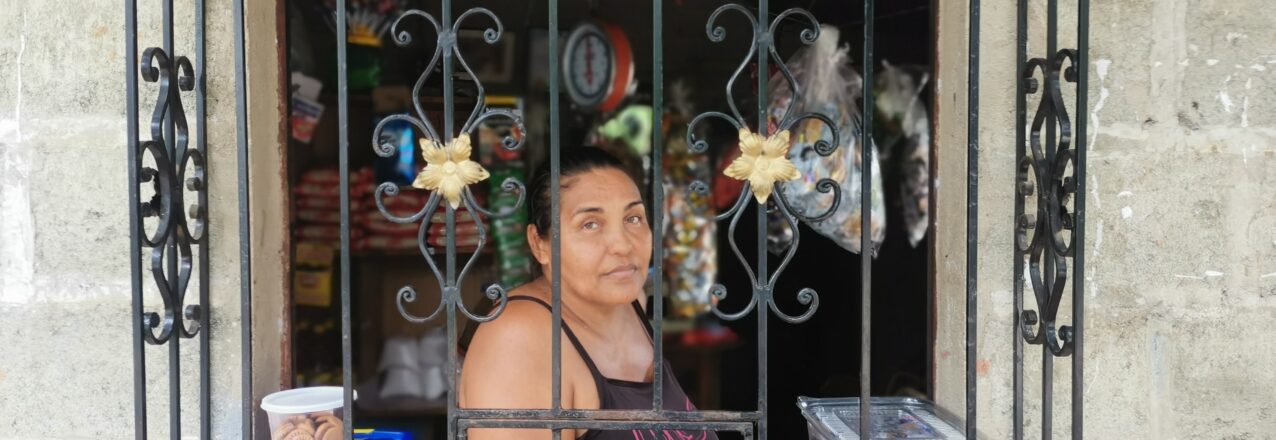

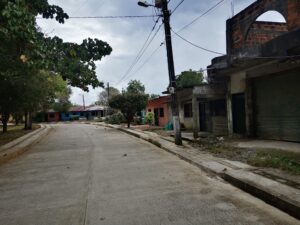
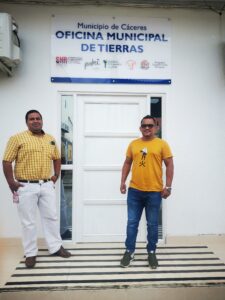 The Caceres Municipal Land Office is slowly trying to change this situation. Embedded in the municipal administration, the land office is the most effective tool for clearing up historical confusion around land ownership in the urban areas of Cáceres. With support from the mayor and financial support from USAID, social worker Wilmer Molina and the land office’s legal expert, Carlos Ávila, are following through on a strategy that expects to formalize hundreds of urban properties, not to mention dozens of public properties like schools, health clinics, and parks.
 Through visits, Molina learned that years before that frightening night when she and her family were chased away from their home, Nuri Jaramillo had tried to formalize her property. When she purchased the property in 1993, she immediately went and legalized it with Colombia’s cadaster management authority, known as the IGAC. However, when she tried to process her land title, it was too costly and too difficult to muster.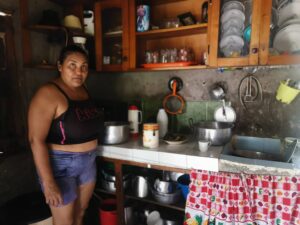
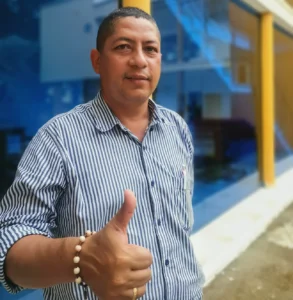
 Since 2020, with support from the Government of Colombia, the Land for Prosperity Activity is leading a massive land formalization campaign in the municipality of Cáceres, in the Bajo Cauca region. Due to the presence of armed groups, illicit crops, land mines, and artisanal gold mining, the initiative depends on community mobilizers for several important steps of the property formalization process. In this interview, Ana Cristina Marchena, a community leader from Guarumo, Cáceres, talks about her role and the value community mobilizers add.


