

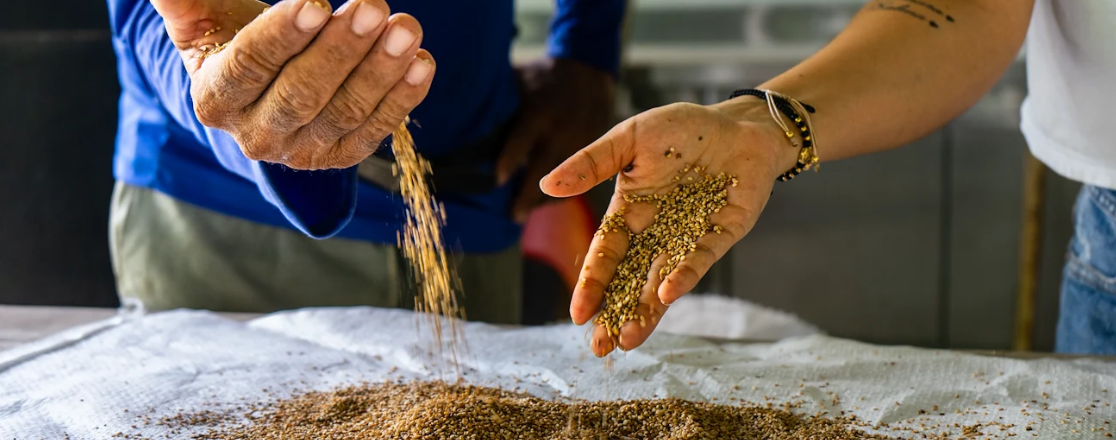
Strategic partnership helps rural farmers gain access to gourmet markets and repair the wounds of the past.
 For thousands of years, sesame seeds have been a key ingredient for a wide variety of Greek foods, from tahini to sesame bar snacks to Greece’s most popular street food, the indistinguishable, sesame-covered rings known as koulouri.
Sesame is deeply ingrained in Greek traditions and cuisine and as Europe’s largest importer of sesame seeds, it is a great starting point to examine how specialty markets emerge searching for flavorful and artisanal processed sesame seeds.
While Greece imports the majority of its 39,000 MT of sesame from Nigeria and Turkey and accounts for 22% of Europe’s sesame imports, countries like Germany are also in the market to sprinkle tasty sesame seeds on its baked goods.
José Hernández, the founder of gourmet exporter SumaPaz Foods has traveled to Europe enough to see there is a potential for artisanal sesame from Colombia to satisfy even the most demanding gourmet chefs.
In 2018, Hernández discovered the secrets of Colombia’s sesame in the hills of Montes de María, which are located in the Caribbean region and have an ideal climate for cultivating sesame. In the municipality of Córdoba Tetón, SumaPaz began working with families involved in sesame for generations.
“Our microclimates give our foods nuanced flavors. Besides Greece, our sesame is popular in Germany, where they like breads with a sesame that is sweeter and less astringent than normal sesame,” explains Hernández.
A History of Survival
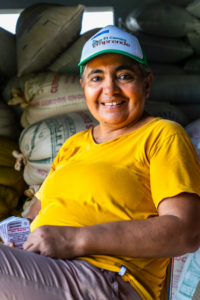 The story of sesame in this region of Colombia mirrors the ugly violence that engulfed it in the early 2000s, when the leftist group FARC expanded its control of the region and the rise of paramilitarism caught rural communities in the middle, leaving villages full of victims in its wake. Rebels and paramilitary groups moved through rural towns stealing the communities’ most important assets: livestock.
“We came to rely more and more on sesame. We are all victims, we were all displaced, and we all lived moments that we would prefer to forget. But here we are doing everything we can to make sure the violence doesn’t happen again,” says Yimmis Severinche, who helped to create the National Federation of Sesame Farmers back in 2002.
Severinche and her neighbors developed ways to transform sesame into new products, putting sesame-based pastes and drinks on the table of every family in the municipality. These families used innovation, but the violence left a hole in their community.
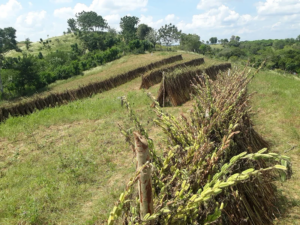 To help rebuild these communities, USAID facilitated a Public-Private Partnership (PPP) that includes SumaPaz, government agencies, and over 600 families from the region. The PPP was signed in 2023 and is valued at nearly USD $1.8 million. The PPP’s objective is to increase production and processing of artisanal sesame, promote organic certification, and establish sustainable market channels, especially in high value markets like Europe and USA.
First step was gaining organic certification, which SumaPaz supported with its own resources. To see the certification through, under the PPP, USAID helped to form a micro enterprise of young agronomists in the region called Integra.
“The focus today is the search for sustainability, but that sustainability is only possible if there is a functional value chain that works. Integra fills an important gap to provide services that rural farmers need,” says Hernandez.
En Route to Europe
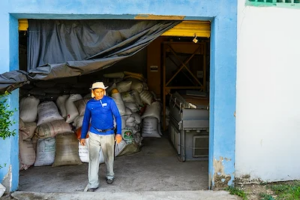 With organic certification under their belt and technical support from SumaPaz, sesame farmers have already exported four containers of high-quality sesame to buyers in the European market. Each container equals approximately 18 tons of sesame for gourmet food buyers in Greece and Germany.
Thanks to the increased capacity built by the PPP, SumaPaz offered sesame farmers future contracts as well as a purchasing price at least 50 percent higher than the price of sesame in the Colombian market.
“The social fabric that was once broken by the violence is beginning to repair itself. USAID works with the communities and builds trust. These farmers have more confidence and are open to the tools to work on mending the social fabric,” according to Hernandez.
Cross-posted from USAID Exposure

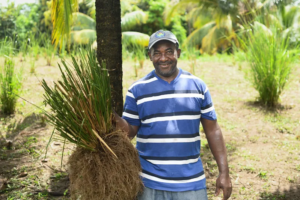
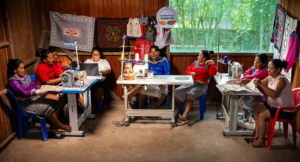
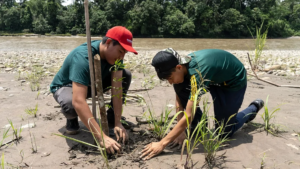

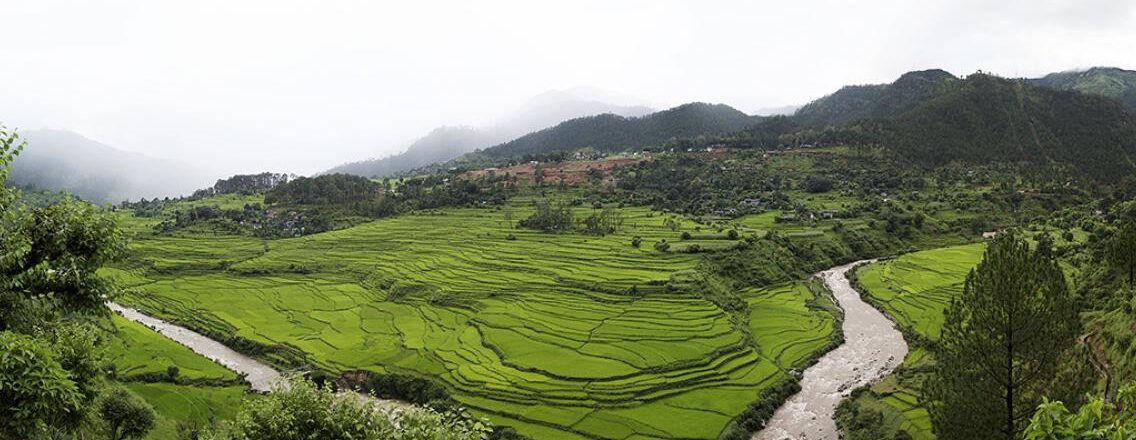
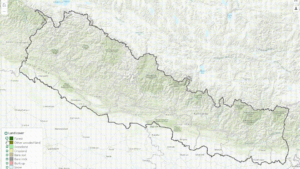

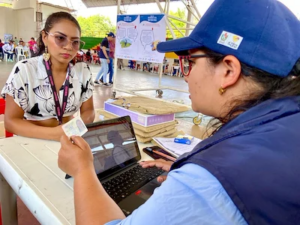
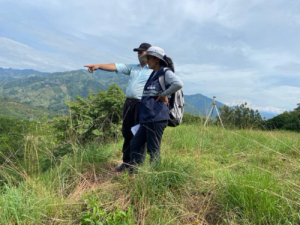
 With USAID support, Colombia’s National Land Agency delivered 83 land titles to families who have voluntarily substituted illicit crops in the municipality of Cáceres, Antioquia. The property titles correspond to over 1,200 hectares of rural land in the heart of Bajo Cauca, a zone affected by years of violence and narcotrafficking.
 Secure land tenure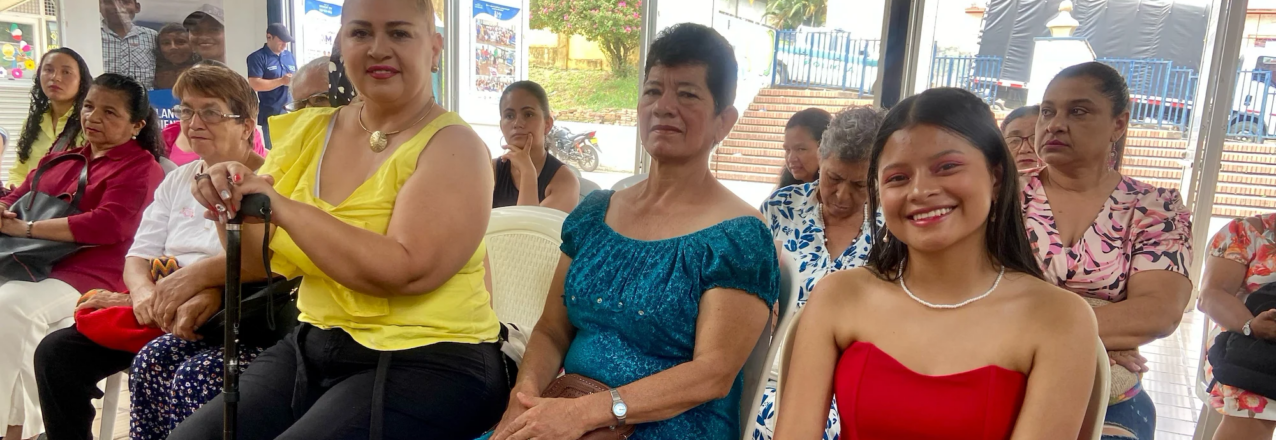
 As part of the Rural Property and Land Administration Plan (POSPR) being implemented in Chaparral, USAID Land for Prosperity (LFP) partnered with Colombia’s Land Restitution Unit to host a series of workshops to empower rural women about their property rights, land ownership, the care economy, and gender-based violence. These workshops, called nucleos de exigibilidad, were piloted first in Ataco during POSPR implementation. During the sessions, 30 female leaders who are participating in land restitution and formalization processes shared their views of their territory and learned about gender-based violence with a focus on patrimonial and economic violence. The women met three times to discuss crucial topics for their personal growth and the one of their communities, as an opportunity to strengthen their leadership and promote gender equality in Southern Tolima.
 The strategy was originally implemented in the municipality of Ataco and was recently extended to Chaparral, with the aim of building the capacity of these women so they can multiply their knowledge with their communities and neighborhoods. The work between the URT and LFP coordinates two important public policies: the one for rural property and land administration, and the one for land restitution.
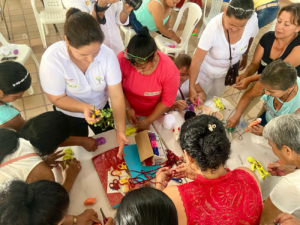 The participants showed an unbreakable commitment in this process, becoming agents of change in their communities. Edna Liliana Castro, resident of the Guanábano Brasilia village, has stood out not just as a farmer but also as an influential leader, playing a valuable role in the implementation of the POSPR as a community volunteer. Community volunteers are vital, as they encourage the communities to participate, and disseminate the POSPR methodology and objectives so that people understand the benefits of titling their land.
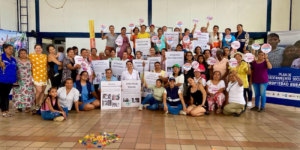 The last session of the workshops coincided with International Women’s Day, and during the event the women held a discussion with public officials from government entities such as the Agency for Rural Development, the Rural Development and the Community Development and Health Municipal Secretaries, and the Municipal Council. The women were grateful for the opportunity to advocate and take action in favor of their rights, both in rural and urban environments.
 “
“
 Despite the success, convincing the private sector to invest in rural land formalization remains a monumental challenge. Land for Prosperity examined the landscape by looking at nearly 2,000 companies in its eight target regions, and then narrowed down the list to 164 potential partners. A total of 77 companies replied to the proposal and engaged in dialogues and presentations on the subject.
 Interview with a same-sex couple who requested a joint title to formalize their property in Chaparral, Tolima.
 What is the story of your parcel and how did you purchase it?
 Mauro: It means a lot to us. In rural areas, homosexuality is sometimes negatively perceived, but our idea is to settle down and to be economically stable in the countryside. We want to access benefits such as loans to continue expanding our productive project and become a business. We want to be role models, show the community that the countryside can be profitable not just through production, but also through transformation. We don’t want to be seen just through discriminatory eyes, we want to show that we are capable of doing things better than a straight couple.
 Mauro: We want to tell them that, regardless of differences, as same sex couples we have the same rights and abilities. We should work together and show the world that homosexuality is not something out of the ordinary. Submitting an application for joint titling is a way to confirm our equality, to give visibility and promote the acceptance of diversity by the wider society, when it comes to land access.
 When Yudy Jiménez divorced her husband three years ago, she did not know the “rules of the game.” The couple, who was married for over 14 years, tried to divide their assets: her ex-husband kept the farm, and she kept the house.
 With the presence of social workers, Yudy felt supported as a single mother and as the owner of her parcel, and despite the pressure of her ex-husband, she completed the application to receive her property title in her name.
 In her role as a community volunteer, Yudy helped to identify conflicts like the one she had with her ex-husband. “I remember when a couple fought because the husband wanted to apply for individual titling. I was there to teach them about the care economy and the women’s rights to joint land titling,” said Yudy.
 “I am proof that women can also play this role. I have spread the message to the entire community, visited every farm, and ensured that everyone, including women, can participate and benefit from land formalization.” – Adela Méndez, Potrerito de Aguayo
 This year at the Cacao of Excellence Awards, Colombian cacao beans garnered the world’s attention. Competing with more than 220 cacao samples from over 50 countries, Workakao, a farmer-owned cooperative based in Meta, was awarded a gold medal and shared the big stage with 18 of the world’s top cacao producers.
 Workakao’s winning sample was the result of hard work to improve quality, yields, and processing through a Public-Private Partnership (PPP) that was facilitated by USAID in 2021. Motivated by the stakeholders of the PPP, Workakao has encouraged its 900+ cacao farming families to sell their “wet” cocoa beans to its collection center, enabling the cooperative to standardize post-harvest processing and achieve a consistently higher-quality bean after fermentation.
 In the wake of the historic moment, USAID’s Land for Prosperity Activity wanted to take advantage of the momentum. Farmers under additional USAID-facilitated PPPs in the cacao value chain traveled around the country for multi-day experience-sharing workshops to learn more about how Workakao and Meta-based producers are improving cacao processing and marketing as well as how to improve the integration of youth and women into the value chain.
 “We were immensely happy because the gold medal represents the work of our entire cacao community. It also has injected us with strength and hard work, because the real commitment starts now. We need to be able to sustain the quality of our cacao and give our products an added value, so the benefits reach our communities well into the future.”
 “We have learned so much on this journey. We have learned that we need to prioritize quality in order to reach buyers willing to pay a better price. Workakao is an example for all of us to continue working towards that quality,” explained Arcelia Prieto, a cacao farmer in Norte de Santander and member of Asoprocanor (Association of Cacao Producers from Norte de Santander and Catatumbo).
 The women-led strategy also takes into account other aspects of their lives and business such as who will replace them and take over their cacao plantations. The long history of illicit economies in the region and the border with Venezuela have made it difficult to keep children safe and insulated from risky behavior and illegal activities. To confront this harsh reality, the women have incorporated their children into the cacao plantations to teach them essential farming techniques and how the bean is processed.
 “If you ask me, chocolate meets all your nutritional needs. It will make you strong and improve your memory. Look at me, this is life, and I am happy,” Betsabeth said.
 It is believed that cacao first grew in the Amazon basin and then spread north and south throughout the Americas, including to the Aztec and the Mayan civilizations, who developed successful processing techniques. For them, the plant was a symbol of wealth, and its beans were used as currency.
 Over the last four years, Land for Prosperity has facilitated the creation of seven PPPs related to the cacao value chain that include over 33,600 farmers, 41% of which are women. In many parts of Colombia, such as Tumaco’s Pacific coast and the mountains of Northern Cauca, women represent half of the workforce.