

Cross-posted from USAID Medium
USAID is committed to placing Indigenous communities at center of locally led development
In Latin America, Indigenous communities are an essential part of efforts to address development challenges — such as issues with equity, government transparency, and environmental sustainability — and they amplify development gains far beyond the life of programs.
USAID supports the efforts of Indigenous communities to drive change in the countries and communities where they live, promoting their culture, expanding their businesses, strengthening governance over their lands, and protecting their rights and resources.
Read about three countries in the region where USAID engages Indigenous communities and elevates them as critical partners in local development.
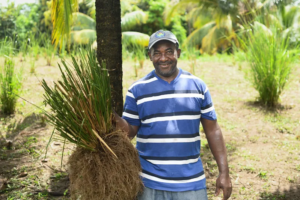
Garifuna Farmers Place Honduran Vetiver on the Map
The Afro-Indigenous Garifuna people of Honduras traditionally grow vetiver grass for medicinal use. Some farmers cultivate the aromatic crop for the essential oil made from its roots — a product highly sought after by the international beauty and wellness industry as a key ingredient in perfumes and aromatherapy.
USAID is partnering with Garifuna vetiver producers to meet that demand, improving farm productivity, creating jobs, and building markets.
A USAID-led partnership with Garifuna-run enterprise Nueva Luz and Honduran firm EFI Solutions sees strengthening the vetiver value chain as an innovative way to increase prosperity for Garifuna communities.
The partnership is pioneering sustainable commercial-scale cultivation of vetiver with six Garifuna communities in the country’s north coastal region. By engaging small Honduran agribusinesses directly into the supply chain, the approach goes beyond simply boosting crop productivity for farmers. It aims to generate employment opportunities for other members of the Garifuna community, including women and young people, and ensure fair market price for crops.
The quality of crops harvested from the vetiver project has exceeded expectations, and now Garifuna producers sell vetiver to Europe-based cosmetic companies. From July 2019 through September 2023, USAID helped EFI generate $7.5 million in sales and over 900 local jobs.
The success prompted a feasibility study to construct the first-ever vetiver oil extraction plant in Honduras. Garifuna farmers hope this will help the country’s vetiver industry to become a bigger global competitor and to generate economic opportunity for many more Hondurans.
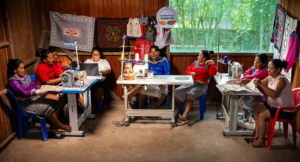
Women Artists Create a ‘Brilliant’ Brand in Peru
A group of Indigenous women in Peru are using their artistic talent to connect past to future.
The artists are members of the Shipibo-Conibo Indigenous community located near the Ucayali River in the Peruvian Amazon.
For centuries, elders have passed down ancestral embroidery, weaving, hand-dying, and painting skills to younger generations. Artists typically have never earned much income from selling handicrafts because the community spent much of its time farming to support itself.
In 2021, a group of Shipibo-Conibo women in the Peruvian Amazon joined together to create and sell traditional geometrically-patterned art, richly colored textiles, and distinctive jewelry. They dreamed of becoming as skilled at running a business as they were at making handicrafts.
To help reach their business goals, the group connected with USAID & Cedro’s Alliance for the Amazon project in 2022. The women registered their venture as a formal business and named it Sanken Beka, a Shipibo-Conibo phrase for “brilliant women.” The USAID-supported project also provided training in financial management, product sales, and digital marketing.
With that support, and recent national and international recognition, Sanken Beka crafts are selling well. The group netted nearly $1,500 in monthly sales over the last three months. They received an additional marketing boost when three textiles traveled aboard the Peruvian Navy’s BAP Unión tall ship, which recently toured ports around the world as an ambassador of the country’s products and tourism.
Indeed the “brilliant women” of Sanken Beka are a shining beacon of Indigenous cultural identity and economic success in their community.
Watch this video to learn more about the women and art of Sanken Beka.
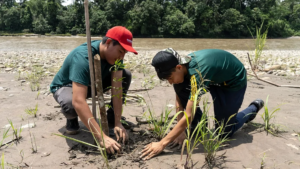
Ecuador’s Indigenous & Mestizo Youth Set a Vision for the Amazon
Indigenous youth in Ecuador will tell you that any commitment to solve environmental challenges should include and empower young people to take action.
Like their elders, Indigenous youth strive for profitable livelihoods that safeguard against deforestation, biodiversity loss, and climate change. They also struggle to ensure decision makers listen to their ideas and protect their rights and resources.
USAID is listening and taking action. Implemented through the World Wildlife Fund (WWF), the Sustainable Environment and Livelihoods for a Vital Amazon (SELVA) project works with the Siona, Siekopai, and Shuar Indigenous People in Ecuador’s northern Amazon region to help them reduce deforestation, develop sustainable livelihoods, and know their decision making and land management rights.
In April, USAID and WWF hosted the First Encounter of Diverse Youth for Conservation in Sucumbios, which brought together for the first time 67 Indigenous and mestizo youth to help shape the future of their Amazon. The workshop used art and creative group activities to encourage reflection and collaboration around environmental safekeeping, advocacy, and inclusive representation.
The experience was transformational for many participants.
One attendee, Jonathan, said: “I saw for the first time the integration of the mestizo and Indigenous Peoples, and I realized that we all have the same struggle — to preserve the environment.”
The workshop prompted the creation of a permanent governance process with the Provincial Government of Sucumbios, allowing Indigenous and mestizo youth to contribute to concrete conservation efforts. Thanks to this USAID-supported effort, young people have set their own vision for conservation and a precedent for inclusive environmental stewardship in Ecuador.
Watch this video from the First Encounter of Diverse Youth for Conservation.
About the Author
Chelsea Milko McAllister is a Senior Communications Advisor in USAID’s Bureau for Latin America and the Caribbean, and David Streed is a Program Analyst in the Strategy and Program Office of USAID’s Bureau for Latin America and the Caribbean.


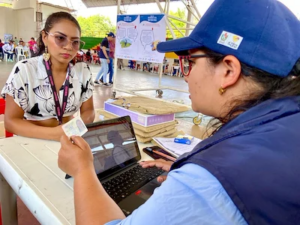
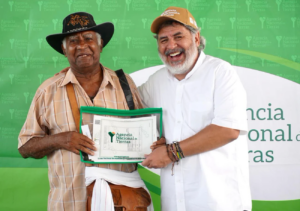
 With USAID support, Colombia’s National Land Agency delivered 83 land titles to families who have voluntarily substituted illicit crops in the municipality of Cáceres, Antioquia. The property titles correspond to over 1,200 hectares of rural land in the heart of Bajo Cauca, a zone affected by years of violence and narcotrafficking.
 Secure land tenure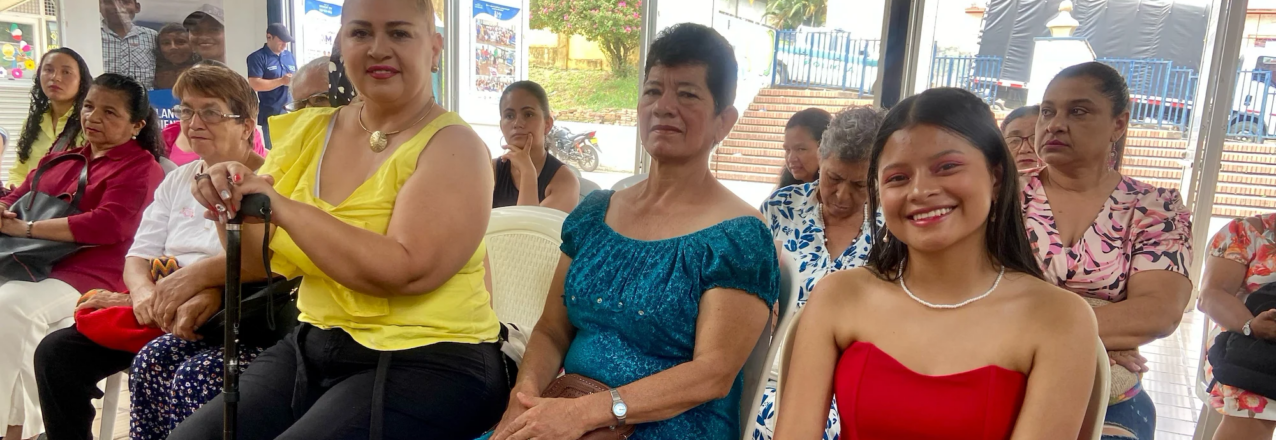
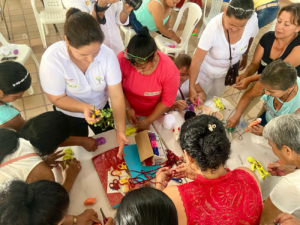
 As part of the Rural Property and Land Administration Plan (POSPR) being implemented in Chaparral, USAID Land for Prosperity (LFP) partnered with Colombia’s Land Restitution Unit to host a series of workshops to empower rural women about their property rights, land ownership, the care economy, and gender-based violence. These workshops, called nucleos de exigibilidad, were piloted first in Ataco during POSPR implementation. During the sessions, 30 female leaders who are participating in land restitution and formalization processes shared their views of their territory and learned about gender-based violence with a focus on patrimonial and economic violence. The women met three times to discuss crucial topics for their personal growth and the one of their communities, as an opportunity to strengthen their leadership and promote gender equality in Southern Tolima.
 The strategy was originally implemented in the municipality of Ataco and was recently extended to Chaparral, with the aim of building the capacity of these women so they can multiply their knowledge with their communities and neighborhoods. The work between the URT and LFP coordinates two important public policies: the one for rural property and land administration, and the one for land restitution.
 The participants showed an unbreakable commitment in this process, becoming agents of change in their communities. Edna Liliana Castro, resident of the Guanábano Brasilia village, has stood out not just as a farmer but also as an influential leader, playing a valuable role in the implementation of the POSPR as a community volunteer. Community volunteers are vital, as they encourage the communities to participate, and disseminate the POSPR methodology and objectives so that people understand the benefits of titling their land.
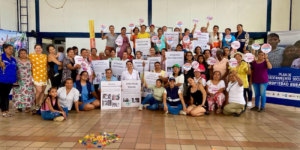 The last session of the workshops coincided with International Women’s Day, and during the event the women held a discussion with public officials from government entities such as the Agency for Rural Development, the Rural Development and the Community Development and Health Municipal Secretaries, and the Municipal Council. The women were grateful for the opportunity to advocate and take action in favor of their rights, both in rural and urban environments.
 “
“
 Despite the success, convincing the private sector to invest in rural land formalization remains a monumental challenge. Land for Prosperity examined the landscape by looking at nearly 2,000 companies in its eight target regions, and then narrowed down the list to 164 potential partners. A total of 77 companies replied to the proposal and engaged in dialogues and presentations on the subject.
 Interview with a same-sex couple who requested a joint title to formalize their property in Chaparral, Tolima.
 What is the story of your parcel and how did you purchase it?
 Mauro: It means a lot to us. In rural areas, homosexuality is sometimes negatively perceived, but our idea is to settle down and to be economically stable in the countryside. We want to access benefits such as loans to continue expanding our productive project and become a business. We want to be role models, show the community that the countryside can be profitable not just through production, but also through transformation. We don’t want to be seen just through discriminatory eyes, we want to show that we are capable of doing things better than a straight couple.
 Mauro: We want to tell them that, regardless of differences, as same sex couples we have the same rights and abilities. We should work together and show the world that homosexuality is not something out of the ordinary. Submitting an application for joint titling is a way to confirm our equality, to give visibility and promote the acceptance of diversity by the wider society, when it comes to land access.
 When Yudy Jiménez divorced her husband three years ago, she did not know the “rules of the game.” The couple, who was married for over 14 years, tried to divide their assets: her ex-husband kept the farm, and she kept the house.
 With the presence of social workers, Yudy felt supported as a single mother and as the owner of her parcel, and despite the pressure of her ex-husband, she completed the application to receive her property title in her name.
 In her role as a community volunteer, Yudy helped to identify conflicts like the one she had with her ex-husband. “I remember when a couple fought because the husband wanted to apply for individual titling. I was there to teach them about the care economy and the women’s rights to joint land titling,” said Yudy.
 “I am proof that women can also play this role. I have spread the message to the entire community, visited every farm, and ensured that everyone, including women, can participate and benefit from land formalization.” – Adela Méndez, Potrerito de Aguayo
 This year at the Cacao of Excellence Awards, Colombian cacao beans garnered the world’s attention. Competing with more than 220 cacao samples from over 50 countries, Workakao, a farmer-owned cooperative based in Meta, was awarded a gold medal and shared the big stage with 18 of the world’s top cacao producers.
 Workakao’s winning sample was the result of hard work to improve quality, yields, and processing through a Public-Private Partnership (PPP) that was facilitated by USAID in 2021. Motivated by the stakeholders of the PPP, Workakao has encouraged its 900+ cacao farming families to sell their “wet” cocoa beans to its collection center, enabling the cooperative to standardize post-harvest processing and achieve a consistently higher-quality bean after fermentation.
 In the wake of the historic moment, USAID’s Land for Prosperity Activity wanted to take advantage of the momentum. Farmers under additional USAID-facilitated PPPs in the cacao value chain traveled around the country for multi-day experience-sharing workshops to learn more about how Workakao and Meta-based producers are improving cacao processing and marketing as well as how to improve the integration of youth and women into the value chain.
 “We were immensely happy because the gold medal represents the work of our entire cacao community. It also has injected us with strength and hard work, because the real commitment starts now. We need to be able to sustain the quality of our cacao and give our products an added value, so the benefits reach our communities well into the future.”
 “We have learned so much on this journey. We have learned that we need to prioritize quality in order to reach buyers willing to pay a better price. Workakao is an example for all of us to continue working towards that quality,” explained Arcelia Prieto, a cacao farmer in Norte de Santander and member of Asoprocanor (Association of Cacao Producers from Norte de Santander and Catatumbo).
 The women-led strategy also takes into account other aspects of their lives and business such as who will replace them and take over their cacao plantations. The long history of illicit economies in the region and the border with Venezuela have made it difficult to keep children safe and insulated from risky behavior and illegal activities. To confront this harsh reality, the women have incorporated their children into the cacao plantations to teach them essential farming techniques and how the bean is processed.
 “If you ask me, chocolate meets all your nutritional needs. It will make you strong and improve your memory. Look at me, this is life, and I am happy,” Betsabeth said.
 It is believed that cacao first grew in the Amazon basin and then spread north and south throughout the Americas, including to the Aztec and the Mayan civilizations, who developed successful processing techniques. For them, the plant was a symbol of wealth, and its beans were used as currency.
 Over the last four years, Land for Prosperity has facilitated the creation of seven PPPs related to the cacao value chain that include over 33,600 farmers, 41% of which are women. In many parts of Colombia, such as Tumaco’s Pacific coast and the mountains of Northern Cauca, women represent half of the workforce.

 With the recent implementation of the Rural Property and Land Administration Plan (POSPR) in Chaparral, the Ivanazka Lemanyá de Calarma community is one of the seven Pijao indigenous groups who are submitting applications to the government to establish reservations. In total, the seven applications encompass 16 parcels covering 1,800 hectares.
 Before working on the applications of the seven reservations, Land for Prosperity carried out Free, Prior, and Informed Consent sessions with 11 communities that represent more than 2,500 people. After giving their consent, each community elected an Ancestral Guide to act as a point of contact for all communication and harmonization between the communities and the team implementing the POSPR, which is backed by Colombia’s National Land Agency (ANT).
 An Opportunity for Indigenous Communities