
USAID Leads Conference on Sustainable Land Governance

Originally appeared in USAID SURGE Project’s Cities Development Initiative Newsletter.

More than 350 experts and delegates gathered in Manila to exchange best practices and new approaches in land reform during the Conference on Sustainable Land Governance on February 8 to 9, 2017. The conference was organized by the U.S. Agency for International Development (USAID) through its Strengthening Urban Resilience for Growth with Equity (SURGE) Project, in partnership with the United Nations Human Settlements Programme (UN-Habitat) and the World Bank. It served as the most recent platform that elevated the discussion of sustainable land management and administration at the national level in the Philippines.

The two-day event featured a range of panel discussions on policy frameworks, urban land constraints, assets management for local government units, commercial pressures on land markets, technology solutions, resilient land management, and gender and social inclusion in property rights.

U.S. Ambassador to the Philippines Sung Kim, Philippines Department of Finance Secretary Carlos Dominguez III and USAID Mission Director Dr. Susan Brems graced the event.
“We are presented with a remarkable opportunity to work together towards sustainable land governance. Secure access to land is key to promoting broad-based, inclusive and sustainable growth of the Philippines,” said U.S. Ambassador to the Philippines Sung Kim.

The country continues to tackle challenges in land governance brought about by overlapping land management and administration policies, high incidence of fake double titles or rights recognition and outdated land use plans.

Nearly half of the Philippines’ 24.2 million land parcels remain untitled, according to the 2004 Land Administration and Management Project funded by Australian aid partnership with the World Bank. Among these untitled land parcels, the Asian Development Bank found that families and communities live on as many as 7.8 million residential parcels without secure land rights.

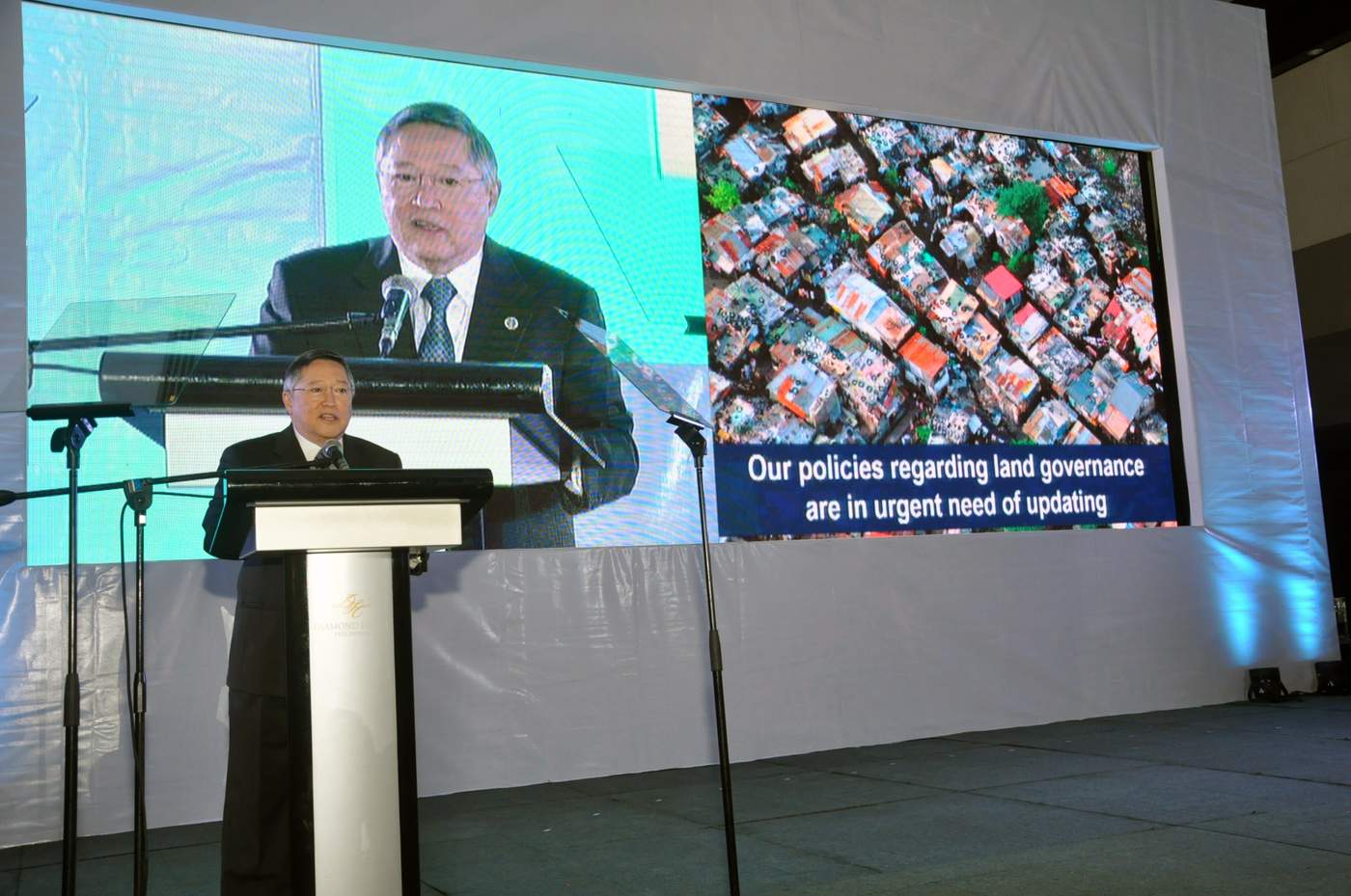
“As our population increased rapidly over the last few decades with our land policies hardly keeping pace, the phenomenon of landlessness has become more severe,” said Secretary Dominguez during his speech.

“Many of our settlements are vulnerable, our cities are congested, our forested areas have been stripped to make way for human habitation. We are truly facing a land governance crisis and must respond decisively on this,” he added.

Click here to watch the full speech of U.S. Ambassador Kim, and here to watch video insights of conference delegates.

Click below to read the full newsletter.

Cities Development Initiative Newsletter
Read our latest stories on land tenure, conservation,
economic development and urban resilience

Enter

Cities Development Initiative Newsletter

Kicker

This is a kicker.

**USAID leads conference on sustainable land governance**

More than 350 experts and delegates gathered in Manila to exchange best practices and new approaches in land reform during the Conference on Sustainable Land Governance on February 8 to 9, 2017. The conference was organized by the U.S. Agency for International Development \(USAID\) through its Strengthening Urban Resilience for Growth with Equity \(SURGE\) Project, in partnership with the United Nations Human Settlements Programme \(UN\-Habitat\) and the World Bank. It served as the most recent platform that elevated the discussion of sustainable land management and administration at the national level in the Philippines.

The two\-day event featured a range of panel discussions on policy frameworks, urban land constraints, assets management for local government units, commercial pressures on land markets, technology solutions, resilient land management, and gender and social inclusion in property rights.

U.S. Ambassador to the Philippines Sung Kim, Philippines Department of Finance Secretary Carlos Dominguez III and USAID Mission Director Dr. Susan Brems graced the event.

> _We are presented with a remarkable opportunity to work together towards sustainable land governance. Secure access to land is key to promoting broad\-based, inclusive and sustainable growth of the Philippines, said U.S. Ambassador to the Philippines Sung Kim._

The country continues to tackle challenges in land governance brought about by overlapping land management and administration policies, high incidence of fake double titles or rights recognition and outdated land use plans.

Nearly half of the Philippines 24.2 million land parcels remain untitled, according to the 2004 Land Administration and Management Project funded by Australian aid partnership with the World Bank. Among these untitled land parcels, the Asian Development Bank found that families and communities live on as many as 7.8 million residential parcels without secure land rights.

“As our population increased rapidly over the last few decades with our land policies hardly keeping pace, the phenomenon of landlessness has become more severe,” said Secretary Dominguez during his [speech](https://www.youtube.com/watch?v=azSmiI6ZaKU&feature=youtu.be).

“Many of our settlements are vulnerable, our cities are congested, our forested areas have been stripped to make way for human habitation. We are truly facing a land governance crisis and must respond decisively on this,” he added.

Click [here](https://www.youtube.com/watch?v=7dHayBmEBjA&feature=youtu.be) to watch the full speech of U.S. Ambassador Kim, and [here](https://www.youtube.com/watch?v=T24qSewgMok&feature=youtu.be) to watch video insights of conference delegates.

Sustainable Urban Land Coalition advocates for reforms, government supports move

The Conference on Sustainable Land Governance also hosted the launch of the Sustainable Urban Land Coalition, which called on the government to improve and make more accessible programs and services to fast track the development and adoption of land policy and institutional reforms.

The coalition, made up of more than 20 key representatives from national and local governments, business, international development and civil groups, announced their ten\-point call to action on the last day of the event. The group emphasized to rationalize the mandates of land related agencies, prioritize the implementation of a massive national titling program, expedite resolution of land\-related cases, and strictly enforce compliance of local government units on property valuation regulations, among others.

The SURGE Project facilitated the creation of the coalition, as part of USAID’s work in improving local land tenure security and land information management in USAID’s Cities Development Initiative \(CDI\) partner cities in the country.

In response, Office of the Cabinet Secretary Deputy Executive Director Jonas George Soriano, during closing remarks, said the call to action is timely as the new government is moving towards all the points raised in the adoption of a sustainable land governance to address the countrys land sector concerns.

We are appealing to our friends from the local government units to push for changes in the government. If you want change, the President is asking the mayors and the governors to lead the way, he said.

Meanwhile, National Economic and Development Authority \(NEDA\) Undersecretary Adoracion Navarro stressed that there is a need to strictly implement existing rules for effective land administration such as timely titling of lands and taxing idle lands sufficiently so that owners will put these lands to appropriate uses, which until now remains a big challenge.

Institutional challenges on the other hand, also remains a challenge, such as multiple administration agencies, multiple laws, multiple land processes and multiple standards in land valuation, she added.

We hope the next steps of this conference will be guided by the policy directions of the Philippine Development Plan. The conference provided solution\-oriented sessions, and we need to take advantage of technologies to improve management and access to land information, and on how computer\-assisted disaster risk models can assist in land use management decisions at the local levels, said Navarro.

The Philippine Development Plan \(PDP\) 2017\-2022 was approved by the NEDA Board on February 20, 2017. According to [NEDA](http://www.neda.gov.ph/2017/02/21/neda\-board\-approves\-philippine\-development\-plan\-2017\-2022/), the PDP is the first medium\-term plan to be anchored on a national long\-term vision, the _AmBisyon 2040_, which represents the collective vision and aspirations of Filipinos. To set the direction for future growth, the PDP is adopting a national spatial strategy recognizing that population, geography and cities are engines of economic growth. It aims to decongest Metro Manila, connect rural areas to key growth areas and to improve linkages between settlements for higher resilience against disasters \(_[NEDA](http://www.neda.gov.ph/2017/02/21/neda\-board\-approves\-philippine\-development\-plan\-2017\-2022/)_, 21 February 2017\).

Palawan tourist attraction adopts revised tourism code to conserve marine resources

The Sangguniang Bayan of Linapacan in the Calamian Group of Islands in Palawan, Southern Luzon recently approved a revised tourism code that requires tourists to pay an environmental fee.

Linapacan is one of Palawan’s tourist attractions, known for its clear aquamarine waters, powdery white sand and diverse aquatic life. It is dubbed as one of the _35 Clearest Waters in the World to Swim in Before You Die_ by American news site Daily News Dig.

The revenue from the environmental fee will be used to protect, conserve and manage the town’s natural environment. It will fund projects such as rehabilitation of marine and upland resources, effective environmental law enforcement, and solid waste management.

The imposition of environmental fee from tourists was adopted by the municipality based on the results of a willingness\-to\-pay study conducted by USAID through its Ecosystems Improved for Sustainable Fisheries \(ECOFISH\) Project.

ECOFISH is conserving marine biodiversity, enhancing ecosystem productivity and improving fisheries and related livelihoods in eight marine key biodiversity areas in the Philippines using an ecosystem\-based approach to fisheries management \(EAFM\) to achieve social, economic and ecological sustainability.

Business owners enjoy faster business registration as cities become more competitive

It used to take us three to five days to get a business permit and there were no clear systems or steps, shared Arsenia Seydandiego, who runs a pension house in Puerto Princesa City in Southern Luzon. Seydandiego is one of more than 130 travel\-related micro and small entrepreneurs in Puerto Princesa City. Every year in the month of January, business owners all over the country flock city halls to apply for business permits.

The renewal process was much easier this year. I hope that the city will keep improving its processes, said Seydandiego.

Fatima Lyn Catingub, who operates a photo services and studio business, shared a similar feedback. I was able to get my permit in less than a day. Everything is more organized and systematic.

About 7,470 business permits were issued during the business registration period in January, an increase to last years 6,794, generating more than Php116 million worth of revenue for the Puerto Princesa City Government.

The faster business registration was made possible through the collaboration of the Puerto Princesa City Government with USAIDs SURGE Project. The project re\-designed the citys business registration procedures to reduce the processing time and number of steps.

Puerto Princesas improved business permits and licensing system supports the goal of the national government to make more efficient the delivery of government services and eliminate corruption. In August 2016, the Departments of Trade and Industry, Interior and Local Government, and the Information and Communication Technology signed a Joint Memorandum Circular \(JMC\) to further streamline the business permits and licensing system in the country.

USAID has been supporting the streamlining of the business registration process of its Cities Development Initiative \(CDI\) partner cities since 2012. Zamboanga City in Western Mindanao also reaped the benefits of streamlining its business registration with the help of SURGE. More than 10,000 business permits were issued during the 29\-day operation of its newly\-established Business One\-Stop\-Shop \(BOSS\) in January this yeara 400 percent increase compared to the same period in 2016. The City Government credits this increase to the efficient BOSS and streamlining of the previous 18 steps for new businesses and 20 steps for renewal to just two steps each.

In Tagbilaran City, Bohol, Central Visayas, business owners received their permits in three hours, compared to waiting for a week during the previous year, after the City Government with assistance from SURGE cut the number of steps from 14 to three and launched its online business permit application form. This resulted in processing more than 4,000 business permits in the first month of 2017 alone, nearly reaching the total number of permits issued for the entire year of 2016.

By improving ease of doing business that benefits business owners and local governments, USAID contributes to promoting a business\-friendly environment and investment climate that can boost the competitiveness of second\-tier cities.

Cagayan de Oro introduces online system for assessing and paying taxes

Taxpayers in Cagayan de Oro City, Misamis Oriental, Northern Mindanao, can now pay property taxes and other government fees online by accessing the online tax payment and billing system on the City Governments official [website](http://www.cagayandeoro.gov.ph/).

This newest innovation allows taxpayers with any Visa branded card to pay property taxes, building fees, traffic violation fees, and market stall rental, wherever internet connection is available.

> We want our constituents and taxpayers to find it easy to conduct business and pay taxes. With this new online system, they can have their taxes assessed remotely and pay for them even from the comfort of their homes or workplaces, said Leonil Mistula, Chief of Computer Division of Cagayan de Oro City Treasurers Office.

Aside from paying online, taxpayers can also view and print their tax billing as the system is capable of processing real time online tax assessment. New business permit applications and renewals can also be processed using the system. Soon, Mastercard branded cards and most Bancnet\-affiliated ATM cards may also be used similarly. Globe and TM mobile subscribers can continue using their GCash to know their assessed amounts and to pay their taxes and fees from anywhere.

This innovative system is part of the City Government’s move to expand its electronic payment offering for Cagayan de Oro taxpayers. It first introduced mobile payments for real property and business taxes in 2014.

Since it was launched, more and more taxpayers are using the online and mobile systems because of the convenience and cost savings that these innovations offer.

Shayryl Mae Ramos, a business owner, tried the online system to renew her business permit and found it easy to use. With this facility, I can pay my taxes and fees quickly and save time in the process.

USAID’s E\-PESO Activity supported the local government in developing its program to provide electronic payment options to constituents. E\-PESO helped conceptualize the online payment system, forged partnerships between the City Government and appropriate payment service providers, and facilitated smooth project management, implementation and collaboration during the development phase. E\-PESO Activity is working with national government agencies, local government units, and the private sector to increase adoption of e\-payments and achieve inclusive economic growth.

Cagayan de Oro and Iloilo delegates to join global forum on urban resilience

Delegates from the cities of Cagayan de Oro and Iloilo will join more than 300 leaders and experts from around the globe to participate in the 8th Global Forum on Urban Resilience and Adaptation on May 4 to 7, 2017 in Bonn, Germany.

Organized by ICLEI, the forum will focus on urban resilience and adaptation to climate change challenges through sessions on localizing global frameworks, disaster risk reduction planning and policy, financing resilience, risk transfer and insurance, and mechanisms for measuring, reporting and accelerating action for resilience building, among others.

Iloilo City Mayor Jed Patrick Mabilog and Mary Ann Gumban, Dean of the College of Management of the University of the Philippines Visayas, will represent Iloilo City, while Eileen San Juan, Local Economic and Investments Promotion Ofcer of the Cagayan de Oro City Government, and Atty. Dionel Albina, Director of Innovation and Technology Solutions of the University of Science and Technology of Southern Philippines, will represent Cagayan de Oro City. The delegates were able to avail of fully\-funded scholarships for the trip.

The forum is part of the Resilient Cities congress series. It was first launched in 2010 in Bonn with the goal of forging partnerships between local government leaders and climate change adaptation experts to pursue solutions for adaptation challenges in urban environments.

The Cagayan de Oro and Iloilo delegates will also join a pre\-conference training on the Educational Partnerships for Innovation in Communities \(EPIC\) framework in conjunction with the Resilient Cities 2017 on May 3, 2017 in Bonn. The EPIC framework, previously known as the Oregon Model, was pioneered by the University of Oregon in the United States in 2009. The framework is known for its scalability and replicability across cities and universities, by matching city needs with university capacityovercoming the gap between knowledge and practiceto come up with innovative solutions to local quality of life issues.

The city\-university delegates are expected to replicate the EPIC model in their cities with the urban development learning centers that will be established by the SURGE Project. The knowledge hubs are envisioned to foster urban development, climate\-resilient land use and infrastructure planning, and sustainable water and sanitation services.

Zamboanga City out\-of\-school transform into ‘outstanding youth’

A batch of 185 youth completers in Zamboanga City received their certificates from USAID’s Mindanao Youth for Development \(MYDev\) Program and the Philippines’ Technical Education and Skills Development Authority \(TESDA\), after completing various livelihood skills trainings that will help improve their employment options.

The past weeks and months have shown everyone that you are ready to transform your own lives. You have invested a lot of time and effort to get to where you are now, from being out\-of\-school youth to now being outstanding youth, said USAID Office of Education Director Brian Levey as he addressed the youth completers in Zamboanga City.

Each of you has the power to promote peace in your communities and advance growth for all. I urge you to take advantage of the opportunities that await, Levey added.

USAID, through its MYDev Program, partners with the TESDA and local service providers such as the Zamboanga\-Basilan Integrated Development Alliance, Inc. \(ZABIDA\) to enable Mindanaoan out\-of\-school youth to have equitable access to relevant livelihood skills training and basic education through the Department of Educations Alternative Learning System \(DepED\-ALS\).

To date, MYDev has engaged more than 13,000 out\-of\-school youth in workforce and community development activities to gain skills and competencies and become productive members of their communities.

Cities Development Initiative

USAID is working to strengthen the economic competitiveness and resilience of secondary cities outside of Metro Manila through its Cities Development Initiative \(CDI\). The CDI seeks to advance the development of secondary cities as agents of growth that is inclusive, environmentally sustainable and resilient. Depending on the most urgent needs of the city, USAID provides a range of technical assistance, drawing from resources in economic growth, health, energy, environment, governance, and education to assist the cities achieve resilience and inclusive growth.

The CDI is a crucial component of the broader Partnership for Growth and Equity, a White House initiated whole\-of\-government partnership between the U.S. Government and the Government of the Republic of the Philippines. The partnership aims to shift the Philippines to a sustained and more inclusive growth trajectory on par with other highperforming emerging economies. Currently, USAID has six CDI partner cities: Batangas, Cagayan de Oro, Iloilo, Puerto Princesa, Tagbilaran and Zamboanga. Legazpi City in Albay, Southern Luzon and General Santos City in South Cotabato, Southern Mindanao are the two upcoming CDI cities.

The Role of Land in Financing Infrastructure in Cities

Originally appeared on USAID’s UrbanLinks.

Cities of the developing world face a daunting challenge in accessing the financing required to build infrastructure and deliver services for their growing populations. The estimated global infrastructure investment required from 2013 through 2030 ranges from $57 trillion to $67 trillion (covering transport, water, and telecoms, but not schools or hospitals), with 75 percent of these investments needed in cities.[1] Expanding access to financing for sustainable urban development is becoming more critical because of three trends:

  1. Cities of the developing world are growing rapidly in population and number: By 2030, a projected 662 cities will have at least 1 million residents, 63 cities are projected to have between 5 and 10 million inhabitants, and there will be 41 megacities (with populations greater than 10 million). Between 2016 and 2030 the number of African cities with 500,000 inhabitants or more will grow by 80 percent.[2]
  2. Donor-funded international development assistance is becoming a much smaller share of developing country finance and investment.
  3. Devolution of authority and responsibility means that cities—not national governments—are often charged with service delivery, transport, and economic development and expected to find the means to pay for and carry out these new functions.

Why isn’t there enough capital to fund infrastructure in cities?

In the past, cities of the developing world depended on their national governments, who often turned to international donors for concessional financing of infrastructure and other large development projects. Since 2000, this has been changing significantly, with domestic investment and foreign direct investment overtaking overseas development assistance. As a result, development agencies like USAID now see their role as catalyzing and leveraging investment from the private sector or helping improve domestic resource mobilization by supporting improvements to tax systems, rather than directly financing investments.

Bringing private finance to the table for public investments in developing countries is tricky because of the inherent risks in long-term investing in unstable environments. In the United States, we have successfully developed instruments, such as municipal bonds, that allow a city to obtain all of the funds to build infrastructure today, while spreading the repayments out over a decade or more. This means that businesses and citizens continue contributing to paying for the infrastructure as they benefit from the services and economic development that it supports. It is a complex challenge to introduce these types of financing instruments in the countries where USAID works because they lack strong financial management systems, have poor country credit ratings, insolvent utilities, low collection rates, and underdeveloped capital markets. One good example is Kenya, where USAID and its technical implementing projects, including the Sustainable Water and Sanitation in Africa (SUWASA) program, worked across water utilities, banks, and the government to encourage lending for expanding clean drinking water services while improving financial performance through cost controls. USAID’s Development Credit Authority (DCA) provided partial risk guarantees to several banks that increased loan security, encouraging local banks to initiate lending to water utilities, which previously had not received commercial financing.

Effective fiscal decentralization—the process of devolving authority and financial responsibility from the national government to local authorities—creates a predictable fiscal transfer flow between national governments and cities and provides incentives for cities to increase their own source revenues, both of which are needed to demonstrate city creditworthiness. The Addis Ababa Action Agenda prioritizes the need for donors and development partners to support domestic resource mobilization in developing countries at the national and subnational level. Best results for fiscally empowered cities come when work at the national level on the intergovernmental fiscal framework is paired with systems improvements at the local level to increase cities’ own source revenues. A 2014 case study on revenue mobilization of Ghanaian local government identified the main obstacles as “inadequate data on revenue sources, lack of enforcement of revenue mobilization bylaws, inadequate revenue collectors and their training.”[3] One way to address this that has worked in Ghana and Tanzania is a local revenue information system that identifies and maps taxpayers for easier billing and to confirm tax payment.

The value of land

Land is often underutilized for generating both capital and operating revenues. Citizens often resist property taxation if it is not directly related to a service received such as user fees for water, electricity or permitting and administrative services. A 2016 case study on Ghanaian local government mobilization noted significant contributions of property taxation to own source revenues, even with a low compliance rate of about 30 percent. The authors conclude that “innovative measures must therefore be adopted by local governments to make property owners appreciate the need to pay taxes. This will help improve property rate mobilization to help local governments move towards fiscal independence.”[4] As Chief of Party for a USAID project in Kyrgyzstan, I saw first hand, how important it was to get journalists on board with the introduction of a new property tax to build local awareness and support. We organized local study tours for the journalists in which mayors explained how cities needed property tax revenues for kindergartens and public health clinics, which changed the journalists’ attitudes fundamentally.

The city of São Paulo has been innovative in creating capital revenues from city land by introducing a development concession mechanism for additional building rights. The theory is to capture some of the increased value of land when regulations change (such as allowing higher density) or when infrastructure improvements are made. The city deposits the funds received from real estate developers into an urban development fund that has paid for social housing projects, new parks, sidewalks and street improvements, drainage and sanitation, community facilities and cultural heritage restoration.[5]

Learning from what works

The complex challenges of urban finance demand a comprehensive and innovative approach to realize the potential of all resources and to draw on the comparative advantages of public and private actors. A good start in capturing relevant experience has been made by United Cities and Local Government (UCLG) which recently launched a Global Observatory of Local Finances. In 2016, UCLG jointly produced a report with OECD on “Subnational Governments around the World: Structure and Finance” that highlights the diversity of the systems in place drawing on a sample of 101 countries.

Cities drive a country’s economic development and urban finance is the key to unlocking the potential of cities in the developing world.

USAID’s E3/Urban team works in a holistic way to help cities and develop partners understand the range of challenges and solutions – from accessing private capital markets to increasing own source revenues – while ensuring transparency and not leaving out the urban poor.

To learn more about:

  • USAID’s urban work, visit: www.urban-links.org
  • USAID’s private capital management work, visit: https://www.usaid.gov/pcm
  • The Development Credit Authority, visit: https://www.usaid.gov/dca


  1. McKinsey Global Institute. (2013). “Infrastructure productivity: How to save $1 trillion a year.” Kim, Julie. (2016). Handbook on Urban Infrastructure Finance. New Cities Foundation.
  2. UNDESA. (2016). “The World’s Cities in 2016 – Data Booklet.”
  3. Ernest Adu-Gyamf. (2014). “Effective Revenue Mobilisation by Districts Assemblies: A Case Study of Upper Denkyira East Municipal Assembly of Ghana” in Public Policy and Administration Review. http://pparnet.com/journals/ppar/Vol_2_No_1_March_2014/7.pdf
  4. Roland Tundyiridam, Alhassan Yakubu Alhassan, Abdul-Rahim Abdulai. (2016). “Contribution of Property Rates to Internally Generated Fund (IGF) Mobilization in Kassena-Nankana Municipality of Ghana” in Advances in Social Sciences Resource Journal. http://scholarpublishing.org/index.php/ASSRJ/article/view/2083
  5. Paulo Sandroni. (2011). “Urban Value Capture in São Paulo Using a Two-Part Approach” Lincoln Institute of Land Policy.

Land Matters Media Scan – 8 May 2017

Here are the recent land tenure and resource management media items:

Global

  1. Defending Earth Every Day With Women Around The World (4/20/17)
    Source: The Huffington Post
  2. Earth Day: Eight amazing facts that prove tribal people are the best conservationists (4/21/17)
    Source: Survival
  3. Land Rights as a Centerpiece of Climate Change Resiliency: From Washington State to Kenya’s Coast Region (4/20/17)
    Source: Landesa / Medium
  4. Collective forest tenure reforms: Where do we go from here? (4/25/17)
    Source: Forests News
  5. Land 2030: Land rights and inclusive sustainable growth (4/27/17)
    Source: World Bank

Recent Events

  1. Conference Roundup: India Land And Development Conference, 2017 (4/5/17 – 4/6/17)
    Source: Land Portal

Indigenous

  1. Argentina’s indigenous march for lost land (4/25/17)
    Source: Al Jazeera
  2. FEATURE-Indigenous group takes Brazil to court in landmark case (4/25/17)
    Source: Thompson Reuters Foundation
  3. Brazil indigenous protest over land rights turns violent (4/25/17)
    Source: Thompson Reuters Foundation
  4. Brazil: A government of death is plundering our ancient Munduruku lands. Help us stop it (4/25/17)
    Source: The Guardian
  5. Brazil’s Indigenous Leaders Convene To Shore Up Eroding Rights (4/21/17)
    Source: Ecosystem Marketplace
  6. Indigenous communities protect forests from onslaught of palm oil industry in Guatemala (4/26/17)
    Source: Land Rights Now
  7. INTERVIEW-Winner of “Green Nobel” says India is plundering not protecting tribal lands (4/24/17)
    Source: Thompson Reuters Foundation
  8. On Nicaragua’s Mosquito Coast, conflict over indigenous land turns violent (4/27/17)
    Source: Daily Mail / Thompson Reuters Foundation
  9. Indonesia: Mapping indigenous lands in Indonesia’s tallest mountains (4/21/17)
    Source: Mongabay

Africa

  1. Ghana: Take over Nkonya-Alavanyo lands – Government urged (4/21/17)
    Source: Ghana Web
  2. Kenya: Rural women struggle to secure land rights (4/23/17)
    Source: Ureport
  3. Nigeria: Clashes Over Grazing Land In Nigeria Threaten Nomadic Herding (4/24/17)
    Source: NPR
  4. DRC: Diamonds Aren’t Forever (4/24/17)
    Source: Slate
  5. South Africa’s ANC to introduce amended land claims bill in May (4/34/17)
    Source: Reuters
  6. Tanzanian polygamist’s puzzle: how to stop six wives warring over 500 acres? (4/25/17)
    Source: Thomson Reuters Foundation

Americas

  1. The Land is Forever: Rodrigo Tot Wins Goldman Prize for Land-Title Quest (4/24/17)
    Source: Daily Mail / Thompson Reuters Foundation
  2. Peru: Amazon natives in Peru take over oil field in land use dispute (4/25/17)
    Source: Thompson Reuters Foundation
  3. Brazil: Hooded gunmen kill civilians in rural Brazil land conflict – security officials (4/21/17)
    Source: Thompson Reuters Foundation
  4. Related: Nine people killed in Brazilian land dispute massacre (4/22/17)
    Source: The Express Tribune

Asia

  1. India: Lords of all they survey: land rights project Telangana (4/22/17)
    Source: The Hans India
  2. FEATURE-India’s Muslim women fight tradition and family for right to property (4/27/17)
    Source: Thompson Reuters Foundation
  3. Vietnam land protesters free final hostages after city official visits (4/22/17)
    Source: Thompson Reuters Foundation
  4. Related: Vietnamese Villagers Release 19 Officials Held Hostage in Land Dispute (4/22/17)
    Source: The New York Times

Today These Families are Happy with the Land Restitution Policy

Q&A with the Land Restitution Unit’s regional director for Sucre, Bolívar, and Córdoba

Originally appeared on Exposure.

In the region of Montes de María, in northern Colombia, citizens have filed more than 6,000 land restitution claims. To date, the government has processed 85% of them. Judges have issued sentences restituting some 4,000 hectares to 300 families. In this interview, Álvaro Tapia Castelli, the Land Restitution Unit’s (LRU) regional director for Sucre, Bolívar, and Córdoba, speaks about the support that USAID’s Land and Rural Development Program has provided for the restitution process and the LRU’s plans to resolve all remaining claims in 2017.

____________________________________

Q: What characteristics have made Montes de María and the LRU’s mission unique?

A: Since the creation of Colombia’s land restitution policy, Montes de María has been characterized by a large number of restitution claims, especially in municipalities like Ovejas and El Carmen de Bolívar. And at the same time, our regional LRU office has suffered from a shortage of personnel, which prevented us from processing claims systematically and efficiently.

Q: USAID began partnering with your office in 2013. How has the partnership helped the LRU attend to restitution claims?

A: Thanks to USAID, we have enjoyed the support of professionals who could help us accelerate the various phases of the restitution process, including the administrative and judicial phases. The support has allowed us to resolve a large number of pending claims, which has allowed us to be able to provide timely responses to the families seeking the restitution of their land. I would say of the more than 6,000 claims in Montes de María, about 15% were processed with the support of USAID’s Land and Rural Development Program.

Q: Where did USAID and the regional LRU office combine efforts to increase land restitution processes?

A: We were able to push forward about 150 cases for people in the village of Macayepo and in the mountainous area of Bolívar. Today, many of these cases have received rulings from restitution judges. Last year, judges delivered 77 rulings that called for the issuing of property titles for families who were forced to abandon their lands, and some of these parcels have already been formalized. Thanks to USAID, today these families are happy with the land restitution policy.

Q: What are some of the challenges in working with the municipalities in terms of attending to restitution beneficiaries?

A: Before, everyone seemed to think that the restitution policy was the sole responsibility of the LRU. We know that there are a series of entities that participate in the process—these are the entities that make up the SNARIV [1]. And for the case of the regional entities, if we hadn’t had a rapprochement with them in terms of organizing participatory forums where they could learn about the restitution policy and their responsibilities in this regard, it would have been quite difficult to implement the policy at the regional level.

Q: Have you been able to change this perception?

A: Yes, we were able to strengthen interinstitutional coordination in the region, which allowed us to address the issue of secondary occupants. This is an extremely important issue that we wouldn’t have been able to address without USAID’s support. USAID opened up channels of communication with the Ombudsman’s Office, the departmental government, and even mayors’ offices in order to lend support to secondary occupants—families who had nothing to do with abandonment and displacement, but are nonetheless involved in the restitution process.

[1] National System for Comprehensive Victim Support and Reparation.


Land Matters Media Scan – 21 April 2017

Here are the recent land tenure and resource management media items:

USAID

  1. Customary Land Certification Reaches Zambia’s Vulnerable Populations (4/21/17)
    Source: LandLinks

Upcoming Events

  1. Using Tools to Advance Transparency in Land Investments (4/26/16)
    Source: Business & Human Rights Resource Centre
    RSVP: Here

Reports and Publications

  1. The 2017 Atlas of Sustainable Development Goals: a new visual guide to data and development (4/17/17)
    Source: World Bank’s Data Blog
  2. Militants exploit growing competition for water, land – study (4/20/16)
    Source: Thomson Reuters Foundation

Global

  1. The Necessary Alliance between Conservationists and Rights Advocates (4/18/16)
    Source: Scientific American
  2. Land Registry: A Big Blockchain Use Case Explored (4/19/16)
    Source: Coin Desk

Africa

  1. Gambia: African Women’s Network for Community Management of Forests Constituted (4/13/17)
    Source: All Africa / The Point
  2. Analysis: South Africa: On land issues, ANC lacks clarity and determination (4/17/17)
    Source: Daily Maverick
  3. Gold rush fever among poor Zimbabweans leaves trail of destruction (4/17/17)
    Source: Thomson Reuters Foundation
  4. Ethiopia rights body: ‘More than 600 protest deaths’ (4/18/17)
    Source: BBC News
  5. Kenya’s pastoralists look beyond patriarchy to property rights for women (4/19/17)
    Source: Thomson Reuters Foundation
  6. Kenya needs two million homes to curb slum explosion, World Bank says (4/12/17)
    Source: Thomson Reuters Foundation
  7. Namibia: Customary land rights holders on communal land urged to embrace each other (4/19/17)
    Source: Namibian Broadcasting Corporation

Americas

  1. Brazilians Dislike Tax Paid to Royal Descendants (4/13/17)
    Source: VOA News
  2. Brazilian tribal leader fronts global protests for land rights (4/18/17)
    Source: Survival International
  3. General Motors Quits Venezuela After Officials Seize Plant (4/20/17)
    Source: NBC News

Asia

  1. Related: This Village In Vietnam Is Holding A Dozen Police Officers Hostage (4/17/17)
    Source: Foreign Policy
  2. Related: Hanoi authorities attempt to settle land dispute (4/19/17)
    Source: VietnamNet
  3. Anatomy Of A Tiger: With all Eyes on Myanmar, See How Land Reform Shaped Asia’s Tiger Economies (4/17/17)
    Source: SKOLL
  4. Does Hong Kong’s land sale system need a new lease of life? (4/18/17)
    Source: South China Morning Post
  5. Cambodia: World Bank Loan of $100 Million Angers Boeng Kak Activists (4/19/17)
    Source: The Cambodia Daily (subscription req’d)
  6. South India’s scorching drought forces farmers into debt bondage (4/19/17)
    Source: Thomson Reuters Foundation

Europe

  1. Post-Brexit farm policy must improve public access to land, campaigners say (4/19/17)
    Source: FarmingUK
  2. Infrastructure for introduction of land market prepared in Ukraine – Agrarian Policy Ministry (4/20/17)
    Source: UKRINFORM

Customary Land Certification Reaches Zambia’s Vulnerable Populations

When Ireen Sakala, a smallholder farmer in Mkanda Chiefdom, heard about a new effort to document land ownership, she feared that as a disabled, single woman, she might be excluded. Confined to a wheelchair since childhood and unable to find employment, Ireen depends on land inherited from her parents for her family’s livelihood. Her land, like most rural land in Zambia, has no documentation and is administered through inheritance from family and verbal histories under the authority of a village headperson and the chief. With a growing population and increased land scarcity, pressures on property rights and land security are rising.

Since 2014, a local civil society organization, the Chipata District Land Alliance (CDLA), with USAID support, has helped chiefs and hundreds of villages document land allocations and provide land certificates to Ireen and hundreds of other villagers. Ireen joined her neighbors, including thousands of women, in having her land rights documented. Holding her certificate, Ireen noted, “I am very happy that equal opportunities are being accorded. I now have a certificate to my field issued in my name and I have registered my daughter as a person of interest to my land. I feel my daughter’s future to use my land is guaranteed.”

Elected as the Secretary of the Village Land Committee, Ireen has now undertaken a leadership role administering the village land register to help others in her community access the same rights she has gained.

Working with organizations such as the CDLA, Zambia’s traditional leaders and government are recognizing the benefits of strengthening community and household land rights. With over three-quarters of Zambia’s land falling under customary tenure, leadership and support from chiefs and chieftainesses creates optimism for the future in farmers like Ireen.

Land Matters Media Scan – 13 April 2017

Here are the recent land tenure and resource management media items:

USAID

  1. Ask the Expert: An Interview with Zemen Haddis, USAID (4/7/17)
    Source: LandLinks

Reports and Publications

  1. Australian governments have failed Indigenous peoples, says Oxfam (4/11/17)
    Source: The Guardian
    Related report: Moving beyond recognition: respecting the rights of Aboriginal and Torres Strait Islander Peoples (4/12/17)

Global

  1. Tested, Cost-effective, and Practical: Secure Community Land Rights Can Help Protect the Earth and Prevent the Climate Crisis (4/12/16)
    Source: Amazon Watch press release

Africa

  1. South Africa: Land Rights and Justice in South Africa (4/11/17)
    Source: Wall Street Journal (subscription req’d)
  2. South Africa’s Zuma talks tough on land, though repeat of Zimbabwe unlikely (4/6/17)
    Source: Thomson Reuters Foundation
  3. Tanzania: At war with the in-laws: Tanzania’s evicted widows push for rights (4/5/17)
    Source: Thomson Reuters Foundation
  4. Côte d’Ivoire: sensitization campaign on land legislation goes on (4/12/17)
    Source: Ecofin Agency
  5. Senegal: World in Progress: land grabbing in Senegal – communities vs investors (4/5/17)
    Source: Deutsche Welle

Americas

  1. Indigenous Guyanese villages to receive titles (4/11/17)
    Source: NationNews / GINA
  2. Brazil’s land titles program improves Amazon forest protection: research (4/5/17)
    Source: Thomson Reuters Foundation
  3. Brazil’s land war between Indigenous people and farmers: ‘We just need to be home’ (4/7/17)
    Source: The Globe and Mail

Asia

  1. India: Don’t confer forest rights to tribals in critical tiger habitats: NTCA (4/12/17)
    Source: Livemint
  2. India’s landless poor can benefit from public ‘land bank’, analyst says (4/10/17)
    Source: The Express Tribune / Reuters

Pacific

  1. Addressing the past, building the future: Land rights challenges in Timor-Leste (4/13/17)
    Source: Leiden Law Blog

Getting the Lay of the Land

A municipal land formalization strategy promotes land security in Colombia’s post-conflict

Originally appeared on Exposure.

USAID AND LOCAL GOVERNMENT PARTNERS CREATED A MUNICIPAL LAND OFFICE TO TACKLE THE TITLING OF MORE THAN 4,600 PARCELS IN SANTANDER DE QUILICHAO. BY BUILDING CAPACITY AT LOCAL LEVELS OF GOVERNMENT, RURAL MAYORS AND THEIR TEAMS ARE EQUIPPED TO CONFRONT LAND INFORMALITY HEAD ON.

At the end of 2016, an infrastructure project in rural Santander de Quilichao was on the brink of losing its funding. Local government officials faced the threat of having to return over US$50,000 if the project’s property was not formalized as municipal property. The project, which was already finished and bringing potable water to over 800 users, was being financed under an agreement with Cauca’s departmental government.

The municipality did something it had never done before: titled a public property in just nine days.

The municipality’s recently created Land Office produced a property title before New Year’s Day 2017, and the investment was saved. The infrastructure project was the office’s first challenge, and its three-man team responded swimmingly.

“The municipalities of Northern Cauca have a lot of needs in basic sanitation, energy, and infrastructure. They are very rural, and overall there is little money flowing in—so if the municipality can obtain funding and is willing to make the investment, the last thing we need is to miss the opportunity due to our inability to register the property,” explains Jaime Andrés Devia, legal assistant in the Land Office.

Santander de Quilichao’s Land Office, which is the result of a partnership with the USAID-funded Land and Rural Development Program, is already playing a critical role in the municipality’s land administration processes and in promoting awareness on how to formalize land rights among the area’s 100,000 residents.

Perhaps most important, the office acts as a link with Colombia’s National Land Agency at a time when the government is poised to formalize land tenure on a massive scale as part of the commitments made in Colombia’s peace agreement with the FARC. The ongoing decentralization of land administration tasks means that the government is placing a larger responsibility on departmental and municipal governments to support to land formalization, land restitution, and rural development.

“When the Land Agency decides on its strategy and how it will carry out massive formalization throughout Colombia, Santander de Quilichao will have a great deal of the work done, especially thanks to the Municipal Formalization Plan,” says Devia.

The plan, a result of USAID’s institutional strengthening programming, is an official roadmap for the Land Office. In Santander de Quilichao, there are an estimated 4,600 informally owned private parcels. This number represents 62% of all parcels eligible for titling in the municipality, which has over 30,000 parcels. However, many of these are collectively owned by indigenous and Afro-Colombian communities and cannot be titled by the municipal government.

There are also more than 200 untitled publicly owned lands, such as schools and health centers, around the municipality. The new office has made titling 100 of these a top priority in 2017, a necessary step to respond to the needs of citizens who live on untitled urban lots and lack basic services.


Ask the Expert: An Interview with Zemen Haddis, USAID

Zemen Haddis, PhD, is the Senior Agriculture Policy Advisor for USAID/Ethiopia and he manages USAID’s LAND project, which focuses on the land rights formalization process in Chifra and Amibara woredas (administrative zones similar to counties) in Afar Ethiopia.

The project works with pastoral communities in Ethiopia to support the formal recognition of customary land rights and strengthen the capacity of formal and customary pastoral land administration and land use institutions. LandLinks caught up with Dr. Haddis at his office in Ethiopia to learn more about his take on the Afar impact evaluation and how the project is engaging pastoral communities and the government around strengthening effective land and resource governance. Here is what he had to say:

Here is what Dr. Haddis had to say (this interview has been edited and condensed for clarity):

“The intervention in Afar was designed to pilot land demarcation and certification in the names of communities and to assist the Government of Ethiopia in establishing a system [for certification] that is accountable and transparent while at the same time empowering the customary institutions.

The project works with the regional Afar government and the pilot is in two woredas, Ambara and Chifra, which have different characteristics; Amibara is more agro-pastoral area with some land allocated for investment, Chifra, on the other hand, is more pastoral and grazing areas. Even though these are different geographic areas, many of the challenges are the same.

One challenge is that the Afar region would like to implement a land use plan that allocates land for grazing, crop production, investment, and other purposes—this shrinks the natural grazing system in pastoral areas. Communities would like to keep this impact on their grazing land as small as possible. We are trying to pilot this project in certain kebeles [local neighborhood governments] where it is not a government priority to allocate land for farming and where the pilot can show how beneficial this kind of land demarcation and certification is for both communities and the government.

We are trying to create a middle ground for communities and government to secure tenure rights together. Communities are trying to get back their control of resources at the same time government officials have been attempting to implement a land use plan that would give the government some decision-making role in land allocation for development purposes on communal lands.

In many places, the government allowed the administrative structure of many kebeles to be according to clan structure. As a result clan leaders in these areas can have an administrative role within both formal and customary systems. This made clan leaders accountable to both the government and to the customary system, which creates some difficulties in differentiating between formal and informal structures.”

What are some of the unique situations you find working with pastoralists?

“The model we use was designed to maintain pastoralists’ access to large grazing areas, because of the nature of their livelihood. A clan may have its own territory but may need permission from neighboring communities to use land seasonally. Pastoralists need this kind of arrangement to be able to utilize large areas to support their livelihoods. Sometimes large farms affect their movement. In many grassy areas, there is also the invasion of the harmful Prosopis bush [an invasive plant that has expanded into some of the best grazing areas].

Many pastoralists are shifting away from cattle production to sheep and goats because of lack of resources and grazing areas. This shows there’s a need for more management of the grazing areas and customary leaders, which are in a better position to manage these areas than the government, don’t feel empowered to manage them at the moment.”

What are the lessons learned, and what advice would you give to others working in pastoral areas?

“One challenge is a perception problem. Pastoral populations are few in number, but use large tracts of land—this is the nature of their livelihood—and they need to move from one place to another to access resources such as water points and different pastures during the wet and dry seasons. People may not understand this and all too often think that they may not need to consult anyone to use open areas of land for investment; even the local people sometimes believe this. One of our take-aways from this intervention is that frequent consultation and discussion with communities is very important in understanding the lives and livelihoods of these communities.

We also need to continue developing awareness of stakeholders who would like to work in pastoral areas and within the pastoralist communities themselves. And the regional government could help train communities, sharing information with the whole community, and support efforts to make sure leaders are accountable; that compensation is for the whole community; and that all members of the community—especially women and other vulnerable groups—can benefit.”

What are some of the challenges that female-headed households face under customary systems in Afar? 

“Normally men come to discussions but you don’t see women or even youth attending and voicing their interests. There is a strong influence of customary leaders and heads of households, making it unlikely that women will be vocal about their interests even when we are soliciting their opinions. This [finding] is in the baseline report. Because of the influence of traditional life, women are not in a position to understand and ask for their rights. In one instance, a woman in Chifra told me that she believed this oppresses women in her community, she said, “This is the first time I am telling anyone because our religion and tradition doesn’t allow women to come out and talk about their problems.”

These beliefs mean that we need to devise different mechanisms that will allow us to better approach women and understand their situation to better resolve their problems. And we need to have an understanding of customary leaders and their communities to get their support if we want to resolve these problems.”

What do you think governments should know to encourage them to provide pastoralists with access to their lands? What examples of successful policies have you seen for pastoral communities?

“Secure ownership of pastoral areas is the first step that governments could take. If pastoralists feel a lack of ownership, they will not be in a position to monitor and take care of their grazing areas. They may fear that land can be taken at any time by the government or by investors, which does not encourage these communities to manage it well.

The government and communities could work together to develop by-laws to establish a better sense of ownership in these areas, this may include consulting with communities before using land for a public purpose and land could be allocated for investment by taking into consideration the interests of the communities. Both government and communities could use a model where the communities are consulted and benefit from any land taken from them and pastoralists are empowered to manage their land. If there is a sense of ownership pastoralists can manage the land; if there is no sense of ownership, I believe, we may see very bad deterioration in the future.”

What would you recommend to others who are interested in working with pastoral communities to secure land rights – or rights to pastures, water sources, migration routes?

“We need to be innovative in our approach to pastoral areas. First, we need to understand the interests of both parties, governments and communities, and find a way to accommodate these interests, We need long-term plans so that government officials in particular can understand how beneficial and empowering secure land rights are to communities.

One of the objectives of the pilot is to show that there’s another way of working together. In Ethiopia, according to the law, the government has all the rights to land. Pastoralists may not understand this because they are only familiar with customary laws, which can lead to conflicts. We need to bring these two groups together to help them understand each other and find “common ground.”

When it comes to land management, allocating land for grazing, forests, or other purposes, has to be done at the community level for it to be done in harmony with both customary and formal land laws. Finding a point of compromise is very important; then government officials can work with the customary institutions more closely.”

USAID has supported the development of the impact evaluation on the Afar project. What information from the baseline report did you find interesting?

“The baseline is very interesting. I had the opportunity to talk with clan leaders before the baseline report and at the time, I had the impression that they had lost their land and that they were very disappointed by the lack of government protection on the ground.

But now I understand that there is no significant claim of land taking for investment without the consent of communities and the baseline tells us that the Afar people were relatively happy and protected. We need to understand this better in the future. The pastoral context is a complex situation so we should not assume anything; we need to continue to learn more.

Going forward, the project can continue with demarcation and improve the awareness of communities and we can see what kinds of changes of perception in terms of benefit arise. I’m optimistic that this intervention may improve perceptions towards communal land administration and management over time in the project area.”

Land Matters Media Scan – 5 April 2017

Here are the recent land tenure and resource management media items:

USAID

  1. Securing Land Rights in Zambia – links to TGCC-related World Bank Paper (April 2017)
    Source: Food Tank

Reports and Publications

  1. How to protect Peru’s rainforest? Indigenous land titles, researchers say (4/3/17)
    Source: Thomson Reuters Foundation
    Related report: Titling indigenous communities protects forests in the Peruvian Amazon (4/3/17)
  2. Protect small farms to meet growing global food needs, study says (4/5/17)
    Source: Thomson Reuters Foundation
  3. LEGEND Land Policy Bulletin: Can technology revolutionise efforts to secure land rights? (March 2017)
    Source: Land Portal / DFID
  4. New study provides a blueprint for engaging indigenous peoples in REDD+ forest monitoring (3/28/17)
    Source: Mongabay
    Related study: Full and effective participation of indigenous peoples in forest monitoring for reducing emissions from deforestation and forest degradation (REDD+): trial in Panama’s Darién (2/17/17)

Global

  1. Improving Land Tenure Security with Low-cost Technologies (3/31/17)
    Source: GIM International
  2. Land Information Ecosystem Declaration (3/29/17)
    Source: Land Portal

Africa

  1. Namibia: Windhoek mayor asks residents not to grab land (4/4/17)
    Source: Namibia Broadcasting Corporation
  2. Somaliland: Multi-million dollar deal for Somaliland’s historic port sparks land rush (4/4/17)
    Source: Thomson Reuters Foundation
  3. Rwandan forces accused of violence over land disputes (4/4/17)
    Source: eNews Channel Africa
  4. Kenya: Samburu, Maasai elders resolve long-standing pasture conflict (4/1/17)
    Source: Citizen Digital
  5. Kenya: Decades Old Tensions Are Driving the Conflict in Kenya’s Laikipia Region (4/2/17)
    Source: AllAfrica / The Conversation
  6. Uganda: Fraud Cited As 230 Luweero Families Face Eviction From Land (3/30/17)
    Source: AllAfrica / The Monitor
  7. Nigeria: Amnesty International tells Lagos govt to stop ‘forced evictions’ (3/28/17)
    Source: TheCable

Americas

  1. Peruvian court: Indigenous communities must be consulted before drilling (4/4/17)
    Source: Catholic Philly / CNS
  2. Brazil: Thieves or Robin Hood? Brazil squatters step up housing occupations (3/30/17)
    Source: Daily Mail / Thomson Reuters Foundation
  3. Venezuela: Saving the Venezuelan Amazon: mega-nature reserve? Or mega-mining frontier? (3/30/17)
    Source: The Ecologist

Pacific

  1. Indonesia: Three decades of tenure reform in Indonesia (3/31/17)
    Source: CIFOR blog