

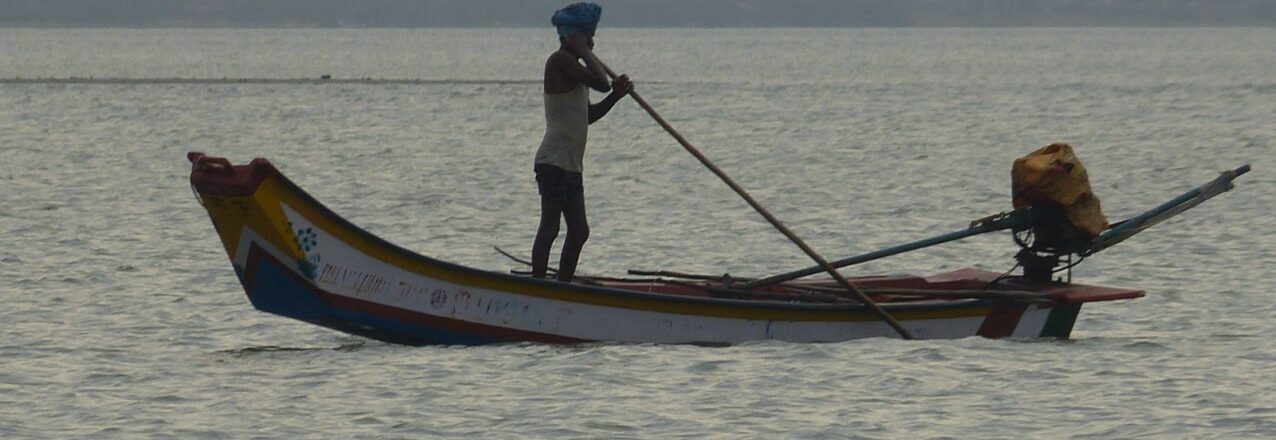
Land governance in Tamil Nadu was the subject of sustained discussion at the ILDC Regional Dialogue on Land, Governance and Coastal Futures, held in Chennai on June 19–20, 2026. The event convened researchers, panchayat representatives, practitioners, and civil society organizations engaged in questions of land, livelihoods, governance, and coastal sustainability. The dialogue’s framing was direct: despite being the first tier of local self-governance, gram sabhas and panchayats are routinely side-lined in decisions over land, associated resources, and access to livelihoods, even as industrial expansion, port development, and infrastructure displace coastal and rural communities. Its second day focused on the role gram sabhas and panchayats can — and currently cannot — play in governing coastal and infrastructure-related land: ports and Special Economic Zones (SEZs), industrial pressure, displacement, and the adequacy of frameworks such as the CRZ notification, the Land Acquisition Act of 2013, and environmental impact assessment processes.
The discussion drew out a distinction that earlier conversations on village and forest commons had already begun to surface: terrestrial and aquatic commons are not the same, and neither are the communities that depend on them. As Sridhar Raghavan, who moderated the discussions on coastal commons, and Saravanan of the Coastal Resource Centre, Chennai, pointed out, the coast is increasingly treated as a frontier (or gold mine) — “vacant,” free resource the state can allocate to private investors in the name of economic development. This framing erases the customary governance through which fishing communities have managed beaches, landing sites, drying yards, and inshore waters for generations.
Unlike agricultural or forest land, coastal commons are fluid, seasonal, and shared across overlapping users—harder to map and therefore more easily treated as vacant or available for state allocation, making them especially vulnerable to enclosure. Coastal communities are also distinct from terrestrial populations: their livelihoods depend on access to interconnected land-, sea-, and shore-based commons, yet governance and tenure systems continue to be designed largely through a terrestrial lens.
The Coastal Regulation Zone (CRZ) framework illustrates this well. While it requires Coastal Zone Management Plans to demarcate fishing villages and commons, recognition in practice has been partial and contested. In Puducherry, fisher panchayats found government draft maps left out large stretches of eco-sensitive areas and seine-fishing grounds their own community surveys had documented — over 1,200 acres missed by official satellite-based mapping. Similar protests over missing villages and commons have surfaced in Tamil Nadu, Goa, and Maharashtra, suggesting a structural gap in how the state sees the coast, not an isolated error. That panchayats, the institutions closest to the commons, remain structurally absent from coastal land-use decisions is itself a tenure security problem, not merely a procedural one — the body best placed to certify customary use has no statutory seat when ports, energy projects, or industrial corridors are approved.
One concrete way to close this gap was set out in a research paper on marine bioregions, which argued for coastal panchayats to be given statutory jurisdiction over the inshore 4 nautical miles of the state’s 12-nautical-mile territorial waters — the zone where small-scale and artisanal fishers actually operate, and which is currently governed, if at all, as an extension of state fisheries departments rather than as a commons under local self-governance. Some semblance of this already exists in Indonesia. In Aceh in Indonesia, the Panglima Laot — a customary institution of “sea commanders” dating to the Sultanate period and now formally recognised under Aceh’s 2008 Qanun on Customary Institutions — has long enforced fishing rules, allocated fishing grounds, and resolved disputes within its own stretch of coastal sea, with the state deferring to that customary authority rather than displacing it. The precedent suggests that statutory recognition of local sea tenure is not just legally feasible but has working models elsewhere in the region; India’s coastal panchayats currently have no equivalent foothold in law.
This gap matters more given the speed at which new claims on coastal space are being made. The Sagar Mala programme, the central government’s port-led development push, is a case in point. In Nagapattinam, plans to expand the port into a greenfield facility and convert it into an economic zone under Sagar Mala have been opposed by the local fishing community, which fears restrictions on access and livelihood. The pattern is not unique to Tamil Nadu — in Karnataka’s Honnavara, ninety acres of commons land were handed to a private port company beside an existing fishing harbour identified as turtle nesting ground, while the overwhelming share of Sagar Mala investment goes toward harbour infrastructure rather than community development.
Energy transition projects add a new layer of pressure on coastal commons. Around Rameswaram in Tamil Nadu, fishers have learned — often informally and late — about proposed offshore wind installations in the Gulf of Mannar, a biosphere reserve some 110,000 fishing families across 268 villages depend on. “We know no details, nobody has discussed it with us… we are seriously concerned and we are against it,” said Jesu Rathinam, a long-time activist based in Nagapattinam. Fishers already work within a narrow strip of sea — about five nautical miles before risking arrest by the Sri Lankan navy — and fear turbines and undersea cables will shrink that space further while disrupting breeding grounds.
Rameswaram’s commons are eroding from the land side too. In Ariyankundu, artisanal fishers allege shrimp farms built without observing the mandatory 200-metre setback from the high tide line have polluted groundwater and encroached on community commons, destroying coral formations that both protect the shore from erosion and serve as fish breeding sites. Locals note the farm owners are outsiders, and the operations create no economic benefit for fishers themselves — a familiar feature of “blue economy” investment that bypasses the people who depend on the resource.
Across Nagapattinam, Rameswaram, and Puducherry, a common thread is the absence of secure, legally recognised tenure over coastal commons. Equally significant is the lack of a local governance institution empowered to assert and defend these rights—a concern that emerged repeatedly during the discussions at the Chennai dialogue. Customary use has not been transformed into a legally enforceable tenure right. As a result, the state is under no obligation to negotiate with customary users, and may instead choose to overlook or selectively accommodate their presence. Strengthening panchayats’ legal standing over coastal and common land would not by itself resolve these conflicts, but it would at least give communities a recognised seat when decisions are made, rather than leaving them to learn of projects after the fact. Until coastal commons are mapped, governed, and titled with fishers and their local institutions as co-authors rather than affected bystanders, every new port, energy project, or aquaculture lease will keep arriving as a fait accompli rather than a negotiation.
Note:
Dr. John Kurien, a steadfast advocate of community management of coastal commons, has long maintained that aquatic commons differ fundamentally from terrestrial commons—and so do the communities that inhabit and depend on them. The discussions at ILDC’s Chennai Regional Dialogue in June 2026 brought this insight to life, helping me better understand the distinctive character of aquatic commons and their commoners.