We value your expert opinion. Please help us by completing a quick survey!

We value your expert opinion.

Please help us improve the MAST Learning Platform by completing a quick Survey!

Yes–I’d like to help!        No thanks


USAID’s Land Technology Solutions (LTS) project is seeking your valuable feedback about the MAST (Mobile Applications for Securing Tenure) technology and approach, as well as to improve the MAST Learning Platform website.

MAST is a mobile technology, coupled with a participatory community-led approach, that empowers communities with the tools to affordably, transparently, and efficiently document their resources and lands (location, extent, and/or boundaries).

The MAST Learning Platform is designed to be the central repository for USAID’s experience with the MAST technology and approach.

Your feedback will help us improve the content and organization on the MAST Learning Platform to be more timely, relevant, and insightful for your development work. Please answer the following brief and anonymous survey about your experience with the site. There is also an opportunity to leave your email address if you want to be contacted for further feedback.

TAKE THE SURVEY!

Thank you.

Jewelers CAN Trace Their Gold

Gold from Conflict-Free Mines in Congo Sold in US Jewelry Stores

By Juliane Kippenberg Associate Director, Children’s Rights Division, Jo Becker Advocacy Director, Children’s Rights Division

People in the United States will now be able to buy jewelry made with “conflict-free” gold from Zales and Kay Jewelers, two of the nation’s largest jewelry retailers.

The RAGS (Responsible Artisanal Gold Solutions) Forum announced last week the first “conflict-free” supply chain from an artisanal mine in the Democratic Republic of Congo to US retailers. This is good news – even though the amount of gold coming this way may be small.

In the past, many mainstream jewelers have understandably avoided “conflict minerals” such as gold from the Congo because of its links with violent and abusive armed groups and elements of Congolese security forces. The RAGS initiative, supported by USAID and civil society groups, worked with a local mine in South Kivu to improve working conditions, address human rights issues, and ensure full traceability from the mine site to the retailer. The gold has been manufactured into earrings now sold by Signet Jewelers, the world’s largest diamond retailer and the parent company of Zales and Kay Jewelers.

Read the full story

Reflections from the first international gathering on artisanal and small-scale mining

By Terah U. DeJong, Country Director, Côte d’Ivoire, Property Rights and Artisanal Diamond Development (PRADD II) Project

What is formalization in the artisanal and small-scale mining (ASM) sector? Reflections from the first international gathering dedicated to ASM in over a decade.

Formalization was a key buzzword at the International Conference on Artisanal and Small-Scale Mining and Quarrying (ASM18) held Sep 11-13 in Livingstone, Zambia. But what does formalization really mean in practice?

In my remarks at the event, I tried to unpack the concept based on my experience running USAID’s Property Rights and Artisanal Diamond Development (PRADD II) project in Côte d’Ivoire over the last five years, offering the following definition:

ASM formalization is the process of collaborative rule-setting and rule enforcement across supply chain actors, governments and communities with the aim of enabling ASM to contribute to local and national peace and prosperity, both now and for future generations.

By thinking of formalization in this way, we avoid just counting licenses and miner cards, and instead look at the degree to which governments, communities, miners and buyers have a productive and collaborative relationship. This relationship must be built on a shared understanding of the legitimate role of ASM in national and local economies, and a shared strategy to regulate and promote it.

Here are 5 ways in which PRADD II tries to apply this in practice.

  1. First, we emphasize the need to develop a deep and accurate understanding of ASM supply chains – who are the miners, who are the buyers, what are differences between them, what power dynamics mark their relationships, how are they socially embedded, who are their leaders… the list goes on. Learning must be ongoing, analytical and participatory.
  2. Second, PRADD II sees collaborative and multi-level policy-making as key. By this we mean an inclusive process to define the vision, objectives and systems that will manage and promote ASM. The resulting policy must reflect the compromises and consensus about tough issues like licensing categories and revenue-sharing. Then, and only then, can resulting laws and regulations be realistic.
  3. Third, PRADD II fosters structured dialogue between all actors to build trust, share information and make necessary adjustments to rules and their enforcement. It is surprising how often actors do not talk to each other and, thus, creating spaces for dialogue is key. And it’s important to recognize that it isn’t just governments who make the rules – communities make rules, buyer networks make rules, diggers make rules. Dialogue is the only way to ensure that these rules are in harmony and effectively implemented.
  4. Fourth, PRADD II works on awareness-raising and norm-setting, so that actors have shared knowledge and a shared understanding when it comes to ASM and common challenges. Increased knowledge is beneficial not just to help actors comply with the laws, but also because it creates a shared “language.” For example, when miners and buyers both understand the principles of diamond valuation, conflict is reduced.
  5. Fifth, PRADD II focuses on incentives – both positive and negative – to make sure everyone remains involved and committed. In Côte d’Ivoire, communities have a big incentive – a 12% tax that they take on the value of the first sale – to record production and ensure the diamonds pass through the mining cooperatives. PRADD II introduced technical assistance measures as incentives to miners. Of course, incentives must be carrots and sticks. The project encouraged authorities and communities to enforce their rules, fairly and equitably, as without consequences there is little reason to comply.

ASM18 was a great forum to share PRADD II experiences and learn from the hundreds of others working on the “formalization agenda”. With a clear vision and clear strategies to achieve formalization, the decade ahead bodes well for ASM, increasing the chances that it will truly live up to its development potential.

Click here to watch the videos for the PRADD II Program

Peace of Land

Like millions of Colombians, 38-year-old Enrique and his mother Eloisa were forced to flee their farm during the country’s 50-year civil war. The Victims and Land Restitution Law, a spearhead of broader land policies contained in the peace accord signed in late 2016 between the Colombian Government and the Revolutionary Armed Forces of Colombia (FARC), calls for the restitution of land to displaced victims of conflict.

Today, USAID supports the Colombian Government in resolving these land issues, which were at the heart of the conflict. For farmers like Enrique and Eloisa, that means being able to return to the land they lost and gaining a legal land title.

With their land returned and their property rights secure, Enrique and Eloisa are now investing in their future — expanding and diversifying crop production, learning modern farming techniques to increase harvests, and selling cash crops — with USAID’s support.

For more stories of transformation, visit: https://stories.usaid.gov.
USAID is also helping to economically empower returning citizens, assisting these communities to invest and grow legal crops, boosting incomes and creating greater self-reliance. This video tells the story of a mother and son who return to their home in Balsillas, Tolima, the birthplace of the FARC, after being forced to flee during the conflict, and build a more economically secure future for themselves, their family and their country.

A Land Behind Time

Since making peace with the FARC in 2016, the Colombian government has pushed rural reform to the forefront of national dialogue by creating a new land administration authority, the National Land Agency, mandated to spearhead land formalization campaigns. Six out of every 10 parcels in Colombia are informally owned. The USAID-funded Ovejas pilot represents one of the government’s highest hopes for achieving the formalization targets set out in the Havana peace accord, which call for formalization of seven million hectares of land over the next decade.

The Ovejas pilot alleviates major time and cost burdens that prevent most rural landholders from seeking a valid title. It also gives the government an efficient tool to organize rural areas and demonstrate to the wider population that the government is behind them. The price tag: an estimated US$1.5 million, or 50% of what it would cost the government to do the same work using the old model. When the pilot wraps up later this year, it will be the government’s job to replicate it in other municipalities.

How can land investments be both sustainable and equitable?

The following is an excerpt from an article posted on Thomson Reuters Foundation PLACE. Follow the link for the full article. 

By Lukasz Czerwinski, Land Tenure Specialist, Landesa

There is no question that land is a fundamental asset for food and beverage companies growing and buying agricultural commodities in Latin America, Africa and Southeast Asia. At the same time, investments in land can threaten the rights of local populations, creating significant risk for local communities and companies and investors alike.

Consider a hypothetical investment: a multinational company has leased 10,000 hectares of land and a production facility from the government to grow and process tea. As part of the agreement, the company committed to establishing an outgrower scheme by purchasing tea directly from smallholder farmers living in the surrounding villages and investing additional capital in equipment, technology and local infrastructure.

Read the full story

Land Matters Media Scan – 29 June 2018

Here are the recent land tenure and resource management media items:

USAID

  1. Risky business: Tenure Issues Main Deterrent for Investment – mentions the Investor Survey On Land Rights 2018 (6/19/18)
    Source: CIFOR
  2. Are Medium-Scale Farms Driving Agricultural Transformation in Africa? (6/21/18)
    Source: Agrilinks
  3. Designing the LandPKS App: Guidelines for Developing a Global App (6/20/18)
    Source: Land-Potential Knowledge System
  4. Evaluation of the Community Land Protection Program in Liberia (6/20/18)
    Source: USAID CLPP Liberia
  5. USAID Land Champion: Stephen Brooks (6/21/18)
    Source: USAID LandLinks
  6. Farmers Need to Start Seeing their Farms as a Business (6/18/18)
    Source: USAID LRDP Colombia

Upcoming Events

  1. The Liberia Land Rights Act (7/9-30/18)
    Source: Land Portal Foundation

Reports and Publications

  1. How Land Reform Can Help Reduce Terrorism in Pakistan (6/21/18)
    Source: The Diplomat
    Related report: Punjab Land Records Management and Information Systems Project
  2. IMF Releases Paper on Foreign Direct Investment in Farm Land (6/23/18)
    Source: Devdiscourse
    Related report: The Globalization of Farmland: Theory and Empirical Evidence
  3. “Gender, Land and Mining in Pastoralist Tanzania” – New Report from WOLTS Team (6/20/18)
    Source: Land Portal Foundation
    Related report: Gender, Land and Mining in Pastoralist Tanzania

Global

  1. How to Take Forest Landscape Restoration to the Next Level (6/18/18)
    Source: CIFOR
  2. Grassroots Participation is the Key to Closing the Data and Gender Gaps (6/11/18)
    Source: Women Deliver

Indigenous Peoples

  1. 5 Ways Indigenous Groups are Fighting Back Against Land Seizures (6/20/18)
    Source: World Resources Institute
  2. Chile: ‘We Burned the Forest’: The Indigenous Chileans Fighting Loggers with Arson (6/14/18)
    Source: The Guardian
  3. Guyana: Protecting Forests by Protecting Rights (6/27/18)
    Source: Rainforest Foundation
  4. Honduras: Indigenous Garifuna Use Radio to Fight for their Land (6/25/18)
    Source: Mongabay
  5. Peru: Indigenous People in the Amazon are Using Drones to Save their Land (6/7/18)
    Source: Fast Company
  6. Thailand: Verdict a Blow to Customary Land Rights (6/16/18)
    Source: Bangkok Post

Africa

  1. Kenya: State Launches New Policy to Tackle Land Woes (6/13/18)
    Source: Daily Nation
  2. Women Call on Liberia’s Weah to Keep His Promise of Equal Land Rights (6/20/18)
    Source: Thomson Reuters Foundation
  3. South Africa: Bungled Land Claims have Created Tinderboxes in SA’s Rural Areas (6/15/18)
    Source: Business Day
  4. Uganda: Greater Rights for Women in Uganda Lead to Large-scale Reforestation Initiative (6/18/18)
    Source: GLF
  5. Uganda: A Land Eviction Portal in Uganda has been Launched to Track and Document Land Evictions (6/20/18)
    Source: Witness Radio

The Americas

  1. ‘Narco-deforestation’ May Boost Disaster Risks in Central America (6/20/18)
    Source: Thomson Reuters Foundation
  2. Brazil: Competing Claims Complicate Land Ownership for Brazil’s Slave Descendants (6/20/18)
    Source: Thomson Reuters Foundation

Asia

  1. India: Odisha is Breaking the Patriarchy, One Deed at a Time (6/23/18)
    Source: Livemint
  2. India: Caste-based Killing in India Over Land Prompts Call for Government Action (6/25/18)
    Source: Thomson Reuters Foundation
  3. Indonesia: How Corrupt Elections Fuel the Sell-off of Indonesia’s Natural Resources (6/7/18)
    Source: Mongabay
  4. Philippines: Community Takes Lead to Rebuild Philippine City after Siege (6/22/18)
    Source: Thomson Reuters Foundation

USAID Land Champion: Stephen Brooks

Tell us about yourself.

I am a Land Tenure and Resource Governance Advisor in the Land and Urban Office in USAID’s Bureau for Economic Growth, Education, and Environment (E3). Within the Land and Urban Office, I advise and manage activities that touch upon natural resource governance issues associated with a range of topics, including coastal, forest, and marine tenure, community-resource mapping and customary rights. I also serve as the Land and Urban Office’s point of contact on land governance in Asia as well as urban and water tenure issues globally.

Why is land governance important to USAID?

The consideration of land and resource governance is essential to addressing development issues globally. Understanding the complex relations between people, communities, institutions and the resources they rely on is central to responsible and transformative development. In the absence of strong resource governance systems and secure property rights, development efforts too often fail to produce lasting benefits that advance partner countries’ journeys to self-reliance.

How is land and resource tenure connected to forest and marine issues?

In the development context, the focus of tenure work has largely been associated with agriculture and rural development. Now, we are increasingly seeing the importance of applying a tenure lens to issues associated with a range of resources beyond land, including forests and marine and coastal resources. For example, in some countries, recognizing a farmer’s right to land does not necessarily confer rights over the trees growing on it (tree tenure), including trees associated with important tree crops. When the principles of tenure are taken offshore and applied to coastal and marine resources, they fit very nicely within ongoing discussions on how to improve coastal and marine-based livelihoods and the ecosystems they depend on. Specifically, using a tenure-responsive approach within coastal communities offers a framework to understand the complex layers of use rights that overlap each other in the coastal interface.

How is USAID working to transform communities through coastal resource management and mangrove forest restoration approaches that address tenure? What are some of the challenges?

Due to the dearth of information on coastal and marine tenure, USAID has worked with partners to develop a better understanding of resource governance constraints to improving coastal and marine-based livelihoods. Coastal communities are some of the most economically depressed and vulnerable in the world. Their incomes are almost entirely reliant on near- and offshore resources. With increased populations and coastlines facing greater pressures and threats, there is an increased need to understand the social and biophysical dynamics of these coastal systems. To date, the majority of research on coastal forest management focused on biophysical variables, with little consideration of the role of tenure. In partnership with the Center for International Forestry Research (CIFOR), USAID conducted a global assessment of mangrove governance, with specific deep dives in Indonesia and Tanzania. The findings from the effort provided important guidance on specific tenure-related trends and considerations to inform future programming. For example, the findings highlighted the crucial role women play in coastal resource management and their lack of access to important economic development incentive programming. The work also highlighted the important role participatory planning processes serve in informing decentralized co-governance and natural resource management arrangements.

What are some of your biggest accomplishments in the land sector?

I consider the recently completed Tenure and Global Climate Change program to represent a significant achievement. I was lucky enough to be able to actively design, manage and guide many of the sub-tasks within Zambia, Indonesia, Vietnam, Myanmar, Ghana, Nepal, Bangladesh and the Philippines. Through this experience we improved global and Agency understanding of a wide range of issues: customary and community tenure over land and resources; the role of tenure in REDD+ programming, fisheries and coastal forest management; gender, resource rights and global climate change; and linkages between strengthened resource rights and deforestation-free commodity supply chains. Additionally, the program’s contribution to the passing and recognition of the National Land Use Policy in Myanmar was a particularly exciting milestone for our work.

Final thoughts?

Over the past 30 years, USAID has served as a leader in elevating the importance of land and resource governance as a foundational consideration for successful development. And, although there are many challenges related to land, we continue to learn more every day about the necessary enabling conditions for appropriate and successful land and resource governance activities. I am truly grateful to be a part of this work and contributing to this legacy.


Designing the LandPKS App: Guidelines for Developing a Global App

The LandPKS app (landpotential.org) helps users make more sustainable land management decisions by assisting users to collect geo-located data about their soils, vegetation and site characteristics; and returning back to users useful results and information about their site. The LandPKS app is a global app that can be used in any location around the world. As visible on the LandPKS Data Portal (landpotential.org/data-portal/), there have been LandPKS sites completed on 6 continents!

While being a global app has major advantages, it also comes with design challenges in order to assist our global users. In order to address this, we have developed three major design guidelines:
1. Simplicity
2. Usability
3. Usefulness

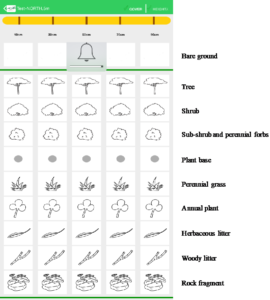
In order to maximize simplicity, the LandPKS team aims to minimize the number of components and screens. We aim to break tasks into manageable chunks so that users are not overwhelmed. Additionally, we strive to have the LandPKS app be as visual as possible by using simple graphics and charts. For example, in the vegetation monitoring module, LandCover, users select vegetation types based on simple images.

Selection of vegetation and cover types in the LandCover module of the LandPKS app. Users choose from these simple images to determine what types of vegetation are present at their site.

In order to maximize usability of the LandPKS app we aim to design the navigation of the app to be intuitive and seamless. Most importantly, the LandPKS app is designed and built to be useable by non-technical experts. Therefore, we aim to use minimal technical language, include question marks with brief text and/or graphical explanations, and include explanatory videos when needed. For example, in the LandInfo module, we include videos that help explain how to hand-texture the soil for a user who is not a soil scientist and may be unfamiliar with how to hand-texture the soil.

Lastly, we focus on the usefulness of the LandPKS app globally. This includes soliciting feedback from our users in order to help mold the LandPKS app to meet their needs. The LandPKS team conducts a bi-annual online user survey to gain feedback about various components of the app. We also spent a month in Tanzania last year testing the app with smallholder farmers and agricultural extension agents, making sure they found the app useful and were able to understand the outputs.

While the effort to create a global app is guided by the three steps outlined here, it is still very much a work in progress. The LandPKS app Version 3.0 is free and available now on the Google Play Store and iTunes Store. Learn more about the LandPKS app on the landpotential.org website. The LandPKS app was developed by the LandPKS Team for the Land-Potential Knowledge System (LandPKS) with support from USAID and USDA-ARS. Please contact us at contact@landpotential.org with any questions, comments, or feedback.

Evaluation of the Community Land Protection Program in Liberia

USAID’s E3/Land and Urban Office, Namati and the International Development Research Centre jointly funded a rigorous midline evaluation of the Community Land Protection Program (CLPP) in rural Liberia. While previous research has focused on the effects of individual land titling programs, there is little quantitative evidence of the effects of supporting communities to protect and govern their own community land. This evaluation fills this knowledge gap by investigating the effects of CLPP on improving resource governance, tenure security, community empowerment and livelihoods.

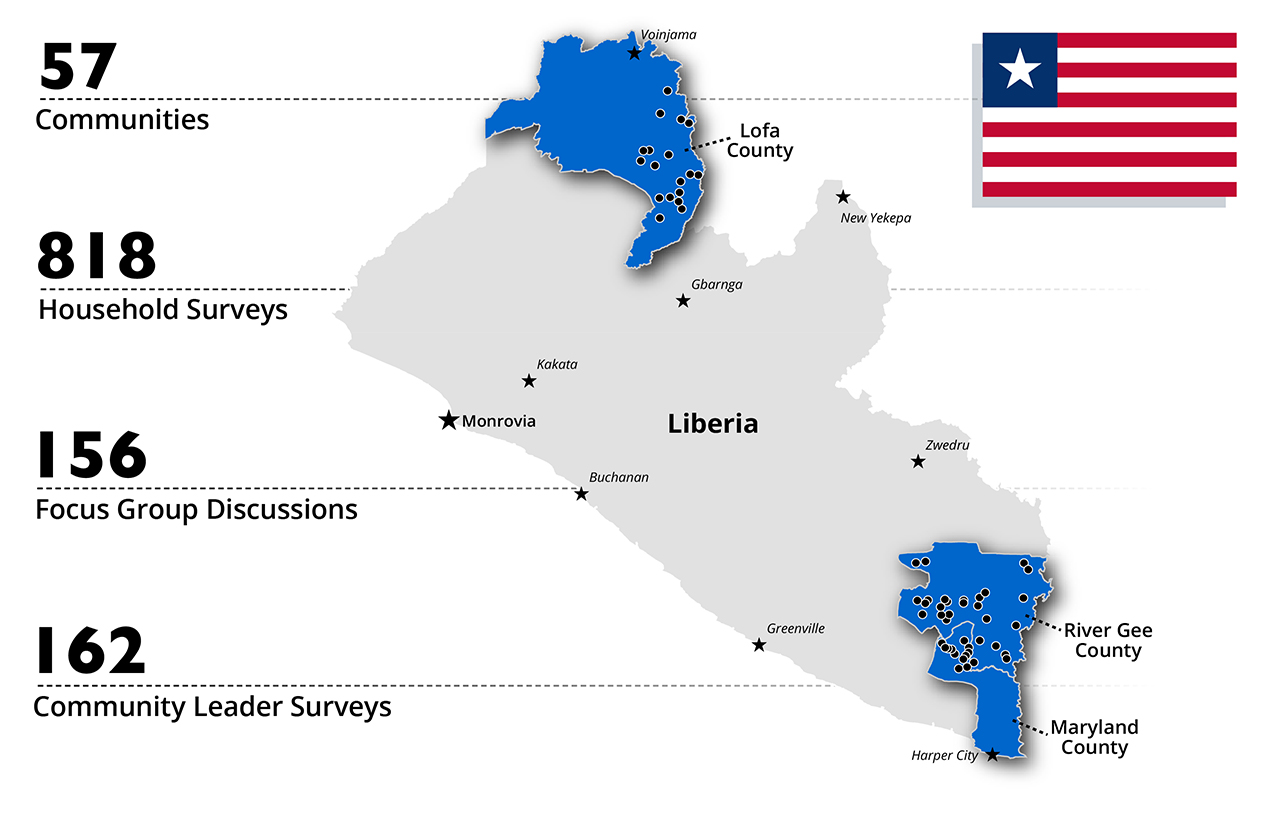
Developed by Namati and funded by the United Kingdom’s Department for International Development, CLPP is a global program that seeks to empower communities to successfully protect their community land rights. In Liberia, the CLPP was implemented from 2016-2017. The midline evaluation used a set of matched comparison communities together with baseline and midline data for 818 households in 57 communities spread across three counties.

CLPP OverviewLiberian ContextEvaluation DesignBaseline FindingsMidline Findings

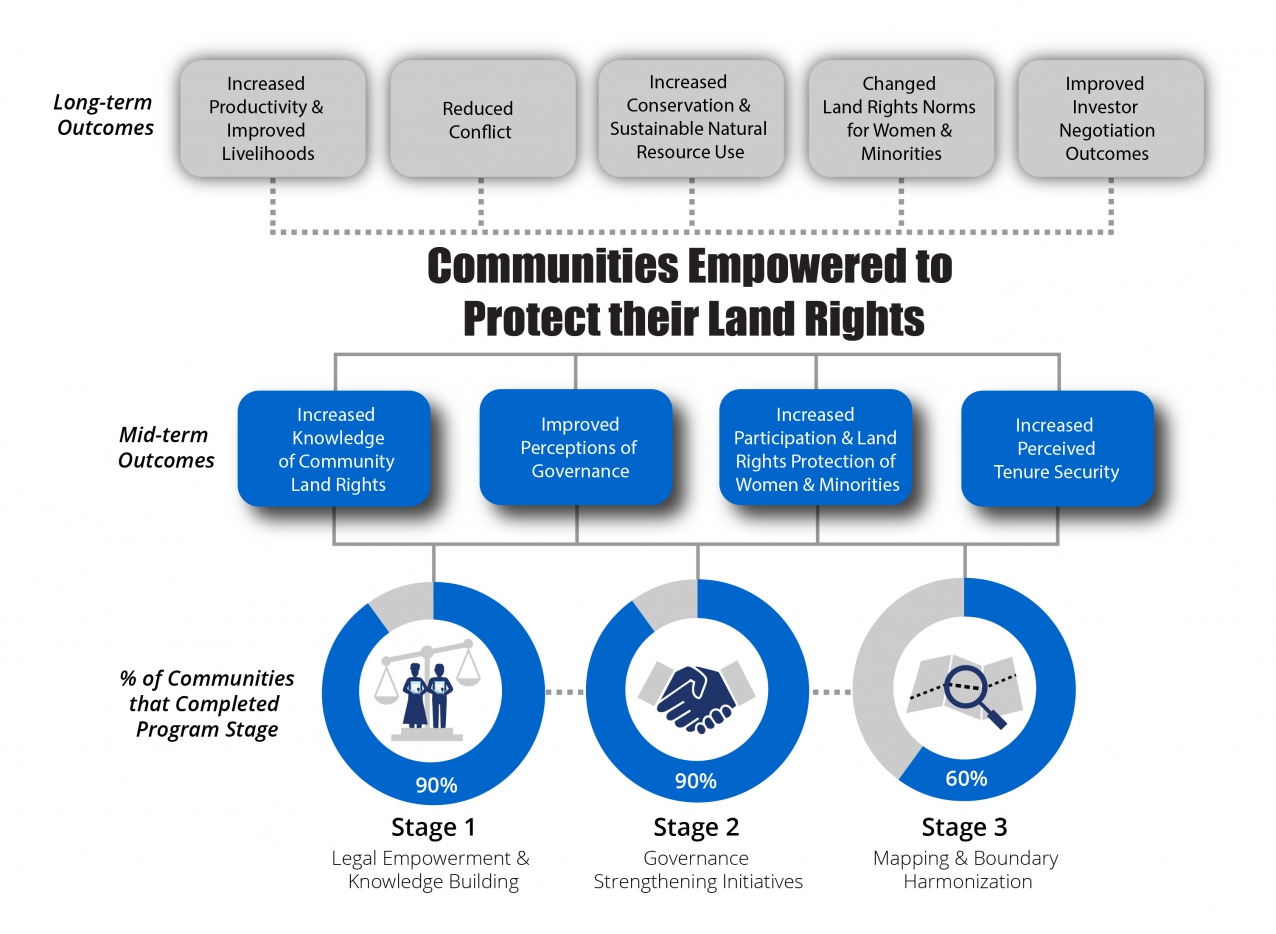
CLPP STAGES, ACTIVITIES & OUTCOMES

The midline evaluation of CLPP looked at both mid-term and long-term outcomes to detect any mid-term results and to track progress toward long-term results, consistent with CLPP’s theory of change. Midline data collection occurred before all the program stages of the CLPP implementation had finished. The percentage of communities that completed each stage of the CLPP’s activities at midline data collection is presented below.

Community Land Protection Program Midline Performance Evaluation Report

LIBERIAN CONTEXT

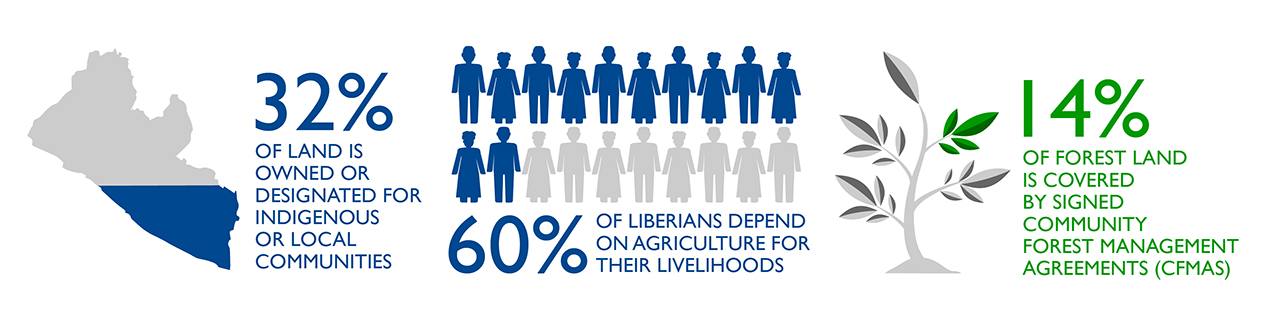
Communally managed land and natural resources provide an essential input into communities’ social, political, and economic sustainability in developing countries, particularly in agrarian societies.  Many communities in Liberia and throughout the developing world use unwritten rules and norms to manage this community property. Since they generally lack official documentation, they are disadvantaged in the face of legal norms that protect land rights based on the possession of formal written records. In Liberia, communities are increasingly pressured by international and domestic investors and the national government due to the demand for land and natural resources.

Since the late 1960s, several African nations have passed laws that recognize and support the central role of communal tenure in rural land administration and management. In some instances, communal land rights have received the same standing as state-issued land rights and included the integration of customary rules and dispute resolution bodies into the national formal system. This trend is also evident in Liberia, where new land reforms provide a potential legal framework for protecting community land.

Two land and property rights issues need to be definitively addressed as Liberia proceeds with post-conflict reconstruction. The first is the issue of the legal status of customary land rights, and the second is the issue of ownership of trees and other forest resources on community forest lands. Key reforms undertaken by the Liberian Government put it on the right track to resolving these issues: the establishment of the Land Commission (2009) and Land Authority (2017) to settle the question of customary land rights, and the enactment of the 2009 Community Rights Law, which returns ownership of forest resources to communities and adoption of the Land Rights Policy (2013).

EVALUATION DESIGN

The evaluation used a set of matched comparison and treatment communities at baseline and midline to investigate whether and how CLPP efforts:

  • Strengthen land tenure security;
  • Improve perceptions of governance and increases local leaders’ accountability;
  • Help communities to document their land boundaries and to codify rules;
  • Protect women’s land rights and the land rights of marginalized groups; and
  • Lead to conservation and sustainable natural resource use.

The CLPP midline evaluation used three primary sources of baseline and midline data from 57 communities including household surveys, community leader surveys and focus group discussions. As shown below, the three counties included in the study are Lofa, River Gee and Maryland counties. Baseline data collection took place prior to the start of program activities in 2014 and midline data collection occurred in 2017.

The CLPP evaluation was initially designed to study 90 communities. However, funding constraints and the Ebola outbreak prompted the implementing organization to reduce the number of communities involved in CLPP in 2016. Due to these constraints, midline data was only collected in a subset of the original CLPP communities. Accordingly, this evaluation is based on this limited sample. If available, additional resources for future program implementation and an endline evaluation will present a valuable opportunity to study the long-term effects of the CLPP activities across the original study area.

For more information about the evaluation design, see the CLPP Pre-analysis Plan.

Land & Natural Resource Governance

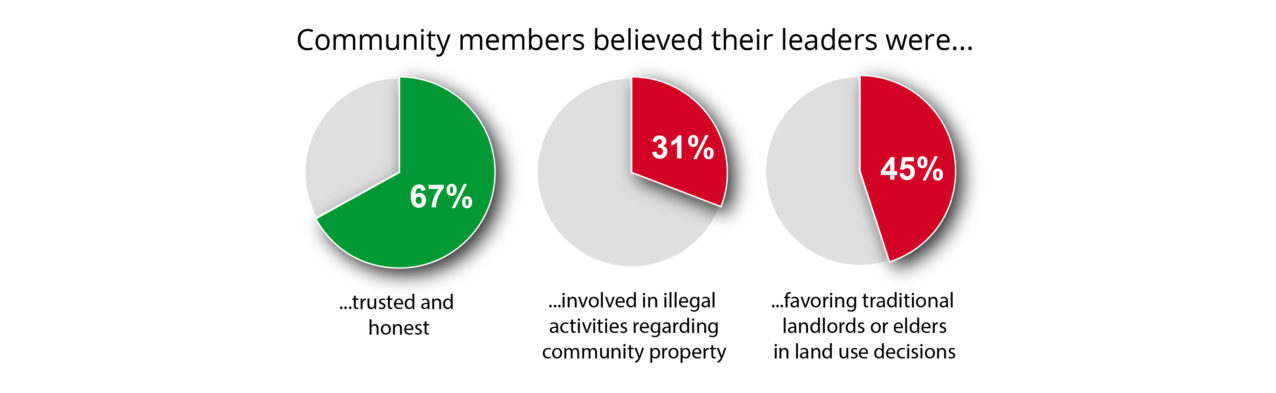
The most important authorities for land and natural resources across rural communities in Liberia are elders and traditional landlords. While these customary governance structures are often not inclusive or democratic, baseline results indicated that 67% of community members felt their leaders were trusted and honest.

Despite this relatively high satisfaction with community leaders, some community members were divided in their perception of their leaders. Community members indicated that they believed their leaders were involved in illegal activities regarding community property (31%) and that they made land use decisions that favored traditional landlords or elders (45%). While this last finding is consistent with customary norms, these decisions may come at the expense of more vulnerable groups.

Community Land & Legal Knowledge

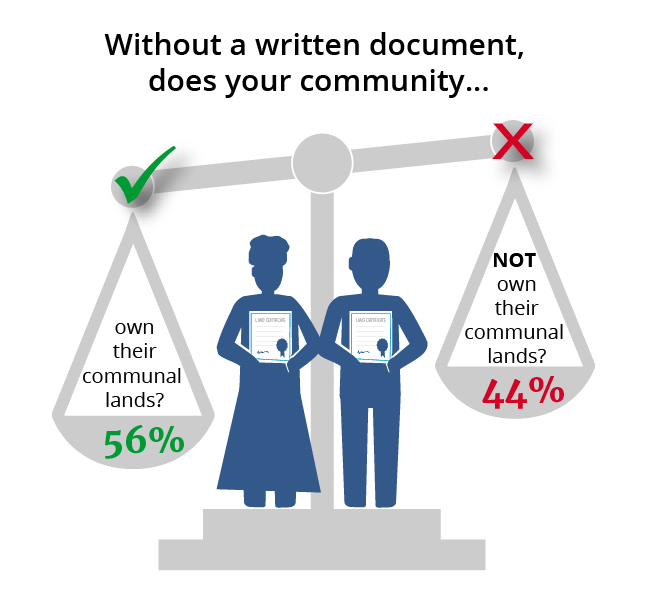
Baseline results indicated that respondents were divided on their knowledge of community property rights. Forty-four percent incorrectly stated that without a written document, the community did NOT own their communal lands.
Additionally, 54% of respondents stated that the Government of Liberia owns the community’s land and natural resources.  Given the current interpretations of Liberian law and policy, it is the community and NOT the government of Liberia that owns a community’s land and natural resources.

These findings confirmed that additional legal knowledge through CLPP could help community members more effectively claim their rights.

Tenure Security

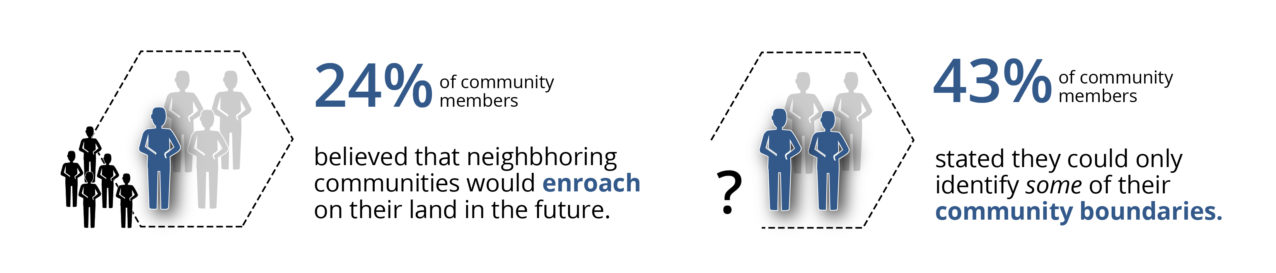
Baseline findings also suggested that respondents were aware of threats to tenure security, largely due to unresolved boundary disagreements with neighboring communities. Approximately one quarter (24%) of community members stated that it was likely that neighboring communities would encroach on their land in the future and almost half of community members (43%) stated that they could only identify some of the boundaries of their community land.

For more information about baseline findings, see the CLPP Baseline Evaluation Report.

Land & Natural Resource Governance

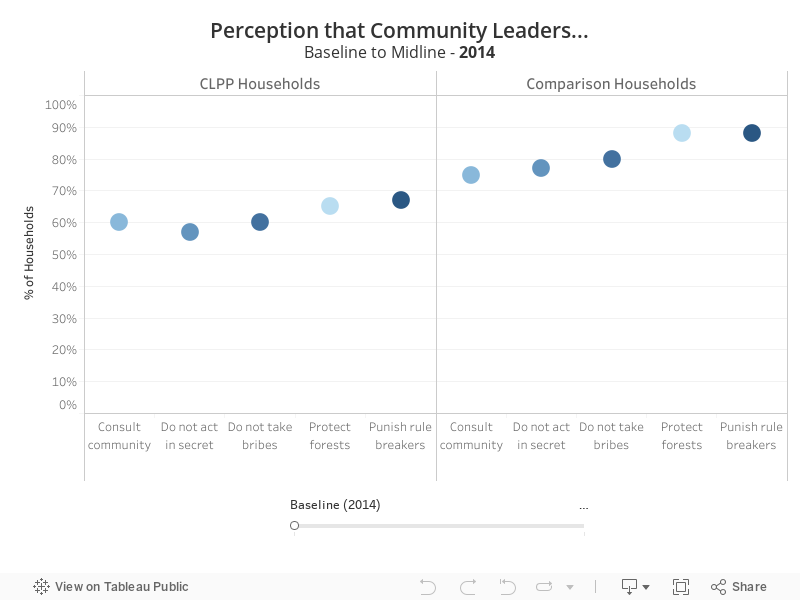
The evaluation found that participation in CLPP is positively associated with perceptions of improved local land governance. As seen in the graph below, households in communities that participated in CLPP activities show a significant increase in their satisfaction, perceived accountability, capacity, and transparency of leaders.

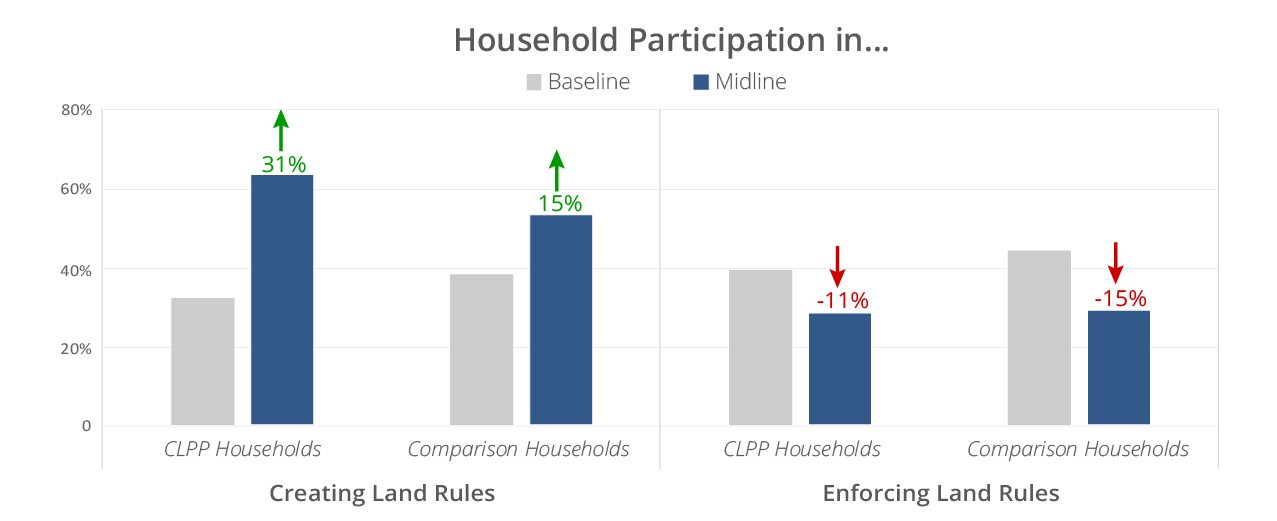
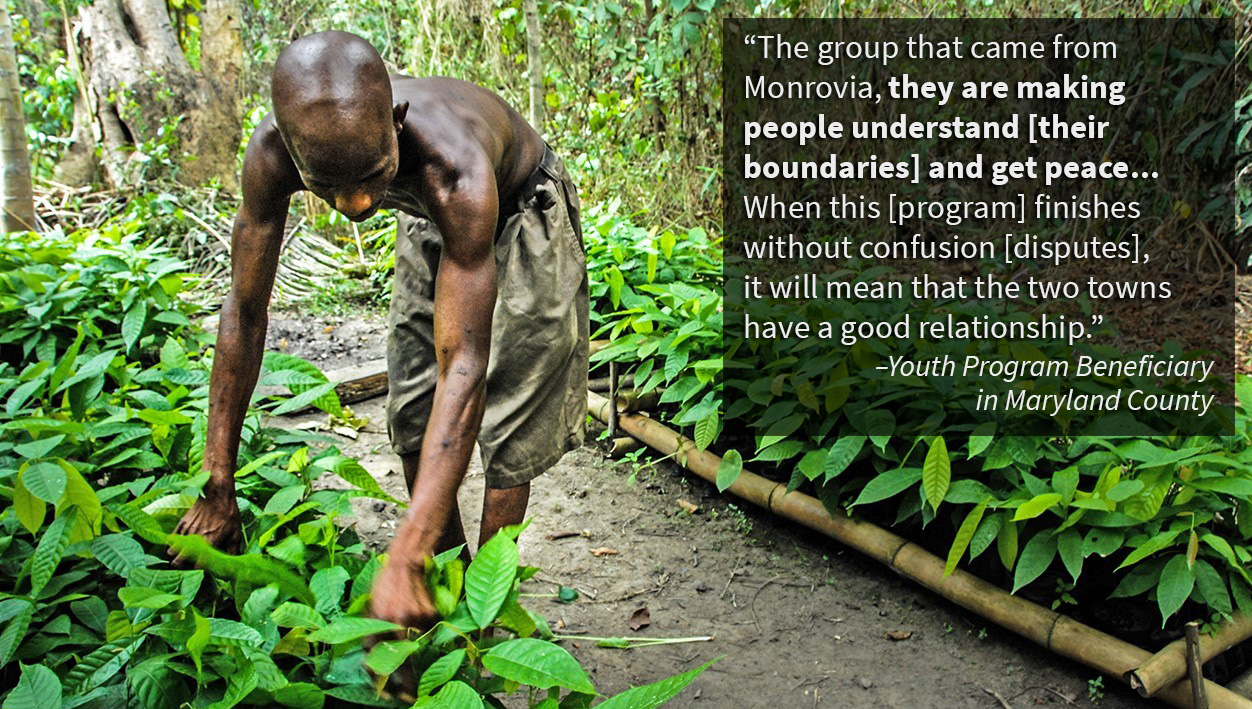
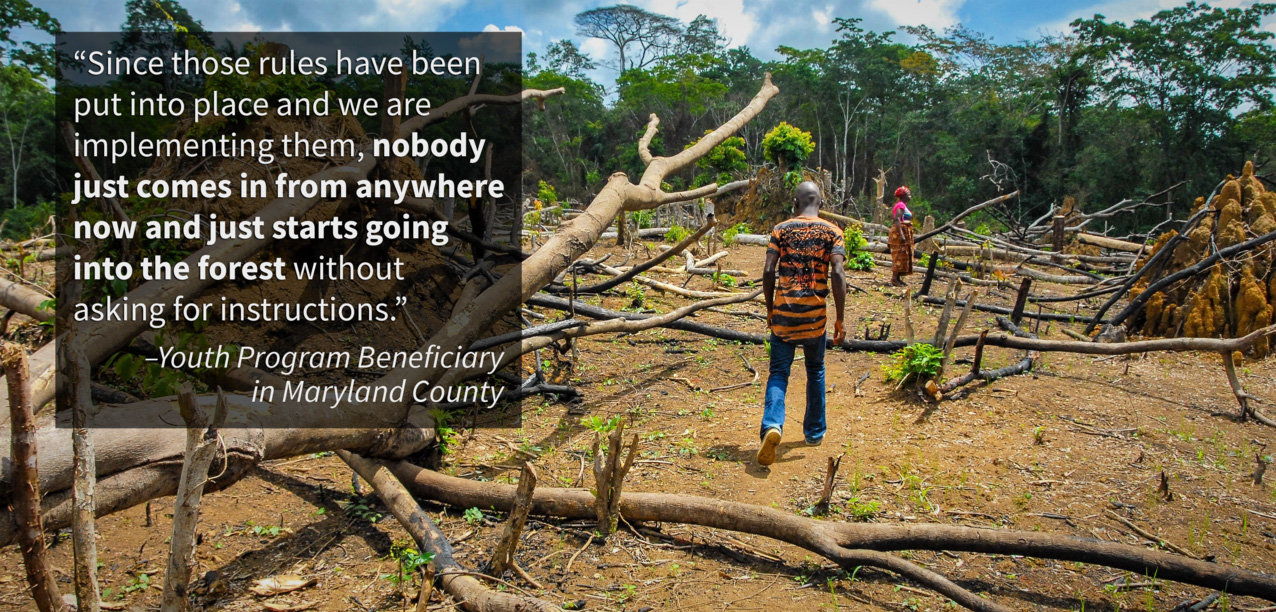
Households in CLPP communities are also significantly more likely to report that their community has written land rules as a result of the bylaws drafting process, which about 90% of CLPP communities had started at the time of midline data collection. Households in CLPP communities also reported higher satisfaction with land rules. A group of youth in one CLPP community in Maryland explained new rules and regulations surrounding forest access in their town:

While evaluation findings show that households in CLPP communities are significantly more likely to participate in the creation of land rules, household participation levels in enforcing land rules fell across both households in CLPP communities and comparison communities.

The reason for these observed decreases in community participation in rule monitoring and enforcement could be that leaders were completing these tasks themselves more effectively, people were following the rules more (necessitating less enforcement), or that the program emboldened community members to oppose laws they consider ‘bad’.

Community Land & Legal Knowledge

There is strong qualitative evidence that CLPP’s boundary identification activities increased community members’ knowledge of community land boundaries. However, there are no statistically significant results in the survey data.

Tenure Security

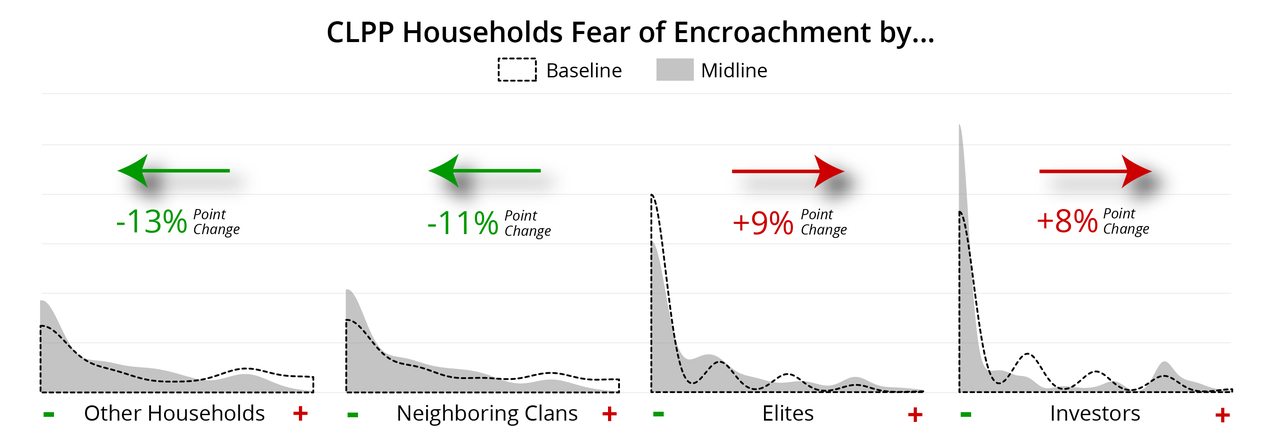
To assess tenure security, the evaluation measured household perception of encroachment on communal land across a variety of actors (neighboring households, neighboring clans, elites, investors, and government officials).  The evaluation does not find clear evidence that CLPP had an impact on perceived tenure security or prevalence of land conflicts in the 10 months since the program began. One possible explanation for the lack of improvement on tenure security indicators might be that the program has not yet completed its activities.

A descriptive analysis for tenure security trends for communal land shows that fear of land expropriation by neighboring households and clans has decreased over time, but decreased more dramatically in comparison households versus CLPP households. This result is likely due to the program reviving a discussion of dormant land disputes and alerting community members of potential risks. If so, perceived tenure security may improve once the boundary harmonization processes are complete.

Additionally, fear of encroachment by elites and investors increased in both CLPP and comparison households, but this change is NOT statistically significant.  Concerns about elite or investor encroachment may stem from ongoing uncertainty around the status of the Land Rights bill. Although no concessions are operating in the study area, the lingering impact of large scale-land acquisitions in recent years may also play a role.

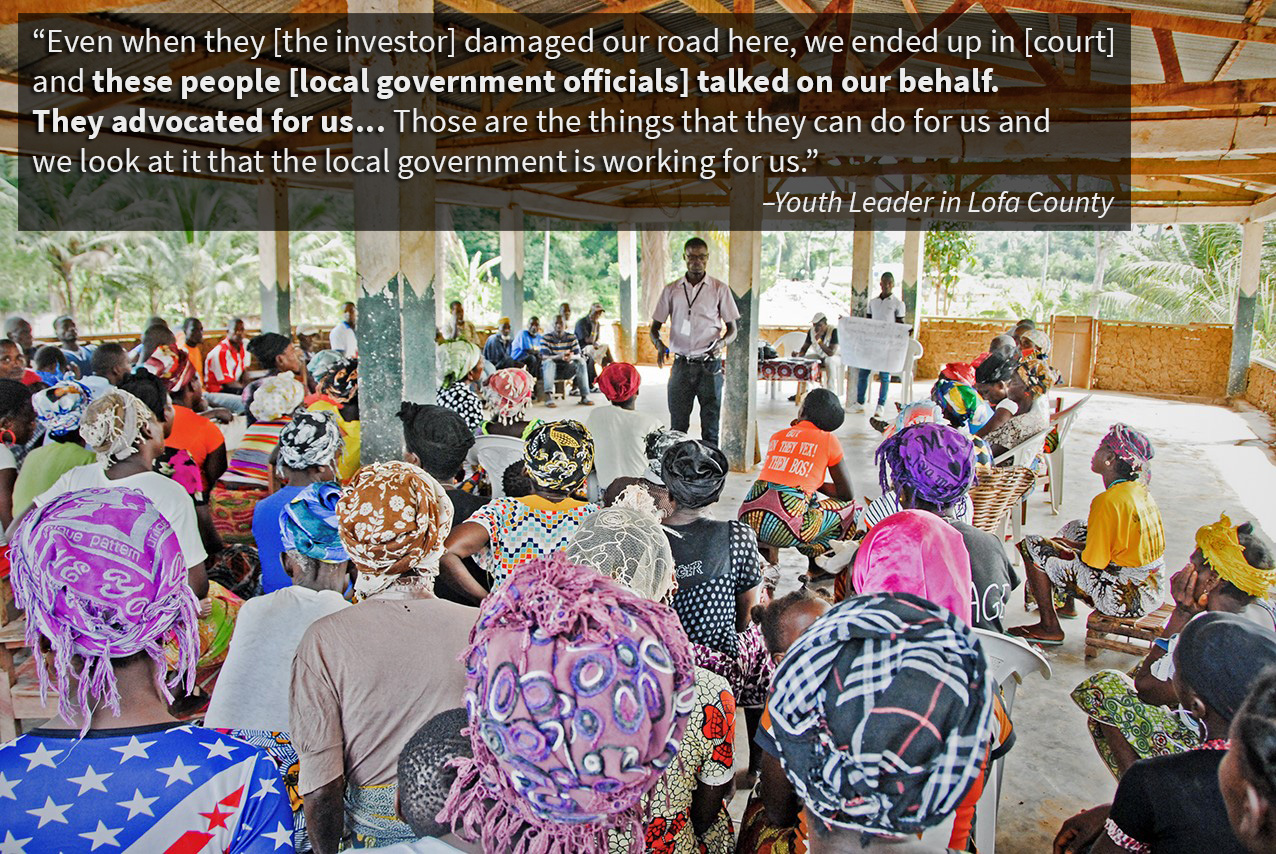
In contrast, community leaders in CLPP communities are more likely to say that the local government respects their land boundaries. A youth leader in a CLPP community in Lofa described how the local government assisted with a dispute with an investor:

Overall, the contradictory findings on the impacts of CLPP on tenure security perceptions indicate that evidence on this outcome is mixed and inconclusive.

Women

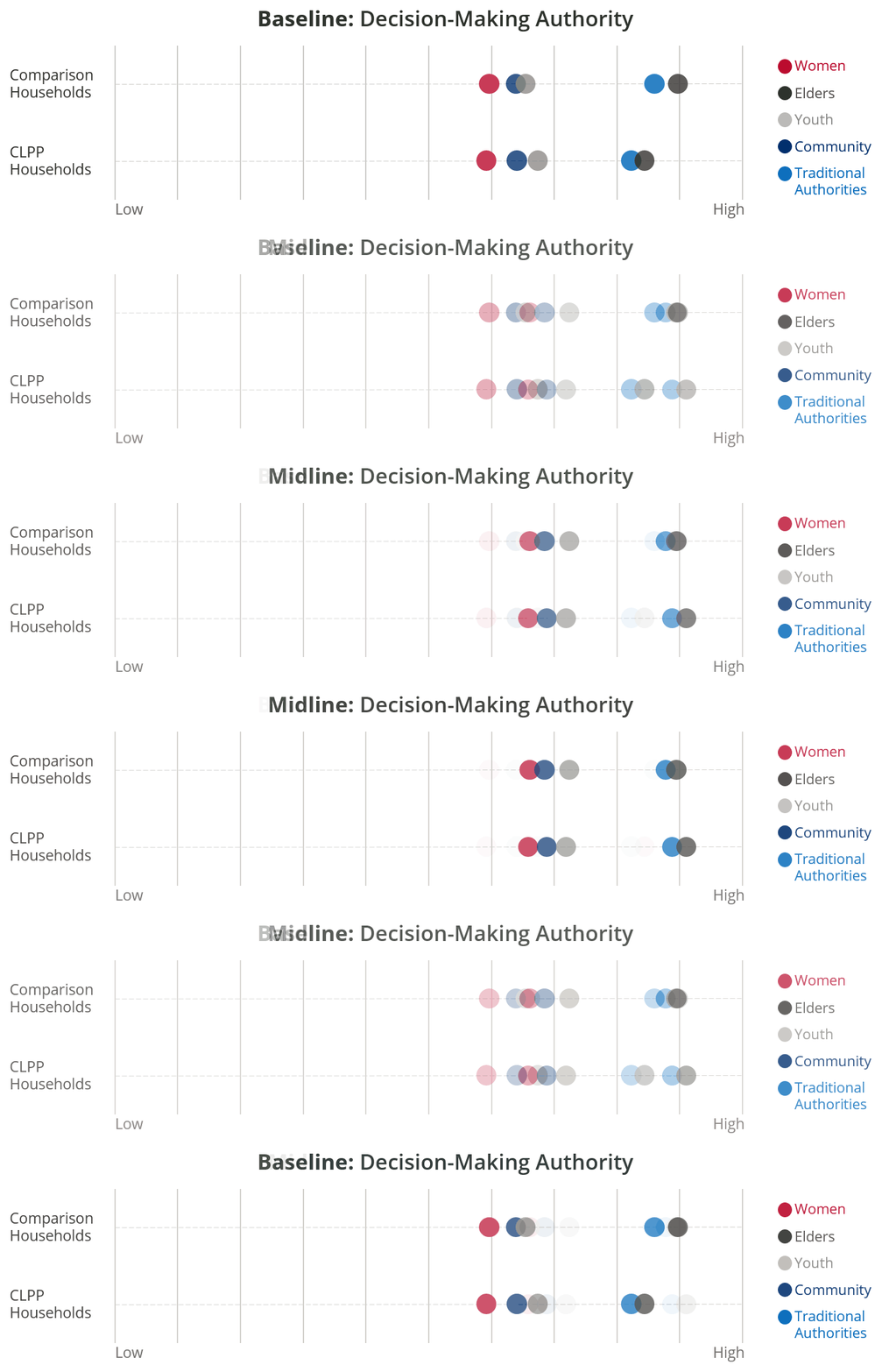
Evaluation findings show an increase across both CLPP communities and comparison communities in their knowledge of formal laws related to women’s inheritance. While women in CLPP communities are more likely to report that they attended a land meeting (68%) compared to women in comparison communities (57%), their overall decision-making authority is still limited. When households and leaders were asked to rank decision-making power by a variety of community members, women ranked far lower than other groups. Though women showed a small trend upward from baseline to midline, there was no significant difference between CLPP households and comparison households.

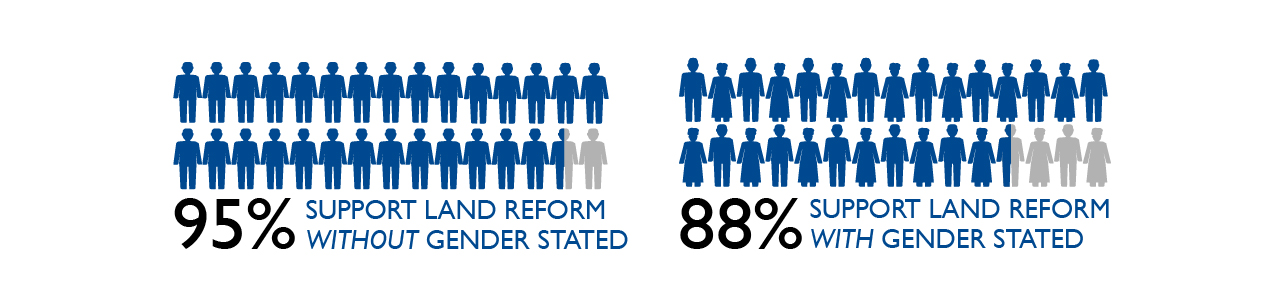
In addition to increased participation and knowledge about women’s land rights, CLPP’s theory of change includes a shift in gender norms. Without changes in norms, increased knowledge may not be sufficient to change behavior or outcomes. The evaluation used a survey experiment to test whether highlighting the women’s rights component of legal reforms affects a respondent’s support of the reform. Results indicated that respondents were less likely to be supportive of land reform if they were told that reform would involve giving women equal rights to inherit, own, use and sell land in their community. Overall, support for land reform in either scenario is still very high.

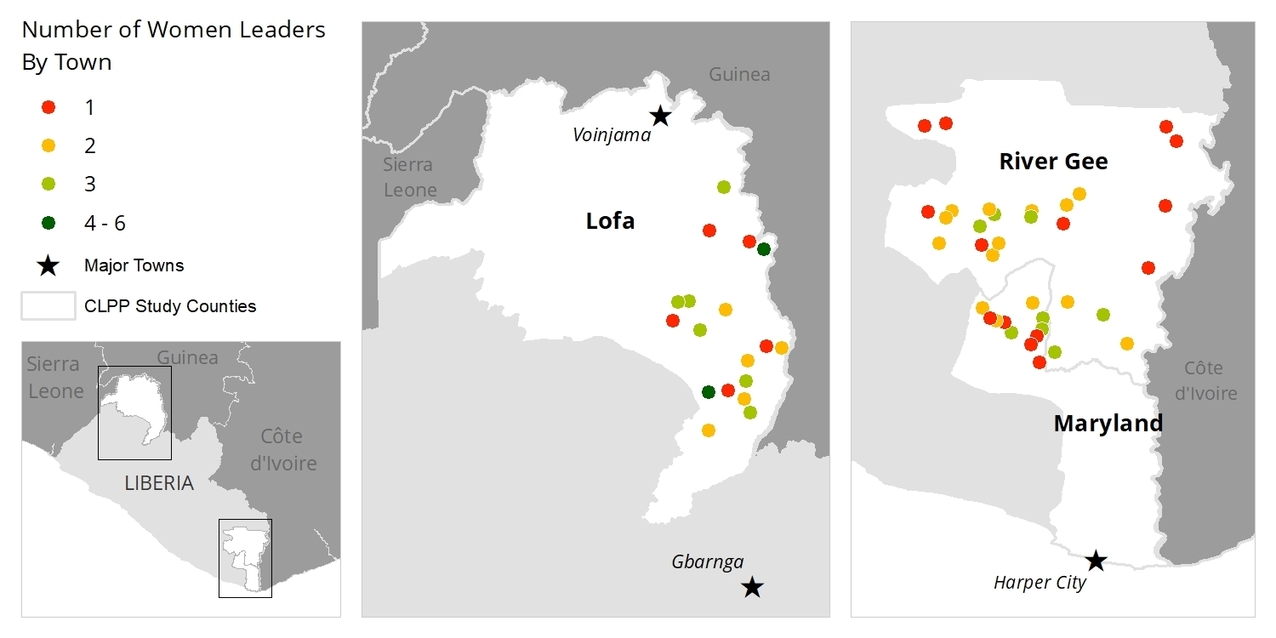
Given the difficulty in effecting gender norms, changing the gender balance of leadership positions will likely be a difficult barrier to overcome. The evaluation finds no change in the number of women serving in community leadership due to CLPP. The geographic distribution of women in leadership positions at midline is shown below.

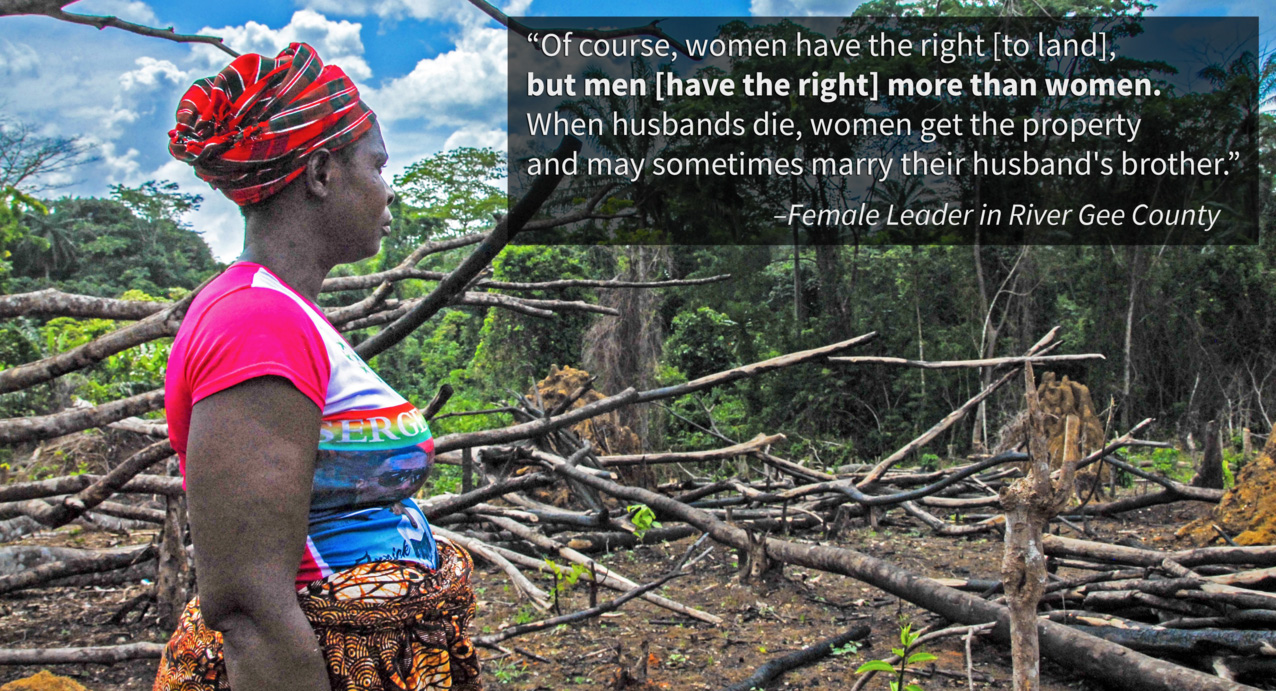
Additionally, while male and female leaders expressed initial support for women’s equality, they later qualified their responses with a series of restrictions on women’s inheritance requirements, such as the requirement that women must have had children or marry her husband’s brother.

All photos by Kate Cummings / The Cloudburst Group.