
ERC Success Story: In Ethiopia Impact Evaluations Are Building Capacity

In January 2015, ten years after the initial launch of USAID’s Ethiopia Strengthening Land Tenure and Administration Program (ELTAP) and Ethiopia Land Administration Program (ELAP) which issued second level land use certification for more than 588,000 parcels, the endline data collection for a rigorous impact evaluation was launched. The evaluation is motivated by and will attempt to answer the question “Does second level land certification marginally increase tenure security and improve rural livelihoods as compared to first level land certification?” Beyond contributing to the evidence base, this impact evaluation serves as a conduit to strengthen Ethiopian local capacity in the data collection sector.

Data collection will take place in Amhara, Oromia, Southern Nations Nationalities and Peoples, and Tigray regions and is being conducted by the Ethiopian Inclusive Finance Training and Research Institution. The firm, which is locally owned and operated, hired eight supervisors and 43 enumerators to carry out the household surveys. The team has a wealth of experience, and supervisors train less- experienced enumerators to strengthen skillsets. Further, supervisors and enumerators alike are sensitized to the subject matter of the evaluation. One supervisor, Line Kinfe shared, “I think I will gain a lot of experience from this survey [on land issues]. Land issues is a big issue in our country.”

This data collection offers the opportunity for the data collection team to learn and expand on their knowledge of CSPro—an open-sourced computer-assisted personal interviewing software package developed by the U.S. Government. They are also building their knowledge of geographic information systems (GIS), as handheld GPS devices are being used to track which households are involved in the data collection and associate geographic and other geodata with these households.

USAID’s impact evaluations are not only building the evidence base to strengthen the knowledge and information used to determine the most appropriate and effective interventions in the land tenure and property rights sector, but are also strengthening local capacity and building skills and knowledge which can be used in the future..

Release Date: Wednesday, April 1, 2015

Where Land Meets The Sea: A Global Review of the Governance and Tenure Dimensions of Coastal Mangrove Forests

Overview

This 8-page brief summarizes key findings from the report Where Land Meets The Sea: A Global Review of the Governance and Tenure Dimensions of Coastal Mangrove Forests. This review provides an overview of the status of mangrove governance and its tenure dimensions globally. In particular, it assesses how effectively the diversity of legal and policy frameworks as well as institutional structures—formal and informal—enable mangrove governance across different settings. The review also examines the institutions and patterns of local management and use, including tenure rights and gender differentiation and how these local institutions might influence mangrove management and rehabilitation efforts. It is part of a larger study funded by the USAID Tenure and Global Climate Change Program that includes national-level assessments in Indonesia and Tanzania.

Key points of the assessment

There is a dearth of research on how mangrove forests are governed and what the role of enabling conditions such as tenure arrangements is for supporting mangrove management to meet multiple goals in the context of climate change.

  1. Authority over mangrove forest management is overwhelmingly vested in state institutions, and state-led mangrove protection is a central objective. Government-led mangrove protection efforts, permitting no or minimal substantive use of its natural resources by local communities, face major challenges; mainly that enforcement is constrained by inadequate personnel, capacities, and budgets.
  2. Given the ambiguous position of mangroves situated between the land and sea, the configuration of state authority for mangrove management is quite complex. Most commonly, this authority falls on a single line agency, namely the forest sector. The forest sector applies the framework used for terrestrial forests, which is often not appropriate to the distinctive ecological characteristics of mangrove systems. In some countries, there is fragmentation of responsibilities across two or more agencies such as forests, fisheries, environment, and wildlife. This contributes to a high level of segmentation and jurisdictional ambiguity.
  3. Mangroves are regulated under legal frameworks intended for forests, environment, water, land, marine, or fisheries sectors. Generally speaking, laws and policies have not been crafted for the specific management requirements of mangroves.
  4. Frameworks and mechanisms for coordinating mangrove governance across agencies and governance levels are uncommon, and where they exist, are difficult to put into practice.
  5. Local tenure rights to mangrove resources vary. Customary rights as well as patterns of use and management are often unrecognized by statutory systems, especially in Africa. Local indigenous rights are often recognized by the state in Latin America, where full ownership, including title, is issued to communities. In Asia, long duration leases are granted to households and communities; these leases often offer a broad range of rights in the bundle, sometimes including transfer rights. In these cases, multiple uses, including collection of firewood, charcoal production, and fishing, are allowed.
  6. There is a mangrove tenure transition underway in a few countries toward increased community participation in mangrove management and governance through devolved tenure arrangements. Experimentation with community-based approaches is increasing, motivated primarily by continued mangrove degradation and loss under strict protection regimes.
  7. Outcomes of community-based approaches for mangrove management should be researched. While national governments continue to be central actors in mangrove conservation, international organizations and NGOs are exerting influence and shaping agendas and approaches to mangrove management. In particular, they are increasingly experimenting with inclusive models of community-based management. Community concessions and extractive reserves that accord full ownership or longer-term rights appear to be more effective in mangrove conservation. Programs involving communities jointly with nongovernmental organizations (NGOs), research organizations, and those that provide other incentives appear to generate better mangrove rehabilitation outcomes. Where customary rights are not respected or recognized and are actively undermined, or community institutions are subject to government interference, mangroves tend to deteriorate.
  8. Gender equality has been a missing element in mangrove conservation and management, despite gender differentiation in the type of products harvested, the economic value of products harvested, and harvesting locations. As a result, their interests and potential contributions to better management outcomes are often diminished and disregarded. However, community-based rehabilitation programs are increasingly integrating gender and some are even focusing solely on empowering women.

Overview: Integrating Geospatial Data and Analysis into Land Tenure Impact Evaluations

Although land rights are spatial in nature, the effects of securing land rights are seldom analyzed spatially. E3/Land is working to change that by leveraging the power of geospatial data and analysis to gain new insights into the most effective land tenure programs and policies. Central to this effort is using geospatial data and analysis to expand opportunities to learn from and inform USAID’s portfolio of land tenure impact evaluations. This offers important opportunities for evaluators to augment the more traditional household survey methods that most impact evaluations employ with geospatial data and analysis. While useful in many contexts, geospatial data and methodologies have important limitations that evaluators should to keep in mind. This document shows some of the ways that E3/Land is integrating geospatial data and analysis into impact evaluations and what we are learning from these efforts.

Overview: Gender-Sensitive Land Tenure Impact Evaluations

There is a growing body of evidence that suggests that stronger land tenure security has a positive impact on important development outcomes, such as improved farming practices, agricultural productivity, and, importantly, women’s empowerment. While the initial evidence is encouraging, notable knowledge gaps remain. Compared with the positive economic and food security gains seen from land tenure formalization programs in Asia and Latin America, results from similar programs in Africa have been mixed. There is also little evidence on the impact of strengthening customary tenure, and very little evidence that is gender-disaggregated, let alone gender-sensitive.

In this context, USAID is conducting eight rigorous impact evaluations of programs, primarily in customary land tenure settings, in Ethiopia, Guinea, Liberia, Tanzania, and Zambia to test development questions relevant to empowering women, enhancing food security, and eliminating extreme poverty. These evaluations are using gender-sensitive methods to better understand how these programs may affect women and men differently.

Overview: Current Land Tenure Impact Evaluations

Evaluations 1 and 2Evaluation 3Evaluation 4Evaluation 5Evaluation 6
Ethiopia Pastoral Land Project: Evaluating how a new approach to formalizing the land rights of pastoral communities in the Afar and Oromia regions of Ethiopia impacts land management, livelihoods, climate change resilience, and conflict.
Ethiopia Farmland Rights Projects: Evaluating the impact of land certification on access to credit, land conflict, land rentals, soil and water conservation, and women’s empowerment.
Zambia Community Forest Project: Evaluating how a Reducing Emissions from Deforestation and Degradation (REDD+) project impacts land tenure, livelihoods, and benefit sharing in forested areas.
Zambia Agroforestry Project: Evaluating the impacts of agroforestry extension and customary tenure strengthening on agricultural investment and other land use practices, including uptake of climate smart agriculture activities.
Tanzania Customary Land Project: Evaluating the impacts of documenting villagers’ land rights on tenure security, land investment, youth and women’s empowerment, and conflict.

There is a growing body of evidence that suggests stronger land tenure security has a positive impact on important development outcomes, such as increased agricultural investment, women’s empowerment, agricultural productivity, enhanced functioning of rental markets, and access to credit. While the initial empirical evidence is encouraging, important knowledge gaps remain. Compared with the positive economic and food security gains seen from land tenure formalization programs in Asia and Latin America, results from similar programs in Africa have been mixed. There is also little evidence on the impact of alternative approaches to strengthening tenure, such as supporting customary land governance institutions or communal land certification, as opposed to more common efforts focused on land titling and the formalization of individual property rights.

In this context, USAID is currently supporting or has recently concluded six rigorous impact evaluations in Ethiopia, Tanzania, and Zambia, and a rigorous performance evaluation in Liberia, to test development questions relevant to eliminating extreme poverty, enhancing food security, improving natural resource management, empowering women, improving climate change resilience, mitigating conflict, and promoting democratic governance and resilience.

Rwanda LAND Policy Research Brief: Implementation and Outcomes of Restrictions on Agricultural Land Subdivision

In Rwanda, it is widely believed that land fragmentation poses a challenge to agricultural productivity; however, land fragmentation also serves as a climate change adaptation and risk management strategy for farmers. Research has also found that the inverse farm size relationship holds true in Rwanda, meaning that smaller farms may be more productive than larger ones. Despite the potential benefits of land fragmentation, the Government of Rwanda has identified land fragmentation through extensive subdivision as a barrier to the realization of its development vision. As such, the Government of Rwanda has adopted and implemented policies restricting fragmentation, including land subdivision. This policy brief focuses on Article 30 of the 2013 Land Law, which provides that: “It is prohibited to subdivide plots of land reserved for agriculture and animal resources if the result of such subdivision leads to parcels of land of less than a hectare in size for each of them. Owners of lands prohibited to be subdivided shall co-own and use the land in accordance with the laws.”

Through literature review, legal analysis, and primary research, this policy brief attempts to elucidate how Article 30 is implemented and the outcomes of the provision on land use practices and tenure security in Rwanda. In summary, the research finds that implementation of Article 30 has not prevented land subdivisions, but rather encouraged informal subdivisions and transfers. While well-meaning, the provision is incongruent with the needs and realities of most rural Rwandan citizens and negatively impacts land tenure security

Land Governance in Tanzania: What to Know, and What to Do

Tanzania’s New Directions in Land Policy

When President Nyerere left power in 1985, the government of President Mwinyi began to chart new directions for Tanzania’s economy and society away from African socialism. The government prepared Tanzania’s first National Land Policy in 1995, which led to the enactment of the Village Land Act and the Land Act in 1999. The Policy argues that procedures for obtaining title to land should be simplified, that land administration should be transparent and further, it recognizes that secure land tenure plays a large role in promoting peace and national unity. In 2005 the Strategic Plan for the Implementation of the Land Laws (SPILL) was prepared and revised in 2013. The Plan seeks to ensure that land law and governance better supports the current and future social, economic, and environmental development of the country, which will be crucial to the success of Tanzania’s ambitious Five Year Development Plan 2011-2016 focusing on priority areas, such as urban development, infrastructure, Information and Communication Technology, agriculture investments, mining, livestock and fishing, forestry and wildlife, and land and housing at the regional level. Despite the progressive provisions of customary land rights and decentralization under the Village Land Act of 1999, land law has not yet been effectively integrated into the land governance framework: village authorities often lack the financial and human resources to effectively perform their duties. Overlapping decision making and weak governance in land administration pose major concerns in terms of delivering land rights in an efficient and equitable manner. Land insecurity in rural areas is still high among small landholder farmers, pastoralists, and women. In urban areas, nearly 60 percent of urban dwellers live in informal settlements and lack tenure security. With demands for resource exploitation expanding, the government needs to address how to handle competing demands for land to help mitigate or avoid conflicts over increasingly scarce land.

VGGT

The Voluntary Guidelines on the Responsible Governance of Tenure of Land, Fisheries, and Forests in the Context of National Food Security (FAO, 2012) are an internationally negotiated instrument that governs rights to land, fisheries, and forests. The Guidelines constitute an unprecedented international consensus on tenure; they are voluntary and do not replace laws and treaties, however, they outline principles and practices to which governments can refer when making laws and administering land, fisheries and forest rights. The Guidelines are primarily directed at governments, but also address the private sector and other groups, such as civil society and academics. They can be used to assess laws and systems, to find guidance or direction when the laws and practices of a country are not clear, and to advocate and educate on tenure rights and good land governance.

Donors in Tanzania

Donors with active land programs in Tanzania include the European Union, Denmark, Germany, IFAD, Sweden, Switzerland, United Kingdom, United States and the World Bank.

Webinar

Join us to learn more about land governance in Tanzania, the VGGT, and how you can program successful land interventions – Wednesday, 24 May 2017, at 8:00 AM EDT / 15:00h Tanzania

A Climate Success Story: Lead Farmers Help Spread Agroforestry in Zambia

Success StoryDownload the Success Story

Rural communities in Zambia’s Chipata District rely on farming for their livelihoods, and face many challenges related to climate variability, low soil moisture, and land degradation. Since June 2014, USAID has been building the capacity of farmers in four chiefdoms to plant and maintain nitrogen-fixing trees on their land through improved agroforestry extension services administered by local partners.

One such farmer is Sosten Daka, of the Maguya Chiefdom. Sosten was initially hesitant and skeptical about the benefits that such trees provide to the environment. Nevertheless, he agreed to work with the agroforestry extension agents as a lead farmer in his area to see if the nitrogen-fixing trees would bring the promised benefits. After a series of meetings and trainings, Sosten went forward with planting 55 Musangu (Faidherbia albida) seedlings, 556 Gliricidia seedlings, and a hedge of pigeon pea.

During a June 2015 visit to Sosten’s field, he proudly showed off his seedlings and the fire breaks he had made to protect them. He plans to increase the number of fields he has under agroforestry in the year ahead as he has become convinced that planting trees will benefit both the environment and his family. “The poor rain pattern affected my harvest last season, and I know trees can be the answer to keep the ground moist,” he said.

As a lead farmer, Sosten has encouraged other farmers in his villages to attend agroforestry meetings and trainings. Sosten was able to use his mobile phone to play radio programs about tree-planting to farmers in his group to help further urge them to plant seedlings of their own. He has also been busy reminding farmers that have planted seedlings to protect them from fire and livestock.

In addition to increasing his own use of agroforestry, Sosten’s goal is now to recruit more farmers to participate in each village. He says there is no turning back on the program now that he has had such a successful start.

For more information on USAID’s work on land tenure and global climate change, visit our Land Matters for Climate Change page or email us at landmatters@usaid.gov.

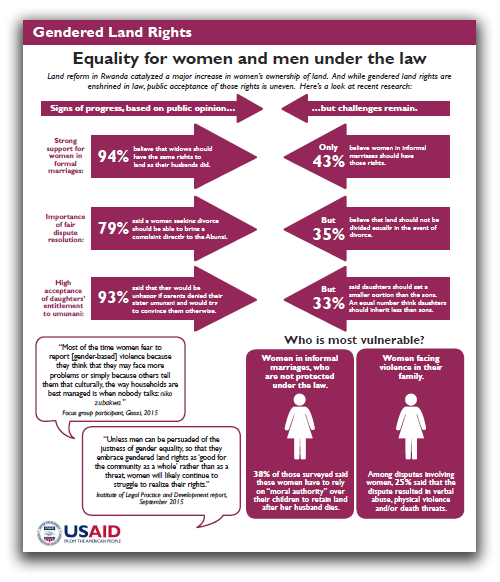
Rwanda LAND Infographic: Gendered Land Rights

Land reform in Rwanda catalyzed a major increase in women’s ownership of land. And while gendered land rights are enshrined in law, public acceptance of those rights is uneven. Here’s a look at recent research.

This document is based on three research reports produced by the United States Agency for International Development (USAID) Rwanda Land Project together with partners including the Institute of Legal Practice and Development and Radio Ishingiro.