

Statement by the spokesperson of EU High Representative Catherine Ashton on the outcome of the Plenary meeting of the Kimberley Process in Washington
Issued on November 30, 2012 by the EU.
Category: Uncategorized
Tension over Land and Mineral Rights in Burma
Recent stories in the Globe and Mail, the Telegraph, BBC and the International Herald Tribune all highlight the significant tensions in Burma between various stakeholders over land, mineral, and other resource rights as the country undergoes significant political reforms. Though the reported details vary, communities in the Sagaing region are resisting attempts by the government to relocate them to allow expansion of mining operations by Wanbao Mining, a Chinese company. An estimated 7,800 acres of land were due to be expropriated for the expansion, requiring extensive forced evictions. According to the reports, the expansion would require the resettlement of approximately 26 villages.
The extensive reporting on the copper mine controversy, both in the international and Burmese press, as well as the on-going protests and advocacy by civil society organizations and citizens against the resettlement, reflect the sweeping positive political reforms taking place in Burma. A National Dialogue on Land Tenure and Land-use Rights recently convened in Rangoon, exemplifying the expanding political space for debate. Nonetheless, communities and advocacy groups claim that the government’s methods are heavy-handed.
According to the BBC, “Between 20 and 30 protestors, many of them Buddhist monks, were injured, some with severe burns after the camps were set alight” while The Globe and Mail opened its story with the headline, “Myanmar security forces assault protestors”. People in the affected villages also claim that the government used intimidation to coerce people to agree to terms that they did not understand. According to the BBC, one villager recounted the process of discussions with government representatives: “One of the farmers said he did not accept the deal – then they arrested him and they threatened us. We were all afraid, so we agreed to the deal, but they made us sign a contract we did not understand.”
The USAID Land Tenure and Property Rights Division will be undertaking an assessment in February, 2013 with the intent of helping the Government of Burma assess tenure and property rights challenges and identify potential opportunities for addressing them. As the Government of Burma expands its political and economic reforms, the use of more transparent, participatory, and equitable processes that recognize and respect citizen’s land and other property rights will be an essential step for reducing and mitigating conflicts and promoting economic growth.
Diamonds, Development, and Property Rights (12 Minute Video)
More Than a Piece of Paper
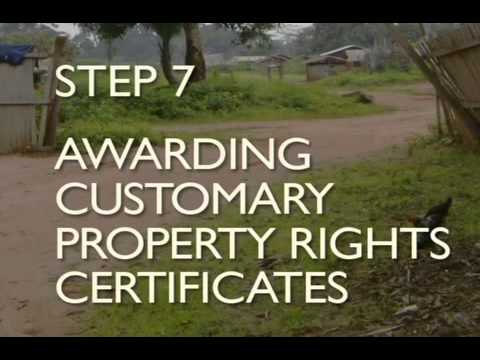
This video details the 8-step process PRADD developed to make the customary property rights of tribal communities visible within the structure of national statutory laws. The PRADD process helps the miners document customary property rights claims, eventually moving towards legalizing those claims at the government level and making it easier to trace the diamonds they find with the Kimberley Process.
About This Video
The Property Rights and Artisanal Diamond Development Project (PRADD) is a USAID-funded pilot program designed to improve the lives of diamond miners and their communities by developing methods to achieve clear, secure, and publicly acknowledged rights to land and resources. The methodology developed by PRADD helps miners to affirm their customary property rights claims, providing them a measure of protection they never had before. It also offers a way to improve compliance with the Kimberley Process, which was developed to trace a diamond’s origin to ensure that it was not used to fund violence. Two videos were made to show government officials, professionals working with the Kimberley Process and others involved in Land Tenure and Property Rights how the process works.
For further information, contact Gregory Myers or Michael Roth at ARD.
Land, Property and Conflict Training Course
On December 11-14, The United States Institute of Peace – in collaboration with USAID, the World Bank, and the International Organization for Migration – will host a Land, Property and Conflict training course. Tenure insecurity and disputes over land and property often play a major role in conflicts, both internally and intra-state. The international donor community recognizes the importance of addressing complex issues related to land tenure and property rights in order to mitigate conflict, promote stability, and foster peace and economic growth. The Land, Property and Conflict training course represents a collaborative effort of the international community to equip practitioners with the tools to analyze and address these critical and complex issues.
New Artisanal Mining Assessment Report Released for Cote d’Ivoire
In Cote d’Ivoire, a UN-imposed embargo on the export of Ivoirian diamonds to other countries has been in place since 2005 due to concerns regarding the control of diamond-mining zones by former rebel groups as well as weak internal controls over the country’s diamond mining sector. Given these concerns and the role USAID’s Property Rights and Artisanal Diamond Development (PRADD) program has played in helping to improve countries with their Kimberley Process compliance, USAID commissioned an assessment of the land tenure and artisanal mining sector in Cote d’Ivoire in September 2012. Please see the report’s findings here.
Involving Local Farmers is Key to Success of Foreign Investment
Involving Local Farmers is Key to Success of Foreign Investment
Issued on November 13, 2012 by FAO.
Strengthening Women’s Property Rights in Cameroon
According to a recent article from the IPS News Agency, women in Cameroon produce 80% of the country’s food needs yet own only 2% of the land. Though a 1974 Land Tenure Ordinance provides women with equal rights to property ownership, in reality customary tenure practices which discriminate against women sometimes trump national laws. In some cases, customary systems have provided women with secure rights to use land and resources however, recently women have experience greater difficulties protecting rights under these systems. Women’s property rights are particularly vulnerable after the death of a husband, as traditional tenure agreements often prohibit women from inheriting property.
“The inability of women to freely access and control productive resources places them in a weaker position in terms of agricultural productivity and economic growth, food security, family income and equal participation in governance,” said Fon Nsoh, coordinator of the Cameroon Movement for the Right to Food. Some local organizations, including Nsoh’s, are pushing the government of Cameroon to provide women with stronger property rights and communities with a greater voice in land negotiations, but the pace of change has been slow.
USAID’s JUSTICE project is attempting to address similar issues in Kenya. The project aims to strengthen women’s property rights by providing them with greater access to customary justice systems and raising communities’ legal awareness. Just last month, 14 women were elected as elders in the project area, meaning they are now part of the decision-making body for many disputes at the local level.
Resource Governance in the United States
Globally, there is a strong push to devolve control over natural resources, including protected areas, to regional and local stakeholders. In many developing countries, communities with long-standing customary claims to land, forests, and other natural resources contest attempts by central governments to claim these resources as “public”, held by government as national resources. In many countries, local stakeholders continue to claim rights to access and use such resources, even at the risk of being penalized for illegal uses. These conflicts are not confined to developing countries.
In Arizona, voters will be voting on a ballot initiative Proposition 120. Proposition 120 would require amendment of Arizona’s constitution, declaring state sovereignty and jurisdiction over the “air, water, public lands, minerals, wildlife and other natural resources within the state’s boundaries”, including Grand Canyon National Park. According to a recent Reuters article, the amendment would not include Native American reservations or federal installations, but would encompass approximately 46,000 square miles, nearly 41 percent of the state.
Regardless of the outcome of the vote, it reflects the continuing disagreement between the Federal government and many stakeholders in Western states over the ownership and rights over resources, often called the “Sagebrush Rebellion”. Despite a well-established body of law and sophisticated systems for administering property rights and resolving conflicts, this dispute persists in the United States, largely fought through political and legal means. In developing countries where rules and systems for governing tenure and property rights are less developed, there is a continuing need for policy and legal reforms and processes that provide peaceful opportunities for stakeholders to debate this issue and decide how best to balance national and local interests in the allocation of rights over land and other natural resources.
Concern Over Climate Change and Land Concessions in Liberia
According to AllAfrica.com, farmers in Liberia are blaming perceived climatic changes on the government’s policy of allocating large-scale concessions for mining, logging, and agriculture. A Liberian non-governmental organization, Green Advocates, organized a workshop in southeast Liberia during which farmers and other participants cited deforestation and forest degradation from large-scale concessions as a major factor in the changing climate in Liberia. Despite the tenuous nature of such attributions, the story highlights the increasing frustration of many rural stakeholders in Liberia over the government’s concession policy. Many participants also rejected the ongoing criticism of rotational slash-and-burn agriculture, practiced by many in areas of customary tenure, as the primary driver of deforestation in Liberia. They noted that the government continues to allocate concessions for logging and other land-uses that result in more widespread deforestation than the agricultural practices of farmers in rural areas.
USAID and the Millennium Challenge Corporation are supporting efforts by the Government of Liberia (GOL) to develop a comprehensive land policy, reform land administration, recognize customary rights over land in rural areas, and better coordinate the allocation of concessions with other land uses. The USAID Land Policy Institutional Support Project is providing technical assistance to the Liberian Land Commission and other GOL stakeholders to develop a national land policy, based upon a transparent, broadly based consultative process. The issue of concessions is one of many issues that the policy and subsequent legal reforms will seek to address.