

The USAID-supported Municipal Land Office in Santander de Quilichao plays a significant role in planning and mobilizing funds for urban development.
At rush hour, dense traffic permeates downtown Santander de Quilichao and slows to a trickle. Cars, buses, and delivery trucks ply the few single-lane streets on a journey to the main arteries of Northern Cauca that connect the highway Panamericana to major cities like Cali and Popayan. For decades, municipal leaders have discussed ways to alleviate the city’s traffic issues by building new roads, improving urban planning, and gathering community input.
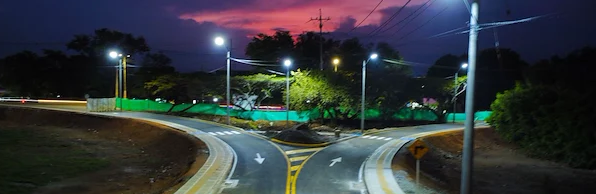
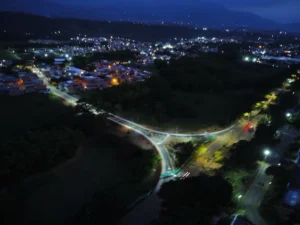
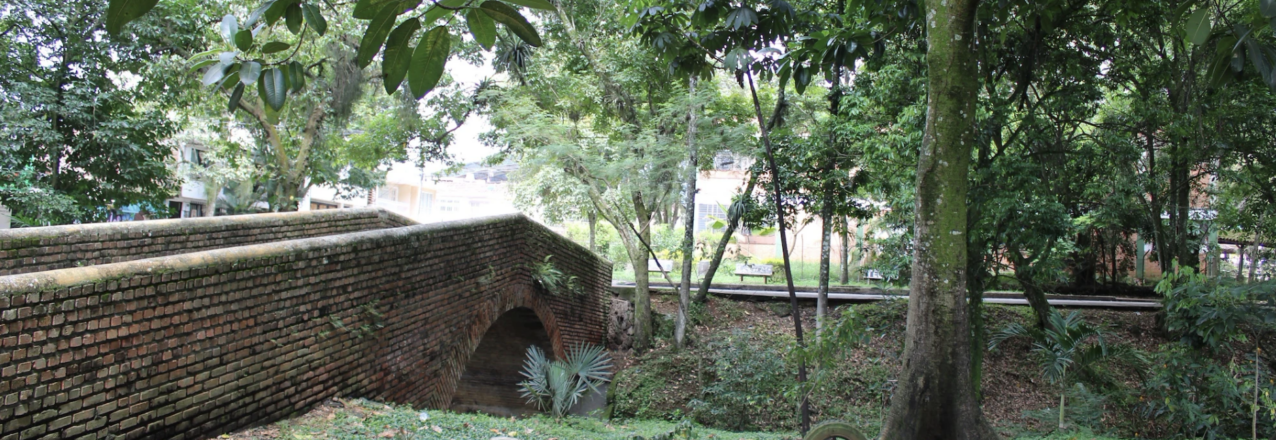
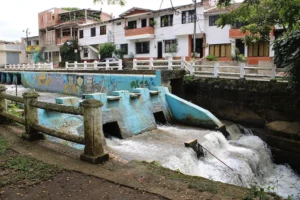
This year, traffic patterns in Santander de Quilichao are finally shifting. Drivers coming from nearby municipalities of Caloto, Toribio, and Guachene now have the opportunity to bypass the city’s center through the neighborhood of Niza, which lies north of downtown. The bypass measures less than a kilometer but includes a bridge over the Quilichao River, saving time for drivers, keeping heavy trucks out of the city’s center, and improving urban development for the community in Niza.
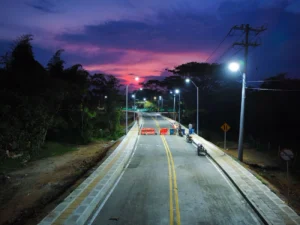 The idea of a road and bridge across the Quilichao has been on the minds of city planners for at least twenty years but was never realized until a team of land experts from the Municipal Land Office took over the process of acquiring the land on both sides of the river.
“The owners on one side of the river were never interested in ceding the land to the city, but when the Municipal Land Office reached out to the property owners to work together, we made them see that this road would increase property values in the neighborhood and the city’s efficiency,” explains Bernardo Pinzón, a social worker in the Santander de Quilichao’s land office.
With the properties lined up, Mayor Lucy Amparo Guzmán, the mayor of Santander de Quilichao, led the campaign to mobilize the 3,400 million pesos required to complete the roads project. City leaders and neighbors gathered in October 2022 to inaugurate the road and bridge, which includes an access ramp, LED streetlights, and sidewalks with wheelchair access.
The success story is the latest example of how land tenure issues lie behind every type of investment in essential public services and infrastructure in Colombia’s rural municipalities. In Santander de Quilichao, land informality rates are above 50 percent, meaning half of all parcels do not have registered land titles. In hundreds of other municipalities, it is much worse, reaching as high as 80 percent.
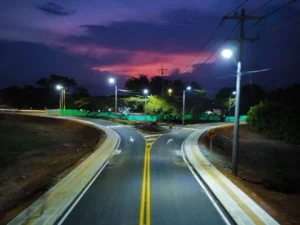
With the properties lined up, Mayor Lucy Amparo Guzmán, the mayor of Santander de Quilichao, led the campaign to mobilize the 3,400 million pesos required to complete the roads project.
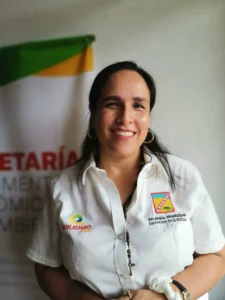
“Legalizing a property gives a project viability and gives the Municipality a chance to mobilize resources. That’s why the Municipal Land Office generates development and urban planning, not only in the short term but in the medium and long term as well. As mayor, I must plan for the next mayor, and the Municipal Land Office helps me in this role.”
-Lucy Amparo Guzman, Mayor of Santander de Quililchao
Titling Urban Properties
With USAID support, Santander de Quilichao’s Municipal Land Office was created in early 2017 as a one-stop shop for local land administration to facilitate rural development initiatives and help rural landowner access property services and information.
In its first iteration, the local land office titled hundreds of urban parcels, including public properties like health clinics, aqueducts, and schools. Among the lands titled in the name of the municipality is a parcel for a University of Cauca satellite campus, a SENA campus serving 1,500 students, a transportation terminal, and a hospital.
“The community values the Municipal Land Office and because of it knows that if community spaces like schools, roads, health centers do not have property titles in the name of the municipality, there is no way to invest in public services,” says Mayor Guzman.
With USAID support, the Municipal Land Office is working closely with the National Land Agency (ANT) to prepare for an upcoming massive land formalization initiative. The municipality’s Social Management of Rural Property Plans, known as POSPR, was approved in 2022, and teams are expected to begin the preliminary stages this year.
“The parcel sweep is very important for Santander de Quilichao. In addition to allowing people to access land and own property, the exercise helps us look at land use, including environmental protection, and it is documented, allowing us to plan better and project the municipality into the future,” says Mayor Guzman.
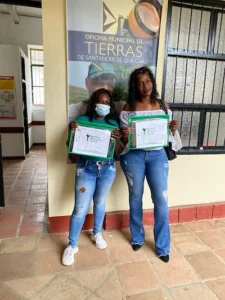
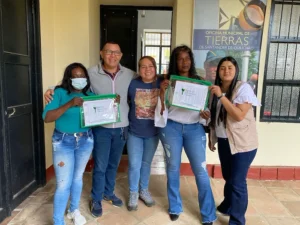
In 2022, the USAID Land for Prosperity Activity renewed its support for the land office, improving information systems and expanding staff and capacity to meet the public’s expectations. Since then, the office has delivered over 150 land titles to urban landowners.
A Successful Strategy
Since 2020, 37 USAID-supported Municipal and Regional Land Offices delivered over 3,000 land titles to families living in the urban areas of rural municipalities. In addition, the land offices have formalized more than 1,000 public properties and provided land and property services to nearly 32,000 citizens.

 That Wednesday morning, Soledid Rosillo, 48, woke up before the roosters, earlier than usual. She silently reviewed the list of her activities making sure not to wake anyone: prepare breakfast for her two children and her husband, pack a snack to take to school, iron school uniforms, clean the house…


 The municipality of Puerto Lleras (Meta) is one of 11 massive land titling initiatives being supported and promoted by the USAID Land for Prosperity program. In partnership with the Government of Colombia, these property sweeps update a municipality’s rural cadaster and title thousands of parcels. Each of the 11 parcel sweeps is focused on an entire municipality and seeks to ensure that rural women recognize their property rights, a key part of stimulating rural development and promoting a formal land market.



 The new guidelines are centered on a philosophy of “do-no-harm” and within its main principles are government cooperation, ethnic group inclusion, and community dialogue. The adoption of the guidelines is remarkable, however, because it marks the first time the Colombian government has formally accepted a strategy that considers formalizing land rights as an incentive to reduce illicit cropping.



 In 2021, when the Municipal Land Office (MLO) team arrived in El Baho to begin the property characterization process, they initially contacted Hernando Gómez, Belcy’s husband and vice-president of the Community Action Board. At that moment, inspired by the possibilities of formalization, Belcy volunteered to join the team in visiting each of her neighbors’ properties—neighbors she has known since she and her husband arrived in the area 25 years ago.


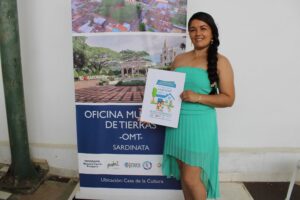
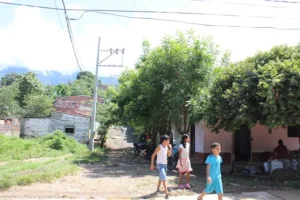
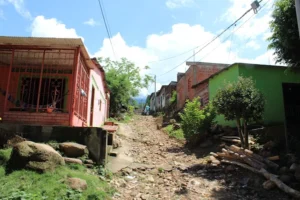


 Secure land rights for women are a crucial part of a gender responsive strategy to strengthen land tenure, and can have an outstanding impact on promoting gender equality and protecting one’s patrimony. When women have access to land and property, studies show they are more likely to earn higher incomes, enjoy increased decision-making power, and feel more protected in marital conflicts.
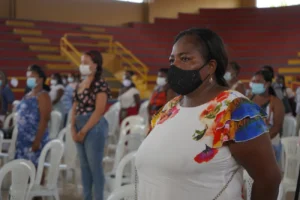 I invite them from the bottom of my heart and soul to be strong women that we are and to go to the Tumaco Municipal Land Office. That the women who have been through these horrible situations, always feeling crushed, need to know that we too can receive many benefits. Even when the men are the ones who work, we also have rights because we are also part of the home.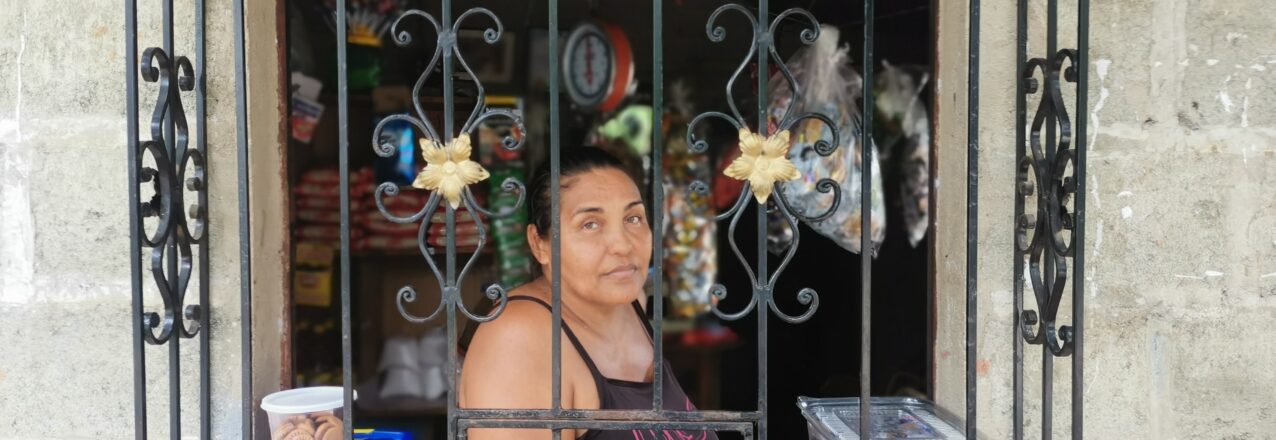
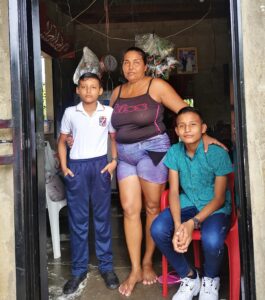

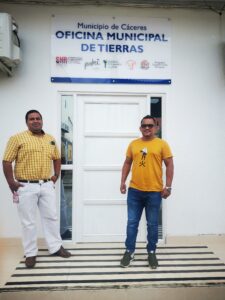 The Caceres Municipal Land Office is slowly trying to change this situation. Embedded in the municipal administration, the land office is the most effective tool for clearing up historical confusion around land ownership in the urban areas of Cáceres. With support from the mayor and financial support from USAID, social worker Wilmer Molina and the land office’s legal expert, Carlos Ávila, are following through on a strategy that expects to formalize hundreds of urban properties, not to mention dozens of public properties like schools, health clinics, and parks.
 Through visits, Molina learned that years before that frightening night when she and her family were chased away from their home, Nuri Jaramillo had tried to formalize her property. When she purchased the property in 1993, she immediately went and legalized it with Colombia’s cadaster management authority, known as the IGAC. However, when she tried to process her land title, it was too costly and too difficult to muster.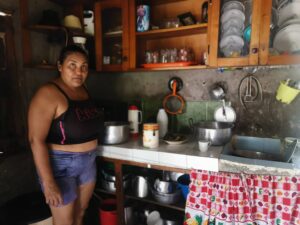
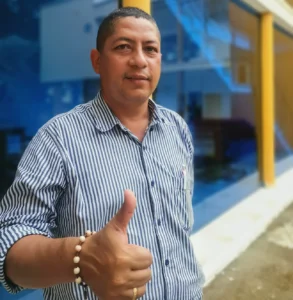
 Since 2020, with support from the Government of Colombia, the Land for Prosperity Activity is leading a massive land formalization campaign in the municipality of Cáceres, in the Bajo Cauca region. Due to the presence of armed groups, illicit crops, land mines, and artisanal gold mining, the initiative depends on community mobilizers for several important steps of the property formalization process. In this interview, Ana Cristina Marchena, a community leader from Guarumo, Cáceres, talks about her role and the value community mobilizers add.


