

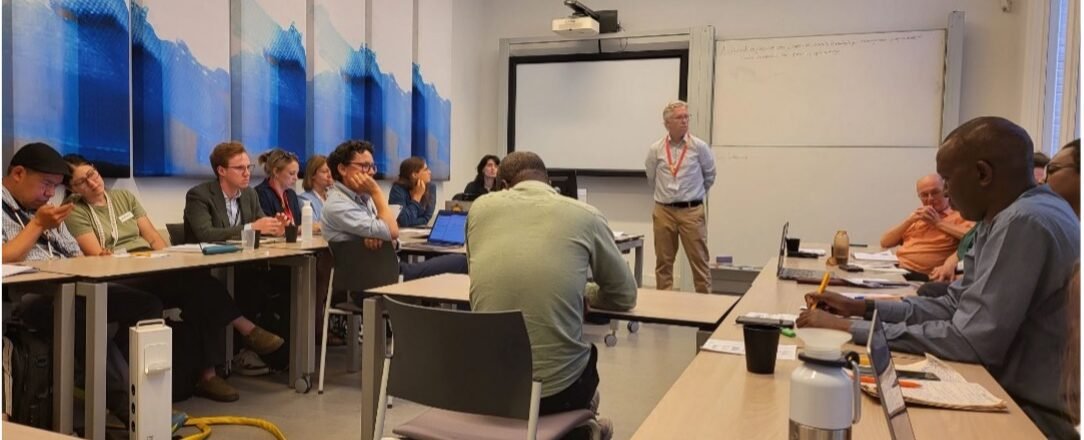
Knowledge management in land governance programs has grown over the years. Knowledge management has been intended to bring different stakeholders together, and to facilitate encounters to identify undocumented knowledge and make it visible. As the five-year experience of knowledge management within Land-at-Scale, spanning 12 countries across the Middle East, Africa, and South America, is coming to an end, we took the opportunity as knowledge management partners of the program to reflect together on the measures that can be taken in the future to enable plurality of knowledge. We have done this in the session by putting certain questions central, which were answered in a roundtable setting by some of the partners of Land-at-scale.
Key Takeaways
- Context is key: stay alert to context at all times
- Negative outcomes, challenges, and problems are part of knowledge and need to be shared
- Knowledge management needs to be alert to power; otherwise, it is ‘business as usual’
- Intercultural communication and knowledge need to be brought to the forefront
Session summary and key contributions
The session started with a short introduction of the Land-at-scale programme by Gemma Betsema (RVO). Before the session, some of the knowledge management partners of Land-at-scale received some questions to prepare and reflect on their experience with knowledge management, ways forward, and plurality of knowledge. These were discussed in the roundtable debate, where there was a lot of fruitful input from the large group of participants that was present. The first question that was discussed was:
What are your experiences with knowledge management within your respective projects? Why were these experiences successes? And others not?
When this question w thrown in the group, first a few reflections were held looking back on what knowledge meant for partners at the beginning of the project as compared to now. One partner shared that at the beginning, when knowledge management was introduced, they asked themselves: but what is knowledge management? Now, looking back, one of the main points made in relation to the question was that knowledge management has now led to the documentation and capturing of real experiences on the ground for many NGO’s and other organizations. However, as noted by one of the partners, knowledge should not remain static, it should be fed by different inputs such as stories, personal insights. An interesting quote from this discussion was:
“it is not only about success, but also about failures, we need to share all the knowledge that we have”
This was shared by Mahamat Abdoulaye, who in the discussion reflected on after-production and the need to share the knowledge that is produced. As an additional point it was discussed how knowledge is often associated with positive knowledge, good outcomes and results. However, negative knowledge is equally important, and we should take into account the negative and failure when we talk about knowledge management to not repeat mistakes. Even when projects are not successful, they need to be documented because that is also knowledge, and knowledge can take on different faces. The next question that was central in the roundtable was:
What constitutes knowledge and what does not? Why?
“Knowledge comes from confronting what people tell you to what you know”
During this conversation, important points were made about how knowledge management takes time, to develop trust, to dig deeper, and to understand problems within the broader issues to provide solutions. To build strong knowledge, there were three important elements mentioned which were the following. The first points is the need to pay attention to context. There is no ‘African context’, ‘West African context’ or ‘Burundi Context’, the context is rooted into place. Participants reflected on how, even in the country where you live, where you speak the language, you could still not know the right context from a neighboring community. The second point is to challenge underlying assumptions which projects have, and the third and final point is acknowledging that not knowing is not a lack of knowledge. Leading from this discussion, in which we discussed the importance of how knowledge is applied, we landed on the question:
Who decides what knowledge is relevant? For policy making?
Centering the conversation specifically on the partners in Colombia, who work specifically with Indigenous and Afro-descendant communities, the question of who decides remains a difficult question to answer. The knowledge of a lot of people is not recognized – peasants, afro-descendants, Indigenous communities. They also work with different legal frameworks, which can cause conflict. We need an intercultural approach, not separate worlds, was concluded from this conversation. There is not as much emphasis on specific rights anymore. From the experience in Colombia, intercultural conflicts are actually practically and locally resolved in-between different groups, across different legal frameworks which regard land, even though conflicts arise. They have found that outside interventions often destroy these local solutions. The key takeaways from this fruitful discussion were that people have knowledge to resolve conflicts, the question remains: how can we contribute to bringing this knowledge is in the forefront? Which led to our following question:
What measures can be taken to address barriers to the integration of diverse sources of knowledge into program adaptation, policy and decision making?
“Knowledge Management is about organising the conversation, in such a way that you can learn from each other, ultimately so you can change the world.”
An interesting conversation arose from this question in which the academic partners together with the LAS partners reflected on what the meaning is on the ground. The project does not need to be unique to understand the meaning on the ground, if what is being done is worthwhile. The most important thing was, that the process, of integration but also more generally, takes time. This is also a reflective process, which does not have to be killed by making it overly procedural. Looking back at the start of Land-at-scale, the academic partners reflected on how at the beginning they felt as if they were nagging about a lot of things, but now these are part of the conversation, reflecting this need for a long-term process. The key takeaway was knowledge management, if done correctly, develops a sensitivity to power, exposes it and addresses it; otherwise, it is business as usual.
Session moderators: Bertus Wennink (KIT) & Aurora Montiel Somer (KIT) Key contributors: Gemma van der Haar (Wageningen University & Research), Maria-Clara van der Hammen (Tropenbos International Colombia), René-Claude Niyonkuru (LANDac researcher Burundi & VNG International Togo), Mahamat Abdoulaye Malloum (Kadaster International), and Borges Chivambo (Centro Terra Viva).
Program: LAND-at-scale.
Related projects: LAND-at-scale Knowledge management: LANDac contribution, LAND-at-scale Knowledge management: International Land Coalition contribution, LAND-at-scale Knowledge management: KIT support to country partners, LAND-at-scale Knowledge management: Land Portal strategy support.
Originally published on the Land Portal. Creative Commons Attribution 4.0 International.