
KNOWLEDGE MANAGEMENT REPORT LAND-AT-SCALE Mozambique JAN 2026
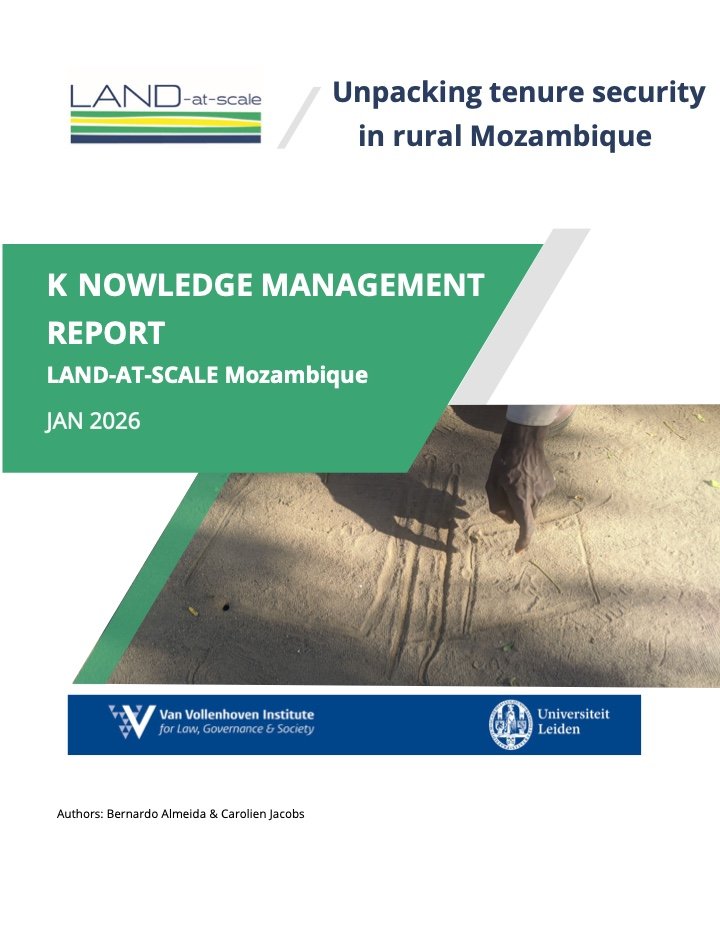
Download the complete publication (PDF, 48 pages)
Abstract
This study investigates how rural people in Nhamatanda district, central Mozambique, experience land tenure security, the external factors that shape it, and its impact on livelihoods and resilience. The research contributes to ongoing discussions on how LAND-at-scale Mozambique (LAS-Moz) interventions can more effectively strengthen tenure security in Mozambique.
Our findings show that people have limited awareness of the rules regulating their legal rights. Few respondents knew that their occupation of land—whether through customary arrangements or good faith use for more than ten years—already provides them with legal tenure security under Mozambique’s Land Law. Many continue to assume that only formal documents that recognize a DUAT can guarantee security. Raising awareness about people’s land rights is hence still needed. However, in Nhamatanda district threats to tenure security remain limited, with relatively low pressure over land, very few communal disputes, and no significant investor interest. As a result, many people who lack formal documents still feel secure, since their land is not threatened. Yet, literature on Mozambique, as well as responses from state officials, show that events such as investor interest on land can quickly erode the de facto tenure security which people currently have. Therefore, the current openness of state entities to the communal land registration conducted by Terra Firma is an opportunity to provide communities with tools to better respond to further threats.
The key exception regarding perceived tenure security relates to the Gorongosa National Park (GNP). Community members living in the current buffer zone of the park often expressed concerns that wildlife undermines their livelihoods and feared that a future expansion of the park could displace them. This fear feeds into a general climate of distrust toward the park, despite its investments in this area, in terms of livelihood support, education, and health care. Unless livelihood protection improves—such as through stronger fencing systems—and communication between the park and communities is enhanced, these tensions are likely to persist. In this regard, people report that communal land registration would give them a stronger voice towards the GNP.
Another significant challenge arises from the impacts of climate change: During the field visit, a long-lasting drought threatened people’s agricultural production and resilience. While tenure security itself does not hinder community-led climate adaptation, problems emerge when the state intervenes, for instance by relocating people from high-risk areas. Without clarity on their rights, communities risk becoming the ones who bear the costs of resettlement. The involvement of CTV in land use planning represents an opportunity to integrate risk mapping, particularly if communal-level mapping is prioritized before (and feeds into) district-level planning to ensure that local realities are captured.
In conclusion, interventions under LAS-Moz can have a transformative impact if they continue to strengthen awareness of rights, prioritize inclusive communal registration, integrate climate and land planning, and make better use of available land data.
Publication details
- Authors
- Bernardo Almeida and Carolien Jacobs
- Publisher / producer
- LAND-at-scale Mozambique
- Publication date
- January 2026
- Resource type
- Knowledge management research report
- Language
- English
- Extent
- 48 pages
- Geographic focus
- Rural Mozambique
- Source note
- The Land Portal catalogue lists February 2026. The PDF is dated January 2026 and states CC BY-NC 4.0.
- Subjects
- Indigenous & Community Land Rights Land & Climate Change Land & Food Security
Program: LAND-at-scale.
Related projects: LAND-at-scale Mozambique: Research on rural tenure security.
Original publication credited to Bernardo Almeida and Carolien Jacobs. Cover reproduced from the first page. Creative Commons Attribution–NonCommercial 4.0. Land Portal source record.