

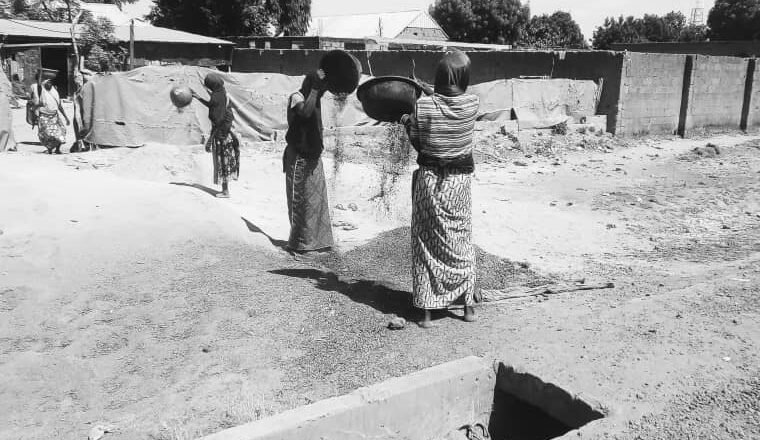
At UNCCD COP17 in Ulaanbaatar, where governments, civil society, researchers, and community leaders gathered under the theme “Restoring Land. Restoring Hope,” one side event asked the question that should sit at the center of every land-restoration debate: who is being asked to restore the land, and what rights do they have over the future they are helping to rebuild?
The event, “Secure Tenure Rights: A Stepping-Stone to Build Stronger Food Systems, Resilient Communities and Achieve Climate Goals,” was organized by the Huairou Commission, Oxfam, Women to Kilimanjaro, and Land Rights Now! It brought together women farmers, pastoralist leaders, land-rights advocates, and practitioners from Kenya, Nigeria, Tanzania, Uganda, Burkina Faso, and the wider Sahel. The speakers did not treat women’s land rights as a narrow gender issue. They framed them as a climate issue, a food-systems issue, a governance issue, and a question of dignity.
That framing matters to me personally. I have worked on land issues since 2012, and women’s land rights have been central to my understanding of the field from the beginning. I have spent years helping communicate evidence, build platforms for debate, and support knowledge exchange on land governance. But events like this are a necessary reminder that expertise does not only come from policy papers, legal reviews, or conference rooms. It also comes from women who know what happens when the rain no longer comes on time, when family land is controlled through patriarchal norms, when pastoral routes are blocked, when restoration funding never reaches the groups doing the work, and when the law looks good on paper but remains inaccessible in practice.
Women’s land rights and land restoration: the carers of land
Pubudini Wickramaratne of Oxfam opened with a deceptively simple question: who cares for the land? Oxfam’s recent briefing note, Who Cares for Carers?, makes the case that climate-induced land degradation falls heavily on women in rural areas, Indigenous Peoples, pastoralists, and smallholder farmers, and that insecure land tenure weakens climate resilience, sustainable land management, and recovery from environmental shocks.
This is more than a moral argument. It is a practical one. If the people closest to the land do not have secure, recognized, and enforceable rights, they are being asked to carry responsibility without authority. They may be expected to plant trees, conserve soil, protect water sources, manage grazing systems, restore degraded fields, maintain food production, and absorb climate shocks. Yet without tenure security, they may lack the confidence, legal standing, finance, and institutional support needed to invest for the long term.
Tenure security is not a side condition for climate action. It is climate infrastructure.
That point came through again and again during the discussion. Land restoration is often measured in hectares restored, trees planted, carbon stored, or funds mobilized. Those measures matter, but they can obscure the central political question: who controls the land after it is restored? If restoration strengthens governments, investors, or elites while the women, pastoralists, Indigenous Peoples, and smallholder farmers who cared for the land remain insecure, then we have not restored hope. We have reorganized inequality.
Grassroots women are already testing the policies others debate
Violet Shivutse of the Huairou Commission and Shibuye Community Health Workers offered one of the clearest examples of why grassroots women must be treated as policy actors, not as “beneficiaries.” Speaking from the experience of western Kenya, she described how many rural women depend on agriculture but struggle to access family land because inheritance and decision-making remain shaped by patriarchal norms.
Her example of land leasing was powerful because it was practical. Leasing is not a substitute for women’s inheritance rights or ownership. It does not solve structural inequality by itself. But in contexts where women are blocked from family land, properly designed lease arrangements can create space for women to farm, restore soil, organize collectively, and strengthen their bargaining power.
Through work with partners, Shibuye helped develop land lease guidelines in Kakamega. According to Violet, more than 1,200 women and youth have used the guidelines, women have formed groups to lease land collectively, and restoration activities have included composting, terracing, agroforestry, water conservation, vegetable production, poultry, fish ponds, and sweet potato cultivation. She also spoke of community learning centers, women serving on land-leasing committees, and community paralegalism as a way to move from temporary access toward a deeper rights agenda.
This is exactly the kind of experience that too often remains invisible in global policy processes. The lesson is not that every country should copy one model. The lesson is that women are already experimenting with ways to make land governance work under difficult conditions. They are building contracts, committees, learning centers, paralegal tools, and soil-restoration practices. They are translating law into usable practice.
A participant from Ghana made a related point: even where land laws are gender responsive, the language of policy can remain too technical for the women whose rights are supposedly protected. Naomi Shadrack, who moderated the event, sharpened that point by asking whether the burden should be on grassroots women to adapt to technical language, or on technical experts to communicate in ways that rights holders can actually use.
That question should unsettle every policy expert in our field. A right that cannot be understood is a right that can be lost.
Pastoralism belongs at the center of the land-restoration agenda
Zainab Arah, speaking from Nigeria and the Kilimanjaro Women’s Initiative, made a crucial intervention on pastoralism. She reminded the room that for a pastoral woman, land is not simply property. It is livelihood, food system, grazing area, water source, children’s future, and community survival.
Her most important point was about mobility. Too often, public debate asks whether pastoralism contributes to land degradation. Zainab asked a better question: what happens when pastoralists lose access to the grazing routes, water points, and mobility systems that have historically allowed them to manage variable ecosystems?
That question changes the policy frame. It moves us away from blaming pastoralists for degradation and toward examining the pressures that undermine sustainable pastoral systems: land conversion, blocked routes, insecurity, conflict, shrinking water access, and policies that fail to recognize mobility as a legitimate and adaptive land-use strategy.
Soudata, speaking from Burkina Faso and the Sahel Land Rights Now campaign, deepened this analysis. She described insecurity in rural areas, reduced access to grazing land and water points, pressure from urbanization and land-use conversion, recurring conflict between farmers and pastoralists, and increasingly severe climate impacts. Her recommendations were direct: reform pastoralist law, secure pastoralist land rights, protect freedom of movement, harmonize pastoralist and rural land laws, strengthen conflict-resolution mechanisms, and recognize pastoralists as solution providers rather than passive recipients of development.
That last point deserves to be repeated. Pastoralists are not merely “vulnerable groups” in need of assistance. They are rights holders, knowledge holders, livestock producers, ecosystem managers, and political actors. Their mobility is not backwardness. In many dryland contexts, it is resilience.
Climate action cannot be built on borrowed land
Eva Mageni Daudi of the Kilimanjaro Women’s Initiative in Tanzania brought the climate crisis into daily life. She asked the audience to see rural climate change through the eyes of a woman farmer: waking before sunrise, looking for clouds, wondering whether the seeds already planted will survive, facing delayed rains, sudden floods, soil erosion, drying water sources, longer walks for fuelwood, and failed crops that force women to reduce their own meals so their children can eat.
Her message was clear: without secure land rights, women are asked to adapt while standing on unstable ground. Why invest in trees, water harvesting, soil conservation, or long-term restoration if the land may be taken away tomorrow? Why build climate resilience on land one does not control?
Eva’s call to action was concrete: fix laws and policies so women can inherit and own land safely; make paperwork simpler and less costly; and send climate finance directly to local groups doing the work. Her words echoed a wider evidence base. FAO has reported that women have less secure tenure over land and less access to credit and training, and that men have greater ownership or secure tenure rights over agricultural land than women in 40 of 46 countries reporting on SDG Indicator 5.a.1.
This is why women’s land rights cannot be treated as a social safeguard added to climate programming after the main decisions have been made. They are part of the main decision.
Power decides whether restoration is just
Hood Lubuwa of Oxfam in Uganda asked another question that stayed with me: who owns the future we are restoring?
His framing cut through a great deal of technical language. Secure tenure is not only about access. It is also about control, ownership, and voice. Women may work the land but lack decision-making power. Youth may participate in restoration but lack authority over land use. Communities may conserve ecosystems for generations, only to be displaced or polluted when an investment corridor arrives.
Hood’s example from Uganda pointed to a larger problem. Land restoration cannot be separated from political economy. Mining, oil and gas, agribusiness, infrastructure, urban expansion, and other investment pressures shape who is displaced, who benefits, and whose environmental stewardship is ignored. A restoration project that counts hectares but ignores power may end up legitimizing the same inequalities that caused degradation in the first place.
This is where land governance becomes unavoidable. The issue is not only whether a community has a document. It is whether institutions are accountable, whether women can speak safely, whether pastoral mobility is recognized, whether customary and collective rights are respected, whether free, prior, and informed consent is meaningful, whether land data is transparent, and whether local knowledge has authority in decision-making.
Technology can help, but it cannot answer those questions alone. Digital mapping, land records, artificial intelligence, and open data all have roles to play. But they must serve rights holders. Otherwise, they risk making dispossession more efficient.
We cannot ignore the political moment
It would be dishonest to reflect on this event without naming the wider context. In many ways, the environment for women’s land rights, pastoralist rights, Indigenous rights, and community-led land governance is getting harder.
Development finance is shrinking. The OECD projected a 9 to 17 percent decline in official development assistance in 2025, following a 9 percent drop in 2024. The dismantling of USAID has been especially consequential. U.S. oversight reporting noted that Secretary of State Marco Rubio announced the cancellation of 5,200 USAID awards—83 percent of USAID programs worldwide—in March 2025. Reuters has since reported on continuing difficulties in the State Department’s takeover of former USAID programs, including staffing shortages, delayed guidance, and IT problems.
For people working on land rights, this is not an abstract institutional story. Funding cuts close civic space in practical ways. They weaken community paralegal programs, women’s rights networks, pastoralist platforms, legal empowerment work, land-data initiatives, participatory mapping, and the slow relationship-building that makes reforms real. The people most affected are rarely those who made the budget decisions.
At the same time, democratic space is under pressure. Freedom House reports that global freedom declined for the 20th consecutive year in 2025, with more countries deteriorating than improving. V-Dem’s 2026 Democracy Report found 92 autocracies and 87 democracies at the end of 2025. This matters for land. Authoritarian and undemocratic governments are less likely to tolerate independent land-rights organizing, dissent over land acquisitions, scrutiny of public land deals, or community resistance to forced displacement.
Women, pastoralists, Indigenous Peoples, and local communities suffer when land governance is captured by centralized power. They suffer when public institutions are hollowed out. They suffer when aid cuts remove support for local organizations. They suffer when civic space closes. And they suffer when climate policy treats them as an implementation labor force rather than as rights holders.
Moving beyond the diagnosis
I appreciated everything that was said in the side event. But appreciation is not enough. The land sector has become very good at naming challenges. We know the phrases: insecure tenure, gender inequality, weak implementation, lack of access to finance, climate vulnerability, customary rights, pastoral mobility, data gaps, political will. The danger is that repeated diagnosis becomes a form of delay.
The speakers at this event were not asking for another round of sympathy. They were pointing to an agenda.
First, land restoration and climate adaptation plans must recognize the people who care for land as rights holders and decision-makers. Women, pastoralists, Indigenous Peoples, smallholder farmers, and youth should not be consulted after priorities are set. They should shape the priorities.
Second, governments and partners need to secure rights in forms that match lived realities. That means women’s inheritance and marital property rights. It means accessible registration and dispute-resolution systems. It means recognition of customary and collective tenure where appropriate. It means pastoral mobility, grazing routes, water points, and commons governance. It means protections against land grabbing and displacement in the name of investment or restoration.
Third, law must become usable. Gender-responsive legal provisions matter, but they are not enough if women cannot understand them, afford the process, safely claim their rights, or find institutions willing to enforce them. Community paralegals, translation of technical language, local learning centers, women’s committees, and trusted intermediaries are not soft activities. They are part of the infrastructure of justice.
Fourth, climate and restoration finance must reach the people doing the work. That requires simpler access rules, direct support for women-led and community-based organizations, grant-based funding where debt would deepen vulnerability, and accountability for whether money reaches rights holders. If local groups can restore land, produce food, conserve water, maintain biodiversity, and manage conflict, they should not be forced to survive on project crumbs.
Fifth, we need to defend civic space as part of land governance. There is no meaningful women’s land-rights agenda without freedom of association, freedom of expression, access to information, independent media, functioning courts, and space for communities to challenge power. Land rights do not flourish where fear governs public life.
The question we should carry forward
COP17’s theme is “Restoring Land. Restoring Hope.” It is the right aspiration. But hope is not restored by declarations alone. Hope is restored when a woman farmer can invest in soil because she knows she will not be pushed off the land tomorrow. Hope is restored when a pastoralist community can move with its herds without being criminalized or blocked from water. Hope is restored when Indigenous Peoples and local communities can say yes or no to decisions affecting their territories. Hope is restored when a grassroots woman is not invited merely to tell her story, but to help design the policy.
Since 2012, I have seen women’s land rights move in and out of political fashion. I have seen strong language adopted and weak implementation follow. I have seen inspiring local practice ignored because it did not fit donor reporting categories. I have also seen women’s groups, pastoralist leaders, Indigenous organizations, and community advocates continue to organize with extraordinary clarity despite underfunding, political pressure, and exclusion.
That is why I came away from this event convinced of something simple: the future of land restoration will be decided less by how often we invoke resilience, and more by whether we are willing to redistribute power.
The women who care for land are not asking to be celebrated and then sidelined. They are asking for rights, recognition, finance, law, mobility, voice, and political seriousness.
They are not waiting for the world to discover the solution. They are already building it.