

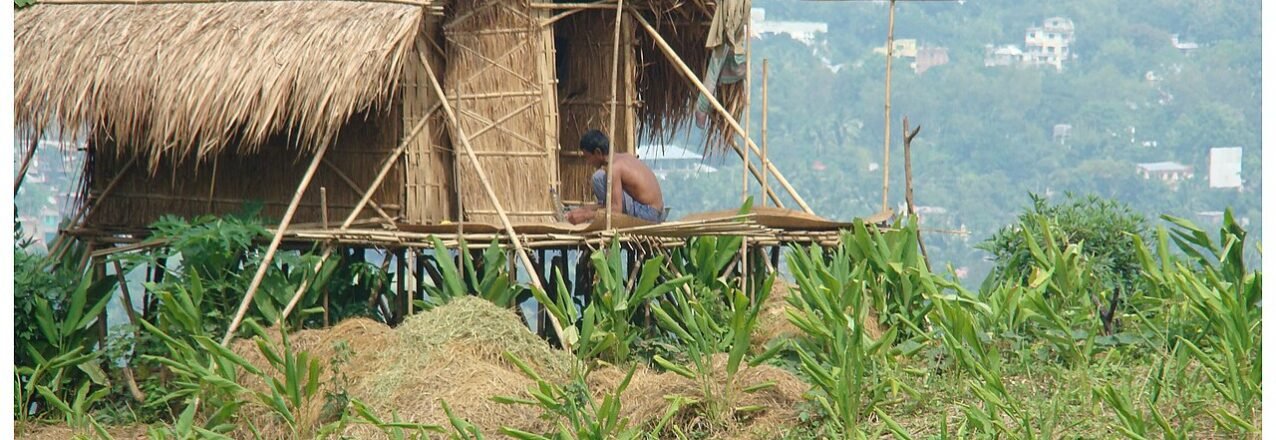
As delegations convene at the United Nations Convention to Combat Desertification (UNCCD) Conference of the Parties to advance Land Degradation Neutrality (LDN), global policy debates frequently fall into an old trap: treating ecological restoration primarily as a financial or technological challenge. It is not. Land stewardship is fundamentally an issue of tenure security, biocultural governance, and collective rights.
Nowhere is this truth more vivid, more precarious, than in Northeast India
| Northeast India’s Tenure Realities | Governance & Structural Pressures |
| Customary & Clan (Community Stewardship) Lands | >60–80% of regional forest landscapes |
| Constitutional Safeguards | Sixth Schedule, Articles 371A & 371G |
| Primary Vulnerability Factors | Non-cadastral commons, “Unclassed State Forest” tags |
| Core Paradigm Shift | Monoculture cash crops, top-down LDN targets, infrastructure exemptions (FCAA 2023) |
The Blind Spot in Global Land Governance
Northeast India forms a vital ecological bridge between the Eastern Himalayas and the Indo-Burma biodiversity hotspot, acting as one of South Asia’s most critical carbon sinks and hydrological anchors. Unlike mainland India, where state agencies hold centralized statutory control, over 60–80% of the Northeast’s forests are stewarded by indigenous communities through their clans, kinship networks, and village councils.
Under constitutional provisions such as the Sixth Schedule and asymmetric protections like Articles 371A (Nagaland) and 371G (Mizoram), communities hold collective tenure over their ancestral domains. Here, land is not a speculative commodity; it is stewarded through interconnected social, cultural, and ecological systems.
Yet, these living commons face mounting structural pressures:
- The “Wasteland” Fallacy: Because customary lands lack individual cadastral titles, dynamic cyclical swidden systems (jhum) and Community Conserved Areas (CCAs) are routinely logged in official records as “Unclassed State Forests” or “culturable wastelands.” The mosaic of regenerating fallows, vital for soil regeneration and biodiversity corridors, are misdiagnosed as degraded land, exposing community lands to top-down diversion.
- Commercial Enclosures: The aggressive promotion of commercial monocultures like oil palm and rubber fragments traditional agroecological mosaics, depleting groundwater tables, eroding regional agrobiodiversity, and accelerating soil loss on steep mountain slopes.
- Statutory and Infrastructure Pressures: Recent legislative shifts, notably the Forest (Conservation) Amendment Act (FCAA) 2023 with its 100-km strategic border exemption, create pathways for linear infrastructure and extractive projects to bypass traditional consultation, a critical vulnerability for a frontier region sharing over 98% of its borders internationally.
- Top-Down Climate Interventions: Centralized carbon-offset schemes and target-driven afforestation initiatives frequently bypass customary authorities, replacing rich, biodiverse commons with monoculture timber plantations in the name of climate mitigation.
The Institutional Gap: Why a Regional Consortium like CLANS is Critical?
Traditional village councils and customary institutions have safeguarded these landscapes for generations. Yet, as they confront increasingly complex statutory shifts, industrial agribusiness contracts, and international carbon-accounting regimes, isolated village authorities find themselves at a structural disadvantage. Local communities retain deep legitimacy and customary ecological wisdom, but they frequently lack the geospatial tools, regional policy networks, legal scaffolding, and aggregated voice needed to negotiate with top-down enclosures and assert their rights.
This structural gap underscores why the Consortium of Landscape Alliance for Nature Stewardship (CLANS) has emerged.
Mobilizing Regional Capabilities: The CLANS Charter Intent
Rooted in the Northeast and driven by grassroots practitioners, legal experts, and community organizations, CLANS is designed as an institutional backbone to operationalize community-led landscape stewardship. Drawing upon the collective capabilities of its founding members, the alliance is chartered to fulfil three primary intents:
- Facilitating Landscape-Scale Planning and Action
By combining indigenous knowledge systems with participatory GIS and landscape planning frameworks, CLANS intends to equip traditional village councils to manage contiguous watersheds, fallow mosaics, and biological corridors across village and clan boundaries.
- Unlocking Flexible, Long-Term, Untied Finance
Recognizing that international climate and UNCCD funding mechanisms rarely reach informal village councils due to bureaucratic compliance hurdles, CLANS is structured to act as an accredited enabling mechanism. Its charter aims to aggregate and channel patient, untied resources directly into community-driven priorities rather than rigid project cycles.
- Connecting Indigenous Systems with Global Commitments
CLANS provides a platform to bridge local biocultural practices with national policies and multilateral targets (such as UNCCD LDN and the Global Biodiversity Framework). It aims to amplify customary authority in policy spaces while defending community wellbeing, resilience, and cultural continuity as integral dimensions of nature stewardship.
The Imperative for COP UNCCD
If the UNCCD’s global targets for Land Degradation Neutrality, drought resilience, and ecological restoration are to move beyond performative commitments, international frameworks must acknowledge a fundamental reality: stewardship succeeds only when local institutions are recognized as primary custodians.
In Northeast India, biodiversity and soil vitality have endured because indigenous communities have actively stewarded these territories for centuries. Supporting regional, member-driven alliances like CLANS is not merely an alternative development model, it is the foundational prerequisite for lasting biocultural resilience across the Eastern Himalayas.
CLANS is emerging as a consortium of local CSOs and Communities, led of young and women leaders from ethnic tribal communities (read indigenous people), with facilitation support of some like-minded stewardship-committed actors. Presently CLANS consists of RNBA, RBA, Kenono Foundation, Lemsachenlok, North East Network, Grassroots, with facilitative support from Foundation of Ecological Security and anchored by Landstack