

Indigenous Resistance Is Not a Footnote to Climate Action. It Is a Form of Governance.
At the LANDac conference in early July, Atribh Deka presented a powerful paper on hydropower, climate risk, and the renegotiation of land rights in Arunachal Pradesh, India. His research focused on three Indigenous and tribal communities—the Adi, Idu Mishmi, and Monpa—and the ways they have resisted large hydropower projects framed by the state as climate action, renewable energy, development, and national security.
The presentation raised a question that reaches far beyond India’s eastern Himalayas: when governments describe large infrastructure projects as necessary for the climate transition, whose land is made available, whose law is recognized, and whose authority counts?
Atribh’s answer is unsettling and important. In Arunachal Pradesh, resistance is not simply opposition to dams. It is a struggle over legal visibility. It is a challenge to the assumption that state law alone defines land, development, legitimacy, and the future of Indigenous territories.
Climate action on contested land
Arunachal Pradesh sits in India’s eastern Himalayas and holds an estimated 40 percent of the country’s hydropower potential. The state has signed more than 160 memoranda of understanding for large dams, with projected capacity of roughly 63,000 megawatts. Yet Arunachal Pradesh’s own electricity demand is far smaller. This imbalance raises serious questions about who benefits from hydropower development and who bears its social, ecological, and territorial costs.
The state’s case for hydropower rests on several overlapping arguments. Dams are presented as renewable energy infrastructure, a contribution to India’s national climate goals, a source of development, and, in a border region with China, an assertion of national security. Each of these arguments carries political weight. Together, they can make opposition appear unreasonable, anti-development, anti-environment, or even anti-national.
This is where Atribh’s analysis is especially valuable. He shows that “green development” is not a neutral category. Climate urgency can become a language through which dispossession is made harder to contest. When hydropower is treated as an unavoidable technical necessity, Indigenous concerns about land, forests, rivers, sacred sites, and customary authority are easily recast as obstacles to progress.
The issue is not whether renewable energy matters. It does. The issue is whether climate action can be considered just when it proceeds by weakening or ignoring the rights of the people whose territories make that action possible.
Law from below
Atribh uses the concept of “law from below” to describe how communities mobilize customary legal orders, collective institutions, spiritual obligations, public refusal, conservation strategies, and litigation to challenge the state’s monopoly over law and territorial governance.
This framing matters. Too often, Indigenous resistance is described as protest, grievance, or reaction. Atribh’s research asks us to see something more precise: communities are not merely resisting state law from the outside. They are asserting their own legal and political authority.
This is not a romantic claim that customary systems are simple, pure, or uncontested. Like all legal systems, they are shaped by power, history, gender, generation, and conflict. But they are legal orders nonetheless. They structure decision-making, allocate responsibilities, define relationships to land and water, and determine what can or cannot be done in a territory.
The state may fail to see these systems, but that does not mean they do not exist.
Three communities, three forms of resistance
Atribh’s presentation examined three cases. Each community used a different strategy. Together, they show that resistance does not take one form.
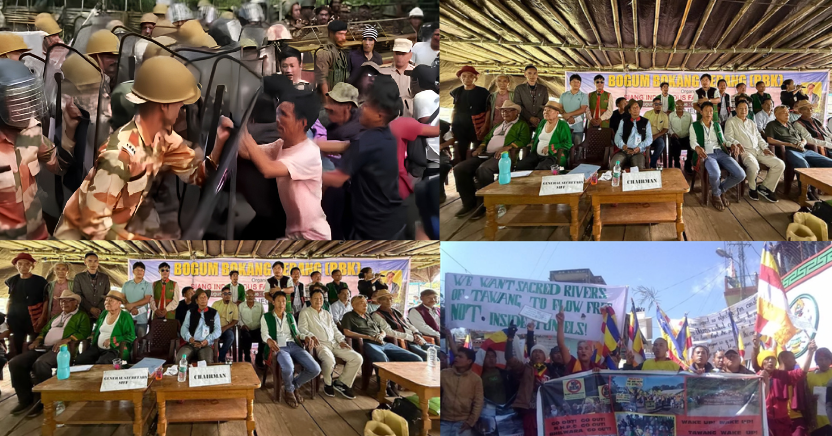
The Adi, in the Siang Valley, have resisted the proposed Upper Siang Multipurpose Project, an 11,200-megawatt project that Atribh noted would threaten 27 Adi villages. Their resistance has centered on the Kebang, a long-standing system of community governance. The Kebang is not merely a meeting format. It is a legal and political institution through which collective decisions are made and binding obligations are established.
In the Adi case, resistance has included collective resolutions, refusal to negotiate, blocking survey operations, dismantling temporary access routes, and ritual practices connected to the Siang River. These actions are often read externally as protest or disruption. Atribh invites us to read them differently: as forms of legal enforcement grounded in Adi authority, moral obligation, and territorial responsibility.
The Idu Mishmi, in the Dibang Valley, pursued a different path in relation to the Etalin Hydroelectric Project. Rather than relying primarily on direct protest, they drew on customary stewardship and conservation law. In 2022, community clans declared the Elopa-Etugu Eco-Cultural Preserve over 70 square kilometers of ancestral territory. This move connected Indigenous governance with international conservation frameworks, including principles recognized under the Convention on Biological Diversity.
This is a striking example of strategic legal engagement. The Idu Mishmi did not simply say no. They advanced a different vision of conservation: one grounded in customary taboos, ecological knowledge, and community authority. In December 2022, India’s Forest Advisory Committee declined forest clearance for the Etalin project, citing biodiversity concerns and Indigenous representations. This did not permanently settle the larger political question, but it did change the administrative terrain on which the project could proceed.
The Monpa, in the Tawang Valley, mobilized sacred geography and formal legal procedure against the Nyamjang Chhu project. The proposed project threatened landscapes associated with Buddhist pilgrimage, including areas connected to the black-necked crane, revered locally and linked to the 6th Dalai Lama, who was born in Tawang. The Save Mon Region Federation used the Right to Information Act to obtain government documents and expose omissions in environmental assessments. The case then moved through the National Green Tribunal, which suspended environmental clearance in 2016 and criticized the failure to properly assess impacts on the crane and its habitat.
Here again, resistance operated across registers: sacred law, ecological concern, administrative transparency, and formal litigation. The project remains stalled.
Effectiveness is not only victory
One of the most important contributions of Atribh’s research is that it does not measure resistance only by whether a project is permanently stopped.
That is too narrow a test.
Resistance can be effective when it delays destructive decisions. It can be effective when it forces environmental assessments to take Indigenous knowledge seriously. It can be effective when it exposes flawed procedures. It can be effective when it compels officials to justify actions that might otherwise have been imposed without meaningful scrutiny. It can be effective when it creates time for alliances, documentation, public debate, and legal strategy. It can be effective when it changes the terms of what the state must recognize.
In the three cases Atribh presented, Indigenous resistance produced tangible effects. Survey operations were suspended. Forest clearance was denied. Environmental clearance was stayed. The state was required to respond, reassess, explain, and negotiate.
These are not symbolic outcomes. They are governance outcomes.
This matters because communities facing land-based infrastructure often confront impossible standards. If they block a project, they are dismissed as anti-development. If they go to court, they are told they are relying on the same system that marginalizes them. If they use conservation law, they risk entering alliances that have historically excluded Indigenous Peoples from their own territories. If they perform rituals, invoke sacred relationships, or rely on oral legal traditions, their claims may be treated as culture rather than law.
Atribh’s research shows that each of these forms of resistance can matter. Direct action, customary assemblies, ritual authority, conservation designations, transparency laws, administrative complaints, and litigation are not separate from governance. They are ways communities force governance to happen.
The danger of climate language without tenure justice
The climate transition is increasing pressure on land. Hydropower, solar parks, wind corridors, carbon markets, conservation areas, restoration initiatives, and transition mineral supply chains all require territory. Many are justified in the name of urgent global goals. Some may be necessary. But none should be allowed to bypass the rights of Indigenous Peoples, local communities, pastoralists, smallholders, or others whose land and resource rights are insecure or weakly recognized.
Atribh’s presentation makes clear that climate language can become a technology of dispossession when it narrows public debate. If a project is labeled “green,” questions about land, consent, governance, sacred sites, forests, fisheries, livelihoods, and identity are too often pushed aside. The urgency of climate action is then used not to deepen democracy, but to compress it.
That is a mistake.
Climate action that ignores tenure security is not only unjust. It is fragile. Projects imposed without recognition, consent, transparency, and credible safeguards generate conflict, delay, reputational risk, ecological harm, and legal uncertainty. The lesson from Arunachal Pradesh is not that every hydropower project must be rejected. The lesson is that no climate project should proceed by pretending that Indigenous law, authority, and territorial relationships are invisible.
From recognition to negotiation
Atribh’s central insight is that law from below does not necessarily replace state law. Instead, it forces state law to confront what it has excluded. It compels the state to govern through negotiation rather than unilateral authority.
That distinction is crucial.
The demand is not simply for consultation after decisions have already been made. It is not a request for compensation after land has already been categorized as available. It is not a plea for cultural sensitivity at the margins of infrastructure planning. It is a deeper challenge: who has the authority to define land, climate responsibility, development, and the future of a territory?
For TenureSecurity.org, this is exactly the kind of question that must sit at the center of global land governance debates. Land rights are not only about documentation, registration, or administrative reform, although those can matter. They are also about power. They are about whose knowledge shapes decisions, whose institutions are recognized, whose histories are treated as legally relevant, and whose futures are negotiable.
The resistance of Indigenous Peoples is often portrayed as a barrier to development. Atribh’s research suggests the opposite. Resistance can be a diagnostic tool. It shows where governance has failed. It reveals what official procedures have ignored. It exposes the distance between climate rhetoric and territorial justice. And, in many cases, it creates the only meaningful opportunity for better decisions to emerge.
What this research asks of us
Atribh ended with open questions about the durability of procedural wins and the future of customary authority across generations. These questions are important. A stalled project can be revived. An administrative victory can be narrowed. A court ruling can remain unenforced. Customary institutions can be weakened by internal inequality, state co-optation, demographic change, or generational erosion.
But uncertainty should not lead us to underestimate what these communities have already achieved.
The Adi, Idu Mishmi, and Monpa cases show that resistance is not one act, one lawsuit, one blockade, or one declaration. It is a field of practice. It is legal, political, ecological, spiritual, and strategic. It can happen inside the system, outside the system, and across systems at the same time.
That is why it can be effective.
In a world racing to build the infrastructure of the climate transition, this research offers a necessary warning and a constructive path forward. The warning is that climate urgency can become a cover for dispossession. The path forward is that just climate governance must begin with the recognition of Indigenous and customary authority, not as an accommodation granted by the state, but as a structural requirement for legitimate decision-making.
Secure land and resource rights are not an obstacle to climate action. They are one of the conditions that make climate action just, durable, and accountable.