

By Oliver Puginier
GIZ/BMZ Participation
The 2025 World Bank Land Conference in Washington brought together over 800 global land governance experts, policymakers, academics, and practitioners. This year’s theme, “Securing Land Tenure and Access for Climate Action: Moving from Awareness to Action” aimed to highlight effective strategies for securing land tenure and access, to scale up land sector initiatives and investments, and to present policy reforms that promote global prosperity and environmental sustainability. There were 57 sessions (including 4 Plenary ones), 32 Operational Sessions, 10 Regional Workshops and 11 Research Sessions.
GIZ was represented by staff from the following projects:
- Sector project Resilient Rural Areas (Anja Schwiertz)
- Global Programme Responsible Land Policy, GPRLP (Christian Mesmer, Ethiopia; Faly Ranaivoson and Tiana Razafindrakotohary; Madagascar and Oliver Puginier; Steering Unit in Bonn)
- Global Programme Strengthening Advisory Capacities for Land Governance in Africa, SLGA (Nanny Wiechert and Jonas Kramp)
- The Sectoral Department (FMB), Division on Rural Development and Food Security (Alexander Strunck, 4D30, Bonn)
- Inclusive and Sustainable Urban Development, ISUD II (Leonie Gomm, Namibia)
BMZ was represented by the new Senior Policy Advisor on Land Rights, Mrs. Wencke Müller-Rilke, who spoke at panel as well as operational sessions.
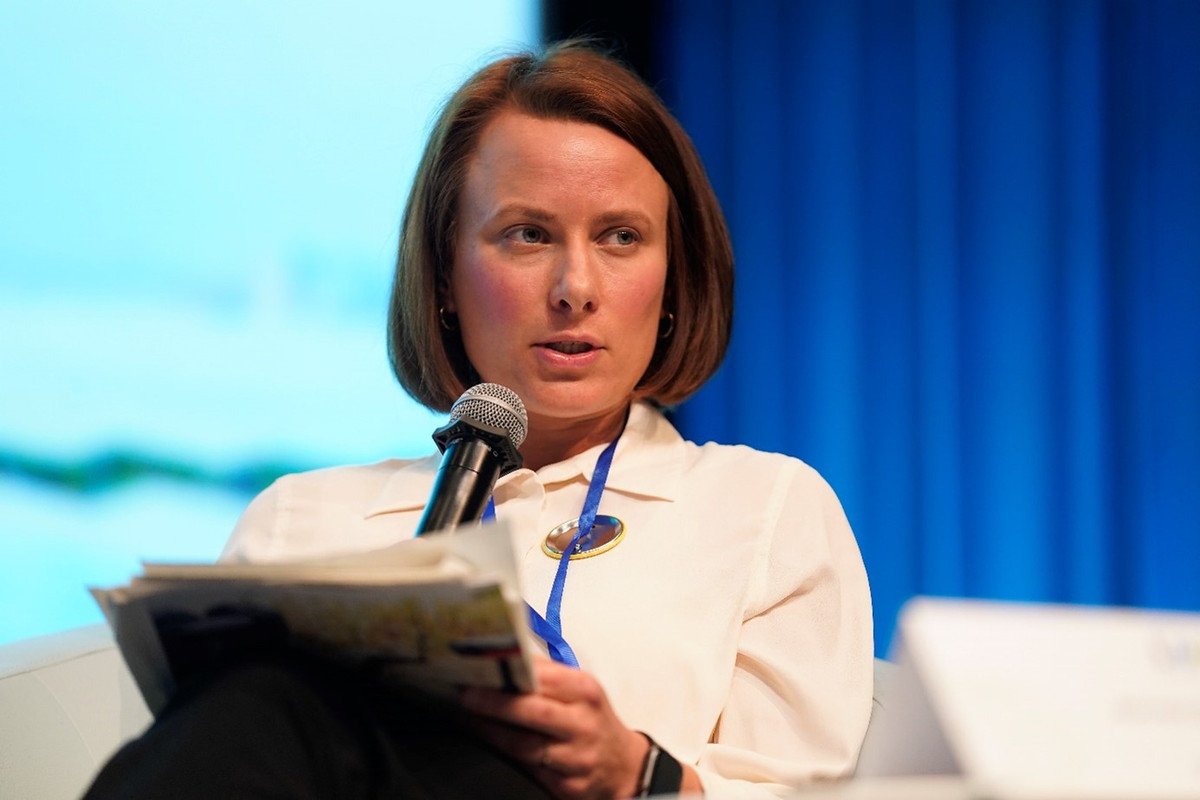
Mrs. Wencke Müller-Rilke from BMZ
Diversity of contributions
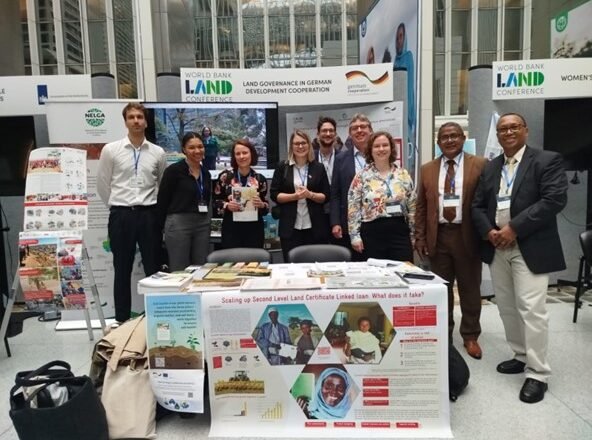
As a Silver Sponsor, BMZ/GIZ had a booth at the Solutions Expo to display information materials, posters and videos on work done in partner countries and achievements, which was well visited, particularly during breaks in the main agenda (see below). The BMZ/GIZ team was involved in a variety of ways to provide inputs, act as moderator or chairperson in the following sessions:
- Transforming discriminatory norms to strengthen women’s land rights: examples from the Stand for Her Land global advocacy initiative
- Securing Land for Climate Action in Africa: Ideas, Concepts and Experiences
- How to: making Climate Interventions work for equitable Land Rights
- Global Land Governance and Tenure: A Call to Action
- Sustainable Financing for Effective Land Administration
- Land registries as a key data source for resilient land use
- Best Practices and Innovations for Securing IP&LC Tenure: Tools Approaches, and Cultural Sensitivity
- Francophone Session: SIF en Afrique : progrès et défis, les perspectives des secteurs publics et privés (Land Information Systems in Africa: progress and challenges, perspectives of the public and private sectors)
German booth at the Solutions Expo: Jonas Kramp, Nanny Wiechert, Wencke Müller-Rilke, Leonie Gomm, Alexander Strunck, Oliver Puginier, Anja Schwiertz, Tiana Razafindrakotohary and Faly Ranaivoson (from left to right). Missing: Christian Mesmer
The participants also joined various side meetings with development organizations, CSOs, think tanks, partner ministries as well as consultancy companies. Partner institutions from target countries also had opportunities to meet BMZ for more specific interactions pertinent to each participating project, which was well-received by partner countries.
Summary assessment
The World Bank Land Conference remains the largest global venue for presentations and exchanges on land tenure, though securing commitments to continue securing access to land tenure has been dampened by the closure of USAID this February. The aim to move towards action is getting more difficult overall, but on the positive side 70 country delegations were able to travel to Washington (compared to 80 in 2024). Overall there were fewer sessions, but more time for panel discussions and Q&A, which enhanced exchanges. Although topics such as spatial, territorial as well as land use planning were mentioned in terms of their relevance, they were dealt with comparatively less than, for example, land administration and land information systems. On the other marine and coastal tenure were included as a new topic. The role of Indigenous Peoples and Local Communities (IPLC) as well as land rights for women obtained more space in panel discussions, but there were less options to focus on specific resources or livelihood challenges (e.g. pastoralism). The land conference continues to be important to share results, join scientific as well as policy debates to advance the cause of land tenure security and to foster strategic partnerships in future.
Explore the Global Programme Responsible Land Policy.
Originally published 22 May 2025 on Land Portal. Author: Oliver Puginier. Photographs via Land Portal.