
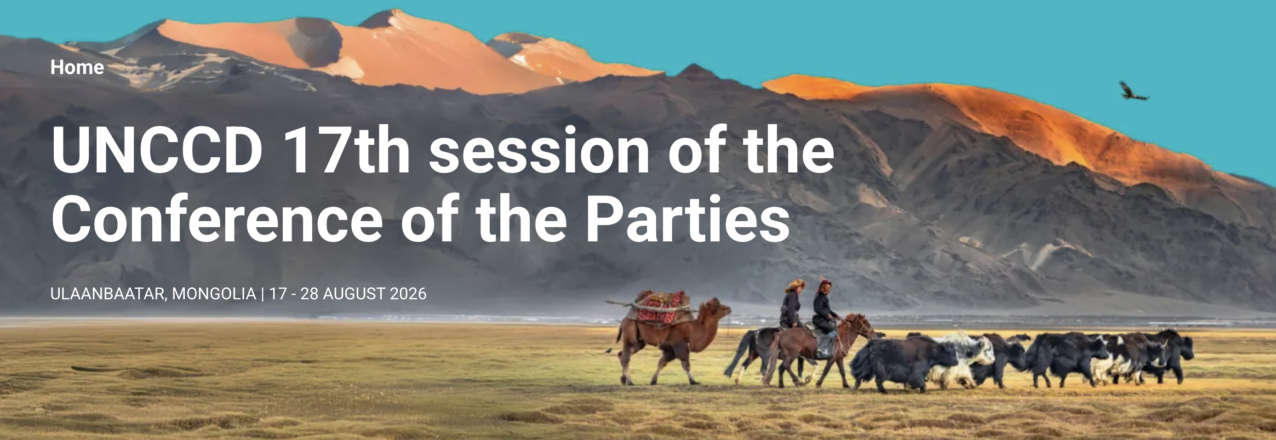
The 17th session of the Conference of the Parties (COP17) to the United Nations Convention to Combat Desertification (UNCCD) will be hosted by Mongolia in its capital city, Ulaanbaatar, from 17 to 28 August 2026 under the theme Restoring Land. Restoring Hope.
COP17 is expected to bring together delegates from UNCCD’s 197 Parties, alongside leaders from government, business and civil society, as well as scientists, youth, Indigenous Peoples, pastoralists and smallholder farmers. They will convene to forge solutions to the interconnected challenges of desertification, land degradation and drought, recognizing that restoring land is also essential to reducing instability, preventing displacement and strengthening human and national security in vulnerable regions.
“Land is our most vital infrastructure — underpinning food security, water, livelihoods and stability. When land fails, insecurity rises — through lost livelihoods, forced displacement and increased competition over scarce resources. With UNCCD COP17, Mongolia is offering the world a powerful message: Restoring Land, Restoring Hope is not only an environmental agenda, but a development and resilience priority. As drought intensifies and land degradation accelerates, the conference must drive practical, investable solutions — from restoring degraded land and soils to strengthening the land–water nexus — so that communities can thrive,” said UNCCD Executive Secretary Yasmine Fouad.
Land degradation is already affecting up to 40 per cent of the world’s land, with far-reaching impacts on food production, water availability, livelihoods and economic stability. COP17 offers a pivotal moment for countries and partners to strengthen implementation and mobilize greater investment in drought resilience and sustainable land management.
With a vast territory of 1.56 million square kilometers, Mongolia is among the countries most affected by desertification and land degradation, with nearly 77 per cent of its land already degraded. Hosting UNCCD COP17 in Ulaanbaatar will place international focus on land restoration priorities, including approaches that safeguard livelihoods, food security and ecosystems in dryland regions.
COP17 is taking place during the United Nations International Year of Rangelands and Pastoralists (IYRP 2026(, declared by the United Nations General Assembly and championed by Mongolia. This presents a major opportunity to accelerate action on the sustainable management, restoration and conservation of rangelands, while spotlighting the needs of pastoralist communities who depend directly on these ecosystems for their livelihoods.
Rangelands cover more than half of the Earth’s land surface, support the direct livelihoods of around 500 million people and provide one-sixth of the world’s nutrition needs, yet remain among the planet’s most overlooked and increasingly degraded ecosystems.
During the two-week conference, participants will engage in a high-level segment including ministerial dialogues, alongside multistakeholder forums and thematic discussions on science–policy integration, innovation and solutions, tools and technologies, and financing. In addition to formal negotiations, COP17 is expected to catalyze collective action on rangelands, resilience and water, as well as food systems and soil health.
In preparation for COP17, Mongolia has launched national initiatives linking land restoration with livelihoods and rural development, including the President-led “Billion Trees” National Campaign, initiated in 2021 and aiming to plant one billion trees by 2030. Mongolia has also expanded public engagement and youth participation through national dialogues and outreach activities, including the “Youth4Land” National Forum. Through the Mongolia Business Council, the COP17 Presidency has been engaging the country’s private sector in support of UNCCD’s Business4Land Initiative that aims to accelerate private sector action for sustainable land management.