e-Consultation: Responsible Land-Based Investment: A Practical Guide for the Private Sector

After being approached by several companies for guidance on this important issue, USAID is developing a practical guide to help the private sector make its agricultural investments more sustainable and inclusive and less risky from a land tenure perspective, in line with provisions of the Voluntary Guidelines for the Responsible Governance of Tenure of Land, Fisheries, and Forests in the Context of National Food Security (VGGT) and the Principles for Responsible Investment in Agriculture and Food Systems (RAI) relevant to private investment. Attached below is an initial draft of such guidance, specifically designed for a private sector audience. In order to make this guidance as useful and comprehensive as possible, USAID is opening the practical guide to public consultation. We hope to learn from a broad range of stakeholders from civil society, academia and the private sector, and will update this document as new lessons and experiences emerge from these groups. We hope that this draft is a useful contribution to the on-going global discussion on this critical topic and we look forward to your comments.

To ensure that comments from all reviewers can be properly organized and considered, USAID requests that reviewers use the form below for providing feedback on the practical guide. If you are commenting on a particular section of the practical guide, please be sure to indicate the paragraph number and sentence. We appreciate you taking the time to provide feedback on this document. If you have any questions or you would prefer to submit comments via email, please contact Yuliya Neyman (yneyman@usaid.gov).

Investing in Smallholder Farmers to Feed the Future

Tim Fella, Senior Land Tenure and Conflict Advisor for USAID’s Land Tenure and Resource Management Office wrote an article that was featured in Devex’s Newswire newsletter last week. An excerpt appears below.

As the International Year of Family Farming winds down, a new set of United Nations principles recognizes that in order to promote global food security, we need to acknowledge and promote family farmers as key investors in agriculture and food systems.

The U.N. Committee on World Food Security is meeting in Rome this week to endorse the Principles for Responsible Investment in Agriculture and Food Systems that pave the way for much-needed agricultural investments that will help feed the world’s expanding population, projected to be approximately 9 billion by 2050. The principles, together with the internationally recognized guidelines for land tenure, paint a picture of how we, as development practitioners, can encourage governments, civil society and the private sector — including family farmers — to collaborate to overcome persistent barriers to food security and poverty alleviation.

Family farmers are often underserved investors. Just like other commercial entities, they need the right policies, laws and processes in place to encourage and expand their investments in food production. Importantly, the new set of principles addresses this need by encouraging governments to create an enabling environment that fosters responsible investment and protects the legitimate land rights of one of the most vulnerable groups of family farmers: smallholder farmers.

Read the full article at Devex.com.

Global Principles for Responsible Agricultural Investments Endorsed

This past Wednesday, the United Nations Committee on World Food Security (CFS) endorsed the Principles for Responsible Investment in Agriculture and Food Systems (commonly referred to as the RAI). The RAI provides much-needed principles to guide national regulations, global corporate social responsibility initiatives, and individual contracts around investment in agriculture.

The RAI was developed over two years through the CFS, an inclusive international and intergovernmental platform through which government, civil society and private sector stakeholders coordinate to improve food security and nutrition. The U.S. Government played a significant role in the RAI negotiations through a broad, inter-agency group involving USAID, the U.S. Department of State, the Millennium Challenge Corporation, the U.S. Department of Agriculture Foreign Agriculture Service, and the Office of the United States Trade Representative.

Incentives to Adopt Climate Smart Agriculture

On September 23, at the United Nations Climate Summit, leaders representing governments, the private sector, and civil society announced that they would join the Global Alliance for Climate-Smart Agriculture (CSA) – a voluntary, farmer-led, multi-stakeholder, action-oriented coalition committed to the incorporation of climate-smart approaches within food and agriculture systems. Signatories to the Climate Summit Action Statement on Agriculture pledge to increase agricultural productivity, enhance the resilience of 500 million people in agriculture by 2030, and reduce greenhouse gas emissions. While acting on that commitment, they should be mindful of the enabling environment that influences the decisions of smallholder farmers.

Research has repeatedly shown that smallholder farmers adopt more sustainable practices when they have secure access to land and resources, and the right to manage and benefit from them. Securing land tenure and resource rights can help strengthen weak enabling environments that, left unchecked, may hamper efforts to promote the adoption of CSA practices. It may also be necessary to support efforts or programming that amends the legal and regulatory environment, such as revising forest codes and rural codes for pastoralists; recognizing individual and customary land rights; revisiting lease laws for agricultural lands; and identifying ways to coordinate land use and land management plans across ministries.

Smallholder farmers are more likely to adopt CSA practices, make necessary investments, and sustainably manage their land resources over the long-term when they have incentives to do so. Strengthened rights and access to land and resources create forward-looking incentives because they provide a sense of permanence, stability, and predictability that allows farmers to make long-term planning and management decisions that are often required to reap the full stream of benefits associated with CSA.

While some CSA practices can be adopted quickly and easily, the following practices are more likely to be widely adopted where land tenure is secure and resource rights are well defined:

  • Agro-forestry: intercropping to improve soil structure, organic carbon content, infiltration, and fertility; establishing shelterbelts to reduce erosion
  • Improved agronomic practices: continuous cropping, use of cover crops, crop rotations
  • Tillage and residue management: soil conservation
  • Improved water management: terracing, water harvesting, bunds/ridges
  • Improved livestock management: managed access to grazing lands, pasture regeneration, managing water use, improving rangeland management

USAID is promoting the adoption of CSA practices to sustainably address broader food security and climate change goals. For further discussion of how secure land tenure and property rights provide the right incentives to adopt CSA practices, USAID’s Land Tenure and Property Rights Division will release an issue brief on the subject by the end of 2014.

Until then, read USAID’s Climate Change, Property Rights, and Resource Governance issue brief.

Does Devolving Rights to Communities Improve Forest Conditions?

Guest commentary by Matt Sommerville, Chief of Party for USAID Tenure and Global Climate Change (TGCC) project.

Tenure and New York Declaration on Forests

This week Heads of State converged on New York City at the request of United Nations Secretary General Ban Ki-moon to demonstrate political commitment for completing negotiations on a climate change treaty by the end of 2015, and to announce voluntary actions on a diversity of topics, including forest management. At the meeting, over 125 developed and developing country governments, companies, indigenous peoples groups and civil society organizations signed on to the New York Declaration on Forests, which laid out high-level goals to address deforestation and promote restoration, alongside an action agenda with specific voluntary actions. Many of these forest-related actions will highlight the importance of engaging local communities more effectively in resource management. Indeed, one of the ten commitments of the Declaration is to: “Strengthen forest governance, transparency and the rule of law, while also empowering communities and recognizing the rights of indigenous peoples, especially those pertaining to their lands and resources.”

The subsequent action agenda notes that: “There is growing evidence that areas where communities have clear and enforced rights over forests have reduced deforestation. In Nepal, deforestation has been virtually eliminated in areas under community management.”

It stresses that “Governments can:

  • Promote and support participation and respect the rights of indigenous peoples, including to their lands, territories and resources, consistent with applicable law.
  • Clarify rights in land tenure systems to improve land security, strengthen community management of natural resources and resolve overlapping forest clearing concessions.”

And that “Indigenous peoples can:

  • Exercise and promote their rights to traditional lands and other natural resources in ways that protect and conserve forests, especially when such rights are secured, consistent with applicable law.”

Within this context, new synthesis research supported by USAID explores the “growing evidence” highlighted in the Declaration on the extent to which devolving forest rights from central authorities to local levels results in improved forest condition. This USAID-funded work includes both a brief and a full literature review. It is important to note that the USAID review considers a range of devolution to local levels, while the Declaration largely refers to indigenous peoples lands, but does not explore the challenging issues around defining “local communities,” which may or may not include indigenous peoples.

Why Consider Forests, Climate Change and Devolution of Rights to Local Levels?

The loss of forest ecosystems globally represents a significant source of the greenhouse gas emissions that contribute to climate change. As a result, the protection and restoration of forests (through a mechanism known as Reducing Emissions from Deforestation and forest Degradation, or REDD+) is one of the most important opportunities for combating climate change by providing incentives to developing countries to reduce emissions from the forest sector. The importance of involving local communities in national REDD+ efforts is commonly recognized in global agreements and project-level guidance. This focus on enhancing engagement of local communities in forest management also overlaps with a global movement to decentralize land and resource rights and protect the rights of local communities in the face of land acquisitions and other land-related pressures in many developing countries. As governments, investors, and project proponents design programs at the local level to reduce deforestation, it is important to critically examine how this relates to achieving climate objectives. Recent publications have described how strengthening community forest rights leads to climate change mitigation (WRI, 2014), and there is a broad set of case studies that examine the successes and failures of local resource management.

Research Findings

The USAID-funded research (released 22 September 2014) calls for a nuanced understanding of the potential causal relationship between devolved resource rights and positive forest outcomes. The review finds some evidence of a positive relationship between devolution of rights and forest condition, but it argues that this does not imply conclusive evidence of a causal link, as there are a range of conditions, including around local capacity, financial incentives, and monitoring and enforcement, that affect whether devolution of rights leads to improved forests. Authors Runsheng Yin, Leo Zulu, and their team from Michigan State University (MSU) find that the full bundle of ownership and management rights are rarely devolved to the local level. As a result, communities are often limited in their rights to extract timber or engage in a range of active forest management activities. In some cases, communities are given management rights, but do not have technical support, for example on low-impact harvesting or in negotiating fair agreements with outside actors. Often, local communities are given responsibilities, for example in monitoring and enforcement, without adequate support, which may undermine communities’ ability to carry out these responsibilities effectively.

The authors also find that the concept of community is overly simplified in existing reviews, with a general failure to explore the range of locally-managed rights regimes. For example, individualized private ownership of forests, local municipality-managed forests, and co-management regimes between a community group and government each represent very different governance regimes with different levels of engagement and different conditions for success. The USAID work calls on researchers and practitioners to explicitly consider the strengths and weaknesses of different approaches to strengthen the rights of local actors in research and project design.

The authors also describe analytical weaknesses in the existing literature. While there are many relevant studies, few have been designed specifically to test the relationship between devolution of rights and the resulting forest condition outcomes. The most common design weakness is an unbalanced focus on either physical science or social science elements. Across the literature, many studies demonstrate a strong understanding of community governance institutions but rely on reported change in forest condition. On the other hand, biophysical studies that track forest degradation and growth, even those done through remote imagery, rarely include rigorous indicators related to local resource governance. Future site-specific research should focus on integrating these social and biophysical science elements and utilize uniform indicators.

Local communities must be a part of natural resource management policy and certainly part of any successful REDD+ program. However, the application of these policies and programs will result in a change in access, use, and management of forests from national to local levels. Not all communities will benefit equally, and some members will find their access reduced. Centralized government management of forests that does not engage with or recognize the rights of local populations has not been a successful forest management approach in most countries. Yet, while a response that places increased rights in the hands of local populations is welcomed, it must be accompanied by specific efforts to ensure that the associated conditions around local capacity strengthening, and links to broader monitoring and enforcement assistance are present. These outcomes should inform the activities that emerge from the New York Declaration on Forests and future REDD+ and land tenure programming and financing.

This work was produced under the Tenure and Global Climate Change project, a global USAID project (2013 – 2018) that focuses on targeted research and pilot activities to explore the relationship between strengthening land and resource tenure and the success of climate change mitigation and adaptation activities.


Aerial Mapping of Diamond Sites Aims to Reduce Conflict, Benefit Miners

In Forécariah, Guinea, a remote-controlled mini-helicopter provided in cooperation with the United States Geological Survey (USGS) is helping the Government of Guinea and the local community aerially map the most likely locations of diamond deposits. That information will enable miners to lease parcels of land that are more likely to generate a return on their investment, the Government of Guinea to better monitor and regulate artisanal mining, and farmers to grow crops on surrounding land with fewer conflicts. Land conflicts in the region are expected to decrease overall due to this effort. This project, and others that are innovatively combating poverty, will be featured at USAID’s Frontiers in Development conference on September 18-19, 2014.

The aerial mapping in Guinea is necessary because neither the government nor miners know where diamonds are most likely to be found. Alluvial diamonds are carried by rivers and deposited across valleys and plains; without geologic surveys, the only way to find them is by beginning to dig and look for telltale signs of their presence. The mini-helicopter uses GPS and a camera to collect high-resolution aerial photos and videos through a process developed by USGS to map the elevation and terrain, leading to possible better understanding of where deposits may be found. The imagery will also be used to help in community mapping of property boundaries. Members of the community were introduced to the mini-helicopter prior to its first flight and confirmed that it would be useful to know where diamonds might be found or where they could continue agricultural practices uninterrupted.

Like many countries, Guinea’s poor resource governance and insecure land tenure have allowed artisanal miners and mining areas to be exploited by predatory actors trying to control and benefit from mineral resources. Consequently, mines are exhausted and left degraded – unfit for agricultural use and often serving as malarial breeding pools, and miners themselves are constantly on the move to new mining areas—sometimes forced to work—never earning full value for the minerals they extract. In order to address this exploitation and the trade in conflict minerals, miners must have clear and secure rights to use land for mining and/or for other economic uses such as fish ponds or gardens.

Through the Property Rights and Artisanal Diamond Development (PRADD) project – a joint initiative by USAID, USGS, and the U.S. State Department – the United States is taking a whole-of-government approach to supporting the Kimberley Process (KP), the international mechanism that prevents rough diamonds from fueling conflict. PRADD was implemented from 2007 to 2013 across the Central African Republic, Guinea, and Liberia. In all countries PRADD’s goals included: 1) improving compliance with the KP; 2) increasing the number of diamonds entering the formal chain of custody; 3) improving livelihoods; and 4) rehabilitating the environment. The KP’s Washington Declaration urges KP member states to improve livelihoods, resource governance, and land tenure. PRADD II is a $19-million, five-year initiative that is now being implemented in Guinea and Côte d’Ivoire (with co-funding from the EU in Côte d’Ivoire). Each country program responds to the realities of rural livelihoods in that country and provides particular strategies for: improving resource governance (including passing or amending laws, building capacity, or changing fees); strengthening local mining communities (with a focus on land rights, resilience, formalization of their work, and incomes); and rehabilitating exhausted mine sites.

PRADD’s positive impact on local communities is clear. In the Central African Republic, PRADD assisted the mining ministry’s distribution of nearly 3,000 “certificates of customary rights.” After only one year, the number of diamond-related conflicts plummeted from 142 to 4 in the area of project implementation. By December 2012, 654 artisanal mining sites had been rehabilitated through gardening, tree planting, and fish pond construction, and some former miners earned more income from fish farming than mining. In Guinea, PRADD had been suspended in 2009 when the government was overthrown, but restarted in 2013 with a multi-step consultative process to define the program activities. The process sought input from KP stakeholders (government, civil society organizations, and the diamond industry), the private sector, and other donor-funded programs (e.g., the World Bank), as well as local communities, through interviews with men and women of all ages, migrating diamond miners, and local authorities. Through the aerial mapping exercise described above, it is expected that land rights, environmental stewardship, and incomes will all improve.

PRADD has also made a global impact, providing technical assistance to the Ivorian Government so that Cote d’Ivoire could meet the KP minimum requirements and have its nine-year United Nations embargo on diamond exports lifted.

Beyond the diamond trade, USAID is also working to strengthen property rights and promote responsible mineral trade and clear chains of custody through the Capacity Building for Responsible Minerals Trade (CBRMT) project in the Democratic Republic of Congo and the Addressing Biodiversity-Social Conflict in Latin America (ABC-LA) project.

Learn more about PRADD’s work in Guinea at USAID’s Innovation Marketplace during the Frontiers in Development Conference, which will take place in Atrium Hall in Washington, DC’s Ronald Reagan Building on September 18 and 19 from 8:30 am to 4:00 pm.

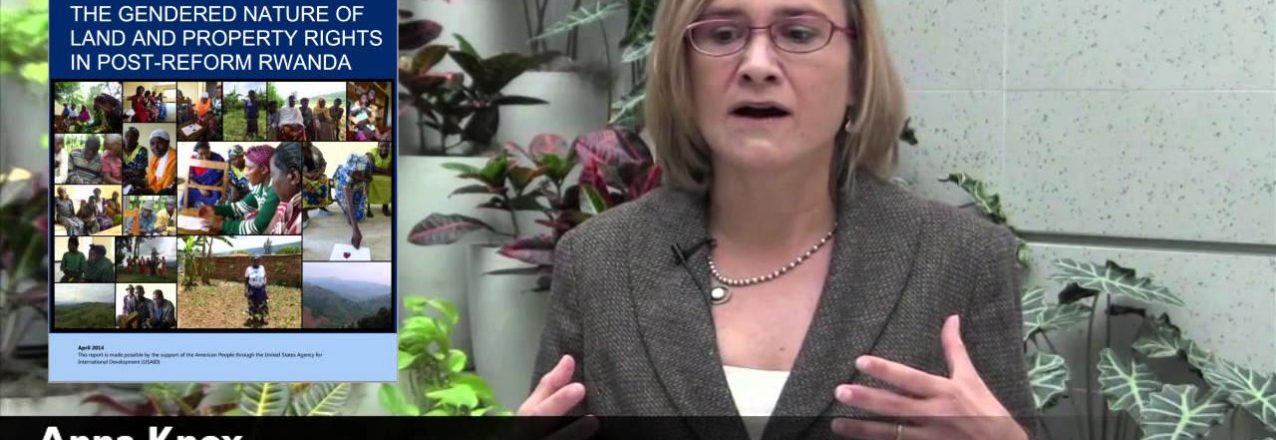
Assessment of Rwanda’s Gendered Land Rights Informs New Approach

Guest commentary by Anna Knox, Chief of Party, USAID’s LAND project in Rwanda.

Earlier this year, USAID’s LAND project in Rwanda carried out field research to assess women’s land rights in practice. Rwanda has a uniquely progressive legal framework that paves the way for gender equality in land rights. Daughters and sons are entitled to inherit equal shares of their parents’ property. Parents’ gifts to children are to be given without regard to sex. A woman married under the community property regime (the default matrimonial property regime) is entitled to administer the family land when her husband dies. During the 2008-2013 land tenure regularization exercise, couples married under civil law were required to register their land jointly. Rwanda’s constitution also prohibits discrimination based on sex.

Qualitative research carried out in 20 administrative sectors of Rwanda sought to understand not only whether people were complying with laws, but the extent to which attitudes and mindsets are imbued with values of gender equality.

Some of the research’s key findings revealed:

  1. There is widespread knowledge of gendered land rights among Rwandans as a result of extensive sensitization efforts. In fact, the study found there to be much greater awareness of the law in rural communities than was suggested by Kigali-based informants who often perceive awareness to be the key constraint to women securing their land rights.
  2. Daughters are increasingly securing land through inheritance and more often in equal shares with their brothers, a major shift since the implementation of the 1999 law governing succession. Likewise, daughters are now claiming umunani from their parents, traditionally a gift given by parents to their sons at the time of the son’s marriage to start their household. Nevertheless, the size and quality of umunani daughters get is typically inferior to what is given to sons, and some women avoid claiming umunani for fear of causing conflict with their brothers or putting extra burden on their parents, especially given the very small land parcels most families in Rwanda have.
  3. Women married in civil unions not only have legal rights to land held with their husbands, but also exercise greater decision-making power over it than in the past. Nevertheless, control rights mainly extend to the ability to prevent men from unilaterally transferring the land since such transfers require the consent of both spouses. Women continue to lack bargaining power in decisions over land use and management; couples may discuss options together, but typically the man decides.
  4. Women who are in “informal” marriages or consensual unions – including women in polygamous unions – have virtually no claims to the property their partners bring into the union. Rwanda’s laws only recognize monogamous civil unions. Women who are in informal arrangements are typically unable to influence the use or sale of land or remain on that property in the case of abandonment, divorce or separation.
  5. While there is increasing application of gender equality norms, many revealed that this was “because it is the law,” not because they have embraced values of gender equality. Women, and especially young women, often faulted people’s “mindsets” for failures to make greater progress in achieving gender justice when it comes to land rights.

Rwanda is unique among many African countries in that: 1) sensitization on women’s land rights has deeply penetrated the rural sector; and 2) law and authority typically have a major influence on people’s behaviors. While leaders and advocates of gender equality can celebrate major strides in compliance with laws aiming to give women rights to land on par with men, actions do not necessarily mirror beliefs, making progress shallow and potentially fragile.

Influencing beliefs can never be as simple as preaching to people what is in the law. Likewise, gender justice cannot be achieved through a singular focus on sensitizing women and girls. Unless men and boys value gender equality, they will continue to use their relatively greater power to undermine genuine equality in control over assets.

Informed by the research findings, the LAND project will depart from traditional approaches to achieving gender equal property rights and will instead support civil society organizations to carry out awareness raising campaigns that primarily target men and boys. The campaigns will seek to reshape notions of masculinity centered on power and dominance by using messages and role models that foster notions of loving partnerships with women, valuing daughters and providing equally for one’s children, and being proud champions of fairness and equal rights among all human beings.

Read the Rwanda LAND project research report and brief.

Highlights from the Kimberley Process Intersessional

By Frank Pichel, Land Tenure and Property Rights Specialist, USAID.

I was pleased to attend the June 2014 intersessional meeting of the Kimberley Process Certification Scheme (KPCS) in Shanghai, China and want to share several noteworthy achievements for USAID’s ongoing efforts to strengthen land tenure and property rights and prevent conflict.

Côte d’Ivoire was welcomed back into an active role in the Kimberley Process (KP) after the United Nations lifted its nine-year-old ban on Ivorian diamond exports in April. Lifting the export ban was largely due to the Government of Côte d’Ivoire’s efforts to improve its legal and regulatory framework to comply with the KPCS. Members of the KP recognized the key role of USAID’s Property Rights and Artisanal Diamond Development (PRADD) project in this major achievement. The PRADD project, which is co-funded in Côte d’Ivoire by the European Union, has worked with the Government of Côte d’Ivoire to strengthen its diamond systems by developing procedures for production and sales tracking, enacting new customs and mining regulations, and registering thousands of miners. The project is a model for increasing legal diamond exports while improving the livelihoods of artisanal diamond mining communities.

Another important development was that the United States Government was granted observer status in the KP Working Group on Artisanal and Alluvial Production (WGAAP), which has emerged as an important mechanism for promoting economic security, formal regulation and sustainable development to increase the number of alluvial rough diamonds entering legitimate chains of custody. In 2012, USAID worked with the WGAAP to develop the Washington Declaration, which formally incorporates development objectives into the KP. Many of the Washington Declaration’s policy recommendations – from strengthening artisanal miners’ property rights to expanding access to mining inputs – are derived from lessons learned under the PRADD program (which also operates in Guinea and previously operated in Liberia and the Central African Republic).

A final noteworthy development was the KP Chair’s endorsement of a regional approach for four West African countries – Côte d’Ivoire, Guinea, Liberia and Sierra Leone – to comply with the KP. The objective of the regional approach is to help participating countries better coordinate to improve internal controls, mitigate smuggling vulnerabilities, and harmonize efforts to prevent the trafficking of conflict diamonds. Read more about how the PRADD project will support this regional approach in Côte d’Ivoire and Guinea.

Read more about the PRADD project in Côte d’Ivoire and Guinea.

Lessons on Decentralized Land Tenure Management and Property Rights Surveys

Guest commentary by Kent Elbow, Independent Land Tenure and Property Rights Specialist.

The second edition of the “Land Tenure Meetings of Bujumbura” (Rencontres Foncières de Bujumbura), sponsored by the Swiss Agency for International Development and Cooperation (SDC), took place in Bujumbura, Burundi June 3-5, 2014. The meetings examined land tenure policies in Burundi, Rwanda and the Democratic Republic of Congo, and were informed by Madagascar’s experience with decentralized land tenure management over the past decade, as well as case studies from Burkina Faso, Senegal and Central African Republic. The June 2014 meetings – building on a first set of meetings in 2011 – targeted two specific issues:

  • Use of parcel-by-parcel inventories as a means to identify and account for diverse types of (especially informal) land property rights; and
  • The challenge of achieving institutional, technical and financial sustainability of recent reforms (heretofore mostly sponsored by international donors) that support decentralized land tenure management.

Management of land tenure is particularly challenging in post-conflict countries like Burundi and Rwanda where intense demographic pressures are further complicated by the demands of returning refugees and internally displaced persons. Most land rights are not written down and exist only in the form of local customs and practices. SDC and other donors have sponsored various approaches and methodologies targeting identification and documentation of land rights based on parcel-by-parcel surveys.

Discussions during the Bujumbura meetings suggest that, at least at a general level, a standardized approach to conducting land rights surveys may be emerging. Among the standardized steps are: a communications campaign to inform rights-holders in the targeted zone; “participatory” parcel-by-parcel visits that include families and neighbors in addition to the presumed parcel “proprietor;” and a period during which declared rights may be challenged by competing claimants. While a primary parcel-level property rights holder often emerges from the surveys, identifying and recording customary access and use rights to land and resources remains a significant challenge. Women and migrants are among the user groups whose access and use rights are not always fully accounted for during the land rights formalization process. The meetings discussed that a possible response would be to accompany parcel-by-parcel land rights surveys with sociological studies that aim to document the full range of customary rights to use land and natural resources.

Another challenge to the survey approach to land and property rights identification is the sustainability of the institutions and tools that support them. For example, SDC and other donors have sponsored establishment in Burundi of decentralized Land Services in a significant number of Communes. Although the line of inquiry is somewhat preliminary at this point, the (partly theoretical and partly empirical) calculations examined during the Bujumbura meetings suggest that financial sustainability, while challenging, may be achievable.

In order to ensure a self-sustaining process for local land tenure management, Burundi’s communes need a critical mass of local participation and buy-in, and it is not yet clear that has been achieved. Among the questions debated in view of filling the possible gap between short-term local buy-in and longer-term sustainability is whether securitization of land tenure (via land certificates in the case of Burundi) should be treated as a public good to be subsidized by the central government, a private good to be purchased by land rights holders, or some combination of the two. While a definitive answer to this and other questions debated during the Bujumbura land tenure meetings remains elusive at this time, recent advances in decentralized land tenure management and conduct of property rights surveys in Burundi, Rwanda, Madagascar and elsewhere continue to appear extremely promising and worth pursuing. No further Bujumbura Land Tenure Meetings have been announced by SDC, but they would be useful in taking another step toward a more nuanced and detailed understanding of land tenure issues and appropriate policy responses currently being tested and expanded throughout Burundi and its closest neighbors.

Further Reading

  • Read more on land tenure in Burundi from USAID

Negotiations on the Principles for Responsible Agricultural Investment

On May 19, the UN Committee on World Food Security (CFS) at the Food and Agriculture Organization of the United Nations (FAO) began multi-stakeholder negotiations intended to finalize the Principles for Responsible Agricultural Investment (RAI)—a set of critical principles that can help guide national regulations, global corporate social responsibility initiatives, and individual contracts covering all types of investment in agriculture. The RAI principles were developed through a broad, inclusive multi-stakeholder process, involving governments, civil society and the private sector.

The United States Government—through a broad inter-agency group, involving the U.S. Agency for International Development (USAID), the U.S. Department of State (DOS), the Millennium Challenge Corporation (MCC), the U.S. Department of Agriculture Foreign Agriculture Service (USDA FAS) and the Office of the United States Trade Representative (USTR)—is committed to making progress toward finalized RAI principles. USAID Land Tenure and Property Rights Division Chief, Dr. Gregory Myers, is leading the U.S. delegation for the negotiations.

The United States Mission to the UN Agencies in Rome welcomed the ongoing negotiations with the following press release:

The United States is pleased to participate in negotiations on the Principles for Responsible Agricultural Investment (RAI) this week as part of the UN Committee on World Food Security (CFS) at the Food and Agriculture Organization of the UN (FAO) in Rome. These multi-stakeholder negotiations are intended to finalize critical principles that can help guide national regulations, global corporate social responsibility initiatives, and individual contracts covering all types of investment in agriculture.

With the world population expected to reach nine billion people by the year 2050, FAO estimates that we will need to increase agricultural production by 60 percent to ensure that everyone is fed. “The task of ensuring enough food for our growing population is too large for governments and public-sector organizations alone,” notes U.S. Ambassador to the UN Agencies in Rome, David Lane. “We must engage the private sector more effectively—including smallholder farmers themselves—to promote much needed private sector investment that will contribute to achieving better food security and nutrition outcomes.”

The United States believes that RAI can provide a clear, practical and predictable guiding framework for investment in agriculture that is pro-growth as well as pro-poor. According to USAID Land Tenure and Property Rights Division Chief, Dr. Gregory Myers, who is leading the U.S. delegation for the RAI negotiations, “An increasing number of private sector firms are taking steps to improve corporate practices related to agricultural investments, especially those involving large-scale land transactions. Yet, many companies still lack a clear understanding of what exactly these practices should entail. For that reason, the U.S. is pleased that the global community has come together to develop clear guidance through a common set of voluntary principles that reflect best practice in responsible agricultural investment.”

CFS negotiations on the RAI Principles began on May 19. The RAI will build on the accomplishments achieved with The Voluntary Guidelines for the Responsible Governance of Tenure of Land, Fisheries, and Forests in the Context of National Food Security, which were unanimously adopted by the CFS two years ago this month through a broad and inclusive consultation process involving civil society, the private sector, and governments, that is the hallmark of the CFS. The RAI Principles promise to be an equally important tool for addressing global food security.