

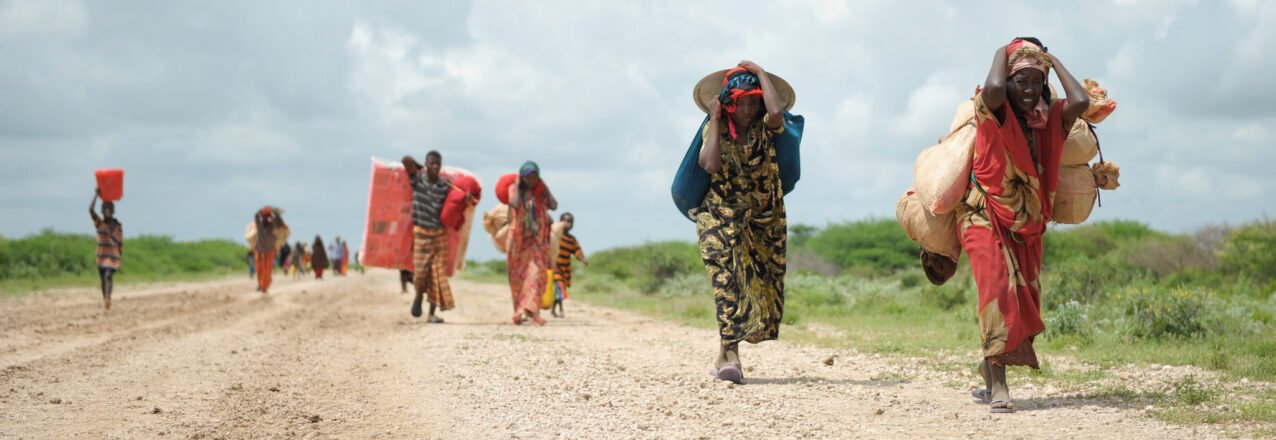
UN Photo/Tobin Jones (CC BY-NC-ND 2.0)
In this panel we discussed the topic of access to land in situations of ongoing or past conflict. A wide range of different situations was brought to light through the various presentations: access to land for IDPs in Somalia, refugees in Uganda, and returnees in Burundi. The topic of tenure security for both (formerly) displaced and ‘host community’ was discussed, as well as how it affects sentiments of home and belonging. It was discussed how, in these different contexts, overlapping or competing land claims were dealt with, and what lessons could be extrapolated from these specific cases to other contexts.
Key Takeaways
- Conflict and displacement lead to complicated situations both in the place of displacement and in the place of return when it comes to access and rights to land.
- Categories of ‘refugee’, ‘host’, ‘native’, ‘IDP’, or ‘returnee’ are always problematic in some sense; in practice, these categories are often blurred or lead to perceived unfair advantages despite similar struggles when it comes to tenure security.
- Suspicion or distrust of institutions can lead to an avoidance of formal pathways to land access and to land tenure security.
- Continued mobility during and post-displacement complicates questions of land rights and problematizes a sedentary perception of ‘home’.
- Land tenure security is an important aspect of, and works in tandem with, people’s ability (despite legal status) to plan for the future.
- Interventions to increase land tenure security through formalization can be successful in different contexts, but also always come with a price that needs to be paid – in these case studies in the form of temporary insecurity, loss of livelihoods, loss of traditional land tenure systems, or uprootedness.
Presentation 1
Land and tenure security in protracted displacement: The case of Bosaso, Somalia
Marta Cavallaro
Land-at-Scale
“Tenure security is not only about access to land or shelter, but also about the right to remain, to be seen, and to plan for the future.”
In this presentation, local meanings of displacement were explored through a case study of land tenure security interventions in Bosaso, Somalia. Bosaso is shaped by a long history of protracted displacement. Here, IDPs arrive and oftentimes settle informally after negotiating an oral agreement with local land owners. This makes them vulnerable to eviction. In order to increase tenure security for IDPs, two interventions have been executed. The first intervention involved relocation of IDPs from Bosaso town to a resettlement site, where they were offered free land including title deeds. This intervention led to an increased sense of tenure security and fewer evictions, but was also emotionally harsh due to the IDPs being uprooted, and led to a loss of livelihoods and access to services. The second intervention involved in-situ protection through agreements between local authorities and landowners. As a result, evictions decreased but fear surrounding it still persisted. Additionally, access to livelihoods and services could remain. Finally, the presenter showed that official definitions of internal displacement do not fully resonate with the perceptions of IDPs themselves. The latter group emphasized the importance of being seen by decisionmakers and having the possibility to secure a right to fully settle in one place. Displacement was also associated with the spatial condition of living in an IDP camp, subject to specific dire conditions, from the threat of removal to protection and hygiene challenges. It was thus wondered whether land provision alone constitutes a durable and comprehensive solution to addressing displacement.
Presentation 2
People at risk of losing access to land during systematic land tenure registration in Burundi: Returnee-resident land conflicts
Alexandra Emerusenge-‘t Lam
ZOA
“Who has more right to access to land, those who remained during the conflict or those who have returned?”
This presentation looked at an intervention by ZOA aimed at land registration in Nyanza Lac in Burundi. Here, there are competing land claims between Burundians who remained in the region during the country’s several violent crises and those who fled but are now returning. It was shown that it is extremely difficult to assess to validity of the various and competing land claims due to multiple layers of displacement, changing political regimes and mandates, and a lack of witnesses still present. Another complicating factor is that there is a lot of distrust both between citizens and between the citizens and the government. As such, it was found that when the land registration intervention started, a lot of ‘sleeping conflicts’ tended to come up again. Despite this initially reported decreased sense of tenure security, it was found that in the longer term people’s sense of tenure security did improve. Together with a reported reduction in land conflict over the past 2 years and the relatively large numbers of land owners withdrawing their land certificates, this indicates the positive contribution of the intervention strategies.
Presentation 3
Improvement of land tenure security for refugees and host communities in Terego district, West Nile, Uganda
Sam Madira, Resty Namuli
ZOA
“The small money refugees get from producing crops on land hired from the host community can help to improve their self-reliance.”
In this presentation there was a focus on an intervention by ZOA, in collaboration with GIZ, to promote formal tenancy agreements between refugees and host community members in the West Nile region of Uganda. This intervention was born out of the observation that there was a need for refugees to rent land from the host community in order to increase self-reliance. Formalizing these arrangements was geared towards increasing transparency for all parties and to enhance peace and livelihood security. It was noted that in this specific context, where the refugee settlement is placed on customary land that is largely undocumented, there was some resistance by the host population to enter into formal agreements. It was found that tenure security for the host community also increased their willingness to rent land to refugees. Overall, clarity on the mechanisms surrounding the renting of land helped to address conflicts between hosts and refugees, and the large majority of those who had signed a tenancy agreement noted improved land tenure security.
Presentation 4
Accessing land in displacement: Practices of love and care, interpersonal helping, and access to land in Kiryandongo settlement, Uganda
Juul Kwaks
Radboud University, Nijmegen
“Practices of love and care exist simultaneously with violence and structural violence, and they require our attention in order to more fully understand the life worlds of refugees.”
This presentation looked at how refugees navigate access to land in and around Kiryandongo refugee settlement in Uganda. This investigation built on the observation that despite being given access to a plot of land upon arrival in the settlement, many refugees did not reside there. This was due to their search for better access to services and facilities, a desire to be closer to family and friends, or as a consequence of land conflict within the settlement. In their quest for access to other land, it was not the governance structures in the settlement that helped refugees, but rather social relationships. Through relational aid and practices of love and care between refugees and between refugees and members of the host community, free access to land was provided or information regarding opportunities was shared. Underpinning this was a narrative of solidarity, where both refugees and members of the host community argued that they recognized themselves in the other, felt connected, and had a shared faith and responsibility. It was argued that shifting the gaze to practice of love and care – also in a situation of (structural) violence that is displacement – opens our eyes to land accessing practices that might remain unseen with a traditional humanitarian gaze.
Program: LAND-at-scale.
Related projects: LAND-at-scale Burundi: Amahoro at Scale, LAND-at-scale Knowledge management: LANDac contribution, LAND-at-scale Knowledge management: International Land Coalition contribution, LAND-at-scale Knowledge management: KIT support to country partners, LAND-at-scale Knowledge management: Land Portal strategy support.
Originally published on the Land Portal. Creative Commons Attribution 4.0 International.