

A woman can take part in a land registration program, have her land surveyed, and have a title issued in her name, yet still have no document she can use to defend her rights. Sometimes she cannot afford the final fee. Sometimes the document remains in a government office. Sometimes she receives it and still faces a relative who refuses to recognize that the land belongs to her.
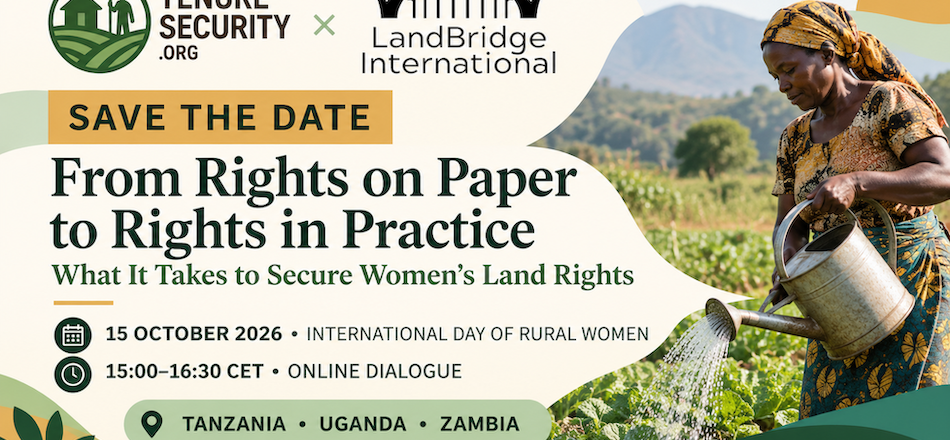
These were concrete situations described during From Rights on Paper to Rights in Practice: What It Takes to Secure Women’s Land Rights, the webinar TenureSecurity.org convened with LandBridge International on October 15, the International Day of Rural Women.
I chose women’s land rights as the subject of TenureSecurity.org’s first webinar because this is an issue I care deeply about and have prioritized in my work for many years. I wanted us to examine what happens between recognizing a right and being able to rely on it. The experiences shared from Tanzania, Uganda, and Zambia showed how much can depend on steps that land programs leave unfinished.
My strongest conclusion is that we need to take responsibility for the whole process women encounter. Targeted assistance can make an immediate difference when a fee or an administrative requirement is preventing someone from obtaining her document. The same work also exposes weaknesses that governments and development partners need to address. A woman should be able to complete registration, understand what has been registered, and find effective help when her rights are challenged.
Why LandBridge focuses on the final steps
Rania Ahmed, one of LandBridge’s three co-founders, began with her own family. Her grandmother had bought property for her daughters in Sudan, but the ownership had not been registered in their names. Watching the emotional strain of completing that process helped her understand the consequences of a gap that can look administrative from a distance.
Later, discussing land titling in Zambia with fellow co-founder Ailey Kaiser Hughes, she encountered a similar problem: women had participated in registration but had not received their titles.
“How many other women have a recognized claim to land and have even begun the documentation process, but couldn’t complete the final steps needed to secure legal ownership?” Ahmed asked.
LandBridge’s response is to work through local partners to identify women facing those obstacles and provide targeted support. As Kaiser Hughes explained, the organization enters where a legal pathway already exists and governments, communities, and other organizations have done much of the groundwork. Its assistance builds on that investment.
That focus has practical value. I have seen land programs reach the end of their funding with crucial work still incomplete. The survey or registration exercise may have advanced, while the person whose rights it was supposed to strengthen is still waiting.
But Kaiser Hughes also cautioned against assuming that the remaining problem is always money: “A fee is rarely the entire story.”
She illustrated this through earlier work she supported in Liberia, where obtaining an official identity document cost about US$5 and required travel to a government office. Without identification, people could not enter the land titling process. Bringing identification services into the community helped more people participate.
The lesson I draw is that support needs to follow the actual obstacle. A grant for a registration fee will accomplish little if the woman also needs identification, transport, information, or someone to help navigate an office that repeatedly sends her away. Local partners matter because they can identify those differences.
Tanzania and Zambia show what an unaffordable fee can do
Mustapha Issa, CEO of Tanzania Land Tenure Assistance, described work to help women obtain Certificates of Customary Right of Occupancy, or CCROs. In the communities where his organization works, he reported substantial progress in women’s awareness of their land rights and interest in documentation. The continuing difficulty was paying for it.
Issa described a cost-recovery approach intended to sustain registration services, with charges rising from about US$10 toward US$20 per certificate. For women with very limited income, especially older women and widows, that remained a serious barrier.
“We only issue the certificate to those who can manage to pay,” he said.
That sentence deserves attention. A fee can be modest in relation to the technical cost of registration and still determine who receives the benefit of the investment. If a woman cannot pay, her willingness to participate and the work already completed do not get her across the final step.
In Zambia, Kamiji Malasha, LandBridge’s gender specialist, described a similar interruption in the government’s land titling process. Households move through information sessions, enumeration, verification, and an offer letter setting out the payment needed for a certificate of title. Women can complete the earlier stages and become stuck when payment falls due.
Malasha put the initial payment at approximately 1,000 kwacha, or US$50, with a total cost of about US$150 in the cases she described. These were her estimates during the webinar, rather than a uniform fee schedule for every applicant. Her central point was the pressure such costs place on households already struggling to cover daily needs.
I find it difficult to regard the resulting failure to complete registration as a lack of commitment. A woman choosing food or school expenses over a title fee is making a decision under severe constraints. The design of the service needs to account for that reality.
Issa proposed a targeted fund for women unable to afford documentation, with support progressively incorporated into local government financing. That is a useful direction: immediate assistance can address exclusion now while helping establish a more durable way to finance access.
Uganda shows why paying the fee may still leave women waiting
Christine Kajumba, Research Manager at Associates Research Trust Uganda, described a different obstacle in Oyam District. Freehold titles had already been produced through a government program, but women still needed to complete payments and an administrative process to remove the fee-related caveat recorded against their titles.
The sums involved were approximately US$28–30, she reported. Yet even when her organization paid, the documents could remain unavailable for months.
“For six months, the titles were not coming out,” Kajumba said of one batch.
Her account made the administrative burden tangible. Women could face journeys between district and regional offices, including a trip of around 70 kilometers to Lira after collecting a title from the district office. Some traveled farther from their own villages. Repeated visits competed with farming, care responsibilities, and other demands on their time.
Digitization had not removed those difficulties. Kajumba described delays involving electricity, internet access, and a broken scanner. A digital process still depends on an office being equipped and able to complete the work.
For me, this was one of the webinar’s clearest lessons about institutional capacity. We need to assess improvements through the experience of the person using the service. How many visits are required? How much does transport cost? Can she find out what is happening? Does paying actually lead to receiving her document?
A system that transfers these costs and uncertainties to women is making access depend on much more than the official fee. Targeted assistance can help them navigate that system, but resolving persistent delays remains a public responsibility.
What changes when women receive their documents
The discussion also offered encouraging accounts of what documentation can make possible.
Lungowe Chintu, a women’s land and resource rights advocate working in Zambia, urged us to examine the changes in women’s lives: “We really have to look at what actually shifts in a woman’s everyday life once she holds that title.”
She reported that seven of nine women surveyed were generating steady rental income. She described women expanding rental accommodation, improving their homes, and reinvesting income in businesses and savings activities. One woman, Miriam, had added a rental unit and improved her home. Chintu also described women expressing greater confidence that they could answer someone who challenged their ownership, and plans among women surveyed to pass land to their daughters.
These accounts matter. They suggest how greater confidence in a property claim can connect with investment, household security, and expectations about inheritance.
They also need to be understood at their scale. A follow-up involving nine women provides valuable experience to investigate further; it cannot establish the average effect of titling or demonstrate that documentation alone caused the changes reported. I would like to see these experiences followed over time, including women whose circumstances improve less, whose rights are challenged, or who encounter new difficulties.
Kajumba was similarly careful about Uganda. She reported that 340 titles had been delivered through the work she described, while emphasizing that it was too early to make claims about changes in income or longer-term impact.
What she could describe was women’s relief at having evidence of their rights, including women with ongoing disputes. Her organization had also begun spending time at distribution meetings explaining what a title means, how transactions must be handled, and how the document can support a claim.
Some women were beginning to assert greater authority over decisions about their land. Kajumba called this an emerging “veto voice.” That is an observation worth following closely: whether a woman can refuse a proposed use or transfer of her land tells us something important about her ability to exercise her rights.
Issa also reported changes in women’s participation in decisions in Tanzania, while warning that family relationships, social norms, and control over money continue to influence whose voice counts. Documentation can strengthen a woman’s position within those relationships. Its effect still depends on how others respond and what support she can access.
A title needs institutions willing to uphold it
Kajumba’s account of a woman called Maureen brought this difficulty into sharp focus. Land had been registered in Maureen’s and her mother’s names, but her mother died before the title arrived. An uncle then allocated the land to his son. Maureen feared confronting him.
The document provided evidence. It did not remove the fear or resolve the dispute.
This is where the question of women’s land rights becomes inseparable from power. A woman may know her rights and possess documentation while facing someone able to intimidate her, ignore her claim, or make seeking help costly and unsafe.
Kajumba called for sustained engagement with men and cultural leaders so that they understand and respect women’s documented rights. Chintu described work with traditional leaders in Zambia, using discussions about what happens to widowed daughters to challenge practices that leave women without land. Some traditional leaders were becoming advocates for women’s land rights themselves.
The audience discussion raised the relationship between women’s rights and customary governance. The country experiences showed why we need to understand the institutions and relationships involved rather than treat customary systems as uniform. The documents under discussion also differed: CCROs in Tanzania and certificates of title in the Uganda and Zambia interventions.
My conclusion is that community engagement and accessible remedies need to reinforce each other. Dialogue can help change expectations and practices. Women also need somewhere effective to turn when dialogue fails or when someone refuses to respect their rights. Their security cannot depend indefinitely on maintaining a relative’s goodwill.
Measure completion and follow what happens afterward
Amanda Richardson, LandBridge co-founder and founder of Resource Equity, offered a useful starting point for assessing results.
“Our first responsibility is to measure completion, not just participation,” she said.
She recalled evaluating an earlier project in India that reported substantial numbers of women’s land registrations. On visiting, she found that many documents remained in government offices and women did not know they were waiting there.
Counting participation would have missed that failure. So would counting documents produced without checking whether women received them.
Richardson identified immediate questions that programs can answer: Was the correct document issued? Are its details accurate? Does the woman understand it? Does she know where to seek help?
She also drew a distinction that should guide the longer-term assessment: “Documenting a woman’s right is not the same as her being able to exercise that right fully.”
Those further questions require follow-up. Does she retain control of the land? Can she defend her rights in a dispute? What changes in household decisions? Does she feel secure? Are there livelihood benefits?
I was glad that the discussion left room for security and peace of mind as meaningful outcomes. Being able to remain in one’s home or pass land to one’s children matters in its own right. Access to credit may be useful for some women, but borrowing should remain a choice, with its risks understood. It is a poor universal test of whether a land right has become more secure.
Audience questions about mapping added another consideration. Knowing how many documents bear women’s names can help identify gaps and track progress. Understanding whether those women can use and defend their rights requires evidence beyond the registry.
What I would like practitioners and funders to do differently
The discussion strengthened my view that land programs should plan and budget for completion from the outset. That includes getting accurate documents into women’s hands, helping them understand those documents, and ensuring that the institutions responsible for the remaining steps can carry them out.
Malasha expressed a practical principle for making services accessible: “Services must come to the women, other than requiring the women to come to the system.”
She proposed mobile titling clinics, community outreach, and trusted local women trained to explain procedures. These approaches respond directly to the distance, time, and information barriers described across the discussion.
Local organizations also need resources for the work that continues afterward: following up with offices, explaining documents, identifying disputes, and helping women reach appropriate support. During the discussion on scaling, Kaiser Hughes identified funding as LandBridge’s immediate constraint. The country accounts showed why financing needs to recognize the time and knowledge involved in making assistance work.
I would also like governments and development partners to treat repeated obstacles as evidence for improving the service itself. If women consistently need outside help to pay the same fee, make the same journey, or obtain the same response from an office, that experience should inform budgets and administrative reform.
LandBridge and its partners are addressing a concrete gap that can otherwise leave years of work unfinished. The webinar showed the value of that contribution while making clear how much remains after a document is delivered.
For me, the next question is whether a woman can rely on the right that document records. Can she make decisions about her land, remain on it when challenged, and determine its future? Following those questions over time is how we will understand whether the work is delivering the security women are entitled to expect.
This article reflects the discussion at the October 15, 2026 webinar convened by TenureSecurity.org and LandBridge International. Country figures and examples are attributed to the speakers who presented them.