

By Shipra Deo, My-Lan Dodd, and Jennifer Brown
We thrive because farmers provide! Farmers nurture the land with love and trust so we can all get our meals.
Of the 1.23 billion people employed in the world’s agri food systems, nearly half are women. While these women work on the soil all their life, they remain invisible and unheard as farmers. And their journey in agriculture is very different from that of men.
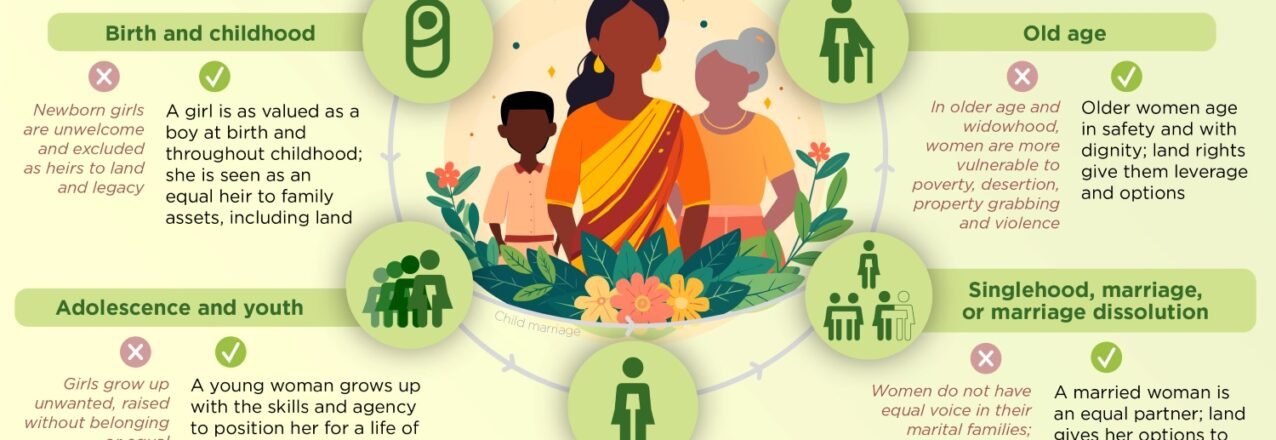
For a woman farmer to truly thrive, her relationship with land must be seen across her life – not only during the times she cultivates. From birth through her adolescence and into adulthood and her twilight years, land can be a cornerstone for agency, opportunity, and dignity. A lifecycle approach to women’s land rights ensures that the protections they confer do not appear only at moments of crisis – such as at death or divorce — but accompany women throughout their lives.
But social perceptions, family dynamics, and cultural practices too often place her on a different path, limiting what should rightfully be hers.
A girl born into a farming family
She may have been unwanted in her family, as farming communities in many parts of the world usually prefer a newborn to be a boy rather than a girl. Born unwanted, she grows up amid neglect and indifference.
She helps her mother and the family sow seeds, fetch water, tend goats, or harvest produce. She also takes care of younger siblings as her mother works the farm. Her labor is essential for the household, as is her mother’s, but is rarely recognized as “real farming.”
While she grows up hearing that she will marry and move out of the birth family one day, her brother may grow up hearing that the land on which the family lives and farms will belong to him, not to his sister.
This early message shapes everything that follows. She internalises that she is of lesser value than the men.
A landless worker in adolescence and adulthood
As she enters adolescence, instead of looking forward to managing the family’s land and dreaming big, she prepares to leave her family’s land and house, anxious about what lies ahead. Without the security of assets to build her life on, her future choices narrow. Her education may stop early, and she may be married before she reaches the legal age of marriage, often without her consent or choice.
In her husband’s family, she continues to do labor on the farm, but her work is seen as the extension of household work. The land and farm she sustains still does not belong to her. She is not seen as a farmer and is largely absent from farmer census data or land statistics.
The pattern is the same across regions and cultures: girls and women contribute significantly to agriculture but remain invisible as farmers.
Because of her invisibility as a farmer, she is rarely the subject of or considered in agricultural policies or farm laws. Research in agriculture is not attuned to her needs or contexts. Men’s needs and realities aren’t merely prioritized, they are the default.
Without ownership or secure rights, she faces constant and compounding constraints. She cannot easily access credit, subsidies or insurance, which are all linked to land ownership. She is overlooked for training and extension services. She is unable to make sustainable investments in agriculture – either to control soil erosion or to increase water use efficiency.
She farms every day, but decisions about land and livelihoods are made by others — husbands, fathers, sons or community leaders. She has no security.
She is more vulnerable to violence in the fields and on the way to fields and markets – by landowners or farm managers and in public places. She is also more vulnerable to abuse in her own family – by intimate partners, in-laws, or extended family.
Meanwhile, men are much more likely to have agency over their land and livelihoods, and can move freely through the world.
When marriage, divorce, or widowhood hits
If her marriage ends — through divorce, separation, or abandonment — she may lose access to the very fields she cultivated for years. If widowed, she may face eviction by in-laws or relatives claiming the land or home. In either case, she may struggle to feed her children and to sustain herself.
When she doesn’t have land, old age brings dependence and insecurity. Without assets, she is at the mercy of others for her livelihood and care.
A different future is possible
Now imagine a different story.
A girl in a farming family grows up knowing she will inherit land equally with her brother. She learns farming not just as labor, but as a skill and business, and this knowledge makes her confident in taking decisions.
As an adult, she holds land in her own name, accesses credit, joins cooperatives, and invests confidently in her soil and the opportunities that spring from it.
She takes informed decisions about marriage. She negotiates her space with dignity and confidence.
She doesn’t endure abusive relationships because she has meaningful options. She stands up for herself throughout her adulthood and in old age, her land sustaining her with dignity.
When women have this kind of security and assurance, communities around the world are positioned to fully thrive.
As we mark the International Year of the Women Farmer, it is important to recognise that land rights are the cornerstone of a more stable and peaceful future for women farmers. They are rights and protections that give women a firm, legally recognized foundation that accompanies them throughout their life, allowing them to live a life with strength and dignity. By adopting a lifecycle approach to land rights, we keep this important reality firmly in sight and help millions more women and their families thrive.