

Reflections from the LANDac 2026 session, “Shadows of Green: The Global Green Transition as a Space of Conflict and Community Claims”
The green transition is often described in terms of technology: solar capacity, wind corridors, battery minerals, carbon credits, protected areas, and restoration targets. But every one of these ambitions has a geography. It requires land, water, forests, minerals, access routes, and authority over who gets to decide how a place will be used.
That is why the transition is not only an environmental or economic project. It is a territorial and political one.
At the LANDac Annual Conference in Utrecht on July 2, the session Shadows of Green brought this reality into sharp focus. Convened by the International Land Coalition (ILC), the discussion connected case studies from Suriname, Kosovo, and Nepal with wider research on how climate, energy, and conservation initiatives can alter land access, control, and use. The session sat squarely within LANDac’s broader 2026 focus on the relationships among land, conflict, justice, and peace.
The central message was not that renewable energy, biodiversity conservation, carbon finance, or restoration are inherently harmful. They are necessary parts of responding to climate disruption and ecological decline. The real question is whether these interventions deepen rights, agency, and accountability, or whether they reproduce old patterns of dispossession under a new green vocabulary.
A low-carbon project that removes people from their land without meaningful consent, excludes them from benefits, or criminalizes customary livelihoods may reduce emissions on paper. It cannot credibly be called a just transition.
The conflict begins when projects overwrite territories
Danique de Ronde’s opening framing drew on two ILC research series: Shadows of Green, examining land-related conflicts linked to green initiatives, and Wisdom of the Land, exploring how communities use evidence, customary knowledge, and geospatial data to defend land claims and sustain ecosystems. Together, the research covered 32 case studies in 26 countries.
The Shadows of Green research identifies six recurring pathways through which environmental initiatives can generate conflict: dispossession under climate agendas; exclusionary conservation; commodification of land and nature; unequal benefit sharing; technocratic governance and loss of commons; and the political instrumentalization of green narratives.
This typology matters because it moves the debate beyond the misleading suggestion that conflict is simply a failure of communication. Often, the disagreement is not about whether a community “understands” a project. It is about who has power to define the project, whose knowledge is accepted, who bears the risk, and who captures the value.
The session captured this tension as a clash between two narratives. In one, nature is translated into quantifiable assets: carbon stocks, lithium reserves, protected hectares, or biodiversity units. Land becomes a neutral surface awaiting more efficient management. In the other, territory is understood as a living social-ecological system: a place of livelihood, memory, identity, customary authority, care, and intergenerational responsibility.
The problem is not measurement itself. Data can illuminate harm, support public accountability, and strengthen community claims. The problem arises when quantification displaces politics, when a carbon map becomes more authoritative than the people who have governed a forest for generations.
That is the shadow cast by too many green interventions: they treat rights holders as an obstacle to be managed rather than as decision-makers with legitimate authority.
Evidence can be a shield, but only when communities control it
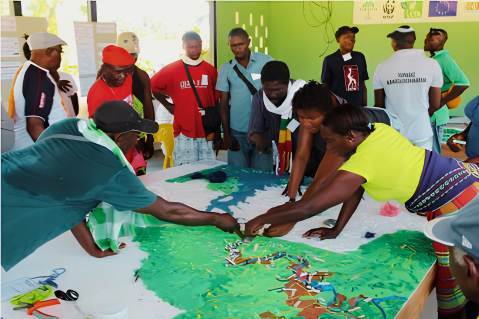
Sara Ramirez’s presentation from Suriname offered a powerful alternative. Her work on participatory mapping showed that spatial data need not be extracted from communities for external planning purposes. It can be co-produced with communities, governed by them, and used to strengthen their own priorities.
The examples ranged from Indigenous participation in conservation planning in southern Suriname to mapping marine conflicts for spatial planning. The most striking case concerned the Saamaka people, whose territory faces longstanding pressure from logging, mining, roads, and other external activity. Participatory mapping and monitoring helped make visible not only how the territory is used, but also how concessions and infrastructure intersect with places of cultural, ecological, and livelihood importance.
This work has particular legal resonance. In 2007, the Inter-American Court of Human Rights held that Suriname must recognize and protect the collective property rights of the Saramaka people, delimit and title their territory, and ensure effective consultation or, where required, free, prior, and informed consent for development or investment projects affecting that territory. The judgment also addressed benefit sharing and safeguards against harm.
The distinction is important. Communities do not need data merely to become legible to government, investors, or courts. They need evidence that strengthens their own ability to negotiate, mobilize, monitor, and decide.
This is why data governance must be part of tenure security. Who collects the data? Who interprets it? Who stores it? Who can disclose it? Who is protected when the data reveal illegal activity, overlapping claims, or powerful commercial interests?
Maps can strengthen land rights. They can also make territory more visible to those seeking to control it. The difference lies in whether communities retain agency over the knowledge they share and whether legal and political systems are prepared to act on what that knowledge reveals.
The ILC’s Wisdom of the Land report makes a similar point across multiple country cases: traditional ecological knowledge, community governance, and geospatial evidence are most powerful when they reinforce each other rather than compete for legitimacy.
The energy transition has a past as well as a future
Odeta Naks’ case study from Kosovo brought attention to what might be called the “tail” of the energy transition. Public debate often focuses on the infrastructure of the future: renewable energy installations, transmission networks, critical minerals, and new industrial corridors. Far less attention is paid to the land insecurity left by fossil-fuel development and conflict.
The Kosovo case highlighted the interaction between post-conflict land insecurity, incomplete cadastral records, ethnic-minority claims, and former coal-mining areas.
This is a crucial reminder. The green transition does not arrive on a blank slate. It lands on territories shaped by war, displacement, extractive economies, weak records, unresolved restitution, and unequal citizenship.
A country may close mines or shift its energy mix while communities continue to live with the consequences of past extraction. If land governance is treated as an administrative afterthought, the transition can leave old injustices intact while introducing new ones.
The test of a just energy transition should therefore not be limited to megawatts installed or emissions avoided. It should also ask: Have historic land claims been addressed? Are affected groups able to participate in decisions? Are women, ethnic minorities, and displaced people recognized as rights holders? Does the transition reduce insecurity, or simply redirect it?
Conservation should not mean power without accountability
Aparajita Gautam’s case study from Nepal addressed another uncomfortable reality: conservation can produce social, economic, administrative, and physical forms of violence when it expands without accountable governance.
Her presentation documented intimidation and power struggles in the buffer zones of two national parks, showing how conservation can restrict or reshape local access to land, forests, and livelihoods.
This does not mean conservation and community land rights are incompatible. Quite the opposite. Conservation that sidelines communities often undermines the legitimacy and practical effectiveness it needs to endure.
Mike Taylor’s reflection following the session made this point well: conservation need not be in conflict with Indigenous Peoples’ and local communities’ struggles for land rights. Securing rights to land and natural resources can be a foundation for effective biodiversity conservation and stewardship, rather than a concession made after the fact. This is also reflected in work by Anthropos Africa with Indigenous communities and institutions in southern Africa to expand and restore rights, land, and livelihoods.
International commitments already point in this direction. Target 22 of the Kunming-Montreal Global Biodiversity Framework calls for the full, equitable, and inclusive participation of Indigenous Peoples and local communities in biodiversity-related decision-making, including access to justice and information.
The issue is implementation. Participation cannot mean being invited into a meeting after boundaries have been drawn, contracts signed, or conservation rules imposed. It must mean real influence over whether an intervention proceeds, where it is located, how it is governed, and how benefits and burdens are shared.
From compelling cases to lasting institutional change
Gemma Betsema of RVO’s LAND-at-scale program brought an essential programmatic perspective to the discussion. Her reflections underscored that evidence of conflict is most valuable when it does more than document harm: it must inform longer-term engagement, adaptive programming, and changes in the institutions that shape land governance. She noted the importance of moving beyond isolated projects toward structural change, while connecting knowledge generated at community level with the policy, financing, and institutional decisions made at national and international levels. This is a demanding task for funders. It requires patience, political awareness, and a willingness to support learning over time rather than expecting short project cycles to resolve entrenched land conflicts.
Communities facing pressure from conservation, extractive industries, carbon markets, or energy infrastructure are rarely confronting a one-off event. They are navigating overlapping histories of exclusion, unequal power, and weak legal protection. A just transition therefore needs more than good safeguards at project approval. It needs sustained support for local institutions, community evidence, legal capacity, and the slower work of changing the rules that determine whose land claims count.
From safeguards to a “do not dispossess” standard
The discussion in Utrecht also raised a harder question for funders, governments, NGOs, investors, and technical agencies: are current safeguards sufficient?
Too often, land rights enter green projects as a compliance requirement near the end of the design process. A social assessment is commissioned. A consultation is held. A grievance mechanism is created. These may be necessary, but they are not enough when the core decision about territorial control has already been made elsewhere.
A genuinely just transition needs a stronger standard: do not dispossess in the name of climate or biodiversity action.
That standard would have practical consequences.
First, tenure and conflict analysis must come before site selection, financing, and project approval. Environmental and social impact assessments should examine collective, customary, seasonal, overlapping, and women’s land and resource rights, not only formal title.
Second, consultation must give way to meaningful decision-making power. For Indigenous Peoples, free, prior, and informed consent is not a public-relations exercise. It is rooted in the right to determine development priorities and strategies affecting their lands and resources.
Third, community legal support, mapping capacity, and local monitoring should be treated as core transition infrastructure. Philanthropic and public funders increasingly recognize the importance of land rights, but that recognition must be reflected in long-term support for local institutions, not only short project cycles.
Fourth, benefit sharing must be transparent, enforceable, and designed with communities rather than announced to them. The monetization of carbon, biodiversity, and other common-pool resources may create opportunities for communities, but only where rights are secure, governance is fair, and communities have the power to refuse harmful arrangements.
Finally, every green investment needs a gender-transformative lens. Conflict and dispossession are not experienced equally. Women’s rights, inheritance, access to commons, participation in local institutions, and control over benefits must be considered from the beginning. Otherwise, a project may reproduce inequalities within communities even while presenting itself as inclusive.
The Voluntary Guidelines on the Responsible Governance of Tenure provide a useful reference point: states should recognize and protect legitimate tenure rights, including those of Indigenous Peoples and communities with customary tenure systems.
There can be no lasting peace without land justice
The most important contribution of Shadows of Green was to place land justice at the center of environmental action.
Climate and biodiversity policies are often discussed as urgent technical imperatives. They are urgent. But urgency is not a license to bypass rights, compress deliberation, or make territorial decisions on behalf of people who will live with their consequences.
Conflict is sometimes described as an unfortunate side effect of transition. It is more accurate to see it as a warning signal. It can expose inequalities in land access, legal recognition, gender, ethnicity, citizenship, and political representation that have been ignored for too long.
The task is not to eliminate conflict by silencing claims. It is to build institutions capable of hearing them, responding fairly, and changing course when a project threatens to deepen injustice.
The green transition will only be durable if it is more than a transition in energy sources or conservation finance. It must be a transition in power: from projects to territories, from extraction to stewardship, from consultation to shared authority, and from invisible claims to secure and enforceable rights.
There can be no peaceful transition without land justice. And there can be no credible climate or biodiversity strategy that treats the people who protect land, forests, water, and rangelands as expendable.