

This interview with Olivia Namukwaya, Programs Coordinator of Girls Outloud Luweero–Uganda is part the Women’s Land Rights Champions series, which profiles people around the world who are working to advance women’s land rights.
Tell us about yourself
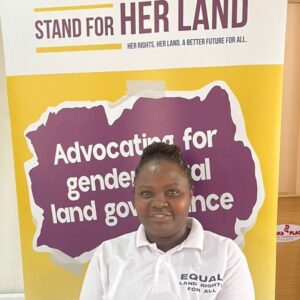
I am Olivia Namukwaya, Programs Coordinator of Girls Outloud Luweero–Uganda, a community-based organization located in Lumu Zone, Luweero Town Council, Luweero District. Our organization works to empower women, girls, youth, and persons with disabilities through advocacy, health education, skills development, information sharing, and community-based support.
I am a Ugandan community leader from Kasoma Zone, Luweero West Ward. I have more than 15 years of experience as a community volunteer and advocate, supporting youth, women, girls, and persons with disabilities in Luweero District. My work focuses on gender equality, community empowerment, sexual and reproductive health rights, menstrual health, disability inclusion, and protection from violence and discrimination.
I am a strong communicator and committed grassroots organizer. In 2024/2025, I participated as a fellow in the Global Multifaith Fellowship, which strengthened my leadership, advocacy, and interfaith engagement in service of vulnerable communities.
Could you briefly introduce Girls Outloud Luweero – Uganda? What inspired the creation of the organization?
Girls Outloud Luweero–Uganda is a community-based organization located in the Lumu area of Luweero District. We envision an empowered community where girls, women, youth, and persons with disabilities live in dignity, harmony, and safety.
Our mission is to build the capacity of girls, women, and persons with disabilities so they can improve their standards of living and participate fully in community development. We do this through skills building, health education, information sharing, advocacy, and support for income-generating activities.
The organization was created in response to the everyday challenges faced by vulnerable groups in our communities, especially girls and women who lack access to information, services, protection, and economic opportunities. We saw that many people were being left behind, not because they lacked potential, but because they lacked support, confidence, resources, and platforms where their voices could be heard.
What are the main challenges facing girls, women, youth, and people with disabilities in Luweero District today?
The challenges facing girls, women, youth, and persons with disabilities in Luweero District are deeply connected. Poverty, unequal access to land and education, gender-based violence, limited health information, and exclusion from decision-making all reinforce one another.
For girls, some of the most urgent challenges are child abuse, neglect, early marriage, teenage pregnancy, and school dropout. Many girls leave school because their families cannot afford scholastic materials, because they lack menstrual hygiene products, or because pregnancy and early marriage interrupt their education. In some households, poverty, alcoholism, and family breakdown also increase the risk of neglect, child labor, and exploitation. These problems are not only individual hardships. They affect girls’ long-term confidence, health, education, and ability to participate in community life.
Women face many of the same pressures, but land rights and economic dependence are especially serious. In Luweero, many women contribute greatly to agricultural production, yet they often do not own or control the land they cultivate. Widows and divorced women may be pushed off family land, and customary inheritance practices often favor men. Many women also have limited knowledge of land laws, land registration processes, and available dispute-resolution mechanisms. When women lack secure rights to land and property, they become more vulnerable to poverty, domestic violence, family conflict, and economic insecurity.
Youth are also facing high levels of unemployment and underemployment. Many young people lack vocational skills, startup capital, and access to productive land or decent work. Rural youth often have few opportunities outside subsistence agriculture or informal low-paying work. This creates frustration and can contribute to migration, school dropout, substance abuse, crime, and other risky survival strategies. Young people also remain underrepresented in local governance and development planning, even though decisions being made today will shape their future.
Persons with disabilities face exclusion across nearly every area of life. Negative attitudes and stigma still prevent many people with disabilities from participating fully in community activities, leadership, education, employment, and family decision-making. Schools often lack disability-friendly facilities, learning materials, and trained teachers. Health services are not always physically accessible or responsive to their needs, including sexual and reproductive health needs. Women and girls with disabilities face multiple forms of discrimination because of gender, poverty, and disability. They may also be excluded from inheritance, land ownership, and decisions about family property.
Your mission focuses on building capacity through skills, education, health information, advocacy, and income-generating activities. What does this look like in practice?
In practice, our work starts with meeting people where they are. We are currently implementing a project focused on sexual and reproductive health and rights, menstrual health management, hygiene, and disease prevention in rural primary schools in Luweero District.
Through this project, we provide accurate information about menstruation, hygiene, puberty, and body changes. We work with girls, teachers, parents, and school communities so that menstrual health is no longer treated as shameful or hidden. We also distribute reusable sanitary pads and educational brochures so that girls have both practical support and reliable information.
Our advocacy work happens alongside this community education. Whenever we meet girls, parents, teachers, local leaders, and community members, we raise awareness about rights and protection issues, including child abuse, gender-based violence, early marriage, discrimination, unequal access to education and health care, and land rights. We also encourage people to seek services, report abuse, and understand that girls, women, youth, and persons with disabilities have rights that must be respected.
Can you share one example of how your work has changed the life of a girl, woman, young person, or person with a disability?
One important example is our menstrual hygiene management project, which we have been implementing since February 2025. Through this project, we have reached more than 1,500 girls and women in 11 schools.
Before receiving support, many girls were missing school during their menstrual periods because they did not have sanitary pads or accurate information about menstruation. Some stayed home until their cycle ended and then returned to school after missing lessons. This affected their confidence, attendance, and academic performance.
By providing reusable sanitary pads and clear information on menstruation and body changes, we have helped girls stay in school during their periods. The project has reduced absenteeism linked to menstruation and helped girls feel more confident, prepared, and supported.
Economic empowerment is one of your key areas of focus. What kinds of livelihood skills or income-generating activities do you support, and why are they important?
Economic empowerment is very important to us because many girls and women remain trapped in harmful situations when they do not have their own source of income. Economic dependence can make it difficult for women to leave abusive relationships, support their children, continue education, or claim their rights.
At the moment, we are not implementing a full skills-building program because of limited funding. However, we have plans to support out-of-school adolescent girls and women, including survivors of gender-based violence, with practical livelihood skills such as knitting and making craft bags for sale. These activities can help women and girls earn income, build confidence, and create safer pathways toward independence.
You also work on Sexual and Reproductive Health Rights and HIV/AIDS awareness. What are the biggest information gaps or barriers young people face in accessing these services?
In Luweero District, especially in rural communities, many young people still lack accurate information about puberty, menstruation, contraception, consent, healthy relationships, sexually transmitted infections, and HIV prevention. Some young people rely on rumors, peers, or incomplete information, which can expose them to health risks.
Stigma is also a major barrier. Many adolescents fear being judged if they ask questions about sexual and reproductive health. Girls may be blamed or shamed, while boys may avoid seeking services because of embarrassment. Young people with disabilities face even greater barriers because their sexual and reproductive health needs are often ignored.
Through our menstrual health project, we share health education wherever we go. For HIV/AIDS services, we provide referrals to Luweero Hospital, where young people can receive testing, checkups, counseling, and medical prescriptions from qualified health workers.
Climate change is one of your thematic areas. How is climate change affecting girls, women, youth, and people with disabilities in your community?
Climate change is already affecting families in Luweero District, especially those who depend on agriculture. Prolonged droughts, erratic rainfall, crop failure, and food insecurity are increasing pressure on households that are already struggling. These impacts are environmental, but they are also social and economic.
Women and girls are especially affected because they often carry responsibility for food, water, firewood, and care work. During dry seasons, they may walk longer distances to collect water and firewood, which increases exhaustion, school absenteeism, and exposure to violence. When harvests fail and household income declines, girls may be at greater risk of school dropout, early marriage, and teenage pregnancy.
Young people are also affected because agriculture is central to livelihoods in Luweero. When farming becomes less reliable, youth have fewer opportunities to earn income or build a future in their communities. Some migrate in search of work, while others may turn to risky livelihood activities. Young women and girls face additional barriers because gender discrimination can limit their access to land for farming, even when land is the main productive resource.
Persons with disabilities are often among the most affected during climate-related crises. Droughts, floods, disease outbreaks, and food shortages can be harder for them to manage because of limited access to information, transportation, health facilities, water sources, and relief services. Many climate adaptation and disaster preparedness programs still do not adequately include persons with disabilities, which leaves them more exposed to harm.
How do you help young people and women become stronger advocates, leaders, and peacebuilders in their communities?
We help young people and women build confidence, understand their rights, and speak about the issues affecting them. We support them to engage with local leaders, schools, cultural institutions, and government structures through community dialogues, campaigns, school activities, and advocacy forums.
These spaces allow women and youth to raise concerns about violence, education, health, land rights, disability inclusion, and community development. They also learn that leadership is not only about holding a formal position. It is also about speaking up, supporting others, resolving conflicts peacefully, and helping communities find solutions together.
Your organization emphasizes teamwork, accountability, love and care, transparency, and servanthood. How do these values guide your work?
Our values guide how we serve the community and how we relate to one another. Teamwork helps us collaborate with community members, schools, health facilities, local leaders, government agencies, and partner organizations. We know that lasting change cannot be achieved by one organization alone.
Accountability and transparency help us build trust. We are committed to using resources responsibly, communicating honestly, and remaining answerable to our beneficiaries, donors, partners, and the communities we serve.
Servanthood reminds us that leadership is service. We listen to community needs, place beneficiaries at the center of our work, and support people to find sustainable solutions rather than imposing answers on them.
Love and care shape the spirit of our work. We approach every person with compassion, respect, and empathy. This helps us create safe spaces where girls, women, youth, and persons with disabilities can access information, services, and opportunities without discrimination.
What are the biggest challenges Girls Outloud Luweero currently faces as a community-based organization?
Our biggest challenge is limited and unpredictable funding. As a grassroots organization, we often find that funding opportunities favor larger NGOs with long institutional histories and stronger administrative systems. This makes it difficult for community-based organizations like ours to secure flexible support for staffing, transport, monitoring, outreach, and day-to-day operations.
The level of need in the community is also much greater than our current resources. Families need support with girls’ education, menstrual health, sexual and reproductive health information, child protection, gender-based violence prevention, disability inclusion, economic empowerment, climate resilience, and land rights awareness. Because our resources are limited, we sometimes have to make difficult decisions about which schools, villages, or groups we can reach.
Another challenge is that harmful social and cultural norms require long-term engagement. Issues such as child marriage, teenage pregnancy, gender-based violence, discrimination against persons with disabilities, and unequal land rights cannot be solved through one activity. They require continuous dialogue with families, local leaders, schools, cultural institutions, and duty bearers.
We also face practical challenges in reaching rural communities. Transport costs are high, roads can be difficult, and some schools and villages are far from our office. We also need a larger office space where staff and volunteers can plan, prepare materials, and sometimes stay overnight before field activities. Being closer to the field helps us arrive at schools on time and implement activities more effectively.
Looking ahead, we are working to strengthen our organizational sustainability. We want to improve our systems, diversify funding, build partnerships, and develop income-generating initiatives that can support long-term community impact.
What kinds of partnerships or support would help you expand your impact?
We would benefit from partnerships that help us expand both our programs and our organizational capacity. Financial support and flexible funding would allow us to reach more schools and communities with programs on education, sexual and reproductive health, menstrual health, child protection, climate action, peacebuilding, land rights, and economic empowerment.
We also need technical and capacity-building partnerships. Training in project management, fundraising, advocacy, safeguarding, digital skills, monitoring and evaluation, and proposal writing would strengthen our ability to serve the community and manage programs effectively. Mentorship opportunities for staff, volunteers, and youth leaders would also be very valuable.
Health partnerships would help us improve access to accurate SRHR information, HIV prevention services, menstrual health support, and youth-friendly care. Education partnerships could support learning materials, reusable pads, school outreach, and assistive devices for learners with disabilities.
We are also interested in climate and environmental partnerships, including support for tree planting, climate-smart agriculture, disaster preparedness, renewable energy, and environmental education. Research and advocacy partnerships would help us document community experiences, generate evidence, influence policy, and amplify the voices of girls, women, youth, and persons with disabilities.
Finally, we value peer-to-peer learning. We would like to connect with other organizations through in-person workshops, exchange visits, and open learning spaces where grassroots groups can share experiences and practical solutions.
Looking ahead, what is your vision for the future of Girls Outloud Luweero and the communities you serve?
Over the next several years, our vision is to expand our reach across Luweero District and beyond. We want to strengthen our programs in education, health, sexual and reproductive health rights, climate action, land rights, economic empowerment, leadership development, peace and security, and child protection.
We hope to see communities where girls stay in school, women can claim their rights and earn income, youth have meaningful opportunities, and persons with disabilities are fully included. We want Girls Outloud Luweero–Uganda to grow into a strong, trusted, and sustainable community organization that continues to serve vulnerable groups with compassion, accountability, and lasting impact.
This interview is published as a contribution to the Stand for Her Land Campaign, a global initiative working to advance secure and equitable land, housing, and property rights for women. The campaign focuses on closing the gap between legal protections for women’s land rights and the realities women face in practice, including discriminatory social norms, limited access to information and services, weak enforcement, and exclusion from decision-making.