


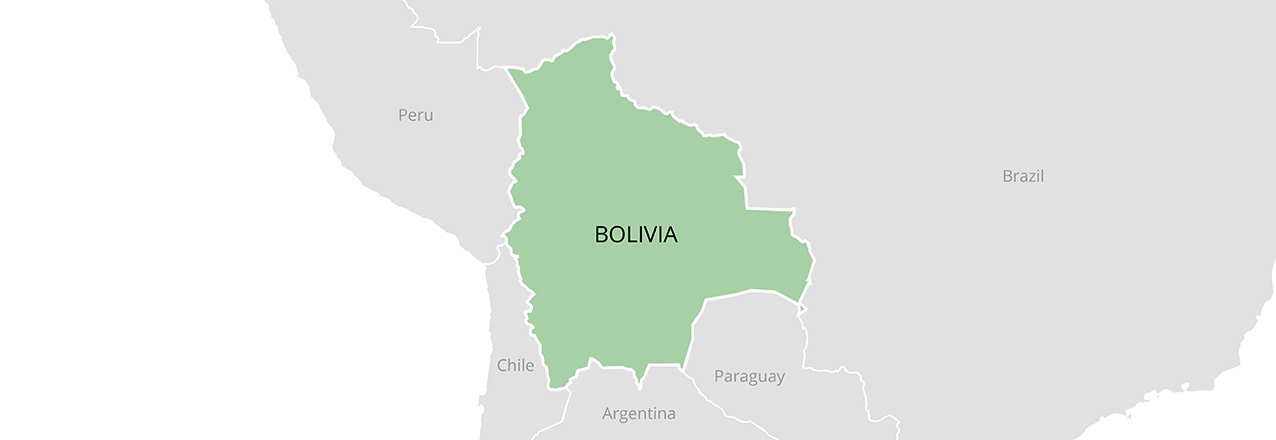
Overview
Bolivia’s land system reflects both the redistribution of large estates and Indigenous peoples’ demands for territory and self-government. The 2009 Constitution recognizes individual and collective land rights, while the agrarian reform process reviews and titles rural holdings. In the Andean highlands, small farms and community institutions are prominent; in the lowlands, Indigenous territories, smallholder settlements, cattle ranches, commercial agriculture and protected forests often meet or overlap.
Legal recognition has expanded, but a title does not automatically settle conflicts over boundaries, resource extraction, access or participation. The distribution of land and the treatment of forests, water and subsoil resources remain politically contested.
History and Political Economy
The 1952 revolution and the 1953 agrarian reform broke up many large estates and redistributed land, especially in the highlands. The reform altered relationships between landowners and rural workers, but its effects differed across regions. State-supported migration and agricultural expansion later encouraged settlement in the eastern lowlands, where large farms, ranches and Indigenous communities have competing land claims.
Indigenous mobilization, including the 1990 March for Territory and Dignity, helped place collective territory on the national agenda. The 1996 agrarian law established a new regularization process, and the 2009 Constitution defined Bolivia as a plurinational state. Farmers, Indigenous nations, settlers, agribusiness, miners and public agencies do not form uniform blocs; their interests can coincide or conflict over the same landscape.
Legal Framework
The 2009 Constitution recognizes individual and collective agrarian property subject, as applicable, to a social or economic-social function. It protects small property as indivisible family patrimony, exempt from agrarian property tax and seizure. It also protects collective property as indivisible, inalienable, imprescriptible and not subject to seizure or reversal. Constitutional rules and acquired-rights provisions must be read with the applicable agrarian law rather than reduced to a single national land-size rule.
Law No. 1715 of 1996 and Law No. 3545 of 2006 provide the main framework for agrarian reform and the saneamiento process. The economic-social function concerns sustainable productive use; compliance and reversal require legal procedures. Expropriation for necessity or public utility requires prior just compensation under the Constitution.
Recent Land Reform
Law No. 1720, promulgated in April 2026, authorized a voluntary procedure to convert titled small property into medium property. It was subsequently repealed in full by Law No. 1731 of May 13, 2026. The repeal law directs the legislature to develop a new framework through consultation, with safeguards for collective territories, communities and natural reserves. That instruction is not itself a replacement conversion law.
Supreme Decree No. 5613 of April 2026 sets operational guidelines for land allocation and titling in the Amazon, prioritizing qualifying applications in Pando and Beni. It provides for technical and legal review and envisages examination of forest concessions and digital agrarian information. Its issuance should not be confused with completed allocation or proof that competing claims have been resolved.
Indigenous and Community Tenure
Collective lands include Indigenous community lands of origin, commonly known as TCOs, and Indigenous native peasant territories, or TIOCs, as well as other community property. The Constitution recognizes territory as more than a collection of farm plots: it includes production, resource use and conservation, and social, spiritual and cultural spaces. Community rules can govern the distribution and use of land within collective holdings.
Article 403 recognizes, under conditions established by law, exclusive use of renewable resources, prior informed consultation and participation in benefits from exploitation of nonrenewable resources in Indigenous territories. A collective title does not transfer ownership of minerals or hydrocarbons to the community. Consultation rights, Indigenous autonomy, collective title and an individual community member’s use rights are related but distinct legal questions. National and local implementation varies.
Land Administration and Data
The National Institute of Agrarian Reform (INRA) administers rural agrarian regularization and titling. As the government’s description of the process explains, it involves gathering evidence, surveying, public disclosure, consideration of objections and an administrative decision before title is issued. Rural cadastral information, municipal urban cadastres and the property-rights registry serve different purposes.
Incomplete information, disputed boundaries and the cost of reaching offices can delay a claim even when a right exists in law. Public access to maps, decisions and appeals helps people identify overlaps. Digital files and georeferenced maps can improve administration, but should include community and seasonal use and provide alternatives for people without reliable internet access.
Women’s Land Rights
The Constitution directs the state to eliminate discrimination against women in access, tenure and inheritance. The agrarian legislation recognizes women’s rights independently of marital status. An Agro-environmental Tribunal decision explains that Law No. 3545 prioritizes women’s participation and provides for joint titles for spouses or partners working the land, with the woman’s name first.
Having a name on a title is important, but does not by itself guarantee control over income, equal inheritance, participation in assemblies or protection against violence. Procedures that communicate in local languages, identify women’s claims directly and record both collective and individual interests can make formal guarantees more effective.
Agriculture and Rural Livelihoods
Highland and valley households cultivate small and often fragmented plots, while lowland agriculture includes family production, commercial soy and cattle. Access to markets, credit, irrigation, storage and roads affects whether land can support a household. Secure rights are also important for long-term soil and water management.
The social and economic-social function is central to agrarian administration, but its application can be contested. Productive land use should be assessed in the context of applicable law and local ecology: fallow, grazing and forest use are not necessarily evidence that land is unused. Expanding production can create income while increasing pressure on forests and the rights of existing occupants.
Pastoralism and Grazing
Grazing systems vary from highland camelid and livestock herding to cattle ranching in the lowlands and Chaco. Households may rely on communal grazing areas, seasonal movement, water sources and individually managed plots. The productivity of a grazing system depends on the relationship among those spaces, not only on the size of a single parcel.
Fencing, agricultural expansion, fire and drought can disrupt movement and reduce access to forage. Land surveys and local agreements should identify shared pastures, routes and water points and include herders whose use may be seasonal.
Land Conflict and Displacement
Conflicts may involve overlapping titles or claims, settlement on disputed land, contestation over protected areas, and disagreement about the location or effects of roads, farms and extractive projects. Community boundaries and the representation of affected people can themselves be contested. State agencies, community authorities and the agro-environmental courts have different roles in resolving disputes.
Fair processes require notice, accessible evidence, protection from intimidation and an opportunity to challenge decisions. Displacement can result from conflict, development or disasters; compensation and relocation should account for livelihoods, cultural ties, communal resources and the needs of women and children as well as structures.
Urban Land and Housing
Urban growth has increased demand for serviced land in and around cities such as El Alto, La Paz, Cochabamba and Santa Cruz. Informal subdivisions and peri-urban settlements can emerge faster than planning, cadastral updating and infrastructure provision. Residents may possess purchase documents or local recognition but still face uncertainty about registration, planning status or overlapping claims.
Municipal land-use planning, property registration and the provision of water, drainage, transport and safe housing need coordination. Regularization is most effective when it is accompanied by services and procedures for resolving disputes rather than treating a certificate as the only measure of security.
Water and Watersheds
Bolivia’s water resources span the Amazon, Río de la Plata and closed Altiplano basins, including Lake Titicaca. Availability differs substantially by season and location. Highland cities and farms face drought and changing glacier-fed water supplies, while pollution and competing demands affect other watersheds.
The Constitution recognizes water as a fundamental right and protects water resources as a public responsibility. Community irrigation systems and local water organizations are important in practice. Mining, agricultural runoff and urban wastewater can affect downstream users; water governance needs to consider quality, access, customary management and participation across an entire watershed.
Forests and Biodiversity
Amazonian, Chiquitano and Chaco forests support Indigenous livelihoods, biodiversity, timber and non-timber forest products. Deforestation and fire are connected to land clearing, agricultural and cattle expansion, drought and enforcement capacity. Community forest management and conservation can protect livelihoods when land rights and local institutions are respected.
UNICEF’s September 2024 situation report documented widespread fires, impacts on communities and smoke-related disruption. Its figures describe a point in an evolving emergency. Fire prevention and recovery require attention to land-use incentives, local fire management, public health and the rights of affected communities.
Climate and Carbon
Drought, floods, wildfires and changing mountain water supplies can undermine farms, grazing, housing and forest-based livelihoods. Secure access to a range of land and water resources helps households adapt, but climate pressures are intensified where people cannot influence land-use decisions or recover after displacement.
Bolivia submitted its third nationally determined contribution in September 2025. A national climate commitment is a policy pledge, not evidence that its measures have been completed. Forest and carbon initiatives should clearly identify rights to land and resources, decision-making authority, benefit distribution, grievance procedures and long-term responsibilities. The existence of a collective title alone does not establish the terms of a particular carbon agreement.
Mining, Hydrocarbons and Lithium
Bolivia has a long history of mining tin, silver and other minerals, as well as natural-gas production. Gold mining and lithium development have increased attention to water, pollution and benefit sharing. The Constitution vests natural resources in the Bolivian people and places their administration in the state; a surface land title is not a mining right.
Extractive activity can affect fields, water, fisheries and health beyond the boundary of a mine. In 2025, UN human rights experts communicated allegations concerning mining impacts on the Ayllu Acre Antequera communities in Oruro, including pollution and displacement. These are allegations raised for response, not findings of a court. Meaningful consultation, independent environmental assessment, monitoring and remedies are central to affected communities’ rights.
Investment and Land Acquisition
Investment in agriculture, roads, energy and extraction can generate employment and public revenue, but may overlap existing occupation, community territories or ecosystem services. Proposed projects should identify all affected users, including people with collective, seasonal or undocumented rights, before boundaries and compensation are settled.
Agreements should make impacts, benefits and obligations understandable to affected communities, respect applicable consultation requirements and provide accessible grievance and appeal channels. A government permit or an investor’s agreement with one representative does not necessarily establish that every relevant right has been addressed.
Sources
Constitution, legislation and administration: Constitution of Bolivia; Government guidance on agrarian reform and land access; Official account of Law No. 1731 repealing Law No. 1720; Supreme Decree No. 5613; Agro-environmental Tribunal, women’s land rights.
Environment and rights: UNICEF, 2024 wildfire situation report; UN human rights experts, 2025 mining communication; Bolivia’s 2025 nationally determined contribution.
Update Log
October 2026: Updated the agrarian and constitutional framework, Indigenous and women’s rights, land administration, urban and rural tenure, natural resources and climate. Added the 2026 repeal of Law No. 1720 and the Amazon land-allocation decree.
Confidence Assessment
Confidence is high in the cited constitutional provisions and the repeal of Law No. 1720. Confidence is more limited in the present local effects of recent measures, the resolution of individual disputes and the coverage of land records: these vary by territory and may change as decisions are implemented. The profile distinguishes documented events and legal provisions from proposals, pledges and allegations.