
A Law Course that Prepares Future Land Experts

With USAID support, law schools in Cauca, Colombia are promoting courses on land and property administration to respond to a growing need in human resources and expertise in land issues.

At 19 years old, it wasn’t long ago when Faisudy Pechene sat watching her parents farm their land to earn a living for her and her siblings in rural Piendamó, Cauca. The memory is imprinted on her mind, but so are memories of how her family and community suffered from the fear of being displaced due to an unfortunate mix of violence and the lack of formal tenure over the land they called theirs.

“Many of the farmers that I grew up with never had access to property services. Their land is not formalized, and they don’t have the knowledge about any of this,” says Pechene, a student in her fourth year of law school at the Universidad Cooperativa in Cauca’s capital, Popayan.

“This is one of the reasons I am so interested in land issues” – Feisudy Pechene

The Catedra Payán

Thanks to an initiative created by two Popayan-based universities, Unicomfacauca and Cooperativa de Colombia, and supported by the USAID-funded Land for Prosperity program, Pechene discovered an opportunity to acquire knowledge specific to land laws and policies in Colombia. The Catedra Payán is a new course required by the universities’ law departments that consists of 54 hours of coursework over six months on topics related to public policy in land administration, property formalization, multipurpose cadaster, and land rights for ethnic groups, among others.

“This course appeared at the right time to strengthen what I know about land laws and will prepare me to help people in need in Cauca,” says Pechene.

First Cohort of Land Experts

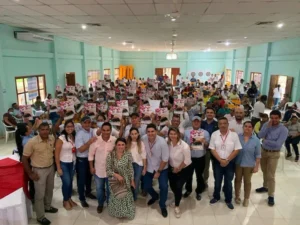
In September 2022, the first cohort of 25 law students finished the inaugural Catedra Payán, which kicked off in February. With USAID support, the universities aim to train at least two cohorts per year, and the second cohort, of which Pechene is a part, has already begun coursework.

Juan Diego Guerrero is one of the 25 graduates of the Payán Chair and is in his fourth year of law at Unicomfacauca, which means he is about to graduate with a degree and find a job. This diploma not only gives him more security when talking about land issues, but also represents an endorsement when looking for a job in the public sector or with an operator implementing massive land formalization initiatives.

“I am interested in working on a parcel sweep to help those people who do not know the status of their property,” Guerrero says. “Today there are not many professionals who really understand these topics.”


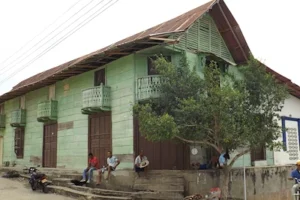
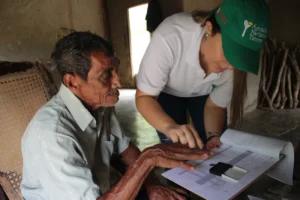
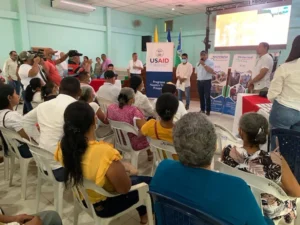
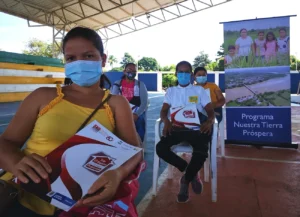
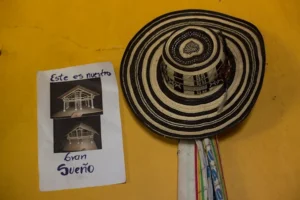
Above, the first cohort of 25 law students finished the Catedra Payán course on Colombian land laws and policies in September 2022. (Middle) Juan Diego Guerrero holds his course completion certification.

Mainstreaming Land Policies

In Colombia, the Unicomfacauca is becoming a pioneer in the development of this type of coursework. What was first an elective course is now a required course for its students, ensuring all law students learn about land issues while they pursue a law degree.

“In Colombia, land represents a long-standing social and cultural problem. With the Catedra Payán, we can strengthen our law students to address these issues and help to meet the objectives of the 2016 Peace Accords,” says Sebastián Toro, Dean of the Faculty of Humanities, Arts, Social Sciences and Education of Unicomfacauca.

The Catedra Payán course is proving to be a successful model that can be replicated by other universities in the country to strengthen the skills of law practitioners and widen a job field in public and private entities related to land administration and land rights advocacy, especially in Cauca where land conflicts persist after centuries of latifundismo and injustice.

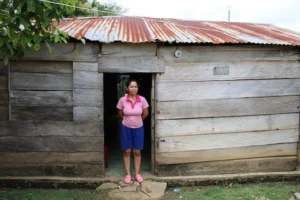
Feisudy Pechene will graduate in 2023

“My parents have always told me that if you can help someone you should do it,” says Feisudy Pechene, who will graduate with a law degree in 2023. It’s a motto that Faisudy treasures and that today defines her motivation and driving force to study law, become a lawyer, and dedicate her life to working on issues related to the land rights of underserved rural families in Colombia.

For the past eight years, USAID has provided direct support to the Colombian government to improve land administration in rural areas and implement massive land formalization initiatives to title thousands of rural parcels that families have lived on for years but have never legally owned. Santander de Quilichao, a municipality that lies at the center of Northern Cauca’s many ethnic conflicts over land, is one of the territories being prioritized by the Government to implement this strategy.


Footnotes
Photography by USAID Land for Prosperity
Cauca, Colombia

Cross posted from Land for Prosperity Exposure site
How a Municipal Land Office Leads to Rural Development

Land formalization provides families with legal security and leaders with a wider tax base to improve their communities

The residents in Villa Esperanza can still remember la invasión, which is the word they use in Spanish to describe the day in November 2011 when hundreds of displaced families banded together and occupied a large piece of land that did not belong to them. The parcel, which today is home to more than 850 families, is located on the outskirts of Puerto Libertador, a town located in southern Córdoba in the Caribbean plains of Colombia.

Over a decade ago, Carbón del Caribe, a coal mining company abandoned the land, leaving discarded coal and large piles of dirt in its wake. The new occupants, who were displaced by the violence spurred by narco-trafficking and gold mining, gathered under some of the largest trees and set up makeshift structures covered with palm fronds.

“In the first week, there was a rainstorm that blew our ranchitos away, if it weren’t for the mango trees, we would have had no protection,” explains Jairo Vergara, one of the community’s leaders, whose 10-year-old house still has a dirt floor and no front door.

Villa Esperanza is the latest phenomenon of urbanization taking place in rural parts of Colombia where ongoing violence, a lack of accessible land, and growing mining concessions have left the poor little recourse. This urban poverty in a rural context translates to hundreds of families who cannot access schools, health services, and basic infrastructure.

On top of this, parents like Jairo must worry about shielding their children from joining the illegal armed groups operating in their neighborhood. “These groups infiltrate our barrio, bring money, and recruit the youth. My name has already appeared on four threatening pamphlets, because I defend the children,” he says.


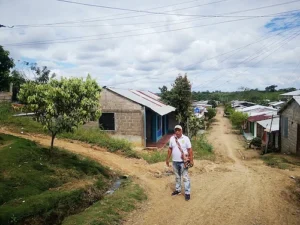
Jairo Vergara (picture on the left) takes a walk through Villa Esperanza in Puerto Libertador. For property issues, a Municipal Land Office can play a role in strengthening the link between the families of San Juan and the government.

Underneath all the problems facing Puerto Libertador’s population, property issues aggravate the confusion. Of the municipality’s nearly 9,000 parcels nearly 70% are not formalized or legalized by the state. This means that the majority of the population does not have any legal guarantees that their land belongs to them. It also means that the municipal administration cannot collect property taxes to invest in improving infrastructure and services. The inability to access new land and to formalize the land they have occupied for decades is a cycle powered by fear and displacement.

“Our municipality has been broken by violence and the payment of property taxes is important to our development. With property taxes, we could invest our own resources in improving the municipality,” says municipal council member, Aristóbulo Ochoa.

Convincing the Council

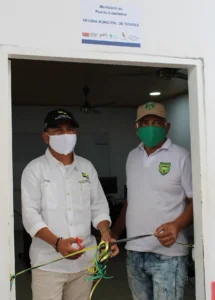
In Puerto Libertador, where just three out of 10 landowners have a land title, the municipal council is trying to play a stronger role in land administration. The USAID-funded Land for Prosperity Activity is supporting Puerto Libertador with the creation of a Municipal Land Office where a social worker, topographer, and law expert lead the way to formalize urban properties. Before the office’s official launch in November, USAID worked hand-in-hand to build the municipality’s capacity and develop the ordinance that allows the mayor to formalize urban parcels, including those that are located in peri-urban areas like Villa Esperanza.

USAID provided the mayor and his council with expertise and consulting to get the ordinance across the finish line. As part of the negotiation, the council agreed that newly formalized landowners would be exempt from taxes in 2022 and will only begin paying property taxes in 2023.

“The lack of formality in our municipality generates chaos. People buy and sell land and never formalize it,” explains Leonardo Callejas, the municipal council’s current president. “Due to the chaos, there is a culture of no-payment of taxes among our population.”

The Story of Tax Collection

In Colombia, rural municipalities like Puerto Libertador depend on regalías, or the payments made by mining and energy companies to the government, for investments in development. The money is distributed for items like education, health, and infrastructure according to the municipality’s category and needs. The amount of regalías funds disbursed often comes down to the ability of the municipality to mobilize resources.

For example, municipalities that cannot prove rural schools are formalized or show an inventory of its tertiary roads, cannot receive national funding for those items. As such, property taxes, which are levied and collected by the mayor, can provide rural leaders with a critical boost and a way to make investments that improve the quality of life for the general population.

In Ovejas, a rural municipality in the department of Sucre, the former mayor saw property taxes increase significantly in the years following the creation of the local land office. In addition to giving citizens a physical place to go for matters pertaining to property, saving them money and time, the municipal land office grew the municipality’s tax base. In a three year period, Ovejas saw tax revenue increase from 46 million pesos (USD $15,000) in 2016 to 155 million pesos (USD $50,000) in 2018.

“Ovejas invested a considerable amount of money in formalizing urban properties. I would like to say it again, so everybody knows, because these investments aren’t always visible, when compared with investing in cement,” the former mayor, Mauricio García, said back in 2018.


In a three-year period, Ovejas saw tax revenue increase from 46 million pesos (USD $15,000) in 2016 to 155 million pesos (USD $50,000) in 2018.

In Chaparral, a highly populated municipality located in southern Tolima, the current mayor, Hugo Arce, describes the updating and legalization of municipal properties as a “political suicide mission, because people feel like we are putting our hands into their wallets,” he said. “But we did it anyway.”

The strategy seems to have paid off. Arce, who was also mayor between 2012-15, says property taxes increased by 300% over ten years, from 800 million pesos to 3,000 million pesos each year.

“And this has helped us acquire machinery for road work during the rainy season. We had to take the risk and think about the municipality and not just ourselves.”

Foundational Diagnostics

The Municipal Land Office’s first task is carrying out a diagnostic of Puerto Libertador’s existing properties. The analysis has revealed that at least 3,600 parcels are able to be formalized by the office, including 240 public parcels that should be formalized in the name of the municipality, such as schools, health clinics, municipal parks, and city buildings.

In 2022, the Municipal Land Office is targeting 700 properties. Fabian López, the office’s legal specialist, is working with the team to identify the parcels. Each week, the team is approaching communities like Villa Esperanza to raise awareness about land formalization and the benefits and responsibilities of property ownership.

“In the field, all of our activities consist of showing the population that the work of the land office is directly associated with the municipality and linked to a differential approach for women-headed households,” explains López. “Before we start working in the field, it is important to strengthen local institutions.”

Cross posted from Land for Prosperity Exposure site
 

Coordination among USAID programs: a win-win for Colombians

Three USAID programs in Colombia are working together to build the capacity local government to leverage USAID investments, mobilize resources, and improve basic services for rural populations

When people talk about Colombia’s Bajo Cauca region, located north of Medellin, many conjure chapters of the most dramatic violence in the history of the nation’s war. But that perception is changing in Valencia, a small municipality of 42,000 people in Bajo Cauca. In the wake of the 2016 Peace Accords, Valencia has benefited from development programs and become an example of how coordinated efforts made through USAID investments can transform Colombia’s rural territory.

In August, farmers living in the village of Santo Domingo saw how Valencia’s Municipal Land Office delivered land titles to 43 families who had been living on unformalized land for decades. They also witnessed how the local land office titled their health clinic, officially making it a municipal property. The property title is one of the first steps to investing in public goods, since public funds can be spent on health clinics that sit on legalized property. The USAID-funded Land for Prosperity (LFP) is supporting municipalities like Valencia with financial and technical assistance to run local land offices and improve land governance.

USAID Partnerships

“By supporting the Municipal Land Office and land formalization, USAID is also supporting rural development, a in this particular case, improving the local health clinic,” said Héctor Sepúlveda, LFP’s Regional Coordinator of Bajo Cauca Antioqueño, where Valencia is located.

Land for Prosperity is USAID’s largest investment in land tenure programming in the world, aimed at strengthening Colombia’s land administration systems and improving rural development and the conditions of rural households.

“USAID is our strategic partner, both in terms of human resources and the Municipal Land Office,” explains Eliécer Martínez, Valencia’s Secretary of Planning. “USAID provided us with the most modern land survey equipment that is used nationally and internationally.”

Since 2016, USAID has increased its focus on Colombia’s Bajo Cauca region, ensuring that its programs avoid repetition and build on each other’s work. In the case of a health clinic titled by the Municipal Land Office, USAID Responsive Governance Program then structures a project to manage funds for the clinic’s improvements in infrastructure and equipment. Then the USAID Partners for Transparency Program creates a civil society group to oversee the funds invested in adapting the health post.

Under this integrated strategy, USAID programs in Colombia can reach those underfunded municipalities historically affected by the armed conflict with complementary services. While Land for Prosperity increases the government’s capacity for land governance and promotes a culture of formal land ownership, the Responsive Governance program improves the management of public finances while the Partners for Transparency program leverages local capacity and commitment to promote a culture of transparency and accountability.

“We can’t lay a single brick if the property is not titled. Land formalization is the first step. Now that the municipality has the registered land title, we can start building and improving the health clinic.”
– Orlando Benítez, Santo Domingo’s health director

Filling Gaps

Land for Prosperity has facilitated the titling of 10 municipal properties in Valencia, including the Santo Domingo health clinic. In addition, the Municipal Land Office has titled 91 private urban parcels, giving poorer residents land titles for land they have owned for decades.

“In Santo Domingo, we are relieved to be getting a health clinic. We have a school but have been missing a health clinic for a long time,” Benítez says. “It is essential for the community, and thanks to USAID programs for moving this project forward.”

Once built, the health post will benefit more than 2,500 people from Santo Domingo and neighboring villages Cocuelo and Cocuelo Medio. It will have outpatient services, dentistry, and medical check-ups. To see a doctor, the inhabitants of Santo Domingo and neighboring villages must pay 50,000 pesos (USD $12) in travel costs to reach Valencia, which is a lot for a farmer whose income, in the best of cases, reaches USD $500 a month.

“In Valencia, USAID saw the opportunity to work on an identifiable need, which is the health center, then we managed to formalize the property,” says Andrea Olaya, Regional Manager of Land For Prosperity. “Partners for Transparency and its overseers are going to be very attentive to the entry of resources.

Concerted Efforts

USAID has prioritized ten regional integration initiatives including Nariño’s Pacific coast (Tumaco), Bajo Cauca, and Catatumbo (Norte de Santander). USAID is investing in property formalization, strengthening local government capacity, and agriculture, all with a differentiated gender approach that places an emphasis on the needs of rural women.

“USAID’s Regional Integration Initiative is crucial because it seeks the synergy among all the initiatives being implemented to produce a greater impact for the populations,” says Andrea Olaya, Regional Manager of Land for Prosperity.

USAID is supporting 11 municipal-wide land titling campaigns across Colombia. Each campaign depends on a variety of factors and is expected to require an average of two years to complete implementation. By 2025, the government will have updated more than 115,000 parcels in the national cadaster with the possibility of delivering up to 40,000 land titles.


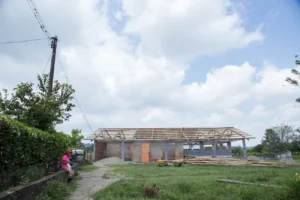
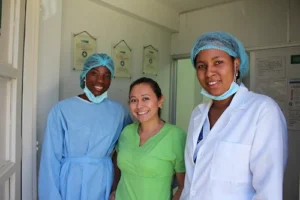
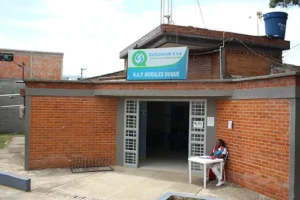
A Health Clinic in Santander de Quilichao, Cauca, titled with support from USAID

In Bajo Cauca, LFP is supporting the municipal wide parcel sweep in Caceres, and Colombia’s National Land Agencies are supporting the parcel sweep in Valencia.

Under the Programs with a Territorial Approach strategy created by the government following the 2016 Peace Accords, places like Valencia have been favored with initiatives managed by the Territorial Renewal Agency (ART) and the municipality.

“In addition to the Land Office, we are highly grateful to USAID programs such as the one that provided us with the road inventory, making us the first and only municipality in Cordoba to have it,” said Valencia’s Secretary of Planning, Eliecer Martinez. “These projects are not physically seen but greatly benefit the people.

Cross posted from Land for Prosperity Exposure site

Off to a Running Start

Volunteer community leaders are building trust and hope among rural citizens and spreading knowledge about land rights

Every morning Luz Estela Velandia wakes up to jog. A spry woman in her late sixties, she is vivacious as ever. She has hundreds of medals from a career in athletics, but these days jogging is as much about her health as it is about her community.

While roosters squawk, she runs by neighboring farms and thinks about her neighbors. She considers a variety of land conflicts common in her village that have split families and divided neighbors. In one family, two brothers are fighting over who gets what land after their father passed away. Over there, a family has built a shack and occupied an empty space next to the dirt road. On another plot of land, which was granted to them by the government in the 90s, some 17 families are living and farming under one single land title, and none can agree on anything.

La Luna is located in the municipality of Fuentedeoro where 6 out of 10 parcels are informally owned. Historically, Colombian land owners are responsible for titling and registering their properties with the state, but due to costs, complicated land laws, and the absence of government services in rural areas, informal land markets thrive.


Some 60% of the properties in Fuentedeoro lack a registered land title. USAID is supporting government to update the land cadaster and deliver land titles.

In La Luna the majority of people do not have a registered property title, and the conflicts seem to be endless. The subject of land tenure has become one of Velandia’s passions. Over the last year, she has learned more about property issues facing her neighbors than ever before. So, when she finds time between jogging, crafting, and leading La Luna’s Community Action Committee, she is teaching people about land rights and how property is titled and administered under Colombia’s arcane laws. Like hundreds of other rural municipalities in Colombia, Fuentedeoro has a decades-long history of violence, tragedy, and the struggle for land rights that has shaped its collective psyche. Under these conditions, reaching the community is not always simple.

“Fuentedeoro is the kind of place where people won’t open the door to strangers or give out personal information. People do not feel safe, and with the recent presidential elections, there is still a lot of uncertainty in the air.

Velandia’s job is to allay some of these fears and assure her neighbors that the government’s objective to increase land tenure security in rural areas is a legitimate, long-term commitment. For the last five years, pressure to title property and strengthen the formal land market has been percolating in the municipality thanks in part to USAID-funded programming to establish a Municipal Land Office and to examine the titling of properties of families living on many parcels under one land title.

In 2021, Velandia became one of dozens of community outreach volunteers raising awareness about land rights, the benefits of land titling, and the ongoing land formalization campaign in Fuentedeoro. As a volunteer, she received training in land formalization issues and social issues with supporting a culture of formal land ownership. The training, which is provided under the USAID funded Land for Prosperity program, includes a kit of teaching tools designed to simplify concepts.

“Before this, I knew nothing about land administration and Colombia’s land laws,” she admits.

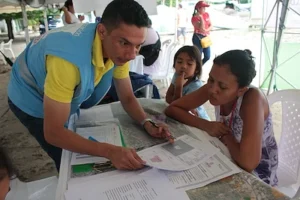
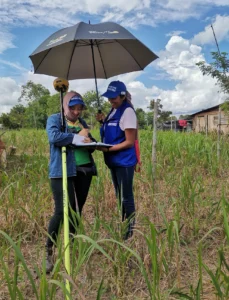
Volunteers and land titling specialists at work in Fuentedeoro, Meta in 2022.

Massive Land Titling

A land surveyor and social worker compare notes in Fuentedeoro, Meta.

Fuentedeoro is one of 11 initiatives funded by USAID and supported by Colombia’s land entities, including the National Land Agency. In total, the Fuentedeoro parcel sweep or barrido predial, as it is commonly referred to in town, aims to net over 2,000 rural property titles for landowners, some of whom have waited 40 years for a registered property title.

Just as important, the campaign will update the municipality’s rural cadaster for more than 6,000 parcels. The cadaster, which was last updated in 2006, is a master chart of all rural properties. Not only have properties changed owners since then, but land has been subdivided among families or sold to newcomers.

This methodology was created and refined by USAID and the Colombian government following the 2016 Peace Accords. Parcel sweeps streamline the collection and processing of property information in order to reduce costs and provide land agencies with integrated and reliable land data. Until recently, neither local nor national government agencies had complete control over this information.

With USAID funding and technical leadership, for the first time ever, Colombia’s three major land administration agencies are cooperating, sharing information, and supporting land titling campaigns to reach a goal of updating more than 100,000 parcels and delivering up to 40,000 land titles over the next five years.

Playing Games

Large land formalization campaigns rely heavily on social workers and outreach, and community liaisons like Luz Estela Velandia are one of the most effective ways to ensure participation. Trusted and motivated neighbors can fill the spaces where the government has been absent. Many in Fuentedeoro have long distrusted the government and believe land titling is just a ploy to take their land away. To overcome this information barrier, Velandia mobilizes her neighbors through neighborhood Whatsapp groups, where she can quickly reach 150 families living in her village.

In the groups, she advertises outreach meetings where she then uses the teaching kit, which includes flip charts, games, and puzzles to improve recognition of complicated land topics. The memory matching game, which requires participants to match land administration concepts, is a crowd favorite.

“The kit is didactic and participatory,” she explains. “It has to be this way, because the subject matter is complex, especially for people who may not have a very high level of education.” The teaching resources are also an attraction. In her first outreach event, 60 people came to learn about the land titling.

“One of the first things we learn together is the difference between a registered land title and a carta-venta,” she says. The carta-venta is a notarized receipt typical of a land transaction in rural Colombia. Over three months, she has reached over 100 people with the community crash course in land rights.

Velandia is not always successful. One group of families living on a collective land parcel say they do not want to participate in the massive land titling campaign, which is free of charge. Over the last five years, the families have invested thousands of dollars in a lawyer who claims he will individually title their properties. Though the government cannot force people to title their land, the campaign still updates property information in the rural cadaster.

Benefits of a formal land market

“I tell people that, yes, they will have to pay property taxes, but a land title can also bring them government subsidies, programs, and better services. I tell them a land title represents their rights. And I tell them that women have the same rights as men to appear on a property title as a man.”

These campaigns to title thousands of properties at once form part of the government strategy to move away from a demand-driven land administration policy to one in which the government assumes the cost of first-time formalization. By doing so, it will alleviate major time and cost burdens that prevent most low-income rural landholders from seeking a valid title. Once a property is registered, future title transfers will be much less time and cost intensive. The Fuentedeoro campaign started in October 2021 and will take place over a period of 12-18 months.

For now, community volunteers like Velandia are becoming the government’s most important allies to increase public participation.


The Land for Prosperity Activity is raising awareness about land formalization among citizens and partnering with academic and educational institutions to prepare the next generations of Colombians for a culture of formal land ownership.

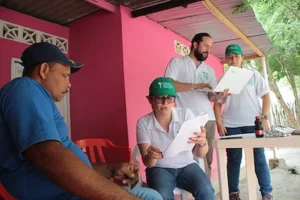
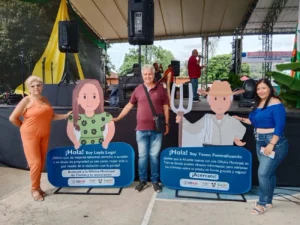
Luz Estela Velandia (Left) with fellow outreach volunteers

“The key is personalizing all these relationships. We spend time together and have coffee and teatime and we can be honest about what is happening in our lives. Especially for the women, I give the program more credibility.”

Cross posted from Land for Prosperity Exposure site