
Rural-Urban Migration and Land and Rural Development Policies in Ethiopia

A guest post by Zemen Haddis Gebeyehu, Senior Agriculture Policy Advisor, USAID/Ethiopia

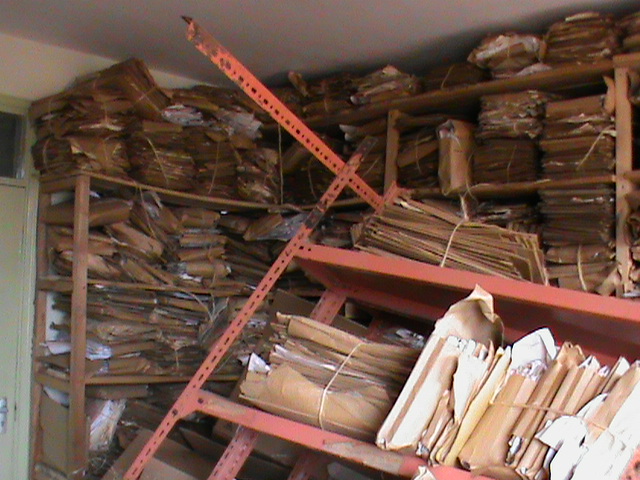
With 83 percent of its population living in rural areas, Ethiopia is one of the least urbanized countries in Sub-Saharan Africa. Agriculture remains the main economic activity of the rural workforce. However, migration from rural areas to cities has been increasing in recent years. This week, I will present a paper that examines the relationship between migration and the land and rural development policies of Ethiopia. The study tests the hypothesis that Ethiopia’s land and rural development policies influence the dynamics of rural-urban migration in ways unanticipated by the policies.

The Constitution of Ethiopia vests all land in the Government of Ethiopia. While rural residents are entitled to indefinite-term use rights to land, the existing land laws discourage landholders from pursuing non-agricultural livelihood strategies away from their holdings. The laws restrict land rental markets and mandate that landholders farm their land or risk losing it through redistribution or expropriation.

As in many countries in the region, farm sizes in Ethiopia are decreasing as a result of population pressure, which results in increased subdivision to allow successive generations’ access to at least a small plot for farming. On the one hand, limited rural land availability may incentivize rural-urban migration, but, on the other hand, land rental restrictions may reduce incentives to migrate by increasing the costs of leaving rural areas. Nonetheless, the combination of improved job and income opportunities in urban areas and deteriorating living conditions in rural areas appears to favor migration.

Despite diminishing farm size and increasing population pressure, the agriculture sector has continued to heavily dominate the rural economy. Notwithstanding attempts to diversify, the lack of capital and skills in rural areas constrain the promotion of non-agricultural activities. At the same time, although the country’s development policy emphasizes the agriculture sector, the available arable land is not able to provide a sufficient livelihood for the growing rural population. Moreover, the rural areas have been deprived of critical infrastructure, such as roads, markets, electricity, communication technologies, and skills development institutions. Absent significant reforms, this lack of investment in rural areas and competition for increasingly scarce arable land is likely to result in increased rural-urban migration.

Although further research is needed, this work suggests the need to consider removing or reducing restrictions on land transfers. Support for land rental markets that is combined with investments in capacity building and rural infrastructure could reduce land pressure and combat the unsustainable subdivision of farmland. Over time, these reforms could both increase investment and job creation in rural areas and reduce rural-urban migration by allowing successful farmers to expand their landholdings through rentals and helping others to successfully transition into non-agricultural livelihoods in rural areas.

If you are attending the World Bank’s annual Land and Poverty conference, the presentation takes place at 1:00 – 2:30 pm on Monday in a session on country level implementation. Read Rural-Urban Migration and Land and Rural Development Policies in Ethiopia.
World Bank Conference to Highlight USAID’s Investments in Land Tenure

This week, the World Bank will host its annual Conference on Land and Poverty in Washington, DC. The theme of the conference is “Integrating Land Governance into the Post-2015 Agenda: Harnessing Synergies for Implementation and Monitoring Impact.”

Throughout the week, USAID staff will chair several sessions, including:

  • Dr. Gregory Myers, Chief of the Land Tenure and Property Rights Division will chair two sessions–“Land policies in Kenya and Uganda: A roadmap for successful implementation and donor support” and “Evidence on ‘Agricultural Investors’ In Africa: Is There A ‘Missing Middle’?”
  • David Atwood, Food Policy Advisor for USAID’s Bureau for Food Security will chair “Monitoring land governance: Options, evidence, and complementarities”
  • Melissa Ho, Senior Policy Advisor for USAID’s Bureau for Food Security will chair “Improving Understanding of Large Scale Investment”
  • Mercedes Stickler, Land Tenure and Property Rights Specialist in USAID’s Land Tenure and Property Rights Division will chair a session on Pasture Tenure

Dr. Myers will present a global land governance database and map that captures information on 445 programs in 119 countries. In the same session, Dr. Myers will also speak about a new multi-stakeholder partnership between the governments of Ethiopia, Germany, the UK, and the U.S. that will strengthen property rights and support greater transparency in rural land governance in Ethiopia. This type of multi-stakeholder partnership provides a model for greater donor coordination in the land and resource governance sector.

Several USAID land tenure projects will be featured throughout the week. Download and read the papers below, then follow @USAIDEnviro @USAIDEconomic and #landrights for live tweets during the presentations.

  • Rural-Urban Migration and Land and Rural Development Policies in Ethiopia (Zemen Haddis, USAID/Ethiopia) (PowerPoint)
  • Exploring the use of conceptual models to identify scenarios, lessons, and entry points for community-scale marine resource tenure and governance (Catherine Courtney, Tenure and Global Climate Change Project)
  • Land use policy reform process in Burma: Engaging stakeholders and learning lessons from the region (Rob Oberndorf, Tenure and Global Climate Change Project)

Visit the LTPR Portal all week for frequent updates from the conference. Make sure to follow USAID’s Bureau for Economic Growth, Education, and Environment (E3) Bureau and #landrights on Twitter:

Environment and Gender Index Includes Women’s Property Rights

The 2014 theme for International Women’s Day is “Equality for Women is Progress for All.” There is a significant opening in the post-2015 global development and environment agenda for strengthening women’s property rights to move towards more broad-based economic growth. To fill that gap, the Environment and Gender Index (EGI) was launched by the International Union for Conservation of Nature (IUCN) at the UN Climate Change Talk’s first Gender Day held in Warsaw, Poland in November 2013. The index is based on gender equality and women’s empowerment data in the environmental arena and includes national government performance on women’s property rights.

The EGI is the first index of its kind. Seventy-two countries have been rated in six different categories: livelihoods; gender-based rights and participation; governance; gender-based education and assets; ecosystem; and country-reported activities. Women’s property rights are an indicator in two of these six EGI categories: governance, and gender-based education and assets. Host country governments, such as Mozambique–the first to produce a national climate change and gender action plan–are keen to use the EGI results to guide policy work on gender equality and environmental protection.

For women, property rights are not simply important for accessing food and natural resources for family livelihoods, but are also stepping stones to obtain financial capital, to effectively engage in natural resource decision-making, and to enhance broader political participation. The strength and security of women’s property rights constitute a central asset that enables multidimensional empowerment. Despite women being active in household farming and forest use, their formal rights to land and forests are often low and their customary rights often depend upon permission from men. Tracking improvements to women’s property rights is therefore critical for understanding how progress is made. The EGI’s first report identified discrepancies between legal rights and the reality on the ground in the areas of inheritance, property, income, and finances.

The EGI enables donors, civil society, and development practitioners to understand the multiple dimensions of the intersection between gender and the environment. With this new tool, we are able to assess, for example, to what extent governments are supporting the secure and equitable distribution of women’s property rights. While the EGI highlights the considerable paucity of gender-disaggregated data to date, it provides strong insight into women’s empowerment, political rights, decision-making capacities, and livelihood conditions. It is an approach that facilitates both global and regional comparisons as well as identifies individual country strengths and weaknesses.

As Lorena Aguilar (Global Senior Gender Advisor for the IUCN) explained at the Warsaw meeting: “As an independent tool outside the UN system to measure government performance, the EGI can help policymakers and civil society evaluate and set new benchmarks for government progress. The ability to compare countries and regions establishes a basis for tracking changes in performance over time, and complements existing monitoring and evaluation tools and assessments.” More broadly, the index will facilitate sharing and learning so as to design better policies and implementation strategies. In order to help make the EGI more directly useful to governments and non-governmental organizations, there are plans afoot to both develop new data sets to specifically help with improving women’s participation in environmental decision-making, as well as to track progress and good practices.

Learn more about the Environment and Gender Index.

Sowing It Forward

A guest post by Bholanath Chakladar, a District Project Manager for Landesa India in West Bengal. This post originally appeared on Landesa’s Field Focus Blog.

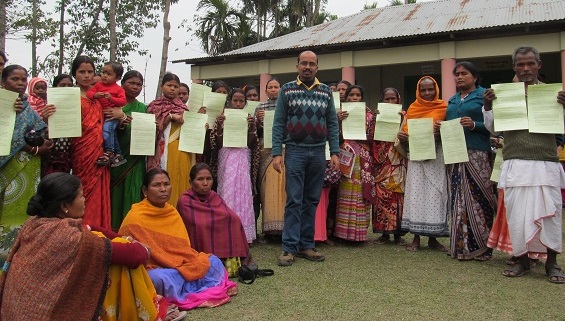
Last week, 55,339 destitute families across West Bengal received legal title to a micro-plot of land. The state of West Bengal, in partnership with Landesa, has been on the forefront of addressing extreme rural poverty through providing poor, landless, rural families with a small plot of land where they can live and grow food. Thus far, West Bengal has provided more than 160,000 landless families with micro-plots.

Few people know better than me what a little bit of land can do.

I lead Landesa’s partnership with government officials in West Bengal at the district level, and in that capacity I have helped tens of thousands of families gain title to a plot of land the size of a tennis-court.

But there is another reason why I understand the power of land rights—my parents were once landless refugees. They migrated to India from East Pakistan (now Bangladesh) on March 12, 1955.

I remember living in a two room hut made of thatch on land that wasn’t ours. My parents had no land whatsoever. The hut they built was on government land. I remember the insecurity and helplessness.

My parents were determined to make a better life. They knew how … with a small piece of land. They knew it was the key to improving their lives. But how could they have land of their own? They were refugees. They had no money.

But I remember one day a government officer came to our hut and said that the government had a program to help poor people. On June 23, 1981—more than 26 years after migrating to India—my parents finally received half an acre of their own land, including a legal title. That’s when life began to change and I started going to school.

And that’s when my parents, my siblings, and I could begin the hard work of climbing out of poverty.

I know plowing. I know harvesting. I’ve done it all. This is how I spent my childhood.

Now my parents own three acres of land and my brother and sisters and I have an education.

I feel like the micro-plot program is my program, because I know that it means so much to the beneficiaries. And it means a lot to me to do something for these people.

When I visit with the beneficiaries of Landesa’s micro-plot program, they know I am one of them. For more photos of the land title recipients, view the photo album on Landesa’s Facebook page.

Modernized Land Registries Reduce Conflict in Kenya

To support Kenya’s efforts to reduce conflict, USAID’s Kenya Transition Initiative (KTI) assisted the Ministry of Land Registries with improving land record storage and access. KTI identified land disputes as a major source of conflict and decided to address one major question: How do current proposed land reforms affect the average citizen day-to-day? Based on initial research, KTI focused on modernizing land registries. Their efforts increased requests for documentation and decreased bribes/manipulation of land records. These results suggest that public confidence in non-violent dispute resolution has increased.

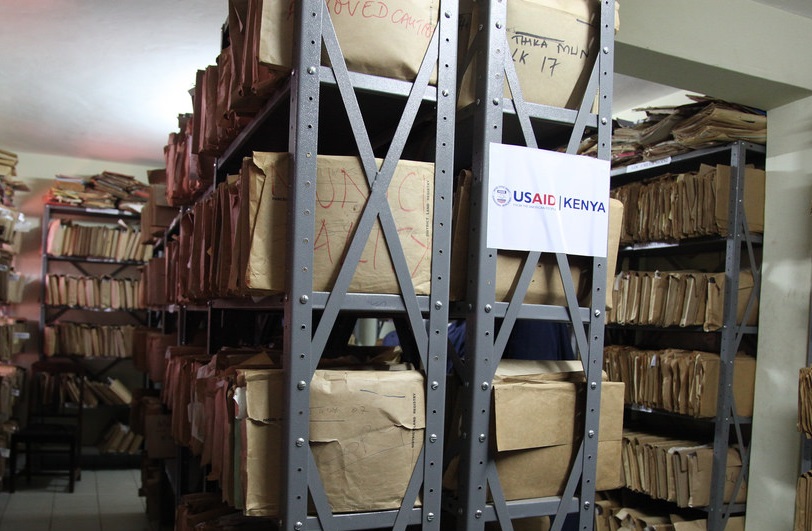
Old damaged shelves at the Thika Lands RegistryIn many of Kenya’s land registries, decades of paper files were piled on top of each other, leaving them vulnerable to accidental damage and loss as well as intentional manipulation, theft, and destruction. In 2012, through KTI, USAID helped the Nakuru Lands Registry organize and store over 100,000 paper records that had been piled in the registry’s storage rooms and halls. USAID also assisted the land registry with inventorizing land records electronically. The electronic inventory made routine land transactions dramatically faster by enabling the staff to conduct searches, check title details, and edit records. A 2012 audit report by the Law Society of Kenya detailed the Nakuru Lands Registry’s transformation from an office “historically fraught with challenges of poor record keeping and missing files” to a “well-organized registry.”
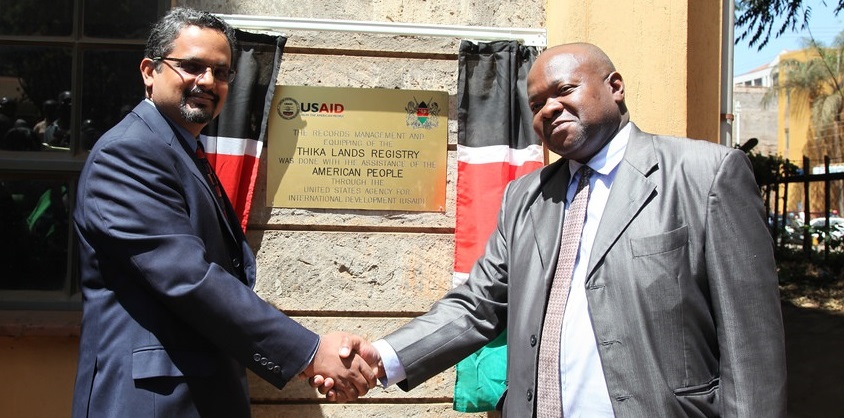
USAID provided similar assistance through KTI grants to the Thika, Kitale, Kajiado and Kilifi land registries. In addition to 126 months of labor to archive and organize files, USAID provided containers for archiving documents, 12 computers, and 3 refurbished reception areas. In the coastal region, USAID supported the Kilifi Lands Registry Office by providing security and additional storage facilities for critical land documents. Once the files were secure, USAID assisted in the development of a simplified electronic filing and management system to reduce the transaction times at the registry. Peter Joakim, Project Coordinator for the Kilifi Lands Registry Office, explained the benefits of the new electronic filing system, saying they “greatly impacted service delivery at the registry, especially during searches where clerks have correctly identified a file and given accurate information on it.”

Some of the metal cabinets provided through KTI for safe keeping of documentsStaff at the Kilifi Lands Registry noted: “We are now able to meet our service charter goals. We should be able to find a person’s file (complete a request) in 4 days. Before we improved our filing system (with KTI grant), we could never locate files. We could take days [looking for] files and it was very frustrating for people who had to come back day after day.”

Read more about the Kenya Transition Initiative.

Haiti Rebuilding, but Land Governance Challenges Remain

By Dr. Gregory Myers, USAID Division Chief, Land Tenure and Property Rights.

Last week, I visited Haiti to assess the land tenure and property rights situation there—four years after a 7.0 magnitude earthquake killed between 100,000 and 300,000 people and displaced another 1.5 million. Many Haitians continue to live in extreme poverty and much needs to be done to address the weak property rights system that slows economic growth and hinders infrastructure rebuilding efforts.

While in Haiti, I met with U.S. Ambassador Pam White, who supports strengthening land rights to help Haiti accelerate its economic recovery. To effectively help Haitians recover and move beyond extreme hunger and poverty, we must help address the country’s long-standing property rights challenges. Important first steps should include preserving existing land records through digitalization and making those records public. These records could then be linked to existing databases including notary and tax records to further strengthen proof of ownership. In rural areas, where smallholders occupy state land, another important first step would be to work with local officials to facilitate granting rights to state land they have occupied and/or for which they have been granted use rights.

Traveling around Port-au-Prince and Cap-Haïtien, one can see a significant amount of investment taking place in residential and commercial buildings. In agricultural areas, there are increased investments by smallholders and mid-size producers. Something important is happening in the Haitian economy. In order for the recovery to continue and to reach all Haitians, we must quickly invest in addressing weak land administration systems and helping Haitians secure property rights.

Recently Tim Hanstad and Roy Prosterman of Landesa, a USAID partner in land tenure and property rights, wrote in the New York Times, “A key factor hampering rebuilding efforts [in Haiti] is the lack of secure land rights among the displaced. A 2012 report by the London-based Overseas Development Institute described a ‘chaotic’ and ‘almost Kafka-esque’ land tenure system in Haiti in which ‘it is almost impossible to know definitely who owns what’.”

As my colleagues from Landesa point out, “the developing world’s landless poor routinely bear the brunt of [natural] disasters.” Their article highlights important links between secure land rights and disaster resilience, making a point that natural disasters are not “equal-opportunity destroyers.” Hanstad and Prosterman assert that, “Families without secure rights to land (and that is a majority of rural residents in many developing countries) often remain in their homes when it is dangerous to do so, fearing they won’t be allowed to return. And without the security of ownership and access to collateral, their homes are often not built to withstand earthquakes, typhoons and other disasters.” This was clearly the case in Haiti, and now we have an opportunity to change this dynamic for Haitians.

In a recent commentary on the USAID Land Tenure and Property Rights Portal, Robert Oberndorf described how Typhoon Haiyan destroyed both property records and boundaries in the Philippines. Mr. Oberndorf provided recommendations on how the rebuilding process can ensure that the land tenure and property rights of vulnerable groups are not impacted negatively – a critical concern in post-disaster situations.

In order to rebuild better in post-conflict and post-disaster situations, we must strengthen land governance and property rights—in particular for the most vulnerable populations. If we do not, they will remain stuck in a cycle in which they build temporary homes in camps or on undeveloped land, continually face the threat of eviction or violence, and do not participate in economic recovery—thus remaining in poverty.

Further Reading

  • Read more on land tenure, property rights and reconstruction in Haiti
  • Read more from Tim Hanstad and Roy Prosterman on how the poor get washed away
  • Read more from Robert Oberndorf on Typhon Haiyan and links between climate change and tenure governance

Property Rights Shift Conflict Diamonds to Kimberley Process Certification

Côte d’Ivoire emerged from a decade-long civil war in early 2011, but its diamonds—which played a role in sustaining the conflict—have remained on the world’s black lists. In November 2013, however, the Kimberley Process (KP) Plenary in Johannesburg recognized that Cote d’Ivoire had met minimum requirements of the KP Certification Scheme, the international mechanism to prevent conflict diamonds from entering the world’s markets. The KP’s decision was the culmination of several years’ efforts to restore good governance in the Ivorian diamond sector, and paves the way for the lifting of the U.N. embargo in place since 2005.

USAID has played a catalyzing role in Côte d’Ivoire’s road to compliance. In late 2012, when the United States was the KP Chair, the Ivoirian government requested technical assistance. As part of the Property Rights and Artisanal Diamond Development (PRADD) project, USAID deployed a technical adviser in March 2013 who worked with the Ivorians to conceive and launch their mine-to-export system of internal controls. In a period of six months, procedures were developed, dozens of new customs and mining regulations enacted, and thousands of miners registered. A review mission sent by the KP in September assessed this system, and based on their final report, the KP made its decision.

In his remarks at the KP Plenary, Ivoirian Mining Minister Jean-Claude Brou expressed thanks to those countries, including the United States, who assisted Côte d’Ivoire in becoming compliant. He noted that compliance was not an end in itself, but a key step in the long-term goal of ensuring that mineral resources benefit the country and the mining communities. The KP Permanent Secretary Fatimata Thes echoed these sentiments, calling the technical assistance invaluable.

“A year ago, Côte d’Ivoire was still a diamond trouble spot,” said Terah U. DeJong, the technical adviser, who is now Country Director of the Property Rights and Artisanal Diamond Development (PRADD II) project that recently launched in Côte d’Ivoire and Guinea. “Today countries in the region are looking at Côte d’Ivoire’s system as a model, and this is due in part to how the government was able to integrate best practices and lessons learned from PRADD’s earlier work. The challenge now is to build on that foundation and make it last.”

USAID’s PRADD II, which is co-funded by the European Union in Côte d’Ivoire, will combine property rights strengthening with other activities aimed at boosting the legal value chain and bringing benefits to mining communities.

Lack of Documented Land Rights Continues to Constrain Descendants of Freed Slaves in U.S.

By Peter Giampaoli, Climate Change Specialist, Land Tenure and Property Rights Division, USAID.

Clear, secure rights to manage and use forests are an important aspect of sustaining traditions and economic opportunities. Although this web site often discusses property rights in the context of developing countries, insecure title and undocumented land rights can undermine smallholder ownership in the United States as well. In the American South, some African American owners of rural land and forests face challenges stemming from imprecise boundaries and a lack of clarity regarding their property rights–both of which are legacies of how land and property rights were allocated to freed slaves following the Civil War.

In an ongoing case near Olney, Maryland, a kinship community is in a dispute with the Maryland-National Capital Park and Planning Commission over the whether a public road actually exists. Residents–descendants of freed slaves who settled in the area following the Civil war–argue that a public road previously existed but was removed from planning maps as the surrounding area was developed. A Commission official commented on the property deeds held by the residents, saying the descriptions of property boundaries are inadequate for determining “who actually is entitled to use a right-of-way.” He went on to note, “Ancient deeds make references to property descriptions in a lot of different ways. Sometimes it’s to a rock. Sometimes it’s to an apple tree.” An attorney representing one member of the community pointed out that if there is no recognized public road, then residents don’t have addresses, and “they can’t build on the land, they can’t get services, they can’t get emergency services, they can’t do anything with the property they’re paying taxes on.” He continued, “Obviously, the property is not worth much. … If you can’t build on it, it’s hard to sell it.”

In North and South Carolina, a pilot program by the U.S. Department of Agriculture and U.S. Endowment for Forestry and Communities is helping sustain the African American legacy of forest ownership in those states by helping clarify smallholder titles over forest lands and providing training on how to productively manage forest lands for economic benefit. Many of these family holdings date back to the period following the Civil War. Often deeded to multiple families, these forest lands are now held in common by numerous inheritors without clear titles. Economic distress has driven some smallholders to sell their forest land, and individual descendants are able to force the sale of these lands–terminating family ownership.

In both the Maryland and North and South Carolina cases, owners face challenges exercising their property rights due, in part, to modern requirements regarding the precision and detail of property records. Such conflicts may be resolved by programs similar to the USDA’s, which attempts to achieve greater precision regarding ownership and property boundaries. The pilot program has enabled African American forest owners to retain ownership of their forest holdings and has been cited as a model for expansion across the South. The USDA program and similar efforts reflect the Voluntary Guidelines on the Responsible Governance of Tenure of Land, Fisheries, and Forests in the Context of National Food Security by helping smallholder owners clarify their rights and by providing extension and other services that allow them to use their land for economic benefit.

Land Tenure and Property Rights Training Videos

Rights to land and resources are at the center of our most pressing development issues: Secure land and property rights create incentives for investment, broad-based economic growth, and good stewardship of natural resources. Insecure property rights and weak land governance systems often provoke conflict and instability, which can trap communities, countries, and entire regions in a cycle of poverty.

USAID has produced nine training videos to provide an overview of the ways that land tenure and property rights issues intersect with other sectors including economic growth, food security, conflict, urbanization, gender equality, climate change, and resilience.

Modules

MODULE # 1: Introduction to Land Tenure and Property Rights

This film--first in a series of nine training modules--introduces ways in which land tenure and property rights issues intersect with those relating to economic growth, food security, natural resource management, climate change, and conflict. It describes the populations that are most affected by land-related challenges and issues and identifies some of the diverse actors, who are working with governments across the world to solve land-related challenges. Finally, the film lists some of the drivers of tenure insecurity and the global pressures that make this issue relevant today.


MODULE # 2: Definitions of Key Concepts and Terms, Land Tenure and Property Rights

This film--second in a series of nine training modules--provides definitions and examples for key concepts and terms frequently used in the land tenure and property rights sector. By providing a clear set of definitions, this film provides the foundation for a shared understanding of language used through the film series and in the land tenure and property rights sector.


MODULE # 3: Tenure and Economic Growth

This film--third in a series of nine training modules--explains ways that land tenure and property rights contributes to economic growth at the household, community, and country level. It identifies some of the economic benefits that accrue when an individual or community has strong property rights and names strategies that are used to increase tenure security and promote economic growth.


MODULE # 4: Tenure and Food Security

This film--fourth in a series of nine training modules--explains ways that land tenure and property rights bolster food security at the household, community, and country level. It identifies food security benefits that accrue when women and men have strong property rights and names strategies that are used to increase tenure security and improve food security.


MODULE # 5: Tenure and Natural Resource Management

This film--fifth in a series of nine training modules--explains ways that land tenure and property rights contribute to the sustainable management and conservation of natural resources at the community and country level. It identifies natural resource benefits that accrue when individuals and communities have strong property rights and names strategies that are used to increase tenure security and improve management of natural resources.


MODULE # 6: Tenure and Climate Change

This film--sixth in a series of nine training modules--explains ways that land tenure and property rights impact climate change adaptation and mitigation at the community and country level. It identifies climate change adaptation benefits that accrue when individuals and communities have strong property rights and names possible strategies that are used to increase tenure security and adapt to climate change.


MODULE # 7: Tenure and Conflict

This film--seventh in a series of nine training modules--explains ways that land tenure and property rights can contribute to conflict situations at the household, community and country level. It identifies possible benefits of reduced conflict that accrue when individuals and communities have strong property rights and names strategies that are used to increase tenure security and mitigate land-related conflict.


MODULE # 8: Principles and Tools for Creating Tenure Security

This film--eighth in a series of nine training modules--describes tools produced for and used by USAID, to strengthen property rights and resolve land tenure issues. It also identifies where these and other tools are located.


MODULE # 9: Conclusion

This film--ninth in a series of nine training modules--summarizes the entire land tenure and property rights training film series.


Typhoon Haiyan Recovery Reveals Important Links Between Climate Change and Improved Tenure Governance

A guest post by Robert Oberndorf, Resource Law Specialist, Tenure and Global Climate Change Project

As the full impacts of Typhoon Haiyan become apparent, many commentators are linking this tragic event with concerns regarding the long-term impacts of global climate change. On the opening day of the UN Climate Change Conference in Warsaw, Poland, the Philippines’ lead negotiator, Yeb Sano, made an emotional speech on this topic. As the global community discusses how to improve the climate resilience of communities, important lessons related to tenure governance concerns should be considered. Many of these lessons can and should be applied in the Philippines as it recovers from the typhoon.

In addition to the staggering death toll from the typhoon, which is largely a result of the 16-foot storm surge that struck the most exposed areas in the storm’s path, it is reported that more than three million people in the Philippines have been left homeless. Many of these people lacked secure tenure before the storm and are now left in a position where they likely have no evidence to prove their land and property rights claims. This vulnerability is highlighted by growing allegations that some developers are claiming large tracts of previously occupied land in storm-affected areas and threatening to evict the current occupants. The lack of property records and the washing away of property boundaries must be recognized as critical post-disaster issues and addressed as communities shift their focus from immediate survival necessities to long-term rebuilding.

Issues that need to be addressed in the rebuilding process to ensure that the land tenure and property rights of vulnerable groups are not impacted negatively include:

  • Inheritance: In instances where property owners have died, clear procedures need to be put into place to ensure the fair and transparent transfer of rights to the next of kin.
  • Property rights clarification: Due to the destruction of residential property and lack of property documentation, there is an increased probability that claims to land could be contested or unclear. To allow for a more rapid resettlement and reconstruction process, a property claims process should be considered that leverages pre- and post-disaster satellite imagery and allows for the identification and vetting of property claims.
  • Land property records: Individuals and households have likely lost their personal records of land property ownership, if they existed to begin with. It is likely that records held by local or regional governments could have been damaged or destroyed. In the future, disaster-resilient record keeping should be developed, and multiple back-ups should be properly stored for insurance purposes (both hard and soft copies).
  • Climate resilient infrastructure built during reconstruction: If hard infrastructure, such as drainage culverts, sea walls, etc., are built to limit the physical impacts of future storms, they could potentially negatively impact existing land tenure and property rights claims. If that occurs, processes must be established to compensate individuals for the loss of existing rights.
  • Effective land use planning: Some populations were located in areas that were inherently vulnerable to storm events. To lessen the costs to society of future natural disasters, there are certain steps the government can take, including establishing and enforcing effective land use controls, guaranteeing secure land tenure rights, and codifying strict building codes that combine climate resilience and locally appropriate methods and materials. Where changes in land use negatively impact existing land tenure and property rights claims, processes must be established to compensate individuals for the loss of existing rights.

According to Tim Fella, USAID’s Land Tenure and Conflict Adviser, “Land rights and land use planning are integral aspects to post-disaster planning and response. Not only does it help facilitate a more rapid and organized resettlement process; it can also contribute to increased resilience to future natural disasters.”

With strong political commitment, improved governance, and assistance from the international community, the communities of the Philippines that were negatively impacted by this event can and should be rebuilt in a more climate resilient manner. Lessons can be learned from other communities that were decimated by similar storms but were rebuilt in ways that lessened the impact of future disasters.

In 1900, the island city of Galveston, Texas, which was only 8.7 feet (~2.6 meters) above sea level at the time, was hit by sustained winds of over 140 miles per hour (225 kilometers per hour) and a storm surge of over 15 feet (4.5 meters). Much of the city was destroyed, and an estimated 6,000 to 12,000 people died (more than 20% of the city’s population). Though devastated, the city of Galveston rebuilt, raised the height of the entire city by 17 feet (almost six meters), and constructed a seawall that today spans ten miles (16 kilometers). The investments in climate resilience proved their worth just 15 years later when a similarly sized hurricane killed only 53 people and caused a fraction of the property damage sustained in the 1900 storm.

Today, USAID is integrating climate resilience into its infrastructure and land-use planning investments. The governments of the U.S., Spain and Costa Rica have led the Adaptation Partnership, a two-year global effort to share knowledge on mainstreaming climate change adaptation into development planning. This partnership spawned a community of practice on climate resilient infrastructure, as well as pilot activities in vulnerable locations. USAID investment and associated technical expertise will be crucial to help promote climate change planning in the urbanization processes underway across Africa and Asia.

History shows us that steps can be taken to properly rebuild the communities impacted by Typhoon Haiyan, but the people of the Philippines and the international community should insist that steps are taken to ensure that this process increases climate resiliency while minimizing negative impacts on property rights and compensating those whose rights are negatively affected.