

One year into the Intergovernmental Land Tenure Commitment
One question has run through my COP31 coverage for TenureSecurity.org in partnership with the Global Land Alliance. What changes for a community once its land rights are recognized? Can it stop an illegal mining operation, challenge a concession, decide how carbon revenues are used, or get the money it needs to carry out its own plans? At the November 17 Delivering Land Rights session in Antalya, speakers gave some concrete answers. They also showed how much work still falls to the people whose rights are at stake.
A year earlier in Belém, governments committed to recognize and strengthen land rights for Indigenous Peoples, Afro-descendant Peoples, and local communities across 160 million hectares by 2030. The Intergovernmental Land Tenure Commitment (ILTC) calls for scaling up rights across at least 80 million hectares and strengthening governance and protection across another 80 million hectares where rights are already recognized. That distinction shaped the discussion in Antalya. A government can move a demarcation forward and still leave a neighboring, already titled territory exposed to encroachment. Both are part of the work.
Opening the session, Paula Vargas put responsibility for delivery in broad terms. “Everyone has a role in securing territorial rights, and with that, in meeting our climate goals.” Governments have the authority to recognize and protect rights. The discussion showed what communities, funders, and civil society can do to make those decisions work on the ground.
What governments are putting into practice
Marie Nyange Ndambo, the Democratic Republic of the Congo’s environment minister, described a national effort built on land-use planning, land law reform, local governance, and community forestry. For her, securing tenure for local communities and protecting forests “reinforce each other.” The DRC’s published target is approximately 54 million hectares by 2030. Work on its national implementation plan began in October. The country has a base to build on, including more than 1,000 local land-use plans completed with Central African Forest Initiative support by the end of 2025. The work now is to connect those reforms and local efforts in an operational plan.
Alitia Bainivalu, Fiji’s Minister for Fisheries and Forestry, started with what families are experiencing. Wells are running low. Farmers are watching dalo and cassava wither in dry spells. In other places, families are replanting after flooding. “Climate resilience begins and ends with land,” she said. Her account of Fiji’s implementation plan made that practical. She described clarifying customary carbon rights, applying free, prior, and informed consent through participatory mapping and land-use planning, getting climate finance and carbon revenues directly to verified landowning units, and using Indigenous knowledge to guide forest and mangrove stewardship. Fiji is working through who can give consent, who can receive payments, and how those decisions are made before a project begins.
In Ecuador, the issue is how to secure tenure in places that are also subject to conservation rules. “When we talk about land tenure, we’re talking about the livelihoods of Indigenous Peoples,” said Jéssica Gallegos Yaruquí, Ecuador’s Undersecretary for Climate Change. She described work on rules for formalizing tenure in protected areas and protective forests, backed by consultation with territorial actors. UNDP documented ten workshops across the country to develop the proposals. Gallegos reported that Ecuador had identified another 4,000 hectares ready for regularization under different conservation arrangements. She put the funding gap at US$40 million and pointed to needs such as improving land records and making different registration systems work together. Her appeal to funders was to help get that work financed at territorial level.
In Indonesia, Catur Endah Prasetiani, the Ministry of Forestry’s Director General of Social Forestry, explained the steps that turn a customary forest claim into legal recognition. The ministry is consolidating data with civil society, training verifiers, doing field checks with customary communities and local authorities, and bringing communities and concession holders into discussions on overlapping claims. “As we pursue the 1.4-million-hectare target, the quality of recognition remains central,” she said. Indonesia aims to accelerate recognition of approximately 1.4 million hectares of adat, or customary, forests by 2029. The ministry reports that by October 2026 it had formally designated 177 customary forests covering 376,280 hectares.
Hege Ragnhildstveit of Norway’s International Climate and Forest Initiative drew a lesson from the government panel. “Political will is really key to both securing and recognizing land tenure for Indigenous Peoples and local communities.” The country examples gave that phrase substance. Political decisions determine whether agencies act on overlapping claims, whether officials have the resources to verify boundaries, and whether a ministry can defend a territory after its rights have been recognized.
What happens after recognition
Brazil showed why the two halves of the global commitment matter. Of Brazil’s 63-million-hectare commitment, 59 million concern Indigenous lands and 4 million concern Quilombola communities. Within the Indigenous commitment, 8 million hectares are to advance through formalization and 51 million are already demarcated lands where tenure needs to be consolidated and protected. Both figures need to stay visible when Brazil reports its progress.
Sônia Guajajara, a Brazilian federal deputy and the country’s first Minister of Indigenous Peoples, set out three priorities. Put territorial commitments in national climate plans with specific areas, deadlines, and budgets. Protect recognized territories by reviewing overlapping concessions and aligning licensing and infrastructure decisions with territorial rights. Get funding directly to Indigenous and community organizations and funds. Underneath those priorities was her insistence that Indigenous Peoples need a seat where decisions are made, with their right to free, prior, and informed consultation respected. “There can be no climate justice without territorial rights,” she said.
Ceiça Pitaguary, Brazil’s National Secretary for Indigenous Environmental and Territorial Management, described protection in practice. She pointed to work in the Sararé Indigenous Territory to remove unlawful occupants and prevent renewed incursions. She also described Vítuke, a funding mechanism developed with the Indigenous movement. “It gets resources directly to Indigenous organizations and funds,” she said. FUNBIO administers the financing, and an Indigenous-majority council governs the mechanism. At COP31, Germany formalized a €15 million contribution through its development bank, KfW. Pitaguary’s request for 2027 was to help fund Vítuke’s first phase and support Indigenous territorial management plans on demarcated lands.
The question of who has a say became sharper in the second panel. Catherine Diam-Valla of UNDP opened it by asking the audience to listen to leaders helping “turn commitments into practical solutions on the ground.” Levi Sucre Romero, speaking from the Global Alliance of Territorial Communities and the Mesoamerican Alliance of Peoples and Forests, gave the shortest answer of the session. “First, listen to us.” He described what it means for a people to learn that land it has lived on for generations has been granted to someone else in a concession. When Diam-Valla asked what governments should do beyond accelerating demarcation, Sucre called for Indigenous Peoples to help define the model of development pursued in their territories and for governments to protect the people defending those lands. His answer changes what an implementation plan has to account for. It has to show how communities influence decisions when their rights are under pressure.
What direct finance changes
Katharina Lehmann-Uschner, speaking for Germany, said that “forests cannot be protected without protecting the rights of those who keep them standing.” She called for reliable, long-term funding, direct access to finance, and technical and institutional support that works alongside it. She also singled out Indigenous women’s leadership. Her point about coordination matters for funders. A community may need the resources to map a territory, an agency able to act on that evidence, and financing to protect the land after recognition. Those activities can fall under different programs even though the community needs all three.
Ode Rakhman showed what simpler funding can look like. He described the Nusantara Fund’s approach as “rights-based and trust-based.” By June 2026, the fund had distributed US$3.4 million directly to 577 initiatives in 35 Indonesian provinces, supporting Indigenous Peoples, farmers, fishers, women, and youth. The activities include mapping customary territories, restoration, and strengthening local economies. The fund’s experience gives donors a concrete example of how smaller initiatives can access capital and use it for priorities defined locally.
Veronica Robledo of the Jacobs Futura Foundation and the Forest Tenure Funders Group brought the discussion back to decisions funders can make themselves. They can accept oral reports and take responsibility for translation when communities report in their own languages. They can bring payments forward or let partners move money between budget lines when circumstances change. They can also bring Indigenous leaders into direct conversation with foundation boards. She proposed judging success by “how much decision power and financial resources are actually reaching the right holders.” That gives the renewed US$1.8 billion Forest and Land Tenure Pledge a practical measure alongside the amount mobilized.
What I’ll look for by the next COP
I would start with three questions. Which territories moved through recognition, and what protection did communities gain in territories they already hold? Where did rights holders shape a decision, including when a concession or other proposed land use was contested? How much finance reached their organizations directly, and who decided how it was spent? The commitment calls for a public annual progress report informed by country data and feedback from Indigenous Peoples, community organizations, and civil society. That report is an opportunity to answer those questions with evidence people in the territories can recognize and assess.
This account draws on the UNFCCC session. Remarks in French, Portuguese, and Spanish are presented in English translation from the edited transcript. The official webcast replay is available online.
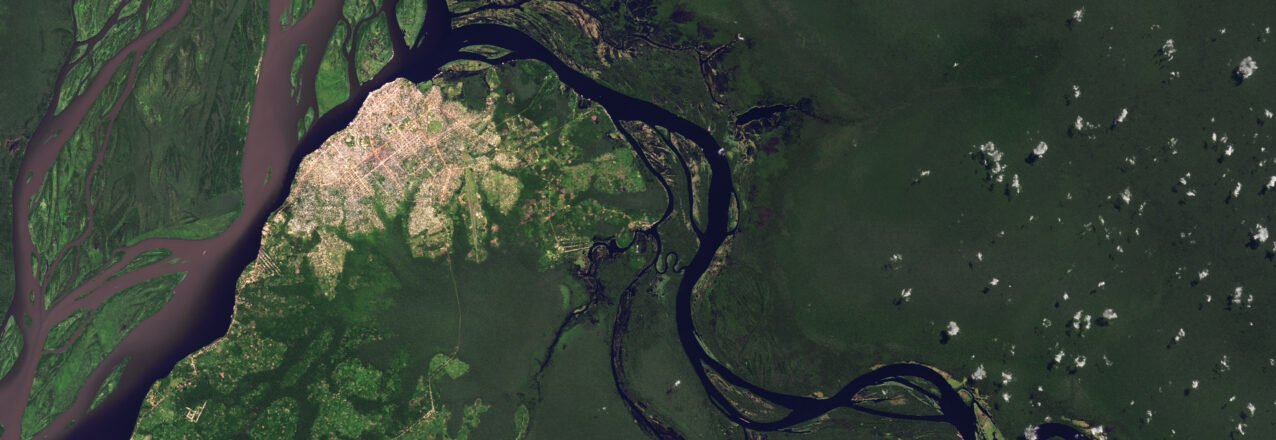
Featured image: the Ruki and Congo rivers in the Democratic Republic of the Congo. Michala Garrison, NASA Earth Observatory, using U.S. Geological Survey Landsat data.