

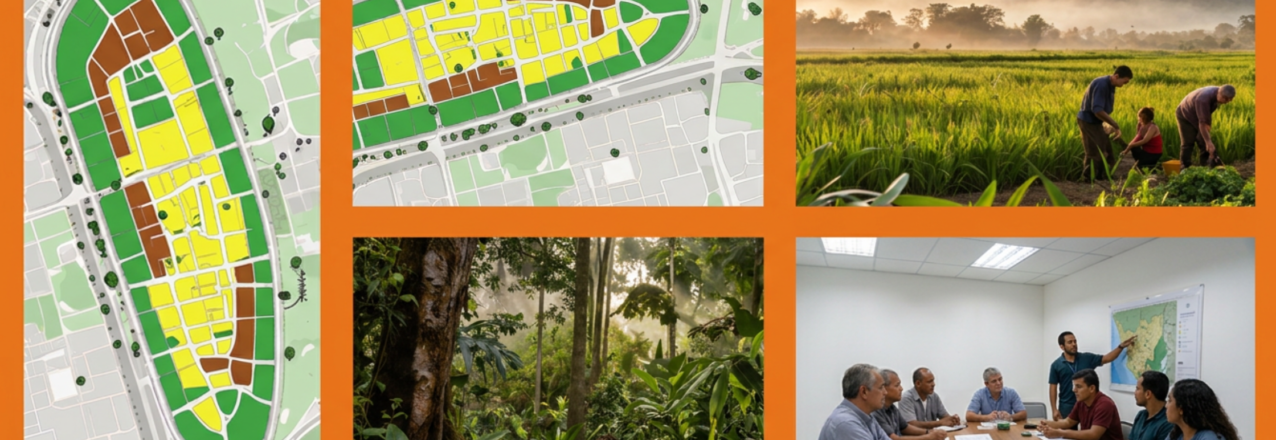
In brief: Neil Sorensen argues that changing development cooperation should push the land sector to make a stronger public case for accountable governance, secure rights and country and community leadership. The article connects land governance with wider transitions in climate, food systems, energy and institutions.
ODI Global’s North Stars for Northern Donors in a Post-Aid World is not a report about land governance. It does not set out a tenure agenda. It does not discuss cadastral reform, customary land, land administration, restitution, land markets, Indigenous territories, women’s land rights, or land conflict in any direct or sustained way.
That is exactly why the land sector should take it seriously.
The report is concerned with a larger question: what becomes of development cooperation when the political, financial, and moral architecture of aid no longer commands the same confidence? ODI describes a “post-aid” world not as the end of aid, but as a sign that the old social contract between Northern governments, taxpayers, and recipient countries has fractured. The opportunity, the report argues, is to think differently about why, how, and over what countries cooperate.
For those of us working on land and resource tenure security, this is more than a debate about donor reform. It is a warning and an opening.
The warning is that land governance cannot depend on the old machinery of donor-funded projects, short funding cycles, and technical assistance alone. The opening is that the next generation of global cooperation will need exactly what good land governance can offer: accountable institutions, legitimate decision-making, secure rights, trusted information, local voice, and ways to manage conflict over resources under pressure.
The land sector should not respond by asking how to preserve its place in yesterday’s aid model. We should ask what public purpose land governance must serve in the world now taking shape.
Land is where global transitions become local realities
The ODI report calls on Northern governments to widen the development cooperation toolbox beyond financial transfers, using diplomacy, technical knowledge, political capital, and regulatory influence to address structural barriers that leave countries exposed to climate vulnerabilities and constrained in their energy, food, and health sovereignty.
Land is not foregrounded in that argument. But it sits underneath it.
Climate adaptation happens on land. Food systems depend on land. Energy transitions require land. Forest protection, biodiversity conservation, mineral extraction, urban expansion, infrastructure, and disaster recovery all involve decisions about land and natural resources. Those decisions determine who is recognized, who is consulted, who is displaced, who benefits, and who can seek remedy when harms occur.
This is why land governance cannot be treated as a quiet technical specialty. It is part of the political infrastructure of transition.
A climate strategy that ignores tenure rights can deepen insecurity. A food-security strategy that overlooks women’s land rights can reproduce inequality. A renewable energy investment that fails to address consent, compensation, and local benefit-sharing can generate conflict. A conservation initiative that treats communities as threats rather than rights holders can undermine both justice and ecological outcomes.
The land sector’s message should be simple: no major transition is credible if the rights, claims, knowledge, and institutions connected to land are treated as afterthoughts.
The end of donorship should push us beyond project logic
One of ODI’s most important propositions is that ending Northern donorship requires more than replacing the word “donor” with “partner.” The report argues that former donors will need a different organizational template and mindset, with greater emphasis on policy change, diplomatic cooperation, knowledge initiatives, and control by others. It also argues that transition planning should begin at project design, with attention to how core functions, institutional responsibilities, resource flows, policy decisions, knowledge exchange, and relationships will be sustained after external support ends.
This should resonate deeply in the land sector.
Land governance work often takes place through projects, but land governance itself is not a project. It is a long-term public function. It involves laws, institutions, social norms, records, dispute-resolution systems, public information, political negotiation, and the everyday ability of people to claim and defend rights.
The sector has produced useful tools, pilots, methodologies, platforms, and reform processes. But we should be honest about the limits of project logic. Too often, success is measured through outputs that are visible within a funding cycle: parcels mapped, certificates issued, meetings held, laws drafted, officials trained, databases launched. These may matter. But they are not the same as durable tenure security.
The harder questions come later. Can records be updated? Can disputes be resolved fairly? Can women use documented rights in practice? Can communities challenge unlawful land allocations? Can public agencies maintain systems without external consultants? Can land information be accessed and understood by those most affected? Can reforms survive a change in government, budget, or political incentive?
A post-aid approach to land governance should begin with these questions, not end with them.
Country leadership must include the people whose rights are at stake
ODI’s fifth “North Star” calls for inclusive country leadership. It states clearly that state institutions are essential and cannot be bypassed, but should not be romanticized. It also argues that local actors closest to problems should have the most influence in defining and implementing solutions.
For land governance, this distinction is fundamental.
“Country-led” cannot mean central-government-led alone. Land is tied to sovereignty, but it is also tied to belonging, inheritance, gender relations, customary authority, livelihoods, housing, identity, and political power. The people most affected by land decisions are often those with the least influence over formal policy processes.
Women may hold rights that are legally recognized but socially constrained. Indigenous Peoples and local communities may govern territories that are mapped as state land. Pastoralists may depend on mobility that fixed-boundary systems fail to recognize. Informal settlement residents may live in places that public authorities describe primarily as problems to be cleared. Displaced people may face housing, land, and property claims that outlast the emergency phase. Smallholders may confront investment decisions negotiated far from the land itself.
The land sector should therefore argue for country leadership that is nationally anchored, locally accountable, and rights-aware.
This means working with public institutions, not around them. But it also means investing in civic space, legal empowerment, community organizations, women’s rights advocates, Indigenous and local knowledge, independent research, public-interest data, and media capable of scrutinizing land decisions.
ODI rightly notes that in fragile and conflict-affected contexts there is little room for romantic assumptions about state benevolence, and that external actors need patience, presence, risk tolerance, flexible support to local actors, and courage to raise civic space in policy dialogue.
That is not a footnote for land governance. It is often the center of the work.
The land sector needs a wider toolbox too
ODI’s call for a wider development cooperation toolbox should prompt a similar shift within our own sector.
Land governance support cannot be limited to land administration, even though land administration remains important. The next phase of land governance work must bring together law, public finance, political economy, open and responsible data, institutional reform, dispute resolution, community capacity, safeguards, and accountability.
That means supporting transparent public land allocation. It means scrutinizing land-based concessions. It means strengthening safeguards for carbon markets, biodiversity finance, mining, infrastructure, and renewable energy. It means ensuring that grievance mechanisms are usable, not merely present. It means protecting land and environmental defenders. It means helping journalists, researchers, and civil society organizations access and interpret land information. It means improving compensation, resettlement, and restitution processes where displacement has occurred. It means placing women’s land rights and collective tenure at the center, not as thematic additions.
It also means being more careful with technology.
Digital land systems, geospatial tools, satellite imagery, and artificial intelligence can improve transparency and efficiency. They can also accelerate exclusion if rights are poorly defined, data governance is weak, or affected people cannot see, question, correct, or use the information that shapes decisions about their land.
Land data is not neutral simply because it is digital. It is part of governance. It should be treated as public-interest infrastructure, with clear rules for accessibility, privacy, accountability, interoperability, and community protection.
Multilateral reform should give land a clearer home without creating another silo
ODI argues that a reformed multilateral development system should be grounded in a shared vision, and that bilateral financing should no longer be the default. The report notes that multilateral institutions can offer reach, scale, and expertise no individual donor can replicate alone, while also questioning whether the UN Development System has a sufficiently clear purpose for the next era.
Land governance has long suffered from a related problem: it is everywhere and nowhere.
It appears in food systems, forests, climate, cities, conflict, gender equality, investment, Indigenous rights, disaster recovery, and biodiversity. It is relevant to FAO, IFAD, UN-Habitat, UNDP, UNEP, human rights mechanisms, climate funds, regional development banks, and the World Bank. Yet because it is spread across so many mandates, it often lacks sustained political priority.
The answer is not necessarily to create another institutional silo. The answer is to make land governance more coherent across the systems that already shape land outcomes.
Multilateral institutions can help where they provide normative guidance, safeguards, technical standards, peer learning, long-term capacity, and public goods. But the value of multilateralism should not be judged by the size of the channel. It should be judged by whether it strengthens legitimate tenure rights, improves accountability, reduces harm, supports local institutions, and makes land-related decisions more transparent and contestable.
We must rebuild the public case for land governance
ODI argues that donors should stop looking for public support for development cooperation and start building it. Development cooperation, the report notes, is often a low-salience issue, vulnerable to political pressure and public misunderstanding. It calls for credible messengers, stronger stories, public education, and people-to-people connections.
The land sector has the same challenge.
We often speak to each other in technical language and then wonder why land governance is missing from broader political debates. We say land rights are foundational, but we do not always show what that means in terms that matter to people outside the sector.
We need a stronger public narrative.
Not a simplistic narrative. Not a donor-branded success story. Not another generic claim that land is “critical.” We need to explain how land governance shapes decisions people can understand: whether a family can stay in its home; whether a farmer can invest in soil and trees; whether a woman can inherit; whether a community can negotiate with an investor; whether a city can upgrade settlements without forced eviction; whether conservation respects rights; whether renewable energy projects build trust or conflict; whether displaced people can return, resettle, or rebuild.
The future of land governance depends not only on better evidence, but on better public meaning.
Governance reform starts with us
ODI’s final and perhaps most important proposition is that Northern donors should commit to governance reform of the development cooperation system. The report argues that more equitable governance is the foundation for a shared, legitimate, and broadly supported post-aid system.
The land sector should apply that challenge to itself.
Who sets the agenda? Who defines evidence? Who controls data? Who receives flexible funding? Who is invited to speak, and who is asked only to validate decisions already made? Which languages dominate? Which forms of local knowledge are taken seriously? Which organizations are treated as strategic actors, and which are treated as implementers?
If we want development cooperation to move beyond donorship, land governance must move beyond consultation as performance.
Rights holders and local institutions should help shape priorities, research questions, risk assessments, data governance, monitoring, and accountability. This is not only an ethical point. It is a practical one. Land reforms that do not reflect lived realities often fail in implementation. Land data that people cannot access or trust will not support accountability. Land investments that ignore power will produce conflict.
What the land sector should say now
The ODI report does not give the land sector an agenda. We should not pretend that it does.
It gives us something more useful: a challenge to define our own agenda in a changing development landscape.
The land sector should respond by saying that tenure security is not a niche concern, a project category, or a technical deliverable. It is part of the governance foundation for climate resilience, food security, gender equality, responsible investment, biodiversity, peace, urban development, and fair economic opportunity.
We should say that future land governance work must be less donor-centered and more durable. Less focused on short-term visibility and more focused on public systems, civic capacity, and rights that can be used in practice. Less comfortable with technical fixes and more honest about power. Less fragmented across sectors and more fluent in the transitions reshaping land and resource use.
And we should say that land governance deserves investment not because it fits neatly into the old aid model, but because it helps answer the defining question of the post-aid era: how can societies make legitimate, accountable, and equitable decisions about the resources on which their futures depend?
That is where the land sector belongs.
Not at the margins of development cooperation, waiting to be included.
At the center of the choices that will determine whether cooperation has public purpose at all.
Explore the land governance evidence
Use the country profiles for national research context, the land projects collection for implementation experience, and the research and publications collection for supporting evidence. For another perspective on political durability, read The Political Half-Life of Land Reform.